- 200 pages
- English
- ePUB (mobile friendly)
- Available on iOS & Android
eBook - ePub
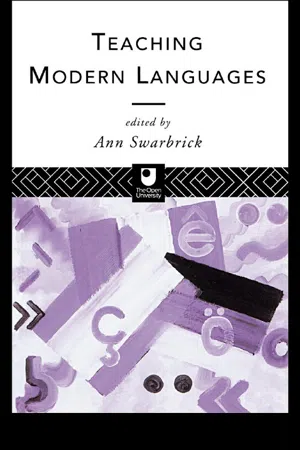
Teaching Modern Languages
About this book
Modern language classrooms are currently dominated by the communicative method of language teaching. This reader draws together recent and newly commissioned papers to show the origins of communicative methodology, how it has developed, what its research justification is and how it can most effectively be used in the classroom. Various chapters examine the particular challenges of differentiation, teaching grammar, encouraging pupils to use the target language together and teaching a foreign language to children with special educational needs. The final section discusses ways of developing creativity in the modern languages classroom through the use of drama, creative writing and role play. Anyone involved in teaching modern languages will find this reader a rich source for reflection and good practice.
Information
Part I
The historical ball and chain
Chapter 1
The historical ball and chain
William Rowlinson
It is easy, and rather dangerous, to view language-teaching methodology, and indeed other aspects of education also, as a continuous upward progress through history. This view recognises that there have been occasional setbacks and difficulties, but generally sees an upward path illuminated by growing scientific insight and culminating in today’s practice, not yet perfect but moving towards perfection. Involved in this attitude is the occasional not too precise glance at assumptions, approaches, methods, courses, syllabuses, examinations of previous times, followed by pious astonishment that their perpetrators could be so obtuse, out-of-touch, ill-informed, or down-right foolish. But in fact a closer reading of older books on language teaching may well surprise: you may be struck by how much there is, once you have allowed for those often trivial matters and attitudes which are specific to the age, that coincides with modern ideas. Read Jespersen or Comenius and you find yourself constantly saying ‘But I thought that was a new idea.’ And these two have much in common with each other, over 250 years, as well as with modern ideas.
Methodologies are as much a product of their times as educational systems, and equally rooted in the ideas of their time. Ideas, too, have a habit of coming into and going out of fashion. What is taught and how it is taught is a product of these ideas, as well as of the conditions in which it is to be taught. It is society that determines the content of education, in the light of the dominant philosophy and (more recently) scientific concept. Many, perhaps most, new approaches are rediscoveries of old methods neglected and left in the shade, now re-illuminated by the light of social need. Language teaching, like all other teaching, reflects the temper of the times.
In medieval Europe the foreign language taught was Latin: before the thirteenth century no languages other than Latin and Greek were formally taught. Latin, though, was not just a lingua franca; it was the key to the world of scholarship and, from the Renaissance on, to the classical treasurehouse of learning. There was a model for this medieval position of Latin in the role of Greek in ancient Rome itself. Then, ironically, Latin was the relatively despised vernacular and Greek the key to all learning, literature, philosophy. The cultivated Roman, like the medieval scholar, had to be bilingual.
The rise of the vernaculars and their diffusion through the new technology of printing meant a gradual separation of functions: Latin was still the key to literature and thought, the essential tool for any sort of education, but more and more through the fifteenth, sixteenth and seventeenth centuries the vernacular took over its social role as a language of everyday communication. Gradually Latin ceased to be taught as, say, English is taught in India and became a thing apart from society in general. So methods were adapted to roles. Modern languages, where taught, were taught by oral methods for communicative purposes; Latin (and Greek) mainly by book methods for literary and philosophical use.
The most famous language teacher and methodologist of this time was the Moravian J.A.Comenius (1592–1670) and it is significant that his concern was initially with the teaching of Latin and his works were written in Latin. An ecclesiastic as well as a teacher, which was not unusual for his time, Comenius was unusual for the time in that he had had some training as a teacher and his writings are derived from his own experience. His works stress the importance of the senses, their role in combination with the word in understanding and retention, and the importance of physical activity in the classroom. He is best known for his use of pictures in language teaching, but in fact he saw them only as a substitute for the real thing. His Orbis sensualium pictus (1654) is often cited as a forerunner of the audio-visual method: it is in fact a sequence of numbered picture vocabularies (in Latin plus three vernaculars, German, Hungarian and Czech). It may equally be seen as the forerunner of the disposable workbook (Comenius wanted the pupils to colour in the illustrations) at a time when textbooks of any kind were still scarce in the classroom, and for all the pupils in a class to have the same textbook was a rarity.
Much in Comenius is quite surprisingly modern:
The exemplar should always come first, the precept should always follow, and imitation should always be insisted on.1
The short before the long, the simple before the complex, the general before the particular, the nearer before the more remote, the regular before the irregular.2
Comenius in his early works sees language in use as the starting point, reality as all-important, grammar as secondary and the language classroom as a place where the senses rather than the mind come first. ‘The Comenian classroom was one in which both teacher and pupils were in constant activity.’3 And yet by the end of his life Comenius had himself done a volteface, was renouncing his earlier methods and was proposing the derivation of language by the learner from a pre-learned set of rules of grammar. What had happened? Was this simply a step towards reaction in an old man?
What had in fact happened was the dawn of the Age of Reason. Comenius stands at a watershed, at the end of the dominance of the Renaissance view of life, of education, and especially of the Renaissance view of the role of Latin.4 The Renaissance man was a doer, the seventeenth- and eighteenth-century man was a thinker. Language for the Cartesian man of reason was governed by the same logic that governed all things: the basic rules of one language were the same as those of all languages. They were embedded in its grammar and the art of translation was a central one, involving the manipulation of universals. Surface appearances might be different, underlying laws were essentially the same.5 The grammar-translation method was born as a new, insightful way of approaching language learning that was exactly in tune with the times, with their emphasis on the primacy of reason, law, logic. It superseded the older more pragmatic oral approaches because its apparent precision and universality gave it a prestige in the eyes of an age that valued these qualities highly. Interestingly, it first made its way in the teaching of modern languages, with the classics (where it eventually became most firmly entrenched) adopting its precepts and methods whole-heartedly only at the start of the nineteenth century. In Britain the pre-eminence it retained through the nineteenth century was related to the ethos of an education system geared to the development of logical thinking and to teaching an élite of cultivated minds.
Modern foreign languages, as well as the classics, as taught in the schools of the nineteenth century, could hardly be justified in utilitarian terms for empire-builders or industrialists in what was clearly the most important country in the world: in such terms they were merely for the specialist. But as part of the development of the mind, a continuation of the eighteenth century’s placing of logic, scientific logic, in the central position, there was much sense in language learning and language manipulation through a set of grammar rules that brought logic and as far as possible universal applicability to the fore. And methods were tailored to these ends. If modern languages were seen as inferior to classical ones in these terms it was not only because the classics still gave access to the great storehouse of literary and philosophical models, but also because the classical languages, being dead, could not be interfered with by inconsiderate foreigners who actually spoke them, altered them, and often refused to follow the rules of the grammar book. They were more easily treated as a self-contained system.
It was the rise of universal education (and especially, in Britain, the growth of the maintained grammar schools as a result of the 1902 Act) that began the swing of the pendulum in the twentieth century back towards a more pragmatic, more communicative approach. There were movements already in this direction on the continent, fuelled by the newly developed ‘science’ of phonetics and its apologist Henry Sweet, and by popularisers such as Viëtor, whose pamphlet ‘Die Sprachunterricht muß umkehren’ (1882) became the Bible of the evangelists of the New or Direct (or a dozen other similar attributives) Method.
Seen on this sort of time-scale the various movements and methods of the twentieth century come together as a single reaction, more in tune with the pragmatism and the educational democracy of the times, turning away from reason, the mind, law and logic as the highest goods. Moreover, they are moving not so much forward as round to the Renaissance position, so that Comenius’s earlier writings are rediscovered as startlingly consonant with the position that has now been reached.6 In these terms the twentieth-century experience can be seen not so much as a group of radicals battling with reactionaries, as the rediscoverers of Renaissance man fighting the inheritors of the age of Reason.
Let us now look at our twentieth-century battles in more detail, for it is only in this way that we can see why one textbook is so heavily weighted towards structure drills, why another course has no textbook at all, why this examination is heavy on multiple-choice tests, why that one still insists on the virtue of prose translation. And we may perhaps see that we are not on a broad uphill road to better and better methodology and more and more efficient teaching, but that methods and materials are necessarily a reflection of aims and purposes which in turn lie in the changing structure and values of the society around us.
The label that has survived today from the nineteenth century is the Direct Method. In content it seems to go back to J.S.Blackie, a Scottish classics teacher who in the 1850s was advocating (one might say re-advocating) the avoidance of the mother tongue, the direct association of word with object, and the relegation of grammar to a subordinate position.7 The new method attempted to legitimate itself by reference to the way a child learns its first language,8 but it was phonetics which appeared to give both a scientific respectability and also a way round the doubtful and difficult orthography of the printed word and the attendant stress on reading and writing. Above all it seemed to provide easy classroom access to communication in society rather than to literature in the study.
At first the reform methods made slow progress. From the central place that language learning had had in the medieval and Renaissance curricula, it had by the nineteenth century been pushed to the periphery, partly because its aims had remained unchanged from those of the eighteenth century, as had its methods, largely grammar-translation. Thus nothing obviously relevant was being taught, and the ‘mental discipline’ aspect of the work, central to the approach and method originally, was felt to be far better catered for by classics and mathematics. Those modern language teachers who were concerned to transform their discipline in the direction of language for communication came together for the first time in a national conference in 1890 and two years later formed the Modern Languages Association. This was something of a turning-point for the new methods in Britain. The teachers were inspired by the German debate surrounding Viëtor’s pamphlet (Viëtor himself addressed the 1890 conference) and passed resolutions supporting oral work, direct method and the use of phonetics.
The turn of the century also produced notable and influential publications. Sweet’s The Practical Study of Languages (1899) is particularly concerned to deny the ‘universal rule’ ideas of Cartesian thought that, however debased, underlay the grammar-translation methods of his time. Exposure to the language is the banner he fights under, with phonetics as his big guns. The language comes first: ‘listen before you imitate’, phonetics allows precise recording of what is heard, and what is heard will be arbitrary, not the product of pre-learned rules. The work is a clear pointer to the behaviourist approaches of the audio-lingual school, but also, in its insistence on a broad exposure to language, a pointer, ...
Table of contents
- COVER PAGE
- TITLE PAGE
- COPYRIGHT PAGE
- FOREWORD
- INTRODUCTION
- PART I: THE HISTORICAL BALL AND CHAIN
- PART II: INVESTIGATING THE COMMUNICATIVE APPROACH
- PART III: THE LANGUAGE LEARNER IN THE CLASSROOM
- PART IV: UN SECOND SOUFFLE: INJECTING CREATIVITY INTO THE LANGUAGE CLASSROOM
- ACKNOWLEDGEMENTS
- NOTES ON SOURCES
Trusted by 375,005 students
Access to over 1.5 million titles for a fair monthly price.
Study more efficiently using our study tools.
Frequently asked questions
Yes, you can cancel anytime from the Subscription tab in your account settings on the Perlego website. Your subscription will stay active until the end of your current billing period. Learn how to cancel your subscription
No, books cannot be downloaded as external files, such as PDFs, for use outside of Perlego. However, you can download books within the Perlego app for offline reading on mobile or tablet. Learn how to download books offline
Perlego offers two plans: Essential and Complete
- Essential is ideal for learners and professionals who enjoy exploring a wide range of subjects. Access the Essential Library with 800,000+ trusted titles and best-sellers across business, personal growth, and the humanities. Includes unlimited reading time and Standard Read Aloud voice.
- Complete: Perfect for advanced learners and researchers needing full, unrestricted access. Unlock 1.5M+ books across hundreds of subjects, including academic and specialized titles. The Complete Plan also includes advanced features like Premium Read Aloud and Research Assistant.
We are an online textbook subscription service, where you can get access to an entire online library for less than the price of a single book per month. With over 1.5 million books across 990+ topics, we’ve got you covered! Learn about our mission
Look out for the read-aloud symbol on your next book to see if you can listen to it. The read-aloud tool reads text aloud for you, highlighting the text as it is being read. You can pause it, speed it up and slow it down. Learn more about Read Aloud
Yes! You can use the Perlego app on both iOS and Android devices to read anytime, anywhere — even offline. Perfect for commutes or when you’re on the go.
Please note we cannot support devices running on iOS 13 and Android 7 or earlier. Learn more about using the app
Please note we cannot support devices running on iOS 13 and Android 7 or earlier. Learn more about using the app
Yes, you can access Teaching Modern Languages by Ann Swarbrick in PDF and/or ePUB format, as well as other popular books in Education & Education General. We have over 1.5 million books available in our catalogue for you to explore.