Chapter 1
The modern period room –
a contradiction in terms?
Jeremy Aynsley
In 1939, the British cartoonist Osbert Lancaster (1908–86) published Homes Sweet Homes. This book confirmed, if confirmation were needed, that conventions of interior decoration were fully understood and the idea of a period room could become a topic of humour broadly understood by the general public. As his well-known illustrations reveal, Lancaster was keen to connect people’s choice of interior design with lifestyle – there was an assumption that manners and interiors could be associated and in so doing, he demonstrated their comic potential. In the context of the outbreak of the Second World War, Lancaster wrote:
For the history of the home provides the most intimate, and in some ways the most reliable, picture of the growth and development of European culture; at all periods the average man (or for that matter abnormal man) has revealed most clearly his prejudices, his standards and his general outlook in the ordering of his most intimate surroundings.1
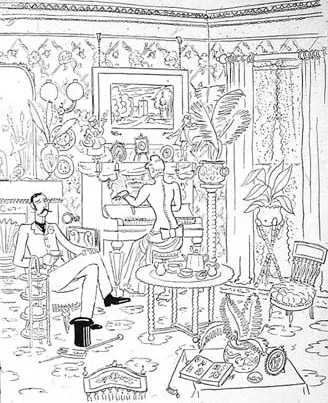
Lancaster’s gender bias aside, his choice of categories can be taken as symptomatic of a broader understanding of how the domestic imagination could be captured in an assured and acutely rendered graphic style for popular consumption. In his book, Lancaster took familiar period styles such as Rococo, Regency and Art Nouveau, and combined them with more finely tuned terms, such as Greenery Yallery, a term that poked fun at the Aesthetic Movement, the Earnest Eighties and those of his own invention, such as Stockbrokers’ Tudor, coined for the first time in this volume. And in terms of the modern, he had no problem bringing his series up to date with ‘the modernistic’, ‘the functional’ and what Lancaster called ‘the even more functional’, which in this case, was an air-raid shelter (Figure 1.1).
1.1 Osbert Lancaster, ‘The Earnest ’Eighties’.
From Homes Sweet Homes, John Murray, London, 1939
So, if by the mid-twentieth century the period room had become a common reference point in popular publishing, what were its origins? Traditionally, the term ‘period room’ has been associated with the conventions of presenting ensembles of furniture, fittings and decorative schemes within the context of a museum. Museological practice has established ways of understanding such interiors for their contribution to a history of style, in a system that elevates authenticity and connoisseurship to paramount and guiding principles. Yet throughout the twentieth century, period rooms also existed in a number of other settings. For instance, they could be seen in the great exhibitions and department stores, on the pages of magazines, as well as at specialist design and home exhibitions. It is the inter-connections between these various forms of display that this chapter seeks to explore.
Initially, I think it is important to distinguish between three broad categories of representation of room. First, there are the ensembles constituted from a previous context, as in the form of the period room transposed to a museum. This tradition is most closely associated with decorative arts museums that were entrusted with responsibility for the care, preservation and display of endangered specimens of what we now call interior design. Here, great effort is made to transpose the fabric of an interior from its original setting to its new context as an object of museum display. While the public usually takes the imaginative leap to believe in these interiors, different levels of reconstruction inevitably take place in such instances. For example, the infrastructure of these newly constituted museum interiors replaces that of the original, as new lighting, museum signage and previously impossible juxtapositions with other museum objects affect their overall context and alter the experience of such rooms.
Second, there are those interiors that have been preserved in situ, as part of historic houses where they remain integral elements of an original architectural setting. Among these, a modern example would be Leslie Martin’s 1970 extension to Kettle’s Yard in Cambridge, the private home and gallery of curator Jim Eade, now open to the public on a regular basis (discussed by Sebastiano Barassi in Chapter 8). Originally, the principle of opening houses to visitors was associated with stately homes and houses of the elite, as the history of the estates owned and supervised by the National Trust in Britain reveals.2 Furthermore, the initial impetus of such house collections was not solely on the interior; rather, as Clough William-Ellis’s book On Trust for the Nation of 1947 indicated, a great emphasis lay on both their built form and grounds as contributions to the national landscape.3 In the last twenty years at least, however, changing priorities in historical interpretation and popular taste, together with a particular fascination for the home in its many guises, have turned the impetus towards making accessible a broader range of houses to an ever-increasing public. Curated houses with period rooms now include examples across all social classes and many design styles, from modernist and moderne to traditional suburbia.4
Finally, a third kind of period room is the representation of an interior as an imaginary or imagined space, whether realised or not. This is a potentially vast field, particularly in the twentieth century, a time of mass publications. Representations of imaginary period rooms, for instance, occurred throughout furniture retail catalogues. They also took the form of exhibition installations, illustrations in children’s picture books and other kinds of imaginative fiction, as well as in the substantial body of home interior decoration and design publications. In recent years, they have even featured in television interior make-over programmes. Such representations form a more diffuse yet important and evocative set of references that impinge on any understanding of the period room today.
Museological conventions
In the field of museums, the period room ended the twentieth century with an ambivalent press. For example, in his introduction to the volume Period Rooms in the Metropolitan Museum of Art in 1996, the museum’s director Philippe de Montebello wrote:
What may not be clear is that their very existence is subject of debate. Some scholars and experts in the field of the decorative arts do not agree on their appropriateness in an art museum setting, their purpose and their degree of authenticity. But others feel that the careful combination of architectural elements rescued from condemned buildings with contemporaneous works of decorative art and furniture serves a number of important functions, not the least of which is preservation.5
In this extract, we immediately encounter the two key issues that recur in the commentaries on the period room – authenticity and preservation. Extending this commentary, Christopher Wilk, Keeper of the Collection of Furniture, Fashion and Textiles at the Victoria and Albert Museum (V&A), has suggested that the acquisition of period rooms by the museum has been informed by a number of impulses.6 Broadly, these fall into four categories, not mutually exclusive; first are those rooms that demonstrate histories of style, or conform to the collecting trends in the decorative arts, usefully demonstrating characteristics in other furniture forms in a total arrangement. Second, the museum has acquired rooms saved from structures about to be demolished or threatened by their owners. A third category Wilk outlined are those rooms that tell national stories; so, for example, the history of the English interior at the V&A. Finally, certain rooms illustrate particular decorative techniques, such as gilding or panelling, which are of special interest to decorative arts specialists.
The earliest room collected by the then South Kensington Museum, the Serilly Cabinet of 1778 from the Hôtel de Serilly of the Marais district of Paris, was acquired in 1869. It complemented the museum’s interests in assembling examples of high-style French furniture and woodwork at the time. By contrast, collecting of rooms started at the Met in 1903 with the acquisition of the Pompeii bedroom, the Bosco Reale Room of 40–30 BC. This was followed by a wood-panelled chamber from Flims in Switzerland with its magnificent stove, and an eighteenth-century bedroom from the Palazzo Sagredo in Venice, notably all important interiors of significant European origin.7
In the area of the modern period room, both the Metropolitan Museum of Art and the V&A coincidentally have interiors by Frank Lloyd Wright as their most recent examples of complete interiors on display. The American Wing at the Met opened in 1924, initially concentrating on Colonial and Federal styles. It was not until 1982 that the Frank Lloyd Wright room, clearly of modern provenance and in a recognisably modern style, was put on display in this sequence. In the words of the museum, this room ‘completes the American wing’s survey of domestic spaces and provides visitors with the opportunity to experience a Wright-designed interior’.8 It was the living-room from Northome, the summer residence of Mr and Mrs Francis W. Little of Wayzata, Minnesota. The house had been torn down in 1972 and the Met subsequently purchased the room, while a number of other architectural elements were distributed to various other museums. The room is installed as a free-standing pavilion, which is intended to evoke its original site, but instead of the Minnesota landscape, its windows now look out on to Central Park (Figure 1.2).
The Littles were important patrons for Wright. Among other things they helped to fund the Wasmuth portfolio of 1910–11, which was responsible for introducing Wright to Europe.9 The museum’s commentary on the room stresses that it is an example of late-Prairie style and that it exemplified the architect’s intentions. The room, it continues, represents ‘an example of dynamic spatial continuity, and open planning, in which outer and inner spaces are unified’.10 Formal and stylistic interests in design are therefore foregrounded. Some of the furniture was made specifically for Northome, other pieces had been created to Wright’s designs for the main Little home in Peoria in 1902. The display is considered important for illustrating Wright’s unified conception of exterior and interior design, and his approach to furnishings. A photograph from Henry Russell Hitchcock’s 1942 survey In the Nature of Materials was used to determine the arrangement of the furniture. It also followed the architect’s original floor-plans.11 Perhaps crucially, it is not arranged as it was when the owners, the Littles, lived in it....