eBook - ePub
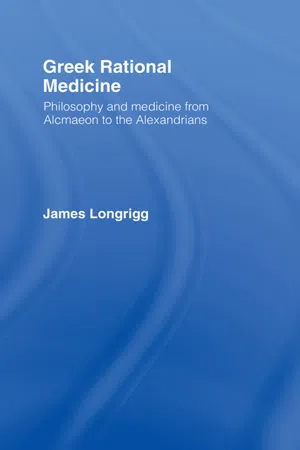
Greek Rational Medicine
Philosophy and Medicine from Alcmaeon to the Alexandrians
- 308 pages
- English
- ePUB (mobile friendly)
- Available on iOS & Android
eBook - ePub
About this book
The ancient Greek medical thinkers were profoundly influenced by Ionian natural philosophy. This philosophy caused them to adopt a radically new attitude towards disease and healing. James Longrigg shows how their rational attitudes ultimately resulted in levels of sophistication largely unsurpassed until the Renaissance. He examines the important relationship between philosophy and medicine in ancient Greece and beyond, and reveals its significance for contemporary western practice and theory.
Trusted by 375,005 students
Access to over 1.5 million titles for a fair monthly price.
Study more efficiently using our study tools.
1
Pre-rational and irrational medicine in Greece and neighbouring cultures
Morbos turn ad iram deorum relatos esse.
(Celsus, De medicina, Proem, 4)
Some records of early medicine in Babylon and Egypt have survived. Although our evidence is in an incomplete and fragmentary state, it is possible to derive some general impressions from it. There is no clear indication that these ancient physicians arrived at any rational conception of disease. Diseases were considered by them to be manifestations of the displeasure of the gods or were held to be caused by the intrusion of some demon or other. The prime purpose of the physician was to appease the god or drive out the demon which had 'possessed' the sick person's body. In order to do so he employed prayers, supplications, sacrifices, spells and incantations.
The ancient Babylonians lived in a world haunted by evil spirits. Whenever they fell ill, they believed that they had been seized by one of these spirits. In their suffering and impurity they sought medical aid and a return to their previous condition. The function of the healer was to help them achieve this end by removing the cause of their illness. Patients were required to atone for their sins and the angry god had to be placated. The treatment involved the employment of ritual involving sacrifice and incantations. In the following text, which conforms to the general pattern, Marduk, the city god of Babylon, is here instructed to make a clay figure in the image of the sick man and perform a ritual incantation to drive out the evil plague demon which had possessed him:
Go, my son [Marduk],
Pull off a piece of clay from the deep,
Pull off a piece of clay from the deep,
Fashion an image of his bodily form [therefrom] and
Place it upon the loins of the sick man by night.
At dawn make the 'atonement' for his body,
Perform the incantation of Eridu,
Turn his face to the west,
That the evil Plague-demon which hath seized upon him
May vanish away from him.
Place it upon the loins of the sick man by night.
At dawn make the 'atonement' for his body,
Perform the incantation of Eridu,
Turn his face to the west,
That the evil Plague-demon which hath seized upon him
May vanish away from him.
(Translated in R. Campbell Thompson, 1903-4, vol. II, p. 101)
The usual practice was for the clay model then to be carried out of the house and destroyed, carrying away with it the demon which had been transferred into it by the magical formulae.
Epilepsy is a disease which, because of its sudden, dramatic onset and the frightening symptoms manifested during a grand mal attack, has been (and still is) regarded with superstitious awe. Two recently translated, duplicate cuneiform tablets,1 which together provide the almost complete text of the twenty-fifth and twenty-sixth tablets of a medical diagnostic series known as the Sakikku or 'All disease', preserve invaluable evidence of Babylonian views regarding the nature of this disease. As is clearly evident from the extract quoted below, we are presented with an accurate and comprehensive description of many features of an epileptic seizure, which provokes comparison with the later and better known account in the Hippocratic treatise, De morbo sacro (see Chapter 2, pp. 35ff.).
12. [If at the time] of his fit [the patient] loses consciousness and foam comes from his mouth, it is miqtu [diurnal epilepsy].
13. [If at the time] of his fit he loses consciousness and his arms and legs bend round to the same side as his neck, it is miqtu.
14. If at the time of his fit . . . takes hold of him and foam comes from his mouth, an [unfulfilled] vow made by his father has seized him. He [the child] will die.
15. If at the time of his fit after it has taken hold of him foam comes from his mouth, — hand of Lilû.
16. If at the end of his fit when his limbs become relaxed again his bowels are sometimes seized and he has a motion, it is 'hand of ghost' [nocturnal epilepsy].
17-18. If at the end of his fit his limbs become paralysed, he is dazed [or dizzy], his abdomen is 'wasted' [sc. as of one in need of food] and he returns everything which is put into his mouth . . ., — hand of a ghost who has died in a mass killing. He will die.
19-22. If at the end of his fit his limbs become paralysed, [the demon] 'pouring out' upon him so much that he loses control [of his functions]; if when he thus 'pours out' upon him his eyes are red and his face expressionless; if his sěr'ānu-vessels pulsate at a quickened rate and he cries although the tips of his fingers and toes remain cold; if when the exorcist asks the sick person to repeat [a prayer] he repeats what he says to him, but after [the demon] has let him go he does not know what he said, — hand of Lilû-la'bi.
23. If before his fit a half of his body is 'heavy' for him and pricks him, and afterwards he has a fit with loss of consciousness and he loses control [of his functions], it is miqtu. At midday it will be most serious for him.
24-25. If before his fit he suffers from frontal headaches and is emotionally upset, and afterwards he . . . [. .] his hands and feet, [and] rolls from side to side [on the ground] without deviation [of the eyes] or foam[ing at the mouth], it is a fall due to emotional shock, or 'hand of Ishtar'. He will recover.
26. If when he has his fit [the fallen person] is looking sideways or the whites of his eyes deviate to the side, and blood flows from his mouth, for female [patients] it is Lilû, and for male, Lilītu.
Unlike the Hippocratic author, however, who, as shall be seen below, rejects superstitious and supernatural causation and gives an entirely natural explanation of the disease, our unknown Babylonian unequivocally maintains: 'if epilepsy falls once upon a person [or falls many] times, [it is (as a result of) possession] by a demon or a departed spirit'.
The outlook of the more prestigious and influential2 Egyptian medicine is not dissimilar. The ancient Egyptian. too, believed that sickness was caused by evil spirits or by the anger of the gods. The surviving Egyptian medical papyri3 consist largely of prescriptions of drugs interspersed with magical spells which were believed to impart efficacy to the prescriptions which follow. Many of these remedies contain noxious or offensive ingredients which were, presumably, intended to make them as unpalatable as possible to the possessing spirit. Coprotherapy is much in evidence. A good example of this nauseating practice may be seen in the Hearst Papyrus (85):
O ghost, male or female, thou hidden one, thou concealed one, who dwellest in this my flesh, in these my limbs. Lo, I brought thee excrements to devour! Beware, hidden one, be on your guard, concealed one, escape!
In ancient Egypt and Mesopotamia, then, the views of the physician on the causes of disease and the operation of remedies were so linked with belief in supernatural forces that a rational understanding of the organs and functions of the body or of the operation of the remedies applied to it was impossible.
There is, however, one medical treatise, dating from early antiquity, which makes one hesitate before dismissing Egyptian medicine, at least, as being completely dominated by magic. This is the famous Edwin Smith Surgical Papyrus, named after its purchaser, which was copied in the seventeenth century bc from a work written in the third millennium. This treatise is organised in a systematic manner and seems, at first sight, to be free from the magical elements which pervade other Egyptian medical papyri such as the Hearst and the Ebers Papyrus. J. H. Breasted, the best modern editor and translator of the papyrus, has claimed that the work is in the true sense scientific.4 His contention, however, has by no means been universally accepted and it has been claimed that there are magical elements contained within the treatise.5 It is maintained that the use of such formulae as: 'it is a malady which I will contend with' or 'wrestle with' implies a belief in magic and entails that the author was still a magician at heart. This conclusion, however, does not necessarily follow since the author could be merely expressing himself figuratively or, more probably, adopting a familiar and traditional mode of expression. The surgeon would be dealing with observable physical causes. It is hardly likely, therefore, that he would regard their effect as due to possession by a demon with whom he would have to 'wrestle'. Moreover, two cases in the papyrus deal with a similar complaint: Case 18 describes a wound in the temple; Case 21 is that of a split in the temple. The surgeon 'contends' with the latter, yet merely 'treats' the former. Are we then to believe that the surgeon would consider the one to be of a mysterious magical origin, the other the result of an observable physical cause?
While this controversy cannot be definitely settled upon the available evidence, Breasted's claim is not, in my view, persuasive. It derives its plausibility from the fact that, unlike the physician, the surgeon had to deal with afflictions which were the result of observable physical causes and had little or no connection with the malignant demons of disease. (It has been suggested on the basis of the wounds described in the papyrus that its author was a surgeon in the army.) A wound caused by a weapon, tool or fall would be well understood and treated accordingly, whereas the causes of a stroke, or epilepsy, for example, would be quite mysterious and their effect regarded as due to the patient's being possessed by some demon or other. Since belief in magic is prevalent throughout the rest of the Egyptian medical papyri and pervades our earliest surviving medical literature generally, there seems to be no good reason to doubt that this particular surgeon, too, was a true child of his times and also believed in the powers of the supernatural.
H. E. Sigerist, however, influenced by Breasted's evaluation of the Edwin Smith Papyrus, finds in ancient Egyptian medicine 'the beginning of medical science, a science ... which endeavoured to explain the phenomena of life and death, rationally without having recourse to the gods' and believes that 'the Egyptians anticipated views and methods of the pre-Socratic philosophers in Greece.,6 It is true that the Greeks were well acquainted with and admirers of Egyptian medicine.7 And, if Diodorus can be trusted, the practice of incubation, a striking feature of the healing cult of Asclepius and other cthonic cults, had its origin in Egypt.8 It seems likely, too, that the Greeks owed a good part of their pharmacopoeia, and some of their gynaecological and (possibly) surgical techniques and practices to the Egyptians. The miraculous, tranquillising drug dispensed by Helen of Troy to soothe her guests in Odyssey IV. 220-32, for example, is described as a gift from a woman of Egypt. In his comedy Peace (Pax 1253), Aristophanes refers to the fame of healing drugs from that country and ingredients carrying the label 'Egyptian' appear in several Hippocratic drug prescriptions.9 Egyptian ingredient also figure frequently in Hippocratic gynaecological treatises10 and may reflect in addition the influence of Egyptian gynaecology generally, since both the medical papyri and the Hippocratic Corpus display parallel interests in 'birth prognoses'11 and in both disorders are held to be caused by displacements of the womb.12 In surgery, too, it has been claimed that there are similarities in the respective Egyptian and Hippocratic descriptions of wounds in the head.13 But notwithstanding these parallels,14 there is no firm evidence to suggest that the rational attitude manifested so strikingly in the Hippocratic Corpus was itself derived from Egypt along with particular borrowings.15 It is, perhaps, worth observing here that the Greeks themselves, who are generous, indeed, over-generous, in acknowledging their intellectual debts to cultures more ancient than their own, in their views upon the origin of medicine16 nowhere recognise any debt to Egypt.17 Furthermore, throughout its long recorded history, Egyptian medicine reveals itself as extraordinarily static — perhaps, as has recently been suggested, because its support and sanction by ritual, by belief in magic, and by the priesthood had rendered it 'immune to re visionary processes that tend to be associated with scientific growth' and perhaps because codification and legal sanctions had further militated against change.18 Given its petrified nature, it would, to say the least, have been exceedingly curious if Egyptian medicine should then have exercised totally disparate kinds of influence in the Heroic Age of Greece and, again, two or three centuries later.
From the Homeric poems, our earliest literary source of evidence for Greek medicine, it is patently clear that the attitudes towards sickness and disease in the Heroic Age were not substantially different from those manifest in ancient Egypt and Mesopotamia, where the views of the physician on the causes of diseases and the operation of remedies are linked with belief in the supernatural. As Celsus says, 'morbos ... ad iram deorum immortalium reIatos esse', diseases were attributed to the wrath of the gods — although here the gods, for the most part, act directly and not through the intermediary of demons or evil spirits. For example, in the first book of the Iliad the plague which attacks the Greek army besieging Troy is represented as supernatural in origin, sent by Apollo as punishment for Agamemnon's arrogant treatment of his priest Chryses, who had come to the Greek camp to try to ransom his captured daughter:
The arrows rattled on the shoulders of the angry god when he moved and his coming was like the night. Then he sat down apart from the ships and let fly a shaft. Terrible was the twang of the silver bow. He attacked the mules first and the swift dogs, but then he loosed his piercing shafts upon the men themselves and shot them down and continually the pyres of the dead thickly burned. For nine days the missiles of the god ranged throughout the host.
(Homer, Iliad I. 46-52)
Eventually, the Greeks, at the suggestion of Achilles, consulted the soothsayer Calchas. He revealed to them that Apollo had sent the disease to avenge his priest and that the god would not lift the pestilence until the girl had been returned to her father, without a ransom and with a hecatomb of oxen for sacrifice. The Greeks complied, purified themselves, cast the 'defilements' into the sea and sacrificed to Apollo. The god was placated and the plague ceased. Here we hav...
Table of contents
- Cover
- Title
- Copyright
- Dedication
- Contents
- Preface
- Introduction
- 1 Pre-rational and irrational medicine in Greece and neighbouring cultures
- 2 Ionian natural philosophy and the origins of rational medicine
- 3 Philosophy and medicine in the fifth century I: Alcmaeon and the pre-Socratic philosophers
- 4 Philosophy and medicine in the fifth century II: Pre-Socratic philosophy and the Hippocratic Corpus
- 5 Post-Hippocratic medicine I: Medicine and the Academy
- 6 Post-Hippocratic medicine II: Medicine from Lyceum to Museum
- 7 Early Alexandrian medical science
- Appendix: The role of the opposites in pre-Aristotelian physics
- Notes
- Bibliography
- Index locorum
- General index
Frequently asked questions
Yes, you can cancel anytime from the Subscription tab in your account settings on the Perlego website. Your subscription will stay active until the end of your current billing period. Learn how to cancel your subscription
No, books cannot be downloaded as external files, such as PDFs, for use outside of Perlego. However, you can download books within the Perlego app for offline reading on mobile or tablet. Learn how to download books offline
Perlego offers two plans: Essential and Complete
- Essential is ideal for learners and professionals who enjoy exploring a wide range of subjects. Access the Essential Library with 800,000+ trusted titles and best-sellers across business, personal growth, and the humanities. Includes unlimited reading time and Standard Read Aloud voice.
- Complete: Perfect for advanced learners and researchers needing full, unrestricted access. Unlock 1.5M+ books across hundreds of subjects, including academic and specialized titles. The Complete Plan also includes advanced features like Premium Read Aloud and Research Assistant.
We are an online textbook subscription service, where you can get access to an entire online library for less than the price of a single book per month. With over 1.5 million books across 990+ topics, we’ve got you covered! Learn about our mission
Look out for the read-aloud symbol on your next book to see if you can listen to it. The read-aloud tool reads text aloud for you, highlighting the text as it is being read. You can pause it, speed it up and slow it down. Learn more about Read Aloud
Yes! You can use the Perlego app on both iOS and Android devices to read anytime, anywhere — even offline. Perfect for commutes or when you’re on the go.
Please note we cannot support devices running on iOS 13 and Android 7 or earlier. Learn more about using the app
Please note we cannot support devices running on iOS 13 and Android 7 or earlier. Learn more about using the app
Yes, you can access Greek Rational Medicine by James Longrigg in PDF and/or ePUB format, as well as other popular books in History & Ancient History. We have over 1.5 million books available in our catalogue for you to explore.