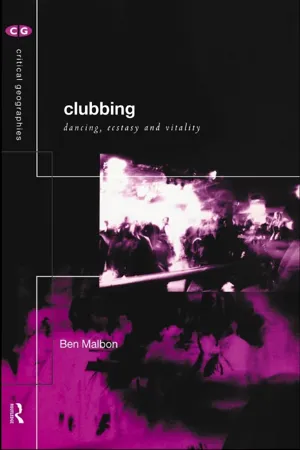
Clubbing explores the cultures and spaces of clubbing. Divided into three sections: Beginnings, The Night Out and Reflections, Clubbing includes first-hand accounts of clubbing experiences, framing these accounts within the relevant research and a review of clubbing in late-1990s Britain.
Malbon particularly focuses on:
the codes of social interaction among clubbers
issues of gender and sexuality
the effects of music
the role of ecstasy
clubbing as a playful act
and personal interpretations of clubbing experiences.
- 256 pages
- English
- ePUB (mobile friendly)
- Available on iOS & Android
eBook - ePub
About this book
Part One
THE BEGINNINGS
To be away from home and yet to feel oneself everywhere at home; to see the world, to be at the centre of the world, and yet to remain hidden from the world—such are a few of the pleasures of those independent, passionate, impartial natures which the tongue can but clumsily define.
(Baudelaire, 1964)

THE NIGHT AHEAD
This book is about clubbing. More specifically, this book is about the experiences of going clubbing. It is concerned with some of the motivations for and the sociospatio-temporal and bodily-emotional practices which constitute the clubbing experience. The book is also concerned with many of the cultures, spaces and mediations influencing and ‘producing’ the clubbing experience. Finally, this book is concerned with sketching out an understanding of the vitality that may be engendered through the experiences of clubbing.
The book sets out to answer three distinct, but closely related questions:
- How is clubbing constituted through the practices, imaginations and emotions of the clubbers themselves?
- How can music and dancing so powerfully affect our experiences of certain spaces, of ourselves and of others?
- How is clubbing, as a form of ‘play’, significant within the identities and identifications of the clubbers, and in what ways can it engender vitality through its playful practices?
In attempting to answer these questions the book is split into three parts. Part One is comprised of a number of introductory sections which I have called ‘The beginnings’ —each section within this initial part of the book performs an important role in contextualising ‘The night out’ to come. So, after this short introduction to the book, the next section in ‘The beginnings’ provides a contextual background for the project in the form of a brief review of the state, scope and scale of clubbing in late 1990s Britain. I follow this contextual introduction by setting out in some detail the three major academic starting points for ‘The night out’. These starting points are: young people at play, consumption and consuming, and the sociality and performativity which arise out of a concern with processes of identity formation and amendment.
After these ‘Beginnings’, the main body of the book, Part Two, comprises an increasingly complex schematic and thematic move through some of the multifarious times, spaces and practices of clubbing. This second part is presented along the broad lines of a night out, beginning with club entry and finishing at the end of the night. Each of the four sections of ‘The night out’ forms a cumulative spotlighting of what I understand to be the key thematic elements that comprise one approach to understanding the constitutive practices of clubbing. Each section builds on the last in introducing a further level of understanding or an added slice of complexity. I turn, in the first section of ‘The night out’, to issues around ‘belongings’ and notions of identification. Some of the reasoning behind clubbers’ desires to go clubbing are discussed, and I develop this through a brief conceptualisation of ‘coolness’ and ‘style’ and an examination of the importance that negotiating entry to the club itself can play in the establishment of these belongings. In the second section of ‘The night out’, I progress this interest in belongings by looking in detail at the importance of music and dancing in constituting clubbing crowds. I draw out, for special attention, the clubbers’ fluctuations between experiences of self and of the crowd, and the timings and spacings of their dancing practices. These clubbing crowds of intense motion and emotion can provide the context for moments of extraordinary euphoria and notions of freedom. Thus, in the third section of ‘The night out’, I address the experiences of what have often been referred to as ‘altered states’, but which I attempt to refine in describing as ‘oceanic’ and ‘ecstatic’ experiences. These experiences are explicitly attained partially though the use of drugs, such as ecstasy (MDMA), and I examine in some detail the use of ecstasy in the clubbing experience. I complete ‘The night out’ by building on these conceptions of alterity in the fourth section of ‘The night out’, where I introduce the central notion of the book—playful vitality. This is a conceptualisation of the sensation of inner strength and effervescence, which, I argue, can be experienced through the practices of ‘play’ and especially through the ‘flow’ achievable through dancing. Playful vitality is conceptualised as an alternative approach to understanding the nature of and relationships between notions of power and resistance.
The third, shortest and final part of the book is Part Three, ‘Reflections’. In one respect the night out ends abruptly as the clubbers leave the club. Yet there are important post-clubbing processes of reflection and attempts at understanding which many clubbers go through, even if they are alone. In addition to tracing a variety of differing routes for the clubbers through these ‘Reflections’, I also reflect upon the night out that has just occurred. Re-visiting the three starting points which I have briefly set out in ‘The beginnings’, I draw out a number of key themes which emerge from returning to these starting points through the lens of ‘The night out’. Clubbing offers a myriad of insights into our conceptualisations of a whole range of social interactions, notions of communality and play, and of being young. Far from being a mindless form of crass hedonism, as some commentators suggest, clubbing is for many both a source of extraordinary pleasure and a vital context for the development of personal and social identities. Yet, I argue, our understandings of clubbing, its practices and its remarkable resonance within the lives of so many young people, are only just beginning.
As far as reading the book is concerned, while ‘The beginnings’, which together constitute Part One, comprise a sketching of some of the boundaries of and context for the book in academic terms, they are not critical to an understanding of ‘The night out’. That said, while these ‘Beginnings’ may therefore be skipped, they remain central in contextualising the particular understanding of clubbing that I present here.
CLUBBING CONTEXTS
Clubbing is a hugely significant social phenomenon, as anyone walking around the centre of a city or town in the UK at 2 a.m. on a Sunday will attest. Clubbing is notable primarily because of the sheer scale of its appeal, and the increasing eclecticism of its constituent genre. Yet clubbing is also notable because of its ‘systematic demonisation’ within the media and the introduction of new legislation inhibiting clubbing—the Criminal Justice and Public Order Act (1994) for example— and the widely-publicised, although somewhat over-hyped, involvement of illegal practices, such as drug use, in clubbing (Ward, 1997).
Clubbing is an overwhelmingly urban form of leisure and is now a major cultural industry (Lovatt, 1996)1. Few towns or cities are without at least a couple of clubs, with many cities such as Manchester, Leeds, Glasgow, Liverpool, Sheffield and London having well-developed and multi-layered clubbing industries which contribute substantially to the local city economies (O’Connor and Wynne, 1995). Indeed, many city authorities have actively pursued programmes of inner city regeneration premised partially on the economy of the night and the attraction of thousands of clubbers with relatively high disposable incomes into these areas.
Clubbing is now also an increasingly international leisure pastime, and it is not uncommon for clubbers living and clubbing in the UK to spend their annual holidays clubbing in another, usually warmer and often cheaper, part of the world. The explosion in clubbing cultures over the last ten years has thus been accompanied by—and undoubtedly further fuelled through—the ever-widening horizons of some of the clubbers themselves (Williamson, 1997). Williamson (1997) suggests that the ‘top eight destinations for British clubbers’ are: Ibiza (Majorca), Goa (India), Guadeloupe (Caribbean), Cape Town (South Africa), Tokyo (Japan), Ko Pha-Ngan (Thailand), Singapore (Asia) and Sydney (Australia). Many of these locations have historically been popular with the ‘alternative’ traveller, but in recent years they have increasingly been appropriated by clubbing holiday-makers. While these evolving cultures of clubbing ‘away-from-home’ would seem to support points that I make later in respect to alternative social orderings, senses of other-worldliness and escape, this text is restricted in scope to spot-lighting the clubbing experiences of clubbers in central London.
The many facets of clubbing in London are changing dramatically, as they always have done (Kossoff, 1995; Thornton, 1995). On a typical Saturday night in 1986, a flick through the pages of the London listings magazine, Time Out, might have revealed a choice of twenty clubs (Collin, 1996b). Thirteen years later this choice has grown to in excess of fifty clubs and this total excludes ‘student’ and ‘gay’ clubs, each of which now have their own sections within the listings. Also excluded from this total are late-night bars with dance floors, the numbers of which are growing rapidly and even starting to pose a threat to clubs, unlisted nights of which there are surprisingly many and clubs much beyond London Transport travel zone 3 (about 6–7 miles from central London), beyond which Time Out takes little interest. With all these taken into account, there may be anything between 400 and 500 club nights on offer every week in Greater London, with the highest number available on Bank holidays when Sunday effectively becomes an additional Saturday—the busiest night of the week.
There are no London-specific studies covering the growth of and recent developments within clubbing as an industry. However, despite tending towards generalisations at times, recent marketing intelligence studies by the market research company, Mintel, provide a valuable and large-scale overview of the ‘nightclub and discotheque industry’ —hereafter the ‘clubbing industry’ —in the UK (Mintel, 1994; Mintel, 1996)2. In particular, these studies provide detailed figures concerning both the continued explosive growth and also the changing structure of the clubbing industry in the UK. However, it should be emphasized that Mintel do not distinguish between nightclubs and discotheques when calculating market size and commenting on the industry as a whole. They define both nightclubs and discotheques as ‘establishments which offer music, drinks, food [where there is a legal requirement to do so], dancing and lounging under one roof’ (Mintel, 1996:1). Thus, Mintel’s analyses encompass nightclubs and discotheques of all sizes and forms, from huge chains of franchised clubs run by companies such as Rank Leisure, Scottish & Courage PLC and Granada to the tiny, independent and single-site clubs that make up the majority of clubbing establishments in the UK. The facts and figures provided by Mintel—some of which I refer to later—are thus concerned with the nightclubbing industry as a whole, whereas my interest in the ‘The night out’, which forms Part Two, is much more concerned with the Time Out-style clubs (see p. 35) located in central London. That said, the statistics and trends provided by Mintel are indicative of the very large scale of the clubbing industry as a whole and are thus useful in sketching this broad overview of the nature of clubbing. Neatly paralleling and complementing the Mintel studies, a recent Release survey (1997) interviewed 520 clubbers for a study of the relationships between clubbing and the use of drugs3. I draw from both these sources in the discussion that follows, as well as throughout the book.
In crudely financial terms, revenue generated by the clubbing industry was forecast to have broken through the £2 billion per annum barrier for the first time in 1996, a 6 per cent increase over 1991 revenue levels, although still 14 per cent less in real terms due to the impact of the recession in the early 1990s (Mintel, 1996). A total of 42 per cent of the general population of the UK now visit clubs (or discotheques) at least once a year, compared with 34 per cent in 1991, and 43 per cent of 15–24 year-olds visit a club once a month or more often (Mintel, 1996:5). The trend over recent years has been for more people to visit clubs, but less frequently, with the average spend per visit being £11.60 per head, which is still considerably lower than the 1991 average of £13.77 (Mintel, 1994; Mintel, 1996). This reduction in average spending is partly explained by a growth in the significance of mid-week clubbing—Monday through to Thursday inclusive — which attracts lower spending per head because of discounted alcohol and admission charges, as well as higher numbers of students. Late 1998 and early 1999 saw the opening of a number of very large club-bar-restaurants (or superbars) in central London, which are all financed by large entertainment and brewery-based companies4. Increasingly, it appears that clubbers are demanding more from a night out, and are no longer content with being charged £10 or £15 to be allowed to dance. It remains to be seen whether the popularity of clubbing as it currently stands will endure these new developments in night-time entertainment.
Structurally, Mintel suggests that the clubbing industry has been badly affected by the early 1990s recession, with the trend towards weekday admissions and discounted admission prices partly reflecting this. A reduction in the total number of clubs from 4,200 in 1994 to 4,100 in 1996 not only reflects the impact of the recession, but also—given the overall increase in admissions over this period— the general trend towards larger club capacities, and an increasing concentration of clubs within the portfolios of large leisure organisations (Mintel, 1996).
It is not immediately apparent that many clubs are owned and run by large national chains, for example Rank Leisure and Granada, because few clubs share nationally-known brand names, usually very little is made of the network of which a club might be just one venue, and accordingly marketing is usually carried out on a local basis (Mintel, 1996; Thornton, 1995). However, increasing numbers of club operators are turning to direct mail in order to target clubbers more aggressively (Mintel, 1996).
Release found that most (85 per cent) of those sampled at what they called ‘dance events’ were under 30 years old, and fell into the 20–24 age-range, a figure which supports the Mintel survey results. Mintel (1996) suggests that a growing number of 25–34 year-olds are clubbers, although the frequency of clubbing visits and the total number of clubbers falls away dramatically with increasing age, with the mid-20s appearing to be a watershed.
Most (78 per cent) of Release’s 520 clubbers started clubbing during their teenage years, with just 8 per cent starting to go clubbing after the age of 24. As far as motivations were concerned, while music (45 per cent), socialising (37 per cent), the atmosphere (35 per cent) and dancing (27 per cent) were the top four in the Release survey, these were very closely followed by drug use (22 per cent). Release suggests it is interesting to note that only 6 per cent of clubber respondents claim ‘meeting prospective sexual partners’ to be important. Men were more likely to say that they enjoyed clubbing for the drug use, while women were more likely than men to suggest ‘socialising’ as important. Socialising also appeared to be more important for the older clubber. While 28 per cent of 15–19 year olds mentioned socialising, this rose to 45 per cent for those aged over 30 years (Release Drugs and Dance Survey: An Insight into the Culture, 1997). In contrast to Release, however, Mintel proposes that single consumers were six times more likely to go clubbing than those who were married, with 19 per cent of single people agreeing that clubs were a good place to meet a prospective boyfriend or girlfriend. This divergence between Mintel and Release over the significance of clubbing as a forum for meeting sexual partners can be partially explained by the breadth of the Mintel survey. The Release survey was restricted to what might be called ‘dance clubs’ —as is this book. However, the Mintel survey, by its very nature, encompassed all types of nightclub and discotheque establishments, from the ‘dance clubs’ of Release, where drug use appears to result in what might be labelled ‘a slight muffling of the libido’, to the Ritzy discotheques that constitute a very different form of clubbing experience5.
As far as generalisations about social class and geographical variation are concerned—and are worth—Mintel (1994; 1996) suggests that frequent visitors to clubs are drawn predominantly from the ‘middle income C and D socioeconomic groups’, and that those living in the northern regions of the UK, especially within the large northern cities, go clubbing, on average, slightly more often than their southern counterparts.
In terms of clubbing genre, ‘gay’ clubbing is marketed to a quite specific fraction of the clubbing population and receives a separate listing space in most listings magazines. However, it should be stressed that many non-gay clubbers enjoy the atmosphere they find at gay clubs and, once again, this is a point that I discuss later. After a broad division along the lines of sexuality, clubs are most often distinguished by both clubbers and listings sources along the lines of musical types and night of the week. A comprehensive survey of the changing and continually fracturing musical genre that constitutes clubbing is beyond the scope of this project. In any case, given the continuing explosion in genre, sub-genre and sub-sub-genre, a survey of this nature would be obsolete within days. However, it should be noted that musical genres continue to fragment, and, despite the continuing prevalence of clubs playing techno, house and jungle (or drum’n’bass), none of these are, at the time of writing (late 1998), particularly in the ascendancy. This is a notable development from, say, even five years ago when most clubs played either house or techno music, with only a minority playing other musical forms. As Collin says:
[O]nce there was simply house. Now genres like jungle, techno, ambient and trance have developed so far from their origins that they are barely traceable to their source…there is no overall blueprint, no master plan, just an endlessly shifting set of possibilities, fracturing scenes and fracturing ideologies.
(Collin, 1996b: 112)
Clubs are currently far more likely to offer an eclectic blend of music within a single club night than just one choice. Some rooms may be set aside to play house or techno music, while others play jazz or drum’n’bass, or perhaps more soothing ‘loungecore’ or easy listening. In short, ‘genre-lisations’ about the musical trends within the cultures of clubbing are impossible to make—the scenery changes too quickly. What is certain is this: that only twenty years after disco’s popularity went i...
Table of contents
- Cover Page
- Title Page
- Copyright Page
- Preface
- Thanks
- Part One The Beginnings
- Part Two The Night Out
- Part Three Reflections
- Appendix
- Notes
- References
Trusted by 375,005 students
Access to over 1.5 million titles for a fair monthly price.
Study more efficiently using our study tools.
Frequently asked questions
Yes, you can cancel anytime from the Subscription tab in your account settings on the Perlego website. Your subscription will stay active until the end of your current billing period. Learn how to cancel your subscription
No, books cannot be downloaded as external files, such as PDFs, for use outside of Perlego. However, you can download books within the Perlego app for offline reading on mobile or tablet. Learn how to download books offline
Perlego offers two plans: Essential and Complete
- Essential is ideal for learners and professionals who enjoy exploring a wide range of subjects. Access the Essential Library with 800,000+ trusted titles and best-sellers across business, personal growth, and the humanities. Includes unlimited reading time and Standard Read Aloud voice.
- Complete: Perfect for advanced learners and researchers needing full, unrestricted access. Unlock 1.5M+ books across hundreds of subjects, including academic and specialized titles. The Complete Plan also includes advanced features like Premium Read Aloud and Research Assistant.
We are an online textbook subscription service, where you can get access to an entire online library for less than the price of a single book per month. With over 1.5 million books across 990+ topics, we’ve got you covered! Learn about our mission
Look out for the read-aloud symbol on your next book to see if you can listen to it. The read-aloud tool reads text aloud for you, highlighting the text as it is being read. You can pause it, speed it up and slow it down. Learn more about Read Aloud
Yes! You can use the Perlego app on both iOS and Android devices to read anytime, anywhere — even offline. Perfect for commutes or when you’re on the go.
Please note we cannot support devices running on iOS 13 and Android 7 or earlier. Learn more about using the app
Please note we cannot support devices running on iOS 13 and Android 7 or earlier. Learn more about using the app
Yes, you can access Clubbing by Ben Malbon in PDF and/or ePUB format, as well as other popular books in Social Sciences & Geography. We have over 1.5 million books available in our catalogue for you to explore.