eBook - ePub
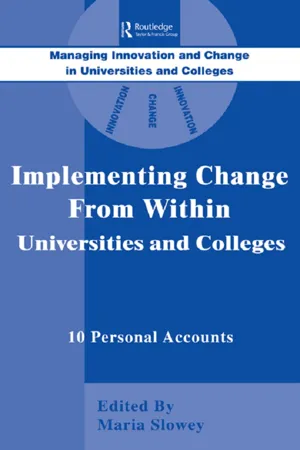
Implementing Change from Within in Universities and Colleges
Ten Personal Accounts from Middle Managers
- 192 pages
- English
- ePUB (mobile friendly)
- Available on iOS & Android
eBook - ePub
Implementing Change from Within in Universities and Colleges
Ten Personal Accounts from Middle Managers
About this book
This volume describes the experiences of a number of middle managers in higher and further education, describing how new developments have demanded new forms of leadership at the middle level of educational institutions.
Information
PART ONE
INTRODUCTION
Chapter 1
Reflections on Change – Academics in Leadership Roles
INTRODUCTION
This book is about reflections – the critical self-assessment and questioning of management practice by people who, in different ways, have responsibility for leading and implementing change within further and higher education institutions. Most were not trained as managers and started their careers as ‘traditional’ academics. It is not an easy transformation and none of those who have made the change underestimate the costs. As an academic, the primary focus of intellectual concern is discipline-centred, but as a manager or ‘change agent’, the academic discipline becomes secondary. Those who swap roles and make the transition end up with new perspectives and outlooks. Their priorities are altered and they often encounter opposition from a less than supportive academic community which, despite its commitment to a search for new knowledge, can be conservative when it comes to new ways of working.
Charged with implementing change, the academic as manager must redefine his or her role. It is for most people a personal challenge and it is also a challenge for the institution as a whole. Change in itself is neither good nor bad; what matters is the kind of change. The reflections of the various contributors will, hopefully, shed some light on the dramatic and profound changes currently affecting further and higher education and the strategies being adopted to respond to external forces in a positive and proactive way.
There are no simple blueprints for success. However, by offering reflections on strategies which worked, and some which did not, it is hoped to contribute to the broader understanding of the nature of the management of change in the complex environment of further and higher education, and to provide support to the increasing numbers of the academic community placed in positions of implementing change within their own institutions.
THE POLICY CONTEXT
To say that both the pace and the nature of change in post-compulsory education in Britain over the past decade have been dramatic is an understatement. Change within further and higher education has been almost without parallel in terms of the explosion of student numbers, levels and methods of resourcing, quality control systems, the curriculum and modes of study.1 The outcome has been, as Trow (1994, p.11) puts it, ‘…a more profound re-orientation than any other system in industrial societies’. These changes have placed tremendous pressures on traditional academic cultures and styles of administration. Two particular effects have been highlighted by Scott (1993). In the first place there is a loss of academic intimacy and the emergence of a new cadre of academic managers. Secondly, there is an increasing tendency towards radical devolution from the centre of institutions to operational units – with an accompanying impact on leadership requirements at the departmental level.
The factors which have led to this ‘profound reorientation’ are not difficult to discern, deriving largely from a political climate which emphasizes ‘value for money’ and radical reform of all aspects of the public sector. It was these objectives which shaped government policy following the 1979 election. While higher education took steps to introduce reform from within the system – through, for example, the work of the Committee of Vice-Chancellors and Principals on efficiency in higher education (CVCP, 1985) – the government proceeded to pursue its policies through legislation and a variety of funding strategies. (Readers should refer to the Appendix for a more detailed account of the policy context and the nature of its impact on the system.)
The essential features of the new agenda for higher education which influenced subsequent developments were set out in the White Paper Higher Education: Meeting the Challenge (DES, 1987). Largely as a result of concerns about international competitiveness there was a major emphasis on (i) expansion of the system by increasing the age participation DES, 1987 rate (that is, the percentage of young people staying on in education beyond the compulsory school leaving age); (ii) widening access to young people with qualifications other than A Levels (Advanced Levels) and (iii) offering new opportunities to mature students. Links with employers and labour market requirements provided a secondary series of themes including continuing part-time education for those in employment who wished to improve their professional knowledge and skills. The policy framework also placed considerable emphasis on
• improvements in the design and content of courses and the quality of teaching;
• external measures of quality in research; and
• increased efficiency of institutions as measured by various performance indicators.
The drive to increase efficiency and the utilization of external measures of quality was rapidly taken further as the Education Reform Act (1988) was followed by another White Paper in 1991, Higher Education: A New Framework (DfE, 1991) and by even more radical legislative changes in the Further and Higher Education Act (1992). The latter introduced separate Higher Education Funding Councils (HEFCs) in England, Wales and Scotland, funding all higher education institutions in those countries; polytechnics were awarded university status (the abolition of the ‘binary divide’); new quality assurance methods were introduced, including a quality assurance role for the HEFCs, and a quality audit unit developed by the universities.
In addition to these legislative changes, another important strategy employed to effect change in further and higher education has been through the use of targeted funding. As the core unit of resource diminished over the period in question, institutions were encouraged to bid for short-term funding made available for development work in support of policy priorities. There is, of course, an irony in a Conservative government firmly committed to market principles adopting such overtly interventionist strategies. As Duke points out:
The paradox of a strongly directive and centralising Administration wedded in principle to the free play of market forces is well displayed in the education sector, and curiously echoes the behaviour of mid-Victorian administrations in the heyday of laissez-faire
(Duke, 1988, p.31).
In particular, the use of additional funds on the basis of competitive bids has been an important instrument in locating further and higher education closer to the sphere of the training infrastructure. It is significant that the bulk of these funds has been channelled through the government department responsible for the labour market and vocational training (the Employment Department) rather than that responsible for education (in England, the Department for Education, in Scotland, the Scottish Office Education Department). While acknowledging the ‘inescapably societal character’ (Barnett, 1990) of higher education, these types of initiatives reflected the dominant interests of the world of work in a new and more explicit way.
One of the most significant of these targeted initiatives in the higher education sector of the late 1980s was Enterprise in Higher Education (EHE). As several of the chapters in this volume point out, this particular initiative was initially greeted with considerable suspicion, if not outright hostility, because it was seen as an attempt at direct ideological intervention in the curriculum – an arrow directed at the academic heart of universities and colleges. However, the level of funding was attractive (in the region of £1m for larger institutions) and most institutions eventually submitted bids, although the decision to do so was by no means always uncontroversial and was frequently accompanied by much internal debate. The reasons for the strength of feeling are not difficult to discern. Institutions were being offered an inducement to undertake curriculum development in line with government policies – with a particular stress on transferable skills and strengthened links with employers. On the other hand, advocates of EHE within institutions argued that the funding could be used to introduce changes which had long been desirable for sound educational reasons, in particular in relation to supporting steps to widen access to a broader section of the population.
With this combination of legislative and funding strategies, by 1994, the government,
…saw itself as having ‘solved’ the issue of higher education. The sector had been reorganized, numbers of students had grown, and issues of quality were being addressed. As the government saw it, the onus was now on the universities and colleges themselves – cajoled by the HEFCs – to make a mass higher education system work efficiently and effectively (Appendix).
National policies undoubtedly set the broad parameters but, as Wagner (1989) puts it, the real ‘action’ takes place at the institutional level. The importance of the institutional dimension is evidenced by the different responses that universities and colleges display despite the fact that they all operate within the same policy context.
These institutional responses have to be managed. This volume contains the personal accounts of a number of those who are centrally involved in this task of assisting their institutions not only to survive, but hopefully to make progress towards the achievement of their respective missions, within this very difficult policy environment.
THE NATURE OF THE TASK FACING AGENTS OF CHANGE
Who are the men and women in universities and colleges who have the job of delivering this ‘efficient’ and ‘effective’ system, while still ensuring that the fundamental values of higher education are at least maintained, if not enhanced? Who are these people who have to take leadership roles in times of dramatic changes in both student numbers and diversity of the student body? Who are the people who have to implement new quality systems in teaching and research at a time of a radical reduction in the unit of resource? What training do they have? What are their backgrounds and values? How do they cope with what appears to be constant change and uncertainty? How do they reconcile traditional academic values with those of a political regime which frequently seems to hold such values in contempt? And perhaps the most important question of all – why do they do it?
It is with a view to answering some of these questions that ten people who, in very different ways, are involved in implementing and managing change in the further and higher education sector, were approached to tell their ‘personal stories’. It is a great tribute to all that they have agreed to share with a wider audience their reflections of the strategies which they have adopted in seeking to shape and control their environment for the benefit of students, colleagues and their institutions. They have been willing to describe what has worked and, perhaps more importantly, what has not worked! They come from different discipline backgrounds and are in different structural positions. Some have senior management roles across their institutions; others are heads of departments; others have no budgets, no managerial authority but act as ‘change agents’ on a variety of fronts; and one is president of a Student’s Union. What all share in common, and this comes through very forcibly in their accounts, is a deep commitment to doing all they can to assist their respective institutions to best cope with fundamental change in a proactive rather than reactive way.
This volume does not set out to provide tidy ‘how to’ tips for those concerned with managing and implementing change in universities and colleges. Instead it offers the considered reflections of people who have, in their different ways, had responsibility for introducing change at some level within their institution. Few of them received formal training in management techniques, and a phrase which recurs is ‘learning on the hoof’. Just how valuable formal management training is, in any case, has long been a subject of heated debate – although many of the contributors acknowledge the lack of formal management training as a perceived handicap which they had to overcome.
As has been argued above, the motive force behind the profound changes that further and higher education have experienced in recent years has been largely political. Almost inevitably, therefore, the managers of change on occasion find themselves in the position of actively implementing government policies. They may well feel less than comfortable with many aspects of these policies but, as the ten accounts in this book reveal, such people see an important part of their role as responding to these external pressures in a positive way, with a view to at least mitigating their worst effects, and at best achieving educationally desirable outcomes. The fact that they are required to implement many government policies and initiatives to which there is a fair measure of hostility amongst their academic peers makes the whole endeavour even more difficult. Most academics would prefer to be left in peace so that they could get on with their research and teaching. To someone whose major professional preoccupation is the refinement of a rarefied theory in nuclear physics, many of the interventions by central government are regarded as unnecessary and unwelcome. Those responsible for leading change, who have themselves typically held (and may still hold) conventional academic positions, therefore find themselves with a role that is not only inherently difficult in itself, as is any kind of management role, but which is also subject to concerns about possible compromise on traditional academic values.
Many of the contributors point to the particular difficulties and challenges of seeking to lead and implement change within academic institutions in contrast to being a manager in industry or commerce. Handy (1993), in his overview of research on issues relating to organizational culture and change, uses the stereotype of the professor to illustrate the professional who would prefer to be operating in a minimalist organizational structure:
He (sic) does what he has to, teaches what he must, in order to retain his position in that organisation. But essentially he regards the organisation as a base on which he can build his own career, carry out his own interests, all of which may indirectly add interest to the organisation though that would not be the point of doing them
(p. 191).
He then goes on to comment, with some degree of understatement, that individuals with this orientation are ‘not easy to manage’ – a point which comes through in the case studies. While this volume was not designed to make a theory, the accounts do shed light on strategies for leading and managing academic staff.
Part of the difficulty arises from lack of clarity about the role of the ‘academic manager’. As Tann (Chapter 6) points out from her extensive staff development work with heads of departments, not only are many such appointments short-term and, particularly in the older universities, are rarely accompanied by a detailed job description, but the nature of the managerial responsibility for other academic colleagues is itself very vague. It is perhaps not surprising, therefore, that contributors intuitively find their way to utilizing some of the best management techniques of persuasion, team building and – a recurrent theme – ‘ownership’.
As King (Chapter 2) emphasizes, the essence of academic training is to promote critical thinking and a questioning of authority. On a bad day an...
Table of contents
- Cover
- Title
- Copyright
- Contents
- Series Editor’s Foreword
- Preface and Acknowledgements
- PART 1. Introduction
- PART 2. Leading Change – Heads of Department and Others
- PART 3. Implementing Cross-Institutional Change
- PART 4. Opportunities for New Actors in Times of Change
- Appendix. Growth and Diversity: A New Era in Colleges and Universities*
- Index
Trusted by 375,005 students
Access to over 1.5 million titles for a fair monthly price.
Study more efficiently using our study tools.
Frequently asked questions
Yes, you can cancel anytime from the Subscription tab in your account settings on the Perlego website. Your subscription will stay active until the end of your current billing period. Learn how to cancel your subscription
No, books cannot be downloaded as external files, such as PDFs, for use outside of Perlego. However, you can download books within the Perlego app for offline reading on mobile or tablet. Learn how to download books offline
Perlego offers two plans: Essential and Complete
- Essential is ideal for learners and professionals who enjoy exploring a wide range of subjects. Access the Essential Library with 800,000+ trusted titles and best-sellers across business, personal growth, and the humanities. Includes unlimited reading time and Standard Read Aloud voice.
- Complete: Perfect for advanced learners and researchers needing full, unrestricted access. Unlock 1.5M+ books across hundreds of subjects, including academic and specialized titles. The Complete Plan also includes advanced features like Premium Read Aloud and Research Assistant.
We are an online textbook subscription service, where you can get access to an entire online library for less than the price of a single book per month. With over 1.5 million books across 990+ topics, we’ve got you covered! Learn about our mission
Look out for the read-aloud symbol on your next book to see if you can listen to it. The read-aloud tool reads text aloud for you, highlighting the text as it is being read. You can pause it, speed it up and slow it down. Learn more about Read Aloud
Yes! You can use the Perlego app on both iOS and Android devices to read anytime, anywhere — even offline. Perfect for commutes or when you’re on the go.
Please note we cannot support devices running on iOS 13 and Android 7 or earlier. Learn more about using the app
Please note we cannot support devices running on iOS 13 and Android 7 or earlier. Learn more about using the app
Yes, you can access Implementing Change from Within in Universities and Colleges by Maria Slowey,Slowey, Maria in PDF and/or ePUB format, as well as other popular books in Education & Education General. We have over 1.5 million books available in our catalogue for you to explore.