- 272 pages
- English
- ePUB (mobile friendly)
- Available on iOS & Android
eBook - ePub
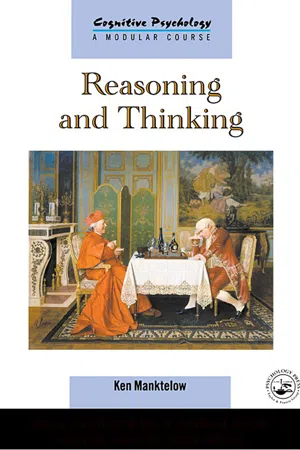
Reasoning and Thinking
About this book
This undergraduate textbook reviews psychological research in the major areas of reasoning and thinking: deduction, induction, hypothesis testing, probability judgement, and decision making. It also covers the major theoretical debates in each area, and devotes a chapter to one of the liveliest issues in the field: the question of human rationality. Central themes that recur throughout the book include not only rationality, but also the relation between normative theories such as logic, probability theory, and decision theory, and human performance, both in experiments and in the world outside the laboratory. No prior acquaintance with formal systems is assumed, and everyday examples are used throughout to illustrate technical and theoretical points.
The book differs from others in the market firstly in the range of material covered: other tend to focus primarily on on either reasoning or thinking. It is also the first student-level text to survey an imporatant new theoretical perspective, the information-gain or rational analysis approach, and to review the rationality debate from the standpoint of psuchological research in a wide range of areas.
Information
Publisher
Psychology PressYear
1999Print ISBN
9780863777097
9780863777080
Edition
1eBook ISBN
9781135481124
1
Reasoning and thinking: A four-way introduction
The psychological study of thinking has both a very long and a very short history. Its long aspect comes from its antecedents in philosophy, where ideas can be traced back to classical antiquity: Aristotle, in particular, casts a shadow stretching over more than 2000 years. On the other hand, the psychology of human thinking, as a branch of cognitive psychology, can hardly be older than cognitive psychology itself, and the birthday of the latter is often located in the late 1950s (see e.g. Baars, 1996). In fact, we can look to even more recent times for the beginnings of a true cognitive psychology of thinking, to Wason and Johnson-Laird’s Psychology of Reasoning: Structure and Content, published in 1972.
Thought and reason are, of course, foremost among the list of properties that we often invoke when we try to mark out what makes us different from other animals. Making inferences is also a fundamental requirement of intelligence, so you might expect the subject to be right in the mainstream of psychological research. In fact, this has not been the case until very recent times. The reason for this probably lies in the ways in which the field relates to, and feeds from, not only other areas of psychology but other disciplines too. The clearest instance of this relation is in the way the study of reasoning has often seemed to assess people against idealised criteria derived from formal systems such as logic, probability theory, and decision theory. The place of normative standards in the psychological account of thinking and reasoning is one of the core issues we shall be concerned with in this book.
Of course, it would be a strange kind of psychology that did not concern itself with thought, and there is now a huge and proliferating literature on reasoning and thinking, informed by the theoretical and empirical methods of both cognitive psychology and cognitive science. So huge, in fact, that I shall have to start by drawing some lines, before outlining what will be covered in this text.
Some boundaries
First let me reassure those readers who dread having to get to grips with technical systems. Although in studying reasoning you cannot totally avoid contact with logic, and in studying decision making you must at some point look at decision theory and probability, systems such as these will be set out only in as much detail as is necessary for the psychology, and with a minimum of maths.
Second, as this field has taken its place in the mainstream of cognitive enquiry, so the borderlines between it and other fields have become blurred. As a consequence, we shall need to refer to ideas from (among others) the psychology of problem solving, language, intelligence, memory theory, social cognition, and cognitive development from time to time; and, outside psychology, from philosophy, economics, and artificial intelligence. As with the technical material, these references will be made in the context of the psychological topic in hand, and won’t be treated as separate issues.
Fields, issues, theories, and tasks: A four-way perspective
Having noted where the borders are, it is time to set out what will be found within them. To help organise your reading, you can think about the material from four angles.
Fields
First there are the fields of research that we shall consider. A traditional division is that between inductive and deductive thinking, with the latter most often equated with reasoning. This division is helpful, but should not be regarded as rigid: as we shall see in later chapters, there are increasing trends towards integration across subfields. Put simply, inductive thinking is what you do when you arrive at a conclusion on the basis of some evidence. Detective work is a good example: a series of crimes may contain common elements such as locality, frequency, or a characteristic method. When put together, they suggest a pattern, which in turn suggests a “model” for the suspect. “Suggest” is an informal label for an inductive process. Thus, induction increases information, in the sense that an induction rules out possible models. However, there is a price: an inductive conclusion cannot be guaranteed to be true. This is because a conclusion may be based on irrelevant evidence, relevant evidence may be ignored, new evidence may force one to change it, or there may be bias in the way evidence is treated; and the wrong suspect may be arrested, or the real one missed. If induction guaranteed truth, we could replace the courts by logicians.
Deduction, on the other hand, involves arriving at conclusions on the basis of statements, called premises, whose truth value can be assumed. The nature of the conclusion is given by the structure of the argument, not its content, and these structural principles are the province of logic. A true set of premises can never lead to a false conclusion. Thus, while deduction is truth-preserving, it does not increase information: no more models are ruled out by the conclusion than were ruled out by the premises. A deduction at best makes explicit what was already there. Deduction is one way of testing inductive hypotheses.
Both these areas cover distinct but related sub-areas. For instance, there is a major area of research involved in exploring how it is that we form judgements about the likelihood of things, which is a very common type of induction. Are the summers getting warmer, do we live in especially violent times, is it safe to eat seafood? As with deduction and logic, there is an obvious relation between human judgements of probability and a formal system of principles, in this case statistical.
Even from these examples, it is clear that assessing likelihoods is only one aspect of the kinds of everyday decisions that we make. Most of the time, we also place a value on the object of the judgement: it may be something we would like to happen, or prefer not to happen. Is it worth buying tubes of factor 20 sunscreen this summer? You need to think about the benefits and costs involved, as well as the likelihood of relevant events happening: are you worried about skin damage, do you think it is likely your skin will be damaged if you do not protect it? Is an uncertain long-term risk enough to put you off the immediate pleasure of being out in the sun? As Baron (1994a) puts it, such decisions depend on both your beliefs and your goals. Once again, there are formal systems that have been developed to set out in principle how these judgements of probability and utility can be expressed: this is the field of decision making.
This last example shows how, in many aspects of our thinking, we are not just considering what is or is not the case, but what we should or should not do. This kind of thinking has attracted a lot of research interest recently, and is known as deontic thinking. Contemplating the blazing sun, and bearing in mind your assessments of the risks of skin damage, you might say to your friend (or yourself), “you must (or should, or ought to) put on some sunscreen” (a statement of obligation), or “if you put on some sunscreen, then you can go out” (a permission). Deontic thinking is an area in which the distinction between reasoning and decision making has become fuzzier.
These then are the major fields of thinking and reasoning we shall cover in this book: deduction, hypothesis testing, induction, judgement, and decision making.
Issues
There are several central questions addressed by researchers in thinking and reasoning that cut across the areas they explore. The one that has led to more experiments and theory than probably any other has already been mentioned several times: the relation between formal systems and human behaviour. Some authors call this the relation between normative and descriptive accounts of thought. Formal systems are called normative because they appear to set out norms, or ideals, of thought. Psychological theories aim to describe, and explain, what people actually do when tested or observed.
The simplest hypothesis about this relation is to propose that we have some kind of formal system in our minds. There have been many exponents of this view. Piaget, for instance, was the most famous of those theorists who argue for a “mental logic” (e.g. Inhelder & Piaget, 1958), and similar proposals have been made about decision theory, especially by economists. A subtler form of this argument which is still actively debated today, is that the mind contains systems of “natural” inference rules. Both the original mental logic idea and its present-day form have been hotly contested.
One of the central problems that inference rule theorists have to confront is that of content. If our minds contain logic-like inference rules, which are by definition abstract, then all problems of a given structure should produce the same solutions. But they do not. People reason better about concrete rather than abstract problems, and about problems with which they are familiar (Garnham & Oakhill, 1994). The role of content in reasoning is a second central issue, one that also cuts across fields of research.
However, this is not to say that people are helpless in the face of more or less unfamiliar problems. They generally perform above chance level, although they may be prone to systematic biases as well as being influenced by content (Evans, Newstead, & Byrne, 1993a). A complete theory of thinking would have to explain all three of these observed properties of human performance.
One general question that arises from these observations and arguments concerns the question of rationality. What does it mean to say that people, singly or in general, are rational or irrational? For years, it has been assumed that rational meant close adherence to a formal system. Psychological demonstrations of bias or content-dependency sometimes seemed to terrify theorists who held this view, as they seemed to put human rationality in serious question. Some theorists (e.g. Cohen, 1981) responded by denying that experiments could ever tell us anything about rationality. Others (e.g. Stich, 1985) took the opposite stance and seemed to accept general irrationality as a demonstrated fact. In recent years these views have been challenged by an “ecological” argument. This reflects a second usage of words such as “rational” or “irrational” in ordinary language, where we often mean that someone did or did not do the right thing in the circumstances: rational thought in this second sense is that which helps us achieve our goals. Questions of rationality and irrationality also cut across research fields.
Lastly, an issue related to the rationality question has also begun to be addressed by theorists, and that is the matter of the relation between psychological research, based on controlled experiments, and wider views of human thought. Do laboratory tasks tell us anything useful about thought in the real world? The discovery of the central role of content in thought makes this question an important one for theorists. On the other hand, environmental considerations have opened up a new way of characterising laboratory performance using Anderson’s (1990) method of “rational analysis.” The relation between the laboratory and the real world is addressed, in the field of decision making, by Fischhoff (1996) in a paper with the arresting title “The real world: what good is it?”.
Major issues that will recur throughout the book are therefore those of the relation between formal systems and psychological observations, the questions of competence, content, and bias, the question of rationality, and the relation between laboratory performance and everyday thinking.
Theories
It would have been neat, if boring, were theories of thinking linked tightly to fields of research, but, like the basic issues just outlined, they are not. I have already mentioned how formal systems have been recruited as theories of thought, and this has happened across fields. Not so long ago, these were the nearest thing we had to general theories of thinking and reasoning, but in the early 1980s there was what at least one writer has described as a theoretical revolution (Byrne, 1996).
A measure of this progress in theory can be seen by looking at a classification made by Evans in 1991. He set out four types of theory: inference rules, content-dependent rules (or schemas), mental models, and heuristic approaches. The second and third of these have been developed since 1980, the fourth since 1970, while the first is still delivering new theories in the 1990s. We shall look in detail at all of them.
The most ambitious of the newer approaches, in terms of its scope and the degree to which it has been tested empirically, is the theory of mental models expounded by Johnson-Laird and his colleagues (Johnson-Laird, 1983, 1995; Johnson-Laird & Byrne, 1991). This has been applied across the board, originally to deduction but latterly also to induction, and also outside the field, e.g. to linguistic inference. The trial between mental models and mental logic theories is an especially lively current debating point.
As if that were not evidence enough of the rate of theoretical progress, note that Evans’s classification is already out of date. In the mid-1990s we have seen the arrival not only of elaborations of existing approaches, but distinct, new approaches that have taken their cue from theories outside the field of thinking, and have been successfully and influentially applied within it. An example is information gain theory, developed by Oaksford and Chater (e.g. 1994a) from Anderson’s (1990) rational analysis approach.
In the areas of judgement and decision making, a...
Table of contents
- Cover Page
- Title Page
- Copyright Page
- Series Preface
- Acknowledgements
- 1. Reasoning and Thinking: A Four-Way Introduction
- 2. Deduction: Experiments With Syllogisms
- 3. Deduction: Experiments With “If” and Other Connectives
- 4. Deduction: Biasesand Content Effects
- 5. Theories of Deduction
- 6. Hypothesis Testing
- 7. Induction
- 8. Judging Probability
- 9. Decision Making
- 10. Reasoning, Thinking, and Rationality
- References
Trusted by 375,005 students
Access to over 1.5 million titles for a fair monthly price.
Study more efficiently using our study tools.
Frequently asked questions
Yes, you can cancel anytime from the Subscription tab in your account settings on the Perlego website. Your subscription will stay active until the end of your current billing period. Learn how to cancel your subscription
No, books cannot be downloaded as external files, such as PDFs, for use outside of Perlego. However, you can download books within the Perlego app for offline reading on mobile or tablet. Learn how to download books offline
Perlego offers two plans: Essential and Complete
- Essential is ideal for learners and professionals who enjoy exploring a wide range of subjects. Access the Essential Library with 800,000+ trusted titles and best-sellers across business, personal growth, and the humanities. Includes unlimited reading time and Standard Read Aloud voice.
- Complete: Perfect for advanced learners and researchers needing full, unrestricted access. Unlock 1.5M+ books across hundreds of subjects, including academic and specialized titles. The Complete Plan also includes advanced features like Premium Read Aloud and Research Assistant.
We are an online textbook subscription service, where you can get access to an entire online library for less than the price of a single book per month. With over 1.5 million books across 990+ topics, we’ve got you covered! Learn about our mission
Look out for the read-aloud symbol on your next book to see if you can listen to it. The read-aloud tool reads text aloud for you, highlighting the text as it is being read. You can pause it, speed it up and slow it down. Learn more about Read Aloud
Yes! You can use the Perlego app on both iOS and Android devices to read anytime, anywhere — even offline. Perfect for commutes or when you’re on the go.
Please note we cannot support devices running on iOS 13 and Android 7 or earlier. Learn more about using the app
Please note we cannot support devices running on iOS 13 and Android 7 or earlier. Learn more about using the app
Yes, you can access Reasoning and Thinking by K.I. Manktelow in PDF and/or ePUB format, as well as other popular books in Psychology & Cognitive Psychology & Cognition. We have over 1.5 million books available in our catalogue for you to explore.