- 500 pages
- English
- ePUB (mobile friendly)
- Available on iOS & Android
eBook - ePub
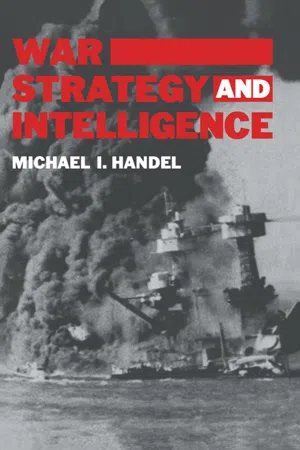
War, Strategy and Intelligence
About this book
Investigating the logic, conduct and nature of war on the highest political and strategic levels, these essays put less emphasis on operational and tactical aspects. They look at the impact of technology on warfare, the political nature of war and the limits of rational analysis in studying war.
Information
PART ONE
Technology’s Impact on Modern War
1
Clausewitz in the Age of Technology
As water has no constant form there are in war no constant conditions.
– Sun Tzu, The Art of War (c. 500 BC)
I. CLAUSEWITZ AND THE STUDY OF WAR
Any early nineteenth-century textbook or theoretical work in chemistry, physics, or geology would be of little more than anecdotal value for the same profession’s contemporary practitioners. It would certainly not be looked to as a source of important relevant insights, nor would it have value for the instruction of modern students, let alone be expected to represent the state of the art in an important profession. In many fields, in fact, the pace of change is so rapid that a major theoretical work can become obsolete within a generation or a decade, and textbooks must be updated or replaced every few years. Yet in the study of war – a subject of the utmost importance for the survival of modern civilization, and an area in which even one mistake can be disastrous for a whole society or generation – no theoretical work has yet surpassed Carl von Clausewitz’ unfinished study, On War (1832), in its richness of wisdom and heuristic value.
This situation stems from the extremely complex nature of modern warfare with its seemingly infinite number of variables, ranging from the quantifiable to the intuitive, from the moral to the material. Since modern warfare therefore is not readily subject to scientific analysis, complete mastery of this subject is extremely difficult for a single scholar. Who can study, in depth, even a fraction of the topics considered relevant today for the understanding of modern war? Under the rubric of modern warfare, one can study psychology; anthropology; politics; political, military and economic history; the extremely wide variety of modern military technologies; measures and countermeasures of all sorts; intelligence; arms control ; civil–military relations ; military-industrial potential ; the origins and terminations of wars ; bureaucratic behavior ; management; leadership ; and decisionmaking processes – to mention only a few.
Modern studies of war are often either specialized monographs (focusing on a particular, narrowly-defined subject area or historical period) and abstract ‘transhistorical’ studies of less than general scope,1 or very broad encyclopedic surveys, such as Quincy Wright’s Study of War2 which include every detail but often explain very little.
Clausewitz was fortunate to live during the last era in which it was still feasible for one person to create a comprehensive and simplified framework for the study of war; that is, to incorporate almost all the relevant knowledge existing in his time without being superficial. Consequently, he could reasonably limit his analysis of politics, strategy, and the essence of war to the actual conduct of war. For the most part, he ignored the origins of war, its moral and economic aspects, domestic or internal politics, and many other subjects now indispensable to a comprehensive theory: war has become too complicated to be studied in the methodological isolation of an amoral, apolitical, ‘non-economic’, non-technological ‘black box’.
It is, then, not surprising to find that all recent attempts to capture the ‘essence’ of the conduct of war in a comprehensive and succinct form have not been entirely satisfactory. They have oscillated between contrived simple generalized formulas on the one hand and encyclopedic surveys on the other. Clausewitz avoided both extremes. He succeeded in being abstract without going theoretically overboard ; in developing powerful concepts while avoiding the temptation to develop ‘laws’, ‘rules’, and ‘practical’ recommendations for action;3 in providing apt examples to demonstrate his points while avoiding the quagmire of excessive trivial detail, including too many case studies. In his work there is not a single cliché to be found on a subject about which others cannot write without clichés.
One hundred and fifty years after his death, Clausewitz’ contribution to the study and understanding of war remains unsurpassed. Still relevant today are his ideas on the primacy of political control in war; on the roles of friction, uncertainty, and chance; on danger and boldness; on historical examples ; on war as an art ; on the need to avoid dogmatic and positive theories, given the existence of several correct solutions to any military problem ; and on the nature of war in general. Concepts such as tension and rest, the culminating point of victory, his critical discussion of maneuver, and the psychology of the defense and offense are perhaps even more relevant today than when they were written. Like that of other great men who were ahead of their time, Clausewitz’ genius was not recognized by his contemporaries, although he had indeed, as he suggested in his note of 10 July 1827, ‘[brought] about a revolution in the theory of war’ (p. 70).4
Despite the wealth of original ideas and concepts that make the most important aspects of Clausewitz’ theory applicable today, many other facets of his theory have grown obsolete or remain valid only by virtue of modification and revision. Other dimensions that are important today, but which remained nascent during his lifetime, are simply not addressed in his writings.
Clausewitz’ theories and observations on war that require modification can be classified in four major categories:
First, the differences in modern warfare resulting from technological innovations he could not have foreseen and therefore could not take into account;
Second, problems that existed in a relatively simple form in the nineteenth century but which are manifested today in a much more complicated form as a result of technological changes : for example, problems in strategic policy-making and in civil–military relations, and in improving the reliability of military intelligence (in which he had little confidence);
Third, topics such as the causes of war, moral/ethical questions related to war, and war’s economic dimension. Clausewitz did not focus on these areas because he was concerned exclusively with the conduct of war itself. These topics are, however, of great interest to today’s student of warfare, and are essential to any modern theory of war.
The fourth category consists of theories or observations that were wrong or inaccurate even for his own time. But my purpose is not to look for flaws in Clausewitz; rather, I will focus on those modifications required by the passage of time, primarily as a function of material changes, in order to give Clausewitz his proper place in the Age of Technology.
II. THE IMPACT OF THE INDUSTRIAL-TECHNOLOGICAL REVOLUTION ON WAR
With the benefit of hindsight it is apparent that Clausewitz lived and created during one of the most decisive transitional periods in the evolution of warfare – at the crossroads of two of the greatest revolutions in history, the French and Industrial Revolutions. The first revolution radically changed the nature of war from its formerly rather limited and moderate scope – in terms of both means and aims – into a matter of total mobilization and immoderate goals. After the powers of nationalism and revolutionary ideology were unleashed, war became, for the first time, not only the business of kings and the military, but also that of every citizen in the state. Democracy and nationalism released a large amount of heretofore latent energy for the pursuit of war. Although Clausewitz clearly identified this new trend in warfare, he was not completely sure that the change it had wrought was irreversible:
Very few of the new manifestations in war can be ascribed to new inventions or new departures in ideas. They result mainly from the transformation of society and new social conditions. But these, too, while they are in the crisis of fermentation, should not be accepted as permanent. There can therefore be little doubt that many previous ways of fighting will reappear. (p. 515)
Ironically, at approximately the same time as Clausewitz’ death, a new revolution which he could not have identified was in its formative stage: in combination with the trends established by the French Revolution, the Industrial and Technological Revolution changed the world in numerous irreversible ways. Since Clausewitz’ time the military/technological environment has undergone at least two major revolutions, one in the conventional realm, the other in the nuclear realm, which have caused a paradigmatic shift in the nature of war. Numerous smaller military-technological and organizational revolutions have occurred as well (for example, the revolution in mobility, the revolution in firepower, the creation of war in the air as a third dimension of warfare, the revolution in communication from the invention of the radio and telegraph to that of ‘smart weapons’, computers and satellites).
Whereas in Napoleon’s era, geography, time, and space were major environmental constraints on strategy, technology has to a large extent modified the imperatives of environment. The radio made distance irrelevant for the transmission of information; the submarine destroyed the British sense of geographic isolation; and ICBMs have threatened the security of ‘Fortress America’. Technology has liberated the military strategist from some concerns of the past, while posing new problems in other areas.
The ‘element of uncertainty’ which – according to Clausewitz – dominates warfare has now been compounded by the introduction of a new dynamic variable. Many factors, including: the performance of new and untested weapons systems on the battlefield; these systems’ interaction; their impact on military doctrines, tactics, strategy, as well as on the development of measures and countermeasures and on the military (and political) decision-making process – all have caused a quantum jump in the complexity of warfare.5
In war and its preparation, every technological change touches off a chain reaction that is not only technological, but also social, political, bureaucratic, managerial, and psychological. Such changes can be clear or subtle, short term or long term, critical or marginal – but they will occur with each technological innovation. When hundreds or thousands of changes occur simultaneously there is a corresponding increase in the uncertainty involved in predicting the shape of modern warfare and of the battlefield of the future.
Within less than a year following Clausewitz’ death (16 November 1831), a major new element in warfare was introduced to Europe in the form of the first railways (‘… the accelerator of nineteenth century warfare’).6 No sooner had the ink dried on the first edition of his magnum opus, On War, than the appearance of this new element of military technology began to render some dimensions of his theory obsolete.7
As early as 1833, a German by the name of Friedrich Wilhelm Harkort made ‘the first definite proposals for the use of railways for strategical purposes’.8 The first actual use of railways for a military operation occurred in 1846 when the Sixth Prussian Corps of 12,000 men with their horses, weapons, and ammunition, was dispatched by rail to subdue the independent Republic of Cracow.9 By the time of the French campaign in Italy, the American Civil War, and the wars of German unification, railways constituted a major element of military mobility and were of decisive importance in warfare.
Clausewitz could still justifiably argue that ‘today, armies are so much alike in weapons, training, and equipment that there is little difference in such matters between the best and worst of them’ (p. 282) [my emphasis]. But the wars of the 1860s irrefutably demonstrated that a new force multiplier – to resort to modern jargon – had been introduced. Technological innovation could now, when all other things were equal, make a decisive difference, a fact that could hardly have been recognized in Clausewitz’ time. For instance, the battle of Koniggratz proved the superiority of the Prussian Dreyse rifle over the Austrian rifle, when ‘the rate of fire of the Dreyse rifles inflicted appalling losses on the advancing Austrians: they suffered 45,000 casualties to the Prussians’ 9,000’.10
The advent of the new technological age was unmistakable when European military observers during the American Civil War focused their interest not on the study of military doctrines or new tactics, but on the performance of new weapons.11 This new emphasis on the study of weaponry would have made little sense to Clausewitz only fifty years earlier.
By the latter half of the nineteenth century, military technology was an autonomous force capable of influencing the shape of war in a decisive way. Man had created a Frankensteinian monster that could no longer be controlled. That battlefield decision, which Clausewitz made central to his theory, had rapidly shifted from the battlefield to the rear; from war to pre-war preparations in peacetime; from the soldier to the worker, inventor, and scientist. In the aftermath of the Industrial Revolution, the outcome of war was to be determined as much by the existence of an industrial base and war potential as by performance on the battlefield. As William James wrote : ‘ .. the intensely sharp competitive preparation for war by the nation is the real war, permanently increasing, so that the battles are only a sort of public verification of mastery gained during the “peace” intervals’.12
Correspondingly, for military leaders in the technological age, the destruction of the enemy’s army – so central to Clausewitz’ theory – became only as important as, or less important than, the destruction or occupation of the industrial centers necessary for the maintenance of enemy forces in the field.13 In the American Civil War, the industrial superiority of the North, despite the equal or superior generalship of the Confederacy, was critical. Such a development would certainly have been strange to Clausewitz (unless of course industrial might could simply be translated to mean much larger armies, a quantita...
Table of contents
- Cover
- Halftitle
- Title
- Copyright
- Dedication
- Contents
- Acknowledgments
- War, Strategy and Intelligence: An Overview
- PART One. Technology’s Impact on Modern War
- PART Two. Intelligence and Strategy
- PART Three. Ending War
Trusted by 375,005 students
Access to over 1.5 million titles for a fair monthly price.
Study more efficiently using our study tools.
Frequently asked questions
Yes, you can cancel anytime from the Subscription tab in your account settings on the Perlego website. Your subscription will stay active until the end of your current billing period. Learn how to cancel your subscription
No, books cannot be downloaded as external files, such as PDFs, for use outside of Perlego. However, you can download books within the Perlego app for offline reading on mobile or tablet. Learn how to download books offline
Perlego offers two plans: Essential and Complete
- Essential is ideal for learners and professionals who enjoy exploring a wide range of subjects. Access the Essential Library with 800,000+ trusted titles and best-sellers across business, personal growth, and the humanities. Includes unlimited reading time and Standard Read Aloud voice.
- Complete: Perfect for advanced learners and researchers needing full, unrestricted access. Unlock 1.5M+ books across hundreds of subjects, including academic and specialized titles. The Complete Plan also includes advanced features like Premium Read Aloud and Research Assistant.
We are an online textbook subscription service, where you can get access to an entire online library for less than the price of a single book per month. With over 1.5 million books across 990+ topics, we’ve got you covered! Learn about our mission
Look out for the read-aloud symbol on your next book to see if you can listen to it. The read-aloud tool reads text aloud for you, highlighting the text as it is being read. You can pause it, speed it up and slow it down. Learn more about Read Aloud
Yes! You can use the Perlego app on both iOS and Android devices to read anytime, anywhere — even offline. Perfect for commutes or when you’re on the go.
Please note we cannot support devices running on iOS 13 and Android 7 or earlier. Learn more about using the app
Please note we cannot support devices running on iOS 13 and Android 7 or earlier. Learn more about using the app
Yes, you can access War, Strategy and Intelligence by Michael I. Handel in PDF and/or ePUB format, as well as other popular books in Politics & International Relations & Military & Maritime History. We have over 1.5 million books available in our catalogue for you to explore.