eBook - ePub
Digital Signage Broadcasting
Broadcasting, Content Management, and Distribution Techniques
- 352 pages
- English
- ePUB (mobile friendly)
- Available on iOS & Android
eBook - ePub
Digital Signage Broadcasting
Broadcasting, Content Management, and Distribution Techniques
About this book
Digital Signage Broadcasting is a perfect introduction to this new world of opportunities for media professionals in all areas. Whether you are in engineering, IT, advertising, or management, you will gain knowledge on the operations of digital signage systems, content gathering, customer billing, and much more on this new exciting media.
This book includes coverage of basic elements, examples of advanced digital signage applications, as well as traffic capacity calculations that may be guidance when choosing means of distribution as physical media, broadband or satellite. Digital Signage Broadcasting helps you discover the fascinating possibilities of this new convergence medium with hundreds of author-created color 3D illustrated graphics and real-life photographs showing the capability and future of digital signage.
Trusted by 375,005 students
Access to over 1 million titles for a fair monthly price.
Study more efficiently using our study tools.
Information
1
AN OVERVIEW OF DIGITAL SIGNAGE
IMAGINE THE WORLD IN 20 YEARS
The bulky cathode-ray tubes of the twentieth century have all long been replaced by ultrathin, inexpensive, high-resolution, and high-quality display panels. These panels can be located indoors or outdoors and can have any format or shape. The panels are fitted to suit the walls in any public area or your home.
The screens are filled with live television as well as near-real-time information that is mixed with non-real-time video spots or still images that are suited to the screen's location or to the person who is watching it at that moment.
This scenario may seem like science fiction, but really, why should this be an impossible forecast of the media of tomorrow?
We can already see an obvious trend where flat-panel display systems become larger, cheaper, and thinner, with improved resolution. Therefore, it is not impossible to imagine that in the not-too-distant future we will find one or more of these thin flat-panel displays in each room of a home. Nevertheless, the world where wallpaper is replaced by electronic display systems is probably still far away.
But in stores and other public areas, things are already on the move. The introduction of flat-panel TV sets and computer screens has meant that dynamic digital media can be found everywhere. The need for content suited for the specific location and the specific moment has made this a reality in these kinds of environments.
However, to get the scenario of the future to work, we need the right content on the screens. In a society of hundreds of thousands or even millions of display panels, all this content must be managed and distributed. And that is what this book is all about.
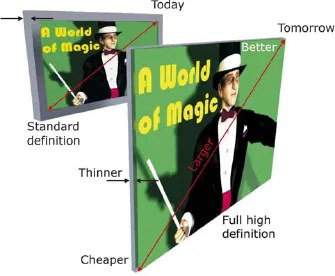
Figure 1.1 Future digital signage applications will make use of thin, inexpensive, high-resolution electronic display devices that may be easily located everywhere. Imagine all the new opportunities!
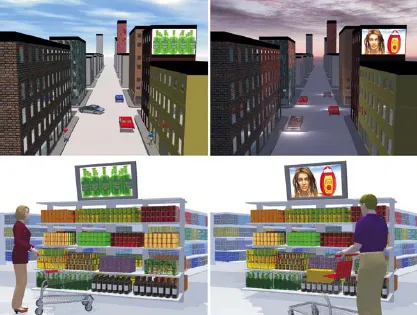
Figure 1.2 Digital signage is becoming a more common sight, both indoors and outdoors. The same messages might appear on plasma or LCD screens in stores as well as on large LED screens outdoors. Actually, they are all the same medium.
This can be done using computers, some people might say. This is certainly true, but still, there is so much more to it.
THE DAWN OF A NEW MEDIUM?
Modern society is a world of satellite, cable, and terrestrial television, now accompanied by Internet Protocol Television (IPTV) and broadband Internet access in an increasing number of homes. Could there really be another medium to discover and to exploit?
It is quite obvious that conventional television is not suited to provide content that is specific to the individual screen, especially not if the content on the screen depends on where the screen is located or who is watching it. In an ideal digital signage system, the screen location, the time of day, or the actual viewer would decide that content. The TV set has one simple way of handling all this: The viewer simply switches the channel using a remote control device.
Digital signage means moving one step further in other respects as well. The content on the screen does not necessarily originate from one single source or channel, as in television broadcasting. Instead, the different picture components can originate from several separate data files in a manner similar to the content on your computer screen. Also, some content may be live broadcast in real time and other information may be stored on its way to the screen. The content may have been stored for a fraction of a second, a couple of minutes, hours, days, months, or perhaps even years.
DIGITAL SIGNAGE: A BRIEF DESCRIPTION
Digital signage is based on various methods of using computer and television screens (as well as other kinds of display devices) in ways that are as efficient as possible to provide advertising and information to people in public areas.
In modern digital signage systems, the screens are divided into regions and layers, and the content on the screens is made up of several files. Inside all this, there may be real-time streaming media as IPTV.
However, the content files and data streams are not enough. Information and instructions are needed to control how, where, and when the content files and streams are displayed on the screens. This control information is stored in scheduling and playlist files. Content files, data streams, scheduling, and playlist files are discussed further in Chapters 4 and 8.
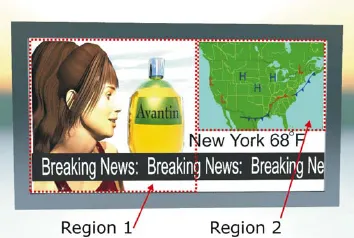
Figure 1.3 The screen is divided into regions and all content does not necessarily originate from the same source.
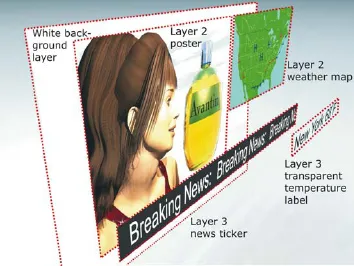
Figure 1.4 Regions, layers, and tickers originating from separate files and IP streams are the basic digital signage screen content components.
How Is Digital Signage Different from Television?
When you watch television or listen to the radio, you are seeing a picture on the screen or hearing the sound from the speakers that originate from a single stream of analog or digital information. When you use your computer, the things you see on your screen do not originate from one single source of information but rather from a large number of files from a large number of providers. In most cases, this also applies to digital signage: modern electronic commercials and information in stores and public environments.
In radio and television, there are ready-made, live-transmitted signals that are processed by the receiving equipment and then presented to the listeners and viewers. The content on a digital signage screen may originate from several different data files. Each file represents the content in a specific region of the screen or in a specific layer or the text content of a ticker. However, this is not the only difference. Conventional broadcasting is based on real-time distribution. This is not necessarily the case in a digital signage system.
Of course, television today is often combined with non-real-time elements such as hard drive storage of programs. In conventional television, however, storing information in the distribution chain is not an automated process, even though a timing feature may be used for automatic recording when you are not able to make the recordings manually. Digital signage systems allow automatic content storage at several locations en route to the viewer. The stored content may also be updated at any time. (See Table 1.1.)
There is another significant difference between conventional radio and television broadcasting and digital signage. In both analog and digital broadcasting, the transmission formats and protocols are specifically designed to carry audio and video signals. In digital signage systems, the Internet Protocol (IP) is used to carry the files and the streams to their destinations. IP is not designed to carry any specific type of information, but it can be a carrier for any existing or future media. As a result, investments in the distribution infrastructure are more or less insensitive to changes in audio and video compressions standards and other transmission formats. And if someone should come up with something completely new, such as some kind of 3D display device, it is likely that an existing IP-based distribution system would be able to carry this content as well. The bitrate of an IP distribution channel can be easily increased to fit any future need.
Table 1.1 Conventional television versus digital signage systems
| Conventional television | Digital signage systems |
One region originating from one source | Several regions originating from several files and/or streams |
One single layer originating from one source (an exception is subtitling in digital television systems) | Several layers originating from several files and/or streams |
| Content transferred in real time | Content may be transferred in real time or near-real time or stored in the distribution chain |
Specific recording formats for audio and video. Storage of other kinds of information only has limited support | Any kind of file format may be used to store audio, video, and other kinds of information |
Specific transmission formats for audio and video (DVB, ATSC) | General transmission formats for all kinds of information (IP) |

Figure 1.5 The differences between conventional television (left) and digital signage systems (right).
Finally, there is another advantage to IP-based distribution: Local area networks exist almost everywhere. Even if there is no network available, it may be possible to quickly establish a wireless local area network (WLAN) for digital signage use. However, as we will explore later, WLANs are not suitable for all kinds of digital signage applications and must be used with some care.
In traditional broadcasting systems, IEC and F connectors are used for the coaxial cables carrying analog and digital TV signals. These TV broadcasting systems usually carry only audio and video, along with some metadata as teletext and program-related “event information.” In an IP-based distribution system, twisted-pair cables with RJ-45 connectors are used to carry IP Ethernet traffic (Figure 1.6). Using IP, which can carry any kind of information, the distribution part of the system becomes quite future-proof.
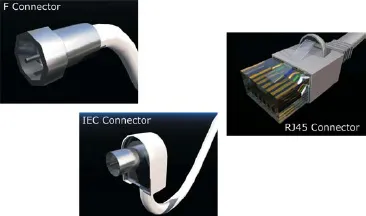
Figure 1.6 Both IEC and F connectors are used for traditional television; RJ-45 connectors are used for IP communication and IP broadcasting.
How Is Digital Signage Different from a Web Site?
So, digital signage is created from several kinds of files or IP media streams rather than just one ready-made, continuous live signal. Why, then, is digital signage not the same as the presentations of content that are bought to us when visiting a web site using a personal computer? web site content is most certainly based on separate files and IP streams.
In digital signage systems, the content is presented to us in a more or less automatic way, just as it is with radio and television once we have selected the desired channel. We do not have to constantly request specific information. In digital signage systems, an automated process handles most things. The key elements of this handling are the schedules and the playlists.
The content is based on one or more files being combined into a complete message on a screen just as they are on the screen of a personal computer. However, just as with television, we do not...
Table of contents
- Front Cover
- Half Title
- Title Page
- Copyright
- CONTENTS
- Acknowledgements
- Preface
- Chapter 1: An Overview of Digital Signage
- Chapter 2: Display Systems
- Chapter 3: Making the Best Use of Displays
- Chapter 4: The Media Player and Feeding the Screens
- Chapter 5: Content Distribution
- Chapter 6: The Edge Server
- Chapter 7: Digital Signage Broadcasting
- Chapter 8: Content and Content Management
- Chapter 9: Content Gathering and Customer Billing
- Chapter 10: Operational Aspects
- Chapter 11: Creating Digital Signage Environments
- Chapter 12: The Future of Digital Signage Systems
- Appendix A: Traffic Capacity Calculations
- Appendix B: More about IP Addressing
- Glossary
- Index
Frequently asked questions
Yes, you can cancel anytime from the Subscription tab in your account settings on the Perlego website. Your subscription will stay active until the end of your current billing period. Learn how to cancel your subscription
No, books cannot be downloaded as external files, such as PDFs, for use outside of Perlego. However, you can download books within the Perlego app for offline reading on mobile or tablet. Learn how to download books offline
Perlego offers two plans: Essential and Complete
- Essential is ideal for learners and professionals who enjoy exploring a wide range of subjects. Access the Essential Library with 800,000+ trusted titles and best-sellers across business, personal growth, and the humanities. Includes unlimited reading time and Standard Read Aloud voice.
- Complete: Perfect for advanced learners and researchers needing full, unrestricted access. Unlock 1.4M+ books across hundreds of subjects, including academic and specialized titles. The Complete Plan also includes advanced features like Premium Read Aloud and Research Assistant.
We are an online textbook subscription service, where you can get access to an entire online library for less than the price of a single book per month. With over 1 million books across 990+ topics, we’ve got you covered! Learn about our mission
Look out for the read-aloud symbol on your next book to see if you can listen to it. The read-aloud tool reads text aloud for you, highlighting the text as it is being read. You can pause it, speed it up and slow it down. Learn more about Read Aloud
Yes! You can use the Perlego app on both iOS and Android devices to read anytime, anywhere — even offline. Perfect for commutes or when you’re on the go.
Please note we cannot support devices running on iOS 13 and Android 7 or earlier. Learn more about using the app
Please note we cannot support devices running on iOS 13 and Android 7 or earlier. Learn more about using the app
Yes, you can access Digital Signage Broadcasting by Lars-Ingemar Lundstrom, S. Merrill Weiss in PDF and/or ePUB format, as well as other popular books in Computer Science & Communication Studies. We have over one million books available in our catalogue for you to explore.