As many as one in four women have suffered severe neglect or abuse in childhood. This doubles the likelihood of their suffering clinical depression in adult life. Based on twenty years of systematic research,Wednesday's Child examines why neglect and abuse occur and demonstrates how such negative experience in childhood often results in abusive adult relationships, low self-esteem and depression.
Drawing on interviews with over 200 women, the authors show vividly what can be learned from the experience of adult survivors of abuse. Most importantly, Wednesday's Child assesses the factors which can reduce the later impact of such experience on both the children of today and the parents of tomorrow.
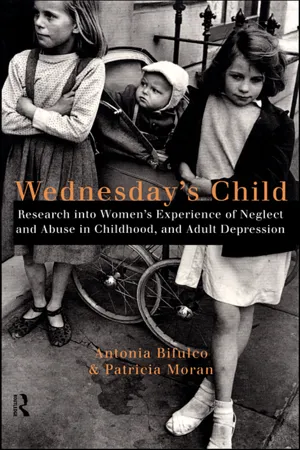
eBook - ePub
Wednesday's Child
Research into Women's Experience of Neglect and Abuse in Childhood and Adult Depression
- 224 pages
- English
- ePUB (mobile friendly)
- Available on iOS & Android
eBook - ePub
Wednesday's Child
Research into Women's Experience of Neglect and Abuse in Childhood and Adult Depression
About this book
Information
Chapter 1
Introduction: history-taking
The patient comes with a story, however tentative and disjointed, which is then worked on by therapist and patient until a more coherent and satisfying narrative emerges which provides an objectification and explanation of the patient’s difficulties, and a vehicle… which links inner and outer experiences.
(Holmes 1993: 158)1
Most people are of the opinion that experiences in childhood have a lasting impact. Indeed, many adults can identify particular experiences occurring in their formative years which they believe have helped to shape the person they have become. Knowing precisely which experiences are influential and how they have effect is a matter for systematic investigation by social scientists and others. Our research team has been exploring the effects of early experience for two decades, with particular interest in its relationship to clinical depression in adulthood. By interviewing women about their childhood it has been possible to identify a range of experiences which increase the chances of depression occurring in adult life. As expected, the types of experiences that play a significant role in this process are those involving neglect and abuse.
For the majority of children the quality of care that parents provide, if not perfect, is adequate for their mental and physical well-being. Nevertheless, it is clear that parental care is seriously deficient for a significant number of children, as evidenced by the large numbers of children placed on child protection registers annually. Figures for England show that as many as 28,000 children were added to the register in 1996.2
These are children known to be subjected to sexual, physical or emotional abuse or neglect. The scale of the problem is likely to be larger when we take into account the numbers of neglected and abused children that never get reported, the children who suffer in silence. Most of us are horrified at the thought of such abuse, and as a society we are probably more concerned and have more agencies attempting to alleviate such suffering of children than at any time in history.
Being on the receiving end of neglect and abuse is obviously distressing and painful for the child at the time it occurs. In addition the long-term damage caused by such experiences can be equally dire, thwarting psychological and social development. Under some conditions this results in individuals entering adulthood too damaged to cope with the demands of everyday living and raising the next generation of children. But do most of us know exactly what constitutes neglect and abuse? Would most of us be able to differentiate parental behaviour that is perhaps impatient, insensitive or overly lax from that which is abusive? Do we know the conditions under which abuse occurs or the extent of the associated psychological damage in adulthood? Despite much debate there is a need for research to establish the precise nature of the relationship between childhood maltreatment and adult outcomes. It is required to inform not only professionals working in the childcare field but also parents and teachers responsible for their own and other children’s welfare, It may also be useful for individuals seeking to understand their own lives in terms of their early experiences.
This book sets out to enhance understanding of child neglect and abuse, and to investigate its long-term effects with particular emphasis on adult depression, one of the most common emotional disorders in women. It draws upon our research findings to present a summary of the key experiences occurring in childhood which are capable of making an impact in adulthood. We examine the circumstances associated with such challenging experiences in order to begin to unravel some of the causes of child abuse. In this vein we explore how parents under stress, who may be coping with troubled marriages, reconstituted families, poverty and their own psychiatric disorder, may influence a child’s upbringing. While the outcome of main interest involves adult depression, along the route we examine other factors associated with abusive childhood experience such as low self-esteem and a lack of supportive relationships.
THE STUDY OF LIFE-TIME EXPERIENCE
The approach we adopted in studying the influence of childhood was a biographical one, based on ‘history-taking’ interviews with adult women. It was Winnicott who described psychotherapy as an ‘extended form of history-taking’.3 While our aim was not one of providing psychotherapy, our approach was similar insofar as we were interested in collecting detailed information laden with both context and meaning for the individual. As in the process described in the title quote, we too aimed to examine such stories to see how the adverse early environment inflicted damage on the child’s and then the adult’s inner and outer world.
We documented the experiences arising throughout the life course which might create either risk for, or protection against, a woman’s chance of developing depression. We adopted this approach not only because we felt it constituted the most thorough measurement of these experiences but also because it aided theoretical understanding. Thus we hoped that by encouraging women to tell their life histories in their own words and by using their quotes in this book, we could generate empathic understanding of the experience of early neglect and abuse and the damage that it inflicts. We also felt we had much to learn from the interviewed women. In this we followed John Bowlby who wrote: ‘Whilst some traditional therapists might be described as advocating the stance “I know: I’ll tell you”, the stance I advocate is one of “You know, you tell me.” ’4
Prior work by our research team had shown that episodes of depression are fairly common, with one in ten working-class mothers developing a new episode of depression in any one year. These episodes are associated with crises occurring in their lives typically involving losses, humiliations, rejections or increasing entrapment in punishing situations. Typical crises involve a husband leaving for another woman, a teenage son in trouble with the police, or the family in an overcrowded flat being refused rehousing. In inner-London boroughs where much of the research took place, such crises are common, affecting over a third of women in any one year.5 Following such crises a fifth of women are likely to become depressed. This means, of course, that the majority do not experience clinical depression in response to such crises. We sought to investigate the reasons why one in five were particularly susceptible to depression and the remaining four protected. On further investigation it was discovered that, prior to becoming depressed, a number of features made women vulnerable to the unpleasant effects of a crisis. These included low self-esteem, a discordant relationship with partner or children, and lack of support from friends or relatives. Conversely, women with higher self-esteem and good support survived similar crises without becoming seriously depressed.6
We set about tracing the origins of such adult vulnerability, and began our search in childhood. We wanted to know, for example, if a woman who finds herself in a relationship with an unresponsive partner, or who finds herself unable to relate to her children is more likely to have been mistreated by her parents when she was a child. We did not, however, expect all adult vulnerability to stem from childhood; we saw that almost anyone could experience difficulties in relationships in adult life which made them temporarily susceptible to depressive disorder. However, we expected that women with more enduring vulnerability emanating from childhood would show signs of greater psychological scarring and disadvantage. They would have a somewhat different experience of depression: their episodes would be more severe and last longer, and they would have repeated depressions throughout their life, with the earliest starting in teenage years.
We also wanted to examine the other side of the coin: that for some an adverse childhood may lead to a strength and resilience perhaps not found in those with uneventful or over-protected early years. The expression ‘earned security’ describes how such women learn to overcome their early life disadvantages. We needed simultaneously to investigate factors which were damaging and those which were protective against the effects of mistreatment. Thus themes of both susceptibility and strengthening required exploration.
GENDER
Our decision to study women rather than men was in the first instance a pragmatic one: rates of clinical depression among women are nearly double that of men.7 This is not to say that the experiences of boys and fathers should not be similarly documented. Research has shown that men similarly suffer neglect and abuse and these also link with adult psychiatric disorders. However, there are differences which require a more detailed investigation than is possible here. These include important differences in the type of childhood experiences, as well as differences in response to maltreatment. Thus adolescent boys have higher rates of delinquent behaviour and alcohol or drug abuse than girls, and have a much higher rate of suicide in young adulthood. Exploring gender differences is complex, and we wanted to avoid introducing this additional element in developing a preliminary model of childhood experience and adult psychiatric disorder. Hence this book is devoted to female experience.
THE STUDY OF CHILDHOOD
We began our work on childhood experience with no fully developed theory in mind. This allowed us to throw our net wide, and measure as full a context of relevant experience as possible. In the early stages of our work we were influenced by the writings of two eminent workers in the field: John Bowlby and Michael Rutter. From John Bowlby we adopted the notion that loss of mother in childhood and disrupted family relationships interfere with a child’s later ability to form close, loving relationships.8 From Michael Rutter we learned that a conflictful and stressful environment in a child’s early years leads to a perpetuation of adverse circumstances into adult life.9, 10 The first emphasised the internal damage suffered by the child, the second the effects of a wider hostile environment. To make sense of the relationship between childhood experience and adult depression, we attempted to bring these two ideas together. This approach took into account not only negative psychological states such as low self-esteem, helplessness and poor ability to relate to others but also the interaction of these with the very real adversities present in the external world. These included economic hardship, the breakdown of family life and disadvantages associated with lower social class position. We felt it was essential to look at the interface between such deprived inner and outer worlds to understand vulnerability to depression.
We chose to interview adult women about their memories of childhood experience rather than attempt to question children directly. We had a number of reasons for this. First, we could collect all the information about a woman’s life history without waiting years to assess what happened to her as she grew up. Second, we felt that the accounts we obtained retrospectively were more comprehensive than those we could have obtain by interviewing children at the time of their abuse. Consider, for example, how difficult it would be for an eight-year-old girl to describe ongoing sexual abuse to an interviewer. Would she understand the questions? Would threats from the abuser have placed her in fear of her life if she told us about the abuse? Interviewing children about their experiences is full of such pitfalls. We felt we were more likely to obtain an accurate description of these experiences by interviewing adult women, when they were old enough to understand the experience and could recount the abuse without fear. We also knew that interviewing children who might have been recently abused would have raised major ethical considerations. Not only would it put the child under unbearable pressure in terms of whether to disclose the information, but it would have changed our research activity into an intervention programme–a worthy aim, but one which we were not qualified or funded to undertake.
MEMORY OF CHILDHOOD
We thus adopted a historical retrospective approach, measuring reports of experiences that happened years ago. We were among the first in the late 1970s to tackle such a long recall period and it was viewed at first with some scepticism by parts of the scientific community. It was argued that people had poor memory of childhood experience, and that recollections would be distorted. Such distortion would arise because people’s memories would be coloured by their feelings towards parents and other family members which would render the collection of accurate, factual information on childhood virtually impossible. It was also claimed that distortion of childhood memories would arise due to symptoms of depression. It was expected that, on the one hand, depressed women would give an account of childhood biased towards a particularly negative view of their experience, and on the other hand, non-depressed women would give an account of childhood that was biased towards a particularly ‘rosy’ view. The exercise, it was argued, would be futile.
We attempted to overcome this problem through very careful and detailed measurement. In our history-taking interviews we concentrated on the factual aspects of women’s childhood experience. We wanted to know as precisely as possible what had occurred, how often, at what age and with whom. This involved going beyond the more subjective feelings women had about the way they were treated in childhood, and probing for ‘hard evidence’ in the form of detailed examples. Although we were interested in the impact of such experience in childhood, we had to show that the women’s feelings were rooted in actual and not imagined experiences. For example, if a woman said she felt her mother wasn’t interested in her upbringing we explored the statement further rather than accepting it at face value. We probed for details both of the care she received in terms of whether she had regular meals and clean clothes, who prepared them, how often, and so on, as well as questioning about her mother’s critical and rejecting behaviour. In this way we built up a body of information illustrated with actual instances of behaviour which was distinct from the women’s subjective feelings about what had occurred. This enabled us to compare childhoods, to see if those women who had the most adverse childhoods were also the most likely to experience depression in adulthood.
From the outset we believed it was possible that women could recall significant events in childhood and be keen to recount them. It would at the very least give the women a chance for their experiences to be listened to and believed. We made certain assumptions about people’s ability to recall their childhood memories. First, we assumed that the more significant experiences in childhood were less likely to have been forgotten than the more routine or trivial happenings. For example, we thought that most people would know the age they were when their mother died or their father left home, but may not recall each birthday party or school exam. Second, we believed that the recall of early memories would be enhanced if asked about in chronological sequence with earlier memories triggering later ones. Certain anchoring dates were used to help map out experiences, such as starting primary or secondary school or births of siblings. Third, we considered that if a woman had enough time to give considered answers, it would be possible to reconstruct in the interview a faithful account of what occurred in her childhood. Hence interviews sometimes lasted several hours and it was not uncommon for women to recall incidents that they had not attended to for years. At times women also revised their view of the sequence of experiences when they reconstructed all their memories for that period of time. For example one woman thought she had been separated from her mother before she started school, then suddenly had a memory of being taken to school by her mother, and realised that it had all occurred a year or two later than she had previously believed.
We had to consider that for certain topics it was possible that not all of these principles of remembering would apply. For example, sexual abuse, although a significant experience, may be hampered in its recall by the sexual ignorance of the child at the time. The experience may never have been coded in memory as sexual abuse. In some instances, women sexually abused at a very young age recreated its meaning subsequently. Sometimes the painful nature of an experience might have pushed the memory out of a woman’s conscious mind for so long that recounting the incident was difficult. Although many struggled to find the right words, and their stories were at times disjointed, most women were able to give full accounts of childhood experience including sexual abuse.
In recent years the debate concerning fabricated memories or ‘false memory syndrome’ has received much attention. Allegations that psychotherapists use suggestion to assist their patients in ‘remembering’ sexual abuse which never actually took place have been tested with litigation in the United States.11 This echoes Freud’s claims earlier this century that his patients’ childhood sexual abuse were fantasies, a position heavily criticised by a later generation.12 The pendulum of public opinion concerning the truth or not of childhood abuse continues to swing back and forth. In terms of our research interviews, we had no reason to disbelieve the women’s accounts of their experiences. After all, they had no pri...
Table of contents
- Cover Page
- Title Page
- Copyright Page
- Preface
- Acknowledgements
- Chapter 1: Introduction: history-taking
- Part I: Neglect
- Part II: Abuse
- Part III: Contexts and outcomes
- Appendix I: Description of samples
- Appendix II: Instruments used
Trusted by 375,005 students
Access to over 1.5 million titles for a fair monthly price.
Study more efficiently using our study tools.
Frequently asked questions
Yes, you can cancel anytime from the Subscription tab in your account settings on the Perlego website. Your subscription will stay active until the end of your current billing period. Learn how to cancel your subscription
No, books cannot be downloaded as external files, such as PDFs, for use outside of Perlego. However, you can download books within the Perlego app for offline reading on mobile or tablet. Learn how to download books offline
Perlego offers two plans: Essential and Complete
- Essential is ideal for learners and professionals who enjoy exploring a wide range of subjects. Access the Essential Library with 800,000+ trusted titles and best-sellers across business, personal growth, and the humanities. Includes unlimited reading time and Standard Read Aloud voice.
- Complete: Perfect for advanced learners and researchers needing full, unrestricted access. Unlock 1.5M+ books across hundreds of subjects, including academic and specialized titles. The Complete Plan also includes advanced features like Premium Read Aloud and Research Assistant.
We are an online textbook subscription service, where you can get access to an entire online library for less than the price of a single book per month. With over 1.5 million books across 990+ topics, we’ve got you covered! Learn about our mission
Look out for the read-aloud symbol on your next book to see if you can listen to it. The read-aloud tool reads text aloud for you, highlighting the text as it is being read. You can pause it, speed it up and slow it down. Learn more about Read Aloud
Yes! You can use the Perlego app on both iOS and Android devices to read anytime, anywhere — even offline. Perfect for commutes or when you’re on the go.
Please note we cannot support devices running on iOS 13 and Android 7 or earlier. Learn more about using the app
Please note we cannot support devices running on iOS 13 and Android 7 or earlier. Learn more about using the app
Yes, you can access Wednesday's Child by Antonia Bifulco,Patricia Moran in PDF and/or ePUB format, as well as other popular books in Scienze sociali & Prestazione di assistenza sanitaria. We have over 1.5 million books available in our catalogue for you to explore.