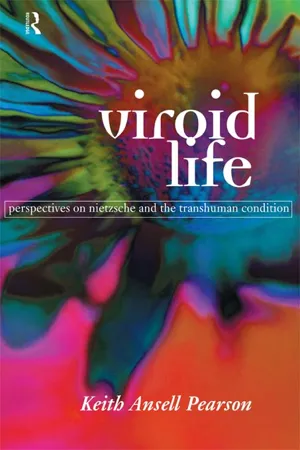
Nietzsche's vision of the 'overman' continues to haunt the postmodern imagination. His call that 'man is something that must be overcome' can no longer be seen as simple rhetoric. Our experiences of the hybrid realities of artificial life have made the 'transhuman' a figure that looks over us all. Inspired by this vision, Keith Ansell Pearson sets out to examine if evolution is 'out of control' and machines are taking over.
In a series of six fascinating perspectives, he links Nietzsche's thought with the issues at stake in contemporary conceptions of evolution from the biological to the technological. Viroid Life; Perspectives on Nietzsche and the Transhuman Condition considers the hybrid, 'inhuman' character of our future with the aid of Nietzsche's philosophy. Keith Ansell Pearson contrasts Nietzsche and Darwin before introducing the more recent figures such as Giles Deleuze and Guy Debord to sketch a new thinking of technics and machines and stress the ambiguous character of our 'machine enslavement'.
- 224 pages
- English
- ePUB (mobile friendly)
- Available on iOS & Android
eBook - ePub
About this book
Information
1
LOVING THE POISON
The memory of the human and the promise of the overhuman
I
Read from a distant planet, the majuscule-script of our earthly existence would perhaps seduce the reader to the conclusion that the earth was the ascetic planet par excellence, an outpost of discontented, arrogant, and nasty creatures who harboured a deep distrust for themselves, for the world, for all life and hurt themselves as much as possible out of pleasure in hurting.
(Nietzsche 1994: 90)
Probably we, too, are still ‘too good’ for our trade, probably we, too, are still the victims, the prey, the sick of this contemporary taste for moralization, much as we feel contempt towards it, – it probably infects us as well.
(Nietzsche 1994: 109)
The Age of Postbiological Man would reveal the human condition for what it actually is, which is to say, a condition to be gotten out of. Friedrich Nietzsche, the philosopher, had already seen the truth of this back in the nineteenth century: ‘Man is something that should be overcome’, he had written in 1883. ‘What have you done to overcome him?’ Back then, of course, the question was only rhetorical, but now in fin-de-siècle twentieth century, we had all the necessary means in front of us … for turning ourselves into the most advanced transhumans imaginable.
(Regis 1992: 175)
Nothing in biology in general, or in our own human life in particular, makes sense except in the context of memory, of history.
(Rose 1992: 327).
The question of the future of the human opens up a zone of monstrous thought, calling into being the necessity of a thinking of the transhuman condition. One thinks of Nietzsche's ‘great’ question: ‘what may still become of “man”?’, in which ‘man’ only becomes such at a certain juncture in historical evolution, his name presupposing a transcendence of race and nation (Nietzsche 1968: section 957).1 Critical questions proliferate: is the overhuman not the peculiar and unique configuration of the future? Can new origins be created for humans, other than those which are canonically handed down to those children of the future who patiently seafare their way to a land that is far away from fatherlands and Oedipal complexes? In discovering ‘for the first time’ the country of ‘man’ do we not also at the same time discover the ‘human future’ (Nietzsche 1969: ‘Old and New Law-Tables’ section 28)? Is not the future our un-natural birth-right? Is the future at all intelligible to the human? Perhaps the unintelligibility of the future applies only to the common sense of humanity and the good sense of philosophic reason. Nietzsche claimed to be able to decipher the hieroglyphs of the future, but for this task there is required an extra-human – and inhuman – sense and sensibility.
Several crucial and complex questions are implicated in the problematic of the future of the human as they relate to Nietzsche, including the following:
• The figuration of the future in Nietzsche, in which Nietzsche portrays himself as a posthumous destiny belonging to another history; his is a philosophy ‘of’ the future which claims to speak not only ‘of’ the future but ‘from’ the future. ‘The future speaks in a hundred signs even now’ (Nietzsche 1968: preface), and ‘It is the future which regulates our today’ (Nietzsche 1986: preface). What is the ‘appeal’ to the future which informs Nietzsche's writing? What would it mean to give the earth a ‘purpose’? To redeem reality from the curse which the ascetic ideal had placed upon it (Nietzsche 1994: II, section 24)? Is Nietzsche entitled to draw upon notions of purpose and meaning in the wake of his critique of metaphysics, of its anthropocentrism and anthropomorphism, as well as his taking on board the impact of Darwin?2
• The question of time, which has barely been thought in relation to the question of the time of the overhuman. On the contrary, its actuality has been conceived either in conventional linear terms, as that which comes ‘after’ humans, or eschatologically and apocalyptically as marking a new beginning. Derrida sought to problematize radically the various moves to think of the human ‘and’ the overhuman in his now classic essay of the late 1960s on ‘The Ends of Man’, noting that what is most difficult to think is an ‘end’ ‘of’ ‘man’ that would not be organized by a ‘dialectics of truth’ and ‘be a teleology in the first person plural’ (Derrida 1982: 121). Within metaphysics the ‘name of man’ has meaning only in an ‘eschato-teleological situation’. Derrida selects Nietzsche as the key post-metaphysical thinker – over and above Heidegger – on account of his pluralization of style and meaning. Within Nietzsche's styles we can locate a ‘laughter’ and a ‘dance’ that come from ‘outside’, which neither ‘repeat’ in the same old fashion of metaphysical humanism nor pursue the ‘beyond’ in the form of a ‘memorial’ of the meaning of ‘Being’. However, Derrida's attempt to think the ‘beyond’ of metaphysics in a way that is attentive to the paradoxes involved in such a move remains entirely with the ‘idealism’ of metaphysics. Thus his invocation at the end of the essay of the notions of ‘active forgetting’ and festivals of cruelty strike us as merely gestural and solely writerly, with no regard for the matter of life and its deviant becoming in either biology, technics, or material history. Heidegger's postwar reading of Nietzsche completely historicized the figure of the overhuman, subjecting it to a reading of technology by linking it to a ‘future master of the earth’ who wields to higher purposes and powers what ‘falls’ to the human of the future with the dawning of the ‘technological transformation of the earth and of human activity’ (Heidegger 1968: 59). The only philosopher of postwar times to connect the overhuman with questions of form and forces in terms of a complex becoming is Deleuze: ‘The question that continually returns is therefore the following: if the forces within man compose a form only by entering into a relation with forms from the outside, with what new forms do they now risk entering into a relation, and what new form will emerge that is neither God nor man? This is the correct place for the problem which Nietzsche called the “superman”‘ (Deleuze 1988b: 130). Nietzsche does speak of man belonging to a ‘higher history’ in the aftermath of the death of God, but this higher history is implicated in a still formative ‘pre-history’ and is bound up with history itself in complicated ways. It is a question of ‘evolution’ as a question of foldings and of ‘life’ conceived as the great fold: ‘Man hitherto – as it were, an embryo of the man of the future; – all the form-shaping forces directed toward the latter are present in the former; and because they are tremendous, the more a present-day individual determines the future. This is the profoundest conception of suffering: the form-shaping forces are in painful collision. – The isolation of the individual ought not to deceive us: something flows on underneath individuals’ (Nietzsche 1968: section 686).
• The question of Nietzsche's relation to modern biology and theories of evolution, notably Darwinism. Why does Nietzsche utilize embryology to articulate his theory of will-to-power, and the primacy it accords to spontaneous and expansive form-shaping forces, in On the Genealogy of Morality? Why does he appeal to biology at certain crucial points in his argument on a genealogy of morals (for example, appraising ‘states of legality’ from ‘the highest biological point of view’, 1994: 54)? To what extent is Nietzsche's genealogy of morals based on a necessary revaluation of Darwinian ‘biological’ values? Heidegger's point contra biologism and a biologistic reading of Nietzsche – namely, that biology is also ‘metaphysics’ – remains important and apposite, but it does not exhaust the question (Heidegger 1961: I, 5l7ff.; trans. 1987: 39ff.). Moreover, why after a hundred years and more do we need to be told again and again of the ultimate truth of Darwin's theory of natural selection by biologists (Dawkins 1976) and philosophers (Dennett 1995b) alike as if it were an uncomplicated ‘truth’ for humans?3 It is here that ‘we’ may sound strangest. The lesson of Nietzsche's genealogy of morality is perhaps more apposite now than ever before. It is not accidental that Nietzsche's genealogy should ‘select’ humans as it focus. It does this while eschewing anthropocentric naivety. His genealogy shows the extent to which the human animal has been subject to an ‘evolution’ characterized by un-natural selection. In saying this we are not positing a dubious metaphysical division between the art and artifice of humans over the blind and dumb mechanical workings of nature, for ‘nature’ too has its technics of invention. However, and paradoxically, it is the refusal to acknowledge the distinctive character of human artificial and technical evolution that leads to a reinstatement of anthropocentrism and that fails to come to terms with ‘the real problem regarding man’. It is thus necessary to demonstrate that through the invention of techniques of the self (the invention of the ‘soul’, the formation and deformation of memory, and so on), which Nietzsche makes central to his conception of the human animal, humans have created for themselves an environment in which artificial excess reigns and governs both their ‘memory’ and ‘promise’. Shorn of its fatal association with Nazi eugenics, a breeding programme designed to produce and reproduce the eternal return of the same entropically, the figure of the Übermensch is once again prominent within techno-discourses on the fate and future of evolution. These discourses speak of a new emerging ‘biotechnological’ civilization in which technology becomes more and more biological, while biology becomes more and more technological (see Kelly 1994: chapter 1, ‘The Made and the Born’). The ‘superman’ of Nietzsche legend has become the emblem of this brave new world of meat–metal symbiosis. However, what is forgotten and erased in this contemporary use and abuse of Nietzsche is that Nietzsche's repeated invocation of the overhuman calls us back to the human. The promise of the overhuman is bound up in ways yet barely explored, and in ways little understood, with the memory of the human. Contemporary techno-theorizing blinds us to the ‘real problem regarding man’.
For Nietzsche, man is the temporal and futural animal par excellence. The real ‘problem’ of humankind is the breeding of an animal which has the capacity or ability to make promises, and this requires a certain training and cultivation. This is a paradoxical task that nature has set itself in the case of man. The labour of over-coming denotes the essence of man; his being has always involved a becoming and a birth from the future. Man has been constituted by the over-man from the ‘point’ of his ‘origin’.4 This is why attempts to cite Nietzsche's declared goal of translating man back into nature, so as to be able to read the ‘eternal basic text of homo natura’, in support of a Nietzschean naturalism or philosophical ecology, are so problematic (Nietzsche 1966: section 230). It suggests erroneously that the question of man's origin is straightforward, that man simply and unambiguously ‘belongs’ among the animals.5 But we know that for Nietzsche man is a sick animal, a strange animal, and that he calls upon us always to aim our vision and riddles ‘beyond’ man. Moreover, man's becoming has never been a question of harmony or balance; on the contrary, it has been characterized by extreme discord and positive feedback. The evolution of ‘nature’ could also be viewed in such non-equilibrial terms, but the difference in the case of man, as Nietzsche's genealogy so spectacularly shows, is that he has internalized this discord in terms of an ‘inner evolution’, pursuing an experimental praxis of life that transcends any alleged natural laws of being and becoming. A genealogy of morals as a genealogy of man has a different, more complex and difficult, lesson to teach us than simply placing man amongst the animals. Man is a bridge, not a goal, but the the bridge (man) and the goal (overman) are one, related immanently, as in the ‘hghtning-flash’ that emerges from out of the ‘dark cloud’ that is ‘man’. A note from the Nachlass informs us that not only does man return eternally, but so does the overman (Nietzsche 1987, volume ll: 281). In other words, the overman would not be possible without the becoming of man, and this ‘becoming’ refers to a ceaseless labour and play of ‘self-overcoming’. The ‘goal’ is immanent, and hence man's ‘being’ is a becoming, nothing other than becoming, becoming as invention.6 How else is it possible to comprehend Nietzsche's statement in Ecce Homo that ‘man is overcome at every moment’ (Nietzsche 1979a: 107)?
A careful reading of Nietzsche's genealogy of morals demonstrates the extent to which for him the human is the site of a perpetual overcoming. The question concerning origins, and the concomitant desire for self-transparency, is displaced at the outset of the book. ‘We’ humans must remain strangers to ourselves ‘out of necessity’; we cannot be knowers, especially when it comes to ourselves. Equally it is important to appreciate that Nietzsche's critical question of a genealogy of morals – to what extent are moral values signs of exuberant life or degenerating life? – is also subject to a derangement. In his uncovering of the history of morality Nietzsche discovers that it is in his becoming-sick, in his ‘blood-poisoning’, that human promise is to be found. It thus becomes possible to show that any attempt to locate the overhuman outside the human, including outside of history, and to give the overhuman different origins, is fundamentally misguided.7 The positing of a pure and purely active overhumanity is out of tune with the spirit of Nietzsche's music in the genealogy of morals, in which all the so-called ‘reactive’ values can be subjected to revaluation if one considers them as tools (techniques) for the further cultivation and enhancement of the human animal. Then one discovers that they conceal an essential activity. Humans’ only justification does indeed lie ‘outside’ – outside themselves, outside nature – but this outside is immanent in their becoming.
Nietzsche's articulation of the need for a ‘critique’ of moral values can easily be interpreted as solely a form of negative critique. Such a critique, however, Nietzsche designs in positive terms as the development of a new kind of understanding and knowledge concerning the conditions and circumstances under which particular values evolved and changed, and in which morality acts as a symptom and a sickness, but also as a stimulant and poison. Nietzsche insists that an inquiry into the ‘origin’ of values and into our tables of good and evil is no way identical with a ‘critique’ of them.8 Revelations of the shameful origin of values may result in a feeling of diminution, but it only prepares the way to a critical attitude towards them (Nietzsche 1968: section 254). In this new general economy of values and morals the question of the problem of ‘man’ can be posed in a way that leads us through and ‘beyond’ morality. The attempt to cultivate a critique of morality and go beyond it also entails ‘discovering’ this hitherto uncharted land for the first time. As the ‘danger of dangers’ morality is fundamentally ambiguous: it has led to the poisoning of man, to the darkening of the skies over him, culminating in our feeling nausea and pity at the sight of his domestication; but it has also cultivated a strange and fascinating breeding ground for his extra-moral self-overcoming. In section 6 to the preface to the genealogy, Nietzsche speaks of morality being ‘responsible’ – the accusation of blame by Nietzsche is an indication of his, and our, implication in the evolution of morality – for the human species never reaching its ‘highest potential and splendour’. Nietzsche informs us that he writes for a species that does not yet exist (Nietzsche 1968: section 958), but in truth the ‘ones’ he writes for will not constitute a ‘species’. In a note of 1883, in which he writes of the rapport between the human and the overhuman, morality is placed within a restricted economy of life conceived as an economy of the ‘species’. If all moralities have hitherto been utilized so as to maximize the ‘unconditional durability’ of the species, then once this has been attained the goals can be set much ‘higher’ (Nietzsche 1987, volume 10: 244). This openness to the future which is open to the risk and dangers of experimentation is part of Nietzsche's promise – which is, as he tells us, a promise to write for the ‘barbarians of the twentieth century’ (Nietzsche 1968: section 868).
Nietzsche claims that his ‘distinction’ is to read ‘critically’ the long, hard-to-decipher hieroglyphic script of our moral past and to take this past seriously. He separates himself from Rée, the author of The Origin of our Moral Sensations, on this point. Although Rée had read Darwin, Nietzsche contends that he had produced a merely ‘entertaining’ account of the confrontation between the ‘Darwinian beast’ and the ‘ultra-modern, humble moral weakling who no longer bites’ (Nietzsche 1994: preface, section 7). In other words, Rée has simply not taken ‘seriously’ what is at stake in the return to the question of man's origins (the ‘real problem’ regarding man). He then speaks of the ‘reward’ one can expect from undertaking a serious inquiry into the origin of morality, turning the tragedy of human history into a comedy of existence, so that history becomes subject to a higher ‘eternal’ becoming, and a new twist and outcome unfolds for the Dionysian drama on the ‘fate of the soul’. The preface concludes by appealing to a new memory of man, one that becomes attainable once we overcome that mode of forgetting which plagues ‘modern man’, namely, a forgetting of the ‘art of reading’. Until this art – an art involving a certain praxis of memory – is relearned, it will be ‘some time’ before Nietzsche's script on our moral past and extra-moral future can become readable. This remembrance of reading has to be incorporated and inscribed upon our bodies as a writing ‘of’ the flesh.
What drives the psychologist? The question becomes acute in the case of man when historical and pyschological inquiry has degenerated into the task of belittling him. How can Nietzsche fight the poison so as to resist the temptation of arriving at a pessimistic suspicion in the face of man, which would be no mo...
Table of contents
- Front Cover
- Viroid Life
- Title Page
- Copyright
- Dedication
- Contents
- Acknowledgements
- Introduction
- 1 Loving the Poison
- 2 Towards the Overhuman
- 3 Dead or Alive
- 4 Nietzsche contra Darwin
- 5 Viroid Life
- 6 Timely Meditations on the Transhuman Condition
- Bibliography
- Index
Trusted by 375,005 students
Access to over 1.5 million titles for a fair monthly price.
Study more efficiently using our study tools.
Frequently asked questions
Yes, you can cancel anytime from the Subscription tab in your account settings on the Perlego website. Your subscription will stay active until the end of your current billing period. Learn how to cancel your subscription
No, books cannot be downloaded as external files, such as PDFs, for use outside of Perlego. However, you can download books within the Perlego app for offline reading on mobile or tablet. Learn how to download books offline
Perlego offers two plans: Essential and Complete
- Essential is ideal for learners and professionals who enjoy exploring a wide range of subjects. Access the Essential Library with 800,000+ trusted titles and best-sellers across business, personal growth, and the humanities. Includes unlimited reading time and Standard Read Aloud voice.
- Complete: Perfect for advanced learners and researchers needing full, unrestricted access. Unlock 1.5M+ books across hundreds of subjects, including academic and specialized titles. The Complete Plan also includes advanced features like Premium Read Aloud and Research Assistant.
We are an online textbook subscription service, where you can get access to an entire online library for less than the price of a single book per month. With over 1.5 million books across 990+ topics, we’ve got you covered! Learn about our mission
Look out for the read-aloud symbol on your next book to see if you can listen to it. The read-aloud tool reads text aloud for you, highlighting the text as it is being read. You can pause it, speed it up and slow it down. Learn more about Read Aloud
Yes! You can use the Perlego app on both iOS and Android devices to read anytime, anywhere — even offline. Perfect for commutes or when you’re on the go.
Please note we cannot support devices running on iOS 13 and Android 7 or earlier. Learn more about using the app
Please note we cannot support devices running on iOS 13 and Android 7 or earlier. Learn more about using the app
Yes, you can access Viroid Life by Keith Ansell Pearson in PDF and/or ePUB format, as well as other popular books in Philosophie & Esprit et corps en philosophie. We have over 1.5 million books available in our catalogue for you to explore.