Tom Crone's classic text has been thoroughly revised by an impressive team of legal experts. It provides an essential source of reference for the key legal issues encountered by those who work in the media such as journalists, editors and producers, as well as media lawyers.
Topics covered include:
Protection of Reputation
Copyright and Rights Clearance
New Media
Breach of Confidence and Privacy
The Data Protection Act 1998
Reporting Restrictions, Contempt of Court and Protection of Journalistic Sources
The Freedom of Information Act 2000 and Official Secrets
Professional Regulatory Bodies and Advertising
The Human Rights Act 1998
The Law in Scotland and the United States of America
Comprehensive supplementary reference material is also provided, including a glossary of legal terms, addresses, telephone numbers and web sites of professional bodies, and specimen agreements including interview agreements and moral rights waivers.
With contributions from: Terence Bergin, Marietta Cauchi, Jane Colston, Mark Cranwell, Charles de Fleurieu, Simon Dowson-Collins, David Green, Peter Grundberg, Rebecca Handler, Joanna Ludlam, Rosalind McInnes, Hugh Tomlinson and John Wadham.
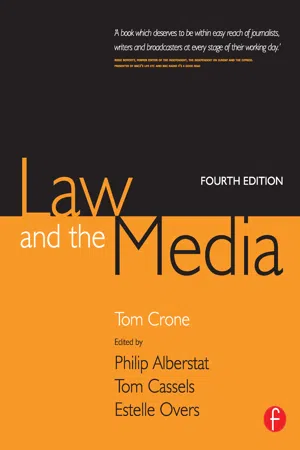
- 373 pages
- English
- ePUB (mobile friendly)
- Available on iOS & Android
eBook - ePub
Law and the Media
About this book
Information
PART I
Protection of Reputation
1 Defamation
1.1 Introduction
The law of defamation protects the reputation of a person from defamatory statements made about him to a third party without lawful justification. The English common law places great value on the right of reputation. It is less concerned with freedom of expression. The result is that those in the media are in much the same position as other members of the public when it comes to defamatory statements, having only limited special protection.
The common law of defamation in England is based on case law codified by statute, most recently the Defamation Act 1996. The origins of the law of defamation date back as far as King Alfred the Great who, in the ninth century, decreed that slanderers should have their tongues cut out. Over the years the penalties imposed upon those who transgress this branch of the civil law have become financial rather than physical. The categories of defamation have continued to grow. However, until the incorporation of the European Convention on Human Rights into English law by the Human Rights Act 1998, the legal principles have remained virtually unchanged. The Article 10 European Convention on Human Rights right to freedom of expression is now the starting point in all cases involving restrictions on expression.
Of all the legal problems impinging upon the writer or broadcaster bringing news and information to the public it is defamation, specifically libel, which is the most common problem, as well as the most expensive. Any individual whose name has been blackened by a newspaper article or television programme will say that a libel case is a two-year nightmare with massive expense and no prospect of legal aid. The newspaper or television company will complain that libel actions are little more than lotteries in which claimants are unduly favoured by the court and damages are completely unpredictable.
1.2 General principles
1.2.1 What is defamation?
A statement is defamatory if it tends to lower the claimant in the estimation of right thinking members of society generally (Sim v Stretch (1936)).
In order to prove defamation, the claimant must show defamatory language by the defendant which:
■ Identifies or refers to the claimant, and
■ Is published to a third party.
The law presumes that the defamatory statement is false and that the claimant is of good reputation. The claimant is not required to prove any actual damage to reputation or other loss. The burden of establishing the truth of the statement or any other defence is on the defendant.
Defamation actions are heard by a judge and jury. In general, the judge determines issues of law and the jury determines issues of fact. Legal aid is not available in an action for defamation.
The real skill for writers and broadcasters and their editors or producers is determining when statements which may be construed as ‘tending to lower the claimant in the estimation of right thinking members of society generally’ can be published with a reasonable degree of safety. Consideration should be given to the following:
■ Is the piece true?
■ Can it be proved to be true?
■ If not, is it covered by one of the other defences to defamation?
■ Is the subject of the piece likely to sue?
1.2.2 Libel and slander
Defamatory language is placed into two categories. The more common and more serious is libel. Libel is defamation in writing or some other permanent form, such as a tape or video recording. Radio and television broadcasts and computer-generated transmissions are defined by statute as libel. Slander is spoken defamation or defamatory language in some other temporary form. Although actions against newspaper and television companies for slander are rare, the writer or broadcaster should always be conscious of the risk of making a slanderous statement – particularly the investigative journalist who is checking allegations of wrongdoing or confronting the wrongdoer in person. If the writer or broadcaster makes defamatory statements about the wrongdoer to or in the hearing of a third party, he is exposed to the risk of being sued for slander.
The distinction between libel and slander is relevant only to the issue of damages. Damage is presumed in cases of libel. In cases of slander the claimant has to prove actual loss, unless the allegation falls within one of four exceptions where damage is presumed:
1. An allegation that the claimant has committed a crime punishable by imprisonment
2. An allegation that the claimant is suffering from a contagious or infectious disease
3. An allegation that the claimant is an unchaste woman or is a woman who has committed adultery
4. An allegation that is likely to damage the claimant’s business or profession.
1.2.3 Malicious falsehood
This is a related tort where a false statement does not damage the claimant’s reputation but causes or is likely to cause the claimant financial loss. The claimant has to prove that:
■ The statement is false
■ It was published maliciously, and
■ It caused financial loss or, in cases when the statement is written or reflects on the claimant’s business or profession, it is likely to cause financial loss.
In practice, proceedings for malicious falsehood are considerably more difficult for a claimant than defamation. The burden is reversed from that of defamation actions. It is for the claimant to establish the falseness of the statement and the malice of the defendant. Actions for malicious falsehood are tried by a judge alone, and are eligible for legal aid.
1.2.4 Who may sue?
All living persons can sue for defamation. This includes children, bankrupts, criminals and those of unsound mind. There is no libel of the dead. Defamatory statements therefore may, and usually are, made with virtual impunity about those who have died. The only risk to the publisher in such circumstances is that the material published is so inflammatory it attracts a prosecution for criminal libel. If the claimant or defendant dies during the action, the action also dies.
In the case of criminals, writers or broadcasters often mistakenly think that the criminal has no reputation to lose and they can publish material about the criminal with impunity. As a general rule, this is not the case. For example, a man with a string of convictions for violence and dishonesty could succeed in a libel action if a newspaper or television programme wrongly accused him of sexual assault. However, there may be cases where a person’s reputation in respect of one form of wrongdoing is so bad that one more allegation concerning similar behaviour would cause no damage even if it were untrue. For example, a celebrity may have such a poor reputation for drinking or drug taking that he is unlikely to gain anything from suing over one more story in a similar vein.
An incorporated body can sue if the defamatory statement refers to its business or trading reputation. It cannot suffer from hurt or injured feelings. However, care should be taken when writing in a derogatory fashion about a company, as an allegation of malpractice against a corporation may enable the individual officers of the corporation to sue. In 1993, Anita and Gordon Roddick and their company Body Shop successfully sued Channel 4 over allegations in a programme questioning the Body Shop’s stance against animal-free testing and the sales methods of their staff.
A political party cannot maintain an action for defamation of character, as it would be against public policy (Goldsmith v Bhoyrul (1998)). Central and local government institutions cannot sue for defamation in respect of their administrative and governmental functions, but the individual leaders of those bodies can sue if the allegation against the body points to the individual (Derbyshire County Council v Times Newspapers Ltd (1993)).
Where a defamatory statement is made about a group of people, the question of whether an individual member of that group can sue depends on the facts of each case. The main factor to be considered by the court is the size of the group and how closely the individuals in that group are associated with the statement. In Riches v News Group Newspapers Ltd (1986), the News of the World reported a story concerning a gunman who was holding hostages to publicize his deranged belief that policemen at Banbury CID had raped and beaten his wife. Although the story did not name any individual officer, it identified the group from which the alleged rapist came. There were only 10 members of the Banbury CID. All 10 officers sued the News of the World and won.
1.2.5 Who may be sued?
Any person who causes or is responsible for the publication of a defamatory statement can be sued. This includes writers, broadcasters, editors, producers, publishers, programme makers, printers, distributors, newsagents and booksellers. Since each separate communication to a third party is a separate publication and therefore a separate libel, the number of people who may be sued over the same defamatory statement can be considerable.
1.2.6 What is defamatory language?
There is no single, comprehensive definition of defamatory language recognized by law. The determination of defamatory meaning is always an objective test, never a subjective test. This means that the court must give consideration to what the ordinary, reasonable person would think about the defamatory statement, not what the claimant actually thinks.
An allegation by the claimant that the defendant’s statement ‘tends to lower the claimant in the eyes of right thinking members of society generally’ necessarily involves an element of moral blame (Sim v Stretch (1936)). Because the test is geared towards what ‘right thinking members of society generally’ consider to be defamatory language, the proper standard to be applied will adapt with the passage of time to reflect the change in society. A statement found by a jury to be defamatory 75 years ago may be considered perfectly acceptable today. Nowhere is this demonstrated better than in society’s attitudes towards sexual matters. An allegation that an unmarried woman spent the night with her boyfriend in a hotel would have lowered her in the eyes of the average person in the 1920s, but would be unlikely to do so today.
Most of the categories of defamatory language are obvious. To suggest that a person is a thief, a fraudster or a cheat will always be defamatory. It is also defamatory to suggest a person is incompetent or unqualified in his trade or profession.
An allegation of criminal or immoral behaviour is usually defamatory, although it must be remembered that the attitude of the ‘right thinking member of society’ towards morality is likely to change with the passage of time. In 1959 the celebrated Daily Mirror columnist Cassandra (in reality the writer William Connor) wrote of the American pianist Liberace:
He is the summit of sex, the pinnacle of Masculine, Feminine and Neuter. Everything that He, She and It can ever want…
The article went on to liken him to:
… a … deadly, winking, sniggering, chromium-plated, scent-impregnated, luminous, quivering, giggling, fruit-flavoured, mincing, ice-covered heap of mother-love …
Liberace claimed the article suggested he was homosexual, and sued for libel. At the end of the trial the jury agreed with him and awarded the then substantial sum of £8000 in damages (Liberace v Daily Mirror Newspapers Ltd (1959)).
The issue of whether an allegation of homosexuality is defamatory was aired before a libel jury again in 1992. Jason Donovan, an unmarried Australian actor and singer with a huge following amongst British teenagers, sued a youth magazine called TheFace for suggesting that he was homosexual. Since Donovan had previously gone on record to say that he was not gay, he also sued the magazine for damages for the implicit suggestion that he was a hypocrite. The jury awarded £200 000 to Donovan, which caused an uproar amongst certain sections of society who protested that being thought of as gay is not something that can damage a person’s reputation. Ironically, Donovan’s reaction was to issue a statement that broadly agreed with this viewpoint. He waived the £200 000 damages and proclaimed that his primary motive in suing the newspaper was to clear his name of the slur of hypocrisy. A decade after the Donovan case the ‘right thinking member of society generally’ may not agree that it is defamatory to allege a person is homosexual.
It is not defamatory to say someone owes money, but it is defamatory to say that a person cannot or will not pay his debts (Winstanley v Bampton (1943)). It is not defamatory to criticize a person’s service or product, but it is defamatory to say someone is unfit for his profession or is incompetent in his business. In practice, it may be difficult to distinguish between these points of view (South Hetton v North Eastern News Association (1894)).
In a demonstration of the importance modern society places on appearance, the case of Berkoff v Burchill (1996) held that calling someone ‘horrendously ugly’ was defamatory because it might expose that person to ridicule.
1.2.7 The construction and meaning of words
It has long been recognized that the strict rules of construction that may be appropriate for ascertaining the meaning of words in other areas of the law will not do for the purposes of libel. The objective approach is used when construing the meaning of the statement. The court must consider how the statement would be understood by the ordinary, reasonable person, not how it is understood by the defendant.
Where there are conflicting interpretations of the defamatory statement, the court must determine just one ‘correct’ meaning. Although the meaning intended by the defendant is irrelevant, an ‘innocent’ defendant can use the ‘offer of amends’ procedure (see paragraph 1.3.4 below).
It is recognized that a seemingly innocent s...
Table of contents
- Cover Page
- Half Title Page
- Title Page
- Copyright Page
- Contents
- Foreword by Rosie Boycott
- Editors' Biographies
- Contributors' Biographies
- Acknowledgements
- Table of Cases
- Table of Statutes
- Introduction
- Part I Protection of Reputation
- Part II Intellectual Property
- Part III Privacy
- Part IV Comment on Court Proceedings
- Part V Prevention of Publication
- Part VI State Restriction on Publication
- Part VII Media Regulation
- Part VIII The Law under the European Convention on Human Rights
- Part IX The Law in Other Jurisdictions
- Appendix A Glossary of Legal Terms
- Appendix B Professional Bodies
- Appendix C Specimen Agreements
- Bibliography
- Index
Trusted by 375,005 students
Access to over 1.5 million titles for a fair monthly price.
Study more efficiently using our study tools.
Frequently asked questions
Yes, you can cancel anytime from the Subscription tab in your account settings on the Perlego website. Your subscription will stay active until the end of your current billing period. Learn how to cancel your subscription
No, books cannot be downloaded as external files, such as PDFs, for use outside of Perlego. However, you can download books within the Perlego app for offline reading on mobile or tablet. Learn how to download books offline
Perlego offers two plans: Essential and Complete
- Essential is ideal for learners and professionals who enjoy exploring a wide range of subjects. Access the Essential Library with 800,000+ trusted titles and best-sellers across business, personal growth, and the humanities. Includes unlimited reading time and Standard Read Aloud voice.
- Complete: Perfect for advanced learners and researchers needing full, unrestricted access. Unlock 1.5M+ books across hundreds of subjects, including academic and specialized titles. The Complete Plan also includes advanced features like Premium Read Aloud and Research Assistant.
We are an online textbook subscription service, where you can get access to an entire online library for less than the price of a single book per month. With over 1.5 million books across 990+ topics, we’ve got you covered! Learn about our mission
Look out for the read-aloud symbol on your next book to see if you can listen to it. The read-aloud tool reads text aloud for you, highlighting the text as it is being read. You can pause it, speed it up and slow it down. Learn more about Read Aloud
Yes! You can use the Perlego app on both iOS and Android devices to read anytime, anywhere — even offline. Perfect for commutes or when you’re on the go.
Please note we cannot support devices running on iOS 13 and Android 7 or earlier. Learn more about using the app
Please note we cannot support devices running on iOS 13 and Android 7 or earlier. Learn more about using the app
Yes, you can access Law and the Media by Tom Crone, Philip Alberstat,Tom Cassels,Estelle Overs in PDF and/or ePUB format, as well as other popular books in Languages & Linguistics & Communication Studies. We have over 1.5 million books available in our catalogue for you to explore.