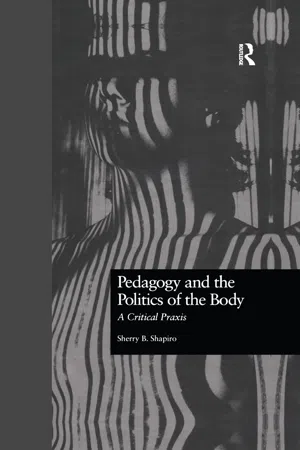
Working within the relatively new perspective on the body as a zone of critical praxis, Shapiro lays the foundation for the theory and practice of a somatically oriented critical pedagogy."
- 176 pages
- English
- ePUB (mobile friendly)
- Available on iOS & Android
eBook - ePub
About this book
Information
CHAPTER ONE
Thinking about Thinking
[T]he most thought-provoking thing about our thought-provoking age is that we are still not thinking... Thinking is not so much an act as a way of living...a way of life. It is a remembering who we are as human beings and where we belong. It is a gathering and focusing of our whole selves on what lies before us; a taking to heart and mind these particular things before us in order to discover them in their essential nature and truth. (Martin Heidegger, What is Called Thinking)
Martin Heidegger (1968) brings our attention to the dialectical relationship between “how we think” and “how we live.” He reminds us that our being-in-the-world is one of relationship to others and to the larger world. What is to be uncovered in relationship are the “truths” of human existence; that which lies before us. There is no final or absolute “Truth,” but there are “truths.” At the same time there is an undeniable reality to existence. This is the social and institutional reality that confronts human beings in their everyday lives—a reality that cannot be ignored or forgotten without punishment. Cornel West (1988) speaks to the “realness” that is found in our everyday lives:
There is a reality that one cannot not know. The ragged edges of the Real, of Necessity, not being able to eat, not having shelter, not having health care, all this is something that one cannot not know. (p. 277)
West (1988) speaks out of that neo-pragmatist tradition that calls into question any claims to truth or reality separated from the social practices from which they are produced. Rejected is the notion of a transcendent reality or ahistorical truth, which have so dominated our philosophical traditions in the West and hidden the connections between knowledge sought and knowledge gained, and the knower and the known (Sandra Bartky, 1990). Under the influence of postmodern thinking recent educational and philosophical conversations have been engaged in a paradigm shift questioning any “totalizing” theory. Not only have particular theoretical perspectives been challenged but so have knowledge claims that aren't culturally and historically situated. Challenged by Heidegger's work, one can no longer think in terms of purified abstractions; rather truth, being, and existence are to be understood as a single event. And further, events, truths, or reality can be better understood through a critical understanding of the individual/social relationship. Understanding of such social relationships requires a critical way of thinking that recognizes and brings to awareness human participation in the co-creation of life as it presently exists.
Most poetically, Heidegger's “ways of thinking” call us back to think with our heart, to hear the most primal call, the call of Being. He brings together the critical, creative, and moral aspects of thinking and unifies them into a philosophy that is ontologically, rather than epistemologically, oriented. The power underlying Heidegger's question, “What is called thinking?” is in his desire to recall the original question of being. This question unites us as humans with a responsibility for ourselves and the world in which we live. This ontological understanding is one in which, Heidegger asserts, thinking and questioning are inherent in being-in-the-world. Questioning leads the way of thinking about our lives and the world in which we live. In connecting what we care about to what and how we question, Heidegger reasserts the importance of the relationship between the structuring of the question (what we both know and desire to know) to the answers or realities we find. This shift from epistemology to ontology suggests that the manner in which we construct and validate knowledge or knowing is related to how we construct reality or experience. Thinking and being are, in a sense, one in the same.
In Old English, as reflected in Heidegger's work (p. 139) thinking is referenced to the word “Thanc,” which means memory; as a thinking that recalls the gift of thinking and gives thanks for it. Heidegger (1968) writes:
The thanc, the heart's core, is the gathering of all that concerns us, all that we care for, all that touches us insofar as we are, as human beings. What touches us in the sense that it defines and determines our nature, what we care for, we might call contiguous or contact... Only because we are by nature gathered in contiguity can we remain concentrated on what is at once present and past to come. The word “memory” originally means this incessant concentration on contiguity. In its original telling sense, memory means as much as devotion... The thanc unfolds in memory, which persists as devotion. (pp. 144–145)
Human consciousness is constituted through memory. “Devotion” here can be thought of as the human desire to “make sense” of life, in ways that it connects to feelings of care and concern. This contiguity Heidegger speaks of is the relationship between all that we touch and all that touches us. Touching can be imaged as all that concerns us in the “everydayness” of our lives. The relationship is one between all that is the subject/object—human/other/world relationship. In this sense, the thinking of wo/man recalls her or his own ability to hold close those things we come to care for and be concerned about. These things are to be known as all inclusive of ourselves and our relationship to others and the larger world. Further, we are to remember that our humanness depends on our construction of these relationships into “a way of living.” In so doing, one devotes oneself to the memory of what has been taken to heart; all that touches us insofar as we are human beings. In giving thanks, the heart recalls where it remains gathered and concentrated. It belongs in acknowledgment of relationship. For Heidegger, the human condition is based on our ability, not to reject history, but to understand that human beings carry within them their history into the present. From this present, we create our future through projections from this historical context (Seidel, 1964). Here there is a place that is “real” enough—one that speaks to the continual dialectic between individual experience and the conditions and circumstances of our lives.
Why start with Heidegger's work? This can only be explained in the context of my own life experiences through which my readings were interpreted at the time of this writing. Growing up during the 1950s and 1960s in the Western Appalachian mountains of North Carolina, I came to understand my body as something strong, even powerful. The experiences of exploring trails through woods, swinging from grapevines, making houses from fallen leaves, and lying on damp moss, all taught me to understand my world through sensual experience. Coming to know was certainly an embodied experience. Truth, limits, and possibilities were composited through experience. Freedom was something felt— exhilarating, breathtaking, and powerful. Early in my forming, I learned that freedom came out of decided action and risk taking. I also learned that it felt liberating. In reading Heidegger, I found affirmation of a way of knowing that wasn't objective, something only outside myself, but something that included me, my own experiences. I learned not only about the woods, trees, and earth; I learned about myself as I felt these things. My being-in-the-world was meaningful, my presence necessary to bring the world into being (not meant in the anthropomorphic sense). What I mean by this is that my sensual understandings had immense importance in the structuring of my being, and just how it is that I relate to others and the environment. My body was the mediator of experience, and knowledge was subjective. Entering school, I learned that coming to know was not inclusive of body knowledge. My physical being, which felt pain, joy, tiredness, exasperation, love, and energy, possibility and freedom, was to be ignored, even controlled. Indeed, I came to understand my body as some “thing” to be controlled. And sensual knowing was simply excised from the process of learning. Philosophically speaking, my body became it, rather than is; knowledge as objective, rather than subjective.
I turned to dance classes that involved body knowledge, even if in a technical way. Unfortunately, dance did not escape the reach of the instrumental rationality that was pervasive, and con tinues to be, in the field of education and arts. My body was an object for the gaining of technical skills. “It” was to learn to do the steps, mirroring the teacher, replicating the knowledge given. Yet the reunion of body and action in dance, contrary to schooling, did give me immense pleasure. I felt the connections between them. It was a confirmation of knowing and doing. Somewhere in these experiences, I was able to sense the relationship between power and possibility. Clearly, I understood the relationship between present action and future possibility as something that was influenced by me. Later in my life, as a woman and dancer, I experienced dance as oppositional, in some ways, to the dominant ideology for women, because dancing is about taking up space, defying stasis, being strong, and bending of the “normal” images and relationships of what “gendered” human beings can be and do. (Note here that both male and female images in dance are also highly problematic. I return to discuss this issue in later chapters.) Dance was a place where I could remember my body, and experience myself as whole again.
Growing up female during this time in history also meant a particular understanding of what the future concerns of a woman needed to be. My mother introduced me at the age of 18 to a 35-year-old man, saying, “Sherry, he is a millionaire.” (We both “understood” what this meant. What more could a girl want? A rich man was certainly the “best” you could do.) My parent's response to higher education for me was, “If you want to go to college you will have to find a way to pay for it.” It wasn't simply that I was female. It was that I was “artistic” and “pretty.” Inherent in the messages, blatantly stated, was, “Why go to school, when you have the looks to get a rich husband?” and “Dancers are not academically smart.” Intellectual scholarship or theory was something with which I was not to be concerned. Denied body in schooling (in the public sphere) and mind in the social construction of women's identity (in the private sphere), I struggled to overcome the painful denial of what I felt myself to be.
Somewhere embedded in my corporeal memories, I drew on body knowledge that “reminded” me of risk taking and possibility. Eventually (after the birth of two sons; two marriages, neither to rich men; and two divorces; a book in itself) I did complete my degrees and entered a doctoral program where, for the first time in education, I was introduced to critical thinking and discourses concerned with human meaning and existence. Starved of theoretical knowledge, I devoured them. Drawn to questions of meaningful existence, I found existential discourse as a powerful source to examine my own life. In Heidegger's work, the concept of “being-in-the-world,” with its strong opposition to institutional conditions that required an unthoughtful acceptance of one's life and reality, provided a philosophically resonant place for me to begin to contemplate the human condition. What I later learned from Marx and feminist theory was to make that place more concrete. I also resonated with Heidegger's understanding of truth to be found in the relationship between subjects and objects; truth is about who we are as human beings not what we are. It is a way of finding truth that depends upon an understanding of ourselves as we relate to others. His explanation of “being-in-time” places humans always within a historical narrative where one carries one history into the present and projects into the future. Here is where conscious possibility is found, in “remembering” the past and imaging the future. In this work a space was opened for me to begin to resolve the mind/body split; where subjective knowledge could begin to be valued, “Truth” questioned, and human agency embraced and positioned within the context of future possibility.
Education and Critical Theory: Finding the Structures
For one year I took Heidegger's work to bed with me. I read and reread. Yet while studying I became dissatisfied with the referencing self, the authentic being (a term commonly called “authentic movement” in dance). This Self, as noted in Hannah Arendt's work (Young-Bruehl, 1982, p. 76), has as its most essential characteristic, “its absolute egoism, its radical separation from all its fellows.” Even where Heidegger posits the value of human sociality, it is historically undifferentiated and institutionally unsubstantiated (maybe this is how he could embrace the Nazi volk so easily). It is precisely in this silence that my encounters with Marxism, critical theory, and feminism were made so powerful. For here in their different ways were clearly indicated structures of human experience and oppression—historically and sociologically specific. Marxism taught me to understand the immense power of capitalism in shaping human life; and feminism, the pervasiveness of patriarchal domination. Each insisted that the point of sociopolitical analysis was not merely to understand the world but to change it. They provided discourses of critique and of possibility. Feminism, in particular, also radically expanded my language of social transformation, making it possible for me to integrate consciously into my work, and my life, notions of compassion, love, and justice.
As an educator and dancer, I began to seriously rethink how, in Western philosophical tradition, sensual knowledge was abstracted from what is called “thinking.” As a woman and dancer my only recourse was to reclaim that which had been taken away. No longer would I be left out of the epistemological conversation; I was determined to reclaim thinking in terms that would acknowledge and affirm what I understood so powerfully, body knowledge. As I gained insight into my own ignorance of and compliance with the oppressing structure, I began to search for another story. I was not seeking a “born-again experience.” What I needed was the ability to make choices that were liberatory and somewhat consistent with my strong sensibilities. It was in critical theory that I was able to ground my philosophy, meet radical democracy, and begin to understand the dynamics of human oppression and alienation in ways more grounded than I had previously seen them (Kanpol & McLaren, 1995). The direction of my existential concerns and pedagogic concerns converged. In encountering other critical educators, I discovered the possibility of integrating my concerns about human existence with questions of pedagogy. At the risk of covering ground that is familiar to some of the readers, I want to return to some of the key ides and insights of these writers.
Critical pedagogy theoretically developed and drew from a number of perspectives including the social reconstructionism of Dewey, the Frankfurt School of critical theory, democratic theory, feminist and cultural studies, and more recently, postmodern ideas and perspectives (McLaren, 1994). Characteristic of these disciplines or perspectives is the concern for the problematization of the concrete relations between the individual and the cultural forms in which they exist. Critical pedagogy starts from a critique of schooling in terms of its role in the shaping of subjectivity for a particular form of social life. Implied in this view is the recognition of the way existing social structures reproduce and perpetuate racism, sexism, and the inequalities of the class structure. Kathleen Weiler (1988) notes, “what essentially defines critical educational theory is its moral imperative and its emphasis on the need for both individual empowerment and social transformation (p. 6).” Critical pedagogy as a philosophy of praxis actively induces a dialogue that struggles with competing concepts of “how to live meaningfully in a world confronted by pain, suffering, and injustice” (Hammer & McLaren, 1989, p. 39). Pedagogy here is not to be equated narrowly with instructional practices. It includes the total reality of the classroom and a critique of how that reality comes to be formed through the integrating of a particular curriculum content and design, classroom strategies and techniques, and methods of evaluation, purpose, and selection of texts. Together they produce a particular ideological version of what knowledge has the most worth; who has the knowledge; what it means to know something; and how we use that knowledge to construct or reconstruct ourselves, others, and our environment. Students’ experiences must be analyzed to understand how those experiences were shaped, produced, legitimated, or disconfirmed in reference to the dominant forms of knowledge. As Roger Simon (1987) writes:
In other words, talk about pedagogy is simultaneously talk about the details of what students and others might do together and the cultural politics such practices support. In this perspective, we cannot talk about teaching practices without talking about politics. (p. 370)
Critical pedagogy takes to heart the possibility of education engaging in a process of human liberation for social transformation. It speaks with a vision of, and commitment to education, with this as its central purpose. Peter McLaren (1989) gives words to the foundational principles.
Critical pedagogy resonates with the sensibility of the Hebrew symbol of “tikkun”, which means “to heal, repair, and transform the world. All the rest is commentary.” It provides historical, cultural, political, and ethical direc...
Table of contents
- Front Cover
- Half Title
- Title Page
- Copyright
- Dedication
- Table of Contents
- Foreword
- Preface
- About the Cover Artist
- Chapter One Thinking about Thinking
- Chapter Two The Body and Knowledge: Towards Relational Understanding
- Chapter Three Skinned Alive: Towards a Postmodern Pedagogy of the Body
- Chapter Four Re-Membering the Body in Critical Pedagogy
- Chapter Five The Dancer’s Life: Existence and Transformation
- Chapter Six Reaching beyond the Familiar: Redefining Dance Education as an Emancipatory Pedagogy
- Chapter Seven Towards a Critical Pedagogy of the Body
- Index
Trusted by 375,005 students
Access to over 1.5 million titles for a fair monthly price.
Study more efficiently using our study tools.
Frequently asked questions
Yes, you can cancel anytime from the Subscription tab in your account settings on the Perlego website. Your subscription will stay active until the end of your current billing period. Learn how to cancel your subscription
No, books cannot be downloaded as external files, such as PDFs, for use outside of Perlego. However, you can download books within the Perlego app for offline reading on mobile or tablet. Learn how to download books offline
Perlego offers two plans: Essential and Complete
- Essential is ideal for learners and professionals who enjoy exploring a wide range of subjects. Access the Essential Library with 800,000+ trusted titles and best-sellers across business, personal growth, and the humanities. Includes unlimited reading time and Standard Read Aloud voice.
- Complete: Perfect for advanced learners and researchers needing full, unrestricted access. Unlock 1.5M+ books across hundreds of subjects, including academic and specialized titles. The Complete Plan also includes advanced features like Premium Read Aloud and Research Assistant.
We are an online textbook subscription service, where you can get access to an entire online library for less than the price of a single book per month. With over 1.5 million books across 990+ topics, we’ve got you covered! Learn about our mission
Look out for the read-aloud symbol on your next book to see if you can listen to it. The read-aloud tool reads text aloud for you, highlighting the text as it is being read. You can pause it, speed it up and slow it down. Learn more about Read Aloud
Yes! You can use the Perlego app on both iOS and Android devices to read anytime, anywhere — even offline. Perfect for commutes or when you’re on the go.
Please note we cannot support devices running on iOS 13 and Android 7 or earlier. Learn more about using the app
Please note we cannot support devices running on iOS 13 and Android 7 or earlier. Learn more about using the app
Yes, you can access Pedagogy and the Politics of the Body by Sherry Shapiro in PDF and/or ePUB format, as well as other popular books in Education & Education General. We have over 1.5 million books available in our catalogue for you to explore.