![]()
PART I
In Search of Critical IS Research
![]()
Chapter 1
The Punch and Judy of Critical IS Research
Carole Brooke
1.1. That is the Way to Do it! Or Is It?
1.1.1. Or Is It?
1.2. Being Fruitful: The Need for Critical Inquiry in IS
1.3. In Search of the Nature of Critical Inquiry in IS: An Overview of the Chapters
1.4. Some Reflections at Last
1.1 THAT IS THE WAY TO DO IT! OR IS IT?
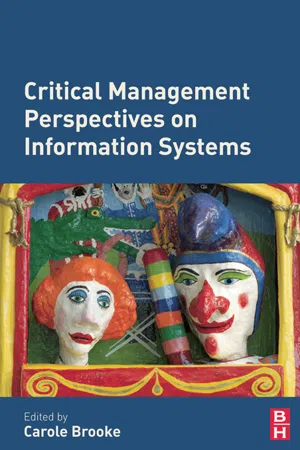
Can we judge a book by its cover? Were you attracted by the cover? Intrigued? Shocked? Perhaps one of your first thoughts when you looked at this book was ‘what is the relevance of Punch and Judy to research in IS?!’ Perhaps you just saw a familiar form of entertainment with old-fashioned or historical roots.
Here we have an excellent example for critical analysis.
As you know, the Punch and Judy show is a harmless form of children’s entertainment from a long and well-established tradition – a set of familiar characters and some repetitive routines that demonstrate appropriate morality and social behaviour. The ‘moral of the story’ is that ‘good’ wins over ‘bad’, the weak are protected and justice is delivered by those in authority over us. Or is it? What if I suggest that the imagery is disturbing, with a thinly-veiled theme of aggression and domestic violence? The Punch and Judy show is a story of gendered social roles, of sexual stereotypes and dysfunctional families? Or is it? The moral of the story is that equality does not exist, unequal power relations are a feature of daily life, and without intervention, less powerful ‘voices’ will tend to be marginalized, even silenced. Or is it? How about this reading: the Punch and Judy show is a fiction, a web of deception, a subliminal instrument of normativity, patriarchy, a form of social regulation, a grotesque depiction of human nature. Or is it?
The Punch and Judy show may not be what it seems. Somewhere, underneath it all, there are values and assumptions at work: ‘theirs’ and ours. Now, take a look at the back cover. Who is in control: Punch, Judy or the puppet master? Does this alter the way you view and interpret what is going on? These kinds of issues are at the heart of critical research or ‘critical inquiry’ within IS.
In 2003 I was invited to give a keynote address at a research methods conference.1 I chose to talk about what I then saw as the newly-burgeoning field of ‘critical research’ approaches in IS. During my preparations I was reminded of Punch and Judy. Why? Too often in academic debates different approaches to research are seen as competitors ‘slugging it out’ until one emerges victorious. Rarely have I seen academic debates where there is a deep appreciation for diversity as opposed to similarity of theoretical analysis and interpretation. This apparent undercurrent of desire for intellectual convergence has been tangible even in contexts where rejection of grand narratives was espoused. Often the search seems to be for ‘more’ or ‘less’ suitable modes of IS evaluation with the implication that this will result in improved research findings and recommendations for change and ‘improvement’.
Back in 2003, there seemed to be two fairly popular theoretical strands to IS research: work based on ideas developed by Habermas and work based on concepts drawn from Foucault. However, even within this limited frame of reference, it felt as if the two approaches as applied within the IS field were in competition with each other. This is not entirely surprising given that the progenitors (Habermas and Foucault) were themselves engaged in a fascinating discourse during their lifetimes. (Incidentally, I recommend you read a chapter by Conway (1999) that presents this dialogue in a very readable fashion.)
My reading of contemporary IS literature led me to conclude that researchers were applying the ideas of Habermas with much the same attitude. His ‘followers’ appeared to be privileging their discourse above others. That is, they were presenting their frameworks at one and the same time as ‘critical’ and yet somehow more productive than alternative approaches without actually investigating their own claims to knowledge. This is not to deny that there is a delicate tension between holding a ‘critical’ position whilst seeking to produce effective theories and methods of research, and this is a point to which we will return. However, I spotted a substantial influence of Habermas within ‘critical’ IS research, more or less to the exclusion of other approaches, or so it seemed. At the same time, I found very little in the literature that employed the ideas of Foucault or others from the ‘critical’ tradition. The one seemed to be growing at the expense of the other. At the risk of employing another metaphor, I have referred to this as a case of Habermasian critique becoming a ‘cuckoo in the nest’.2 Habermasian research was nudging the ‘competition’ out of the nest. In short, I sensed the danger of IS research lapsing into a form of paradigmatic hegemony. This seemed particularly ironic given that Habermas himself emphasized emancipation from domination.
So, how do we deal with the ‘problem’ of the Punch-like competitive element (aka the hegemonic relations) of IS research? Before I elaborate on my concerns for the IS discipline which began in 2003, we need to establish a starting point for considering the ideas of Habermas. So, here follows a very brief overview of some key ideas from his seminal works.
Habermas recognized that communications between individuals or groups tended to produce inequality at various levels. The overall context in which communication is played out he referred to as the ‘Lifeworld’. He developed a framework that could be operated within the Lifeworld and he called it ‘communicative rationality’. The purpose of communicative rationality was to provide a conceptual arena within which Lifeworld communications could take part, without inequality or, at least, where such inequalities were significantly reduced. Underpinning this logic is the assumption that it is possible to facilitate a ‘more equal’ process of communication. He referred to this condition as ‘ideal speech’. The benefits of such an approach are clear to see within the field of IS, especially in systems design and implementation, where the importance of the involvement and engagement in dialogue of a wide variety of stakeholders has been attested (Sauer, 1993).
It seemed to me back then, however, that Habermas was more strident in his views, and less accommodating than Foucault who always tended to see more similarity between their philosophical aspirations than difference. As I read their respective writings and the work of others who applied their ideas, I gained the overall impression that there was an intrinsic contradiction in the claims of Habermas.
Stop! I now experienced a contradiction at two levels. In proposing the notion of ‘ideal speech’, I felt that Habermas was presenting us with a picture of an external reality, one which left little room for alternative constructions and interpretations to be identified and valued. This felt like a closing down of intellectual inquiry rather than an opening up. Within the context of scientific inquiry, where the overall aim is to produce a reproducible and generalizable set of ‘norms’ and behaviours, this tendency may be more acceptable, but even within the broad church of ‘critical’ research (Brooke, 2002a) this felt uncomfortable. In summary, there appeared to be a contradiction and tension between holding a ‘critical’ position whilst seeking to produce effective theories and methods of research.
For further explication, let us return to Punch and Judy.
The Punch and Judy show is our Lifeworld. Punch represents a devotee of Habermas. He believes that there is an external reality and that his views are more valid. Judy represents the Foucauldian (or any other ‘critical’ for that matter) researcher. Her power is more subtle. One of her concerns is to protect the baby. The baby is more obviously vulnerable in terms of power relations, although very vocal. I propose that the baby represents diversity of intellectual tradition and interpretation.
Punch is strong and aggressive, Judy is not so. Punch will try to dominate Judy and assert his voice over hers through physical acts. It will require the Police Officer (communicative rationality) to use his truncheon (ideal speech) to ensure that justice prevails and, especially, that the baby is not harmed.
1.1.1 Or Is It?
Do you see the dilemma I encountered at that time? How can the very thing that purports to ensure the richness and diversity of communication prevails, also claim the status of ‘authority’. It does not make sense. Rather than a Punch-and-Judy style confrontation, could we not choose to shift our frame of reference? For instance, we could choose to engage in an on-going dialectical dance. That would seem somehow more fluid and to allow for more mutuality of dialogue.
I must stress here that as researchers we do not need to mirror the same pattern of intellectual ‘behaviour’ as the thinkers who influence our ideas. I am not rejecting the possible contribution of Habermasian (or any other) theory to a richer understanding of IS. Indeed, I hope that you will find the chapters in this book provide some suitably convincing and diverse examples of the application of his ideas. No, the point I am making here is one of attitude and intention.
I think we had better abandon our Punch and Judy metaphor now because, as Morgan (1993) said, after a while it breaks down, but I hope that I have succeeded in opening up for you some challenging questions with regard to the state of critical research as it is within the field of IS. These questions are what motivated me to produce this edited collection.
Before we move on, though, you might take another look at the back cover. The artist (Roy Ealden) intended this to represent the gentleman who is operating the Punch and Judy show. For me, this is nicely emblematic of critical inquiry. A key aim of critical research is to discover/uncover underlying values and beliefs, quite often by exposing hidden or marginalized aspects. Frequently, there is an overall intention (though no guarantee) of some level of emancipation, a deeper understanding of power relations and an attempt at reflexivity. Once we have ‘seen’ the person behind the show, a whole new set of issues may emerge for us. Who is it? What is their motivation and intent? What drives their actions? And so on. We need to remain alert to these issues in organizational research.
Now that we have introduced the idea that critical inquiry is somehow useful and requires a level of intellectual diversity and an attitude of openness, we will take a closer look at what this might mean within the context of IS research and indicate how the chapters in this book can make a fruitful contribution.
1.2 BEING FRUITFUL: THE NEED FOR CRITICAL INQUIRY IN IS
Taking the somewhat political stance of the puppet master as our starting point, we might reasonably begin by asking who or what is ‘behind’ the academic development of critical thinking in IS? If we are to understand its recent past, its current state and its future potential for development, we probably need to know something about its historical roots.
How far back to go is a difficult decision to make when considering the genesis of an emerging approach. A relatively early protagonist is a contributor to this book – Heinz Klein. Yet we need to go back further, to the early 1960s at least, and note the essential contributions made by researchers like Joan Woodward, Enid Mumford and others to the field of technology and organizations. Such work, it was noted in 2007 (at an event to commemorate the work of Enid Mumford who had recently died3), is still relevant in today’s ‘post-modern’ world. [The term post-modern is used here in the form that Hassard and Parker (1993) described as an ‘epoch’.] The approach taken in this early research is often referred to as ‘socio-technical’ in nature, with its desire to recognize the role and contribution of people and its attempt to redress the imbalance towards an emphasis on purely technical matters.
More recently, and certainly since the 1990s, there have been many attempts to describe the nature of ‘critical research’, mainly within the field of general management (Alvesson & Willmott, 1992; Hassard & Parker, 1993). Still more recently, a critical research tradition has been developing from within IS, for which there is some evidence in the published literature. For instance, there have been special issues of journals (Database for Advances in Information Systems, 2002), and dedicated conference tracks at international conferences (e.g. Critical Management Studies; European Conference on Research Methods; American Academy of Management; European Conference on Information Systems).
Alvesson and Deetz (2000) have argued that critical research has at least three overlapping fundamental areas to address. These are gaining insight into lived experience (e.g. through more frequently conducting in-depth empirical work), undertaking a critique of the values and assumptions that underpin organizational and managerial practices, and transformative redefinition. By the latter they refer to the extent to which research can lead to the relevant knowledge and practice needed in order to effect change in approach and ways of working (Alvesson & Deetz, 2000).
The third area of work – transformative redefinition – is a particularly interesting one. It continues to provide a significant challenge to all researchers but, arguably, especially to those working from a critical viewpoint. As I suggested earlier in this introduction, there is a delicate tension between holding a ‘critical’ position whilst seeking to produce transformation that claims to be ‘better’ than that which previously existed. A critical voice seeks to shed light on something or bring a new perspective with the intention for generally ‘good’ outcomes. Thus, there is always some implied reference point in relation to which the ‘good’ is deemed to be an improvement, being contrasted to a notion of ‘bad’, of course. So we could argue that there is a role for an implied or necessary normativity here. Simultaneously, though, a critical approach needs to leave room for other voices to express different viewpoints on relative ‘goodness’, not to mention the researcher having to leave space for self-critique as well. This need to keep reflexing backwards and forwards between process and content whilst leaving room for other interpretations poses enough of a challenge but, where there is a normative element to the research, the task would seem even greater. Yet the problem does not end there. Much critical research has been taken to task, either for its lack of self-awareness and/or for its lack of transparency in the recruitment of normative concepts. A number of authors in this book recognize this situation, but the chapters by Stahl, Cecez-Kecmanovic and Janson, and Klein pay particular attention to it.
Various issues have been highlighted since Alvesson and Deetz’ paper as needing treatment within the sphere of critical research, and the chapters in this volume seek to identify and address them. In so far as this book, then, brings together the philosophical and the practical, and re-visits the foundational values of critical IS, it addresses some of the significant gaps that were identified in the literature (Alvesson & Deetz, 2000).4
Historically, writings on ‘critical’ approaches to information systems have been fairly fragmented. In addition, what there is tends to give the impression that the study ...