- 320 pages
- English
- ePUB (mobile friendly)
- Available on iOS & Android
eBook - ePub
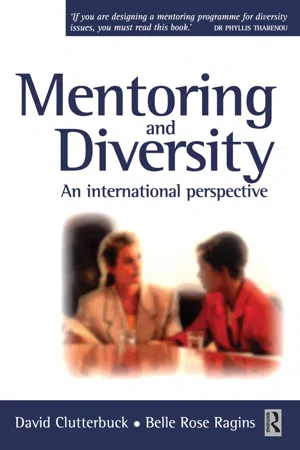
Mentoring and Diversity
About this book
Organizations with a diverse workforce will have a leading edge in the New World economy. 'Mentoring and Diversity' illustrates the importance of mentoring as a proactive tool in diversity initiatives, and demonstrates how mentoring can be used to recruit, develop and retain a diverse and innovative workforce.
This book brings together new and innovative perspectives on diversity and mentoring relationships within a variety of international settings. 'Mentoring and Diversity' provides a unique blend of research and practice, and is an indispensable guide for any company that seeks to develop a more diverse workforce. It will serve as a fundamental text for practitioners interested in developing effective mentoring programmes and for researchers seeking to understand these critical and complex relationships.
Interviews, cases and qualitative data from a variety of international settings are used to support the models and theries developed in the text. These cases illustrate "diversity in action" in mentoring relationships, and provide guidance for developing effective mentoring programmes and diverse mentoring relationships in organizations.
The book is composed of four sections that reflect theory, research and practice:
* An overview of the theory and research on diversified mentoring relationships, followed by an applied model of diversity in mentoring relationships.
* Some empirically based and pragmatic observations of "best practices" that are used by diversified mentoring programmes in various international contexts.
* A collection of international case studies of diversity in both mentoring programmes and individual mentoring relationships. These cases illustrate the challenges and benefits associated with diversity in mentoring relationships. Organizational cases are drawn from such companies as Procter & Gamble, Volvo and World Bank. These cases provide practical guidance on how to develop effective mentoring programmes.
* An integrative analysis of some of the recurring themes in the case studies that are supported by existing research but also chart new ground for emerging reseach and theory.
9Organizational case studies
DOI: 10.4324/9780080496559-9
Diversity by accident: London Borough of Ealing
Marianne Ecker1
When the London Borough of Ealing launched its pilot mentoring scheme in 1999, it was not particularly focusing on any racial or gender group, although it has a wide mix of backgrounds among its 7500 staff. It simply wanted to establish twelve mentoring pairs, from whose experience it could learn how best to spread the approach more widely within the authority. In the event, all the applicants to be mentees were women, primarily from clerical areas, while the mentors were both men and women from various departments and ethnic origins.
Like most boroughs in the UK, Ealing deals with a spread of community responsibilities ranging from housing and education to parks and street cleaning. Some of these activities are managed directly by the borough; others are contracted out.
Launching the scheme
The pilot was managed by a team of three people, an operational manager and two people from corporate development and training, with the backing of senior managers. They launched the scheme with a poster campaign and articles in the staff newspaper, asking people to put themselves forward to be either mentors or mentees (or both). The benefits promoted to mentees were that they would have a flexible development opportunity to discuss career and personal development choices in a confidential and supportive environment. For mentors, the intended benefits related to being able to hone their developmental skills out of the normal working routine. The programme was linked directly to a policy that aims to give every employee at least twenty hours of development each year – mentoring was positioned as a practical means of delivering development to people.
To apply for the scheme, mentees had to complete a detailed application form that explored their motivations for wanting a mentor, their career ambitions and progress so far, and what other training and development they had been through. They were also asked to carry out a strengths, weaknesses, opportunities and threats (SWOT) analysis on themselves and their careers and to indicate any preferences for gender or race of their mentor. Finally, their application was accompanied by a supporting statement by their line manager.
Mentors were also given a questionnaire and asked to do a similar SWOT analysis of themselves. The questionnaire explored in particular whether they could provide sufficient time to build and sustain the mentoring relationship, how they would review progress and what benefits they saw arising from the programme. They were also asked about their own history of training and development.
To ensure that the programme design had the support of actual and potential participants, the co-ordinators ran a number of focus groups to explore issues such as confidentiality, matching and the respective roles and responsibilities of mentors and line managers.
Out of these discussions and advice based on experience in mentoring programmes in other organizations, a number of practical guidelines emerged. Relationships would last formally for twelve months, although they could continue informally thereafter. Meetings would meet once a month, with each meeting and its preparation taking about three hours in all.
Matching mentors and mentees
The matching process took into account people's wishes about race and gender, and about where they might like to work in the future (i.e. by providing a mentor with current knowledge or experience of that area). Some effort was also made to ensure that people's working styles were compatible. Some very senior potential mentors were turned down for the pilot on the grounds that there were too many hierarchical layers between them and the mentees – a maximum of three layers became the ground rule. However, most of these were offered the opportunity to participate in another programme of mentoring across local authorities.
Training
Both mentors and mentees attended one-day courses that explored the nature of mentoring and how to get the most out of their relationships. Line managers were also offered a half-day workshop to educate them in how to align their role with that of the mentor and to reassure them about the intent of the programme.
Evaluating the pilot
At the midpoint (July 2000) mentors and mentees were invited to discuss in group meetings how their relationships were progressing. All the mentors remained with the borough, although some relationships have ended because the mentee has left. Only one of the twelve relationships failed to get off the ground – the mentor was not actively available. Three other relationships had ended for more positive reasons; two people had obtained promotions to posts in other authorities and one was on maternity leave. However, all twelve participated in the review process, either in the group or through a one-to-one interview.
Mentors reported a good deal of satisfaction with the relationship and the speed with which the mentee was able to establish a clear sense of direction and personal objectives for career and personal development. The clearer the mentee was about their needs, the easier and more enjoyable the mentor found the sessions. Mentors found that the discussions with mentees caused them to reflect upon and review their own career position, and to review how they deal with their own direct reports. They also reported that the programme had helped reinforce their development skills in general and had added to their knowledge of other areas of the authority.
Mentees also felt positive about the meetings, with several reporting increased self-confidence to pitch for greater responsibility or for higher education opportunities. (This was identified at the beginning of the pilot as a key measure of success.) They found the mentors especially useful in making links and networking. Some mentors had suggested practical tasks for the mentee to attempt between meetings.
Problems surfaced during the review centred around those relationships where the mentee had not been able to define sufficiently closely what they wanted to achieve, or had been unable to break big, vague objectives into manageable steps. Some pairs had experienced minor problems in the relationship between line manager and mentor (for example, when it became apparent that one mentor and line manager were very close). The main lessons to come from the review process, however, were:
- the need for continuing support for both mentor and mentee. Mentors, in particular, can benefit from regular (two or three times a year) ‘supervision’ in the form of a group discussion of experiences, facilitated by an (external) expert
- the value of using current participants' experience to publicize mentoring more widely. (Ealing intends to start the next tranche of mentoring with a social event that brings the pilot volunteers together with people, who are interested in taking part in the future.)
- the possibility of using mentoring to support specific issues, such as National Vocational Qualifications.
Mentoring up at Procter & Gamble – USA
Reproduced by permission of Procter & Gamble
Introduction
Procter & Gamble's (P & G's) mentoring scheme within its marketing division aims to retain and advance female managers within the company. The scheme was initiated as part of the Advancement of Women Taskforce (AWTF) in response to a disproportionate lack of retention and advancement of female managers in the early 1990s.
Background
The stimulus for the project was a ‘regretted loss’ survey that P & G carried out in the early 1990s. The survey results showed that promising young female managers were not leaving for typical reasons, such as promotion and better pay, but because they were not feeling valued in their job.
While a prime assignment, promotion or pay increase translates to men as a sign that the organization values their work, the same rewards don't always convey the same message to female managers. They want to be explicitly told of their value, to hear their contributions verbally acknowledged, to have their career options openly discussed
says Kristen Nostrand, a marketing director within P & G, who has had the responsibility of overseeing the mentoring up programme (Zielinski, 2000).
Mentoring up was developed as a tool to help educate upper management to these gender differences, thereby better meeting the needs of women. It gave them another opportunity to mix with the management and increase the amount of cross-gender communication taking place. This, in turn raised the ability of top mangers, both male and female (senior female managers are also given the opportunity to participate in the mentoring up scheme as mentees) to improve their personal skills in managing against issues specific to junior female managers.
While there was a traditional mentoring scheme in place in the marketing function to help all junior managers understand how to perform to gain promotion and also provide a degree of sponsorship, it was not designed or conducive to addressing gender differences. Arguably this course of action indirectly suggested that any ‘problems’ were with the women themselves rather than the organization and culture they worked within, which the regretted loss survey showed was not the case. Procter & Gamble enlisted the help of the AWTF to help develop a suitable mentoring scheme.
The AWTF is an enabling organization committed to understanding issues facing female managers and developing programmes to address these issues, thereby helping to improve the satisfaction, retention and advancement of women in US advertising. Because the loss of top performers is especially acute among women, our efforts will focus on them. However, we expect that most programmes will also be effective among men, and we will take that into consideration as we deploy programmes. We will track results against goals and will share successes for global reapplication.
The AWTF was founded in 1991 as the Retention of Women Taskforce (RTWF). It was subsequently reorganized in 1994 to facilitate greater line management involvement and ensure that all other business sectors, not just advertising were represented. After significant successes and progress in terms of retention, the focus was shifted in 1996–9 to encompass the advancement of women as well – Hence the Advancement of Women Taskforce. The taskforce has also developed links with the Minority Development Taskforce to facilitate strong cross-fertilization of learning and co-ordination of programmes. It is from this vast and varied experience base that P & G's ‘Mentor Up’ scheme was developed.
There are four main areas of action outlined by an AWTF programme:
- the creation of an environment in which all individuals can work to their full potential
- the improvement of advancement and retention results among minority women
- the improvement of recruiting efforts to bring talented women into an organization
- the creation of strong networking programmes to ensure connectedness within an organization.
The mentoring up programme at P & G was used to help the company take action upon these areas.
Mentoring Up
Mentoring Up's objectives were to:
- provide male managers with informal non-threatening feedback on how to manage issues specific to women
- provide male managers with a sounding board
- allow junior women to develop quality relationships with senior management.
Programme leadership
In order for the scheme to be a success it was important that leadership and steering should be sought from all the most effective areas. The senior managers agreed to provide support and drive the programme following an executive committee presentation, and the sponsorship from the AWTF was an excellent resource of know-how, experience and guidance. It was agreed that the programme should be executed on a sector basis and led by a line manager, ideally teamed with an HR manager. The overall programme is co-ordinated by a Mentor-Up Steering Team, which meets bi-monthly to discuss progress, issues, and improvements.
Establishing mentor pairs
Potential mentors were selected from the ranks of female junior and middle management. Mentees were selected from upper management. In the first instance participation was voluntary, but now all eligible male senior-level and female junior-level managers are expected to take part. The women are usually one to two management levels beneath their mentee. The mentors are expected to have a minimum of one year's good performance prior to starting in a mentoring relationship.
Great care was taken to ensure that the mentors and mentees were paired to c...
Table of contents
- Cover Page
- Half Title Page
- Title Page
- Copyright Page
- Contents
- Preface
- Gender and race in mentoring relationships: a review of the literature
- Understanding diversified mentoring relationships: definitions, challenges and strategies
- Establishing and sustaining a formal mentoring programme for working with diversified groups
- Building and sustaining the diversity–mentoring relationship
- Individual case studies
- Some further reflections by the mentor
- Differences that make a difference: common themes in the individual case studies of diversified mentoring relationships
- Organizational case studies
- Some key issues for diversity mentoring
- Index
Trusted by 375,005 students
Access to over 1.5 million titles for a fair monthly price.
Study more efficiently using our study tools.
Frequently asked questions
Yes, you can cancel anytime from the Subscription tab in your account settings on the Perlego website. Your subscription will stay active until the end of your current billing period. Learn how to cancel your subscription
No, books cannot be downloaded as external files, such as PDFs, for use outside of Perlego. However, you can download books within the Perlego app for offline reading on mobile or tablet. Learn how to download books offline
Perlego offers two plans: Essential and Complete
- Essential is ideal for learners and professionals who enjoy exploring a wide range of subjects. Access the Essential Library with 800,000+ trusted titles and best-sellers across business, personal growth, and the humanities. Includes unlimited reading time and Standard Read Aloud voice.
- Complete: Perfect for advanced learners and researchers needing full, unrestricted access. Unlock 1.5M+ books across hundreds of subjects, including academic and specialized titles. The Complete Plan also includes advanced features like Premium Read Aloud and Research Assistant.
We are an online textbook subscription service, where you can get access to an entire online library for less than the price of a single book per month. With over 1.5 million books across 990+ topics, we’ve got you covered! Learn about our mission
Look out for the read-aloud symbol on your next book to see if you can listen to it. The read-aloud tool reads text aloud for you, highlighting the text as it is being read. You can pause it, speed it up and slow it down. Learn more about Read Aloud
Yes! You can use the Perlego app on both iOS and Android devices to read anytime, anywhere — even offline. Perfect for commutes or when you’re on the go.
Please note we cannot support devices running on iOS 13 and Android 7 or earlier. Learn more about using the app
Please note we cannot support devices running on iOS 13 and Android 7 or earlier. Learn more about using the app
Yes, you can access Mentoring and Diversity by Belle Rose Ragins,David Clutterbuck,Lisa Matthewman in PDF and/or ePUB format, as well as other popular books in Business & Human Resource Management. We have over 1.5 million books available in our catalogue for you to explore.