- 374 pages
- English
- ePUB (mobile friendly)
- Available on iOS & Android
eBook - ePub
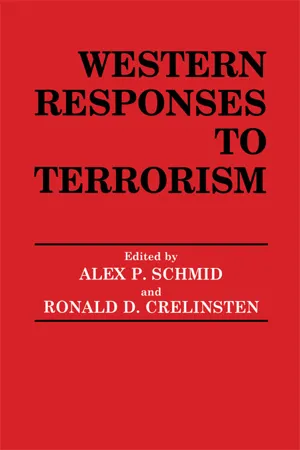
Western Responses to Terrorism
About this book
This volume combines case studies of national responses to terrorism with analyses of conceptual, political, economic and data-collection problems surrounding the control of terrorism in democratic societies over the last 25 years.
Information
PART I
THE PROBLEM
Editor's Introduction: Western Responses to Terrorism
To me the most urgent problem of our time is the problem of
discovering a way of overcoming evil without becoming
another form of evil in the process
discovering a way of overcoming evil without becoming
another form of evil in the process
Laurens van der Post
This volume is the outgrowth of a congress organized by the Association des Etats Généraux des Etudiants de l'Europe (AEGEE) and the Center for the Study of Social Conflicts (COMT) of Leiden University on 16–17 March 1989. Its title was ‘Towards a European Response to Terrorism: National Experiences and Lessons for the Europe of 1992’. With the prospect of a Europe without frontiers, the problem of a common anti-terrorist policy gained new urgency. While nations like the United States and Israel had developed certain response models for coping with terrorism, which model of anti-terrorist policies should be adopted by the countries of the European Community? Should it be a German model with features like Berufsverbot and high-security prisons like Stammheim? Should it be a British model, based on counter-insurgency experience gained in Palestine, Malaya, Cyprus and Northern Ireland? Or is it possible to learn from other European nations in order to develop a new model combining effectiveness with democratic acceptability?
The congress was meant to stimulate public discussion on a matter which security experts generally prefer to discuss among themselves. The invited speakers and panelists came from ten countries and included academic scholars, retired military and intelligence experts, lawyers, politicians and journalists. For the present volume, the Greek conference paper could not be included as it was never completed in written form. One case, France, was never expanded into a full article but the original is included for the sake of completeness. In addition, we invited two more authors (Stahel and Vetschera) to highlight their nation's response. Altogether, the present volume covers the national experiences of eight European countries. Unfortunately, we could find no scholar willing to describe critically how the Turkish government copes with terrorism. Since Turkey is Europe's most affected country, the lessons to be learned from Turkey are especially important. To write about terrorism seems to be as dangerous as being considered a terrorist in Turkey, where the ‘cure’ for terrorism has been almost as bad as the ‘disease’ of insurgent terrorism prior to 1980:
Since the last military coup of September 1980, the following developments took place: 650,000 persons were arrested and imprisoned. 212,000 of them were brought to trial; 4,500,000 are on a black list; 914,000 have been removed from their jobs; 14,000 lost Turkish citizenship; 48 persons were executed; 170 died from torture.1
As this sombre list illustrates, terrorism can have as great an impact on domestic political life as on international affairs. A nation like Lebanon has been nearly destroyed by it. Superpowers have been affected by it (President Carter's embassy hostage crisis and President Reagan's Irangate). Europe's future, too, might be affected by the doings of small groups of terrorists. This volume, then, is meant to contribute to a neglected but necessary debate.
In the first two contributions, Alex Schmid outlines the conceptual and practical problems surrounding the control of terrorism in democratic societies. In the third article, A.J. Jongman then surveys the incidence of terrorism, both domestic and international, in Western Europe in the 20-year period since 1968, when counter-terrorism first became a major policy issue in the West. At the same time, he highlights problems surrounding the recording of incidents and the conflicting assumptions that underlie the best known data bases.
The next eight chapters are eight national studies from Europe. First, Alex Schmid looks at international and domestic terrorism in the Netherlands and the ways in which the Dutch government dealt with them. Next, Fernando Jiménez surveys the Spanish government's response to the terrorist threat in Spain, with particular emphasis on the Basque question. Gilbert Guillaume then briefly surveys the kinds of terrorism encountered by France and recent legal, diplomatic and police responses. In the next chapter, Kurt Groenewold focuses on the Federal Republic of Germany's struggle against the Red Army Faction, particularly the legal and administrative dimensions of the government's response. Having himself undergone the Federal Republic's special procedures for prosecution of the Red Army Faction, as defense attorney for some Faction members, Groenewold highlights the intricate ways in which the legal and administrative procedure was altered in the name of counter-terrorism.
Donatella della Porta describes in detail the Italian state's fight against terrorism, including analysing how the Red Brigades were defeated by special amnesty laws. David Bonner examines the British government's different measures to combat terrorism both in Britain itself and in Northern Ireland. He also assesses their effectiveness and their sensitivity to civil liberties. Albert Stahel provides a glimpse of a country usually ignored in the literature on terrorism: Switzerland. Stahel shows how Switzerland serves as a logistical base for both European and international terrorism. Finally, Heinz Vetschera examines another oftneglected nation, Austria, reminding the reader of both its historical links with terrorism and its contemporary experience.
The next six contributions take a broader look at more regional approaches to counter-terrorism and the problems of international co-operation. The first two focus on the newly emerging European Community: F. Korthals Altes’ Dutch perspective on the difficulties of co-ordinating national policies and Meliton Cardona's chronicle of European regional and international efforts to co-operate. Paul Bremer next presents an American perspective on international co-operation, highlighting more recent successes in legal prosecution of international terrorists. Then Richard Clutterbuck surveys the chequered history of negotiations policy in hijacking and hostage-taking, both in the public and the private sector, and examines the key issues involved. M.P.M. Zagari returns to the European Community with the European Parliament's activities in counter-terrorism and the idea of establishing a European juridical area, with a European Court to try international terrorist cases. Finally, Richard Clutterbuck discusses the implications of a unified Europe with no internal border controls for identifying terrorist and criminal suspects.
In our conclusion, we survey the range of approaches that have been taken toward countering terrorism over the past 25 years and assess their relative effectiveness as well as their acceptability to democratic values. In discussing Western trends in counter-terrorism, we focus in particular on the military option, which has received considerable attention in recent years, and on the psychological approach, which has received very little attention at all. Finally, we discuss how to maintain a balance between effectiveness and democratic acceptability in Western responses to terrorism and attempt to identify the most common ways in which this balance has been threatened.
The original conference upon which this volume is based was held in March 1989. Since then, the world has changed dramatically. The emergence of Europe as a major political and economic entity has been accompanied by the reunification of Germany and the emergence of Eastern European democracies, the collapse of the Soviet Union and its empire and the end of the Cold War, the 1991 Gulf War and related realignments in the Middle East and significant electoral change in many Western nations. The vision of a ‘New World Order’, with its ‘peace dividend’, that was heralded when the Cold War ended has been clouded by economic hardship, both in the new states emerging from the ashes of the Soviet Empire and in the West, and by the emergence of ethnic and nationalist warring and anti-immigrant and anti-refugee violence in Europe. Add to this the increasingly influential role of religious fundamentalist thought in the political life of nations both East and West, for example Afghanistan, Algeria, Israel, Turkey, even the United States, and the electoral gains of right-wing extremists in France, Germany and Italy. With these profound and dramatic changes has come a transformation of terrorism and political violence in general. The increasing importance of religiously-inspired, right-wing, nationalist or anti-foreign violence and the increasing recognition, as highlighted in many contributions to this volume, that domestic and international forms of terrorism are often closely connected, necessitate a rethinking of traditional approaches both to the study of terrorism and to its control by democratic states.
By looking back over the past two and a half decades of terrorism when a new era in international affairs is just beginning, we hope that this volume will serve to highlight the need to rethink traditional concepts of both terrorism and counter-terrorism and to develop new approaches for the democratic control of terrorism in a rapidly changing world.
NOTES
1. Milliyet, Nov. 1989, as quoted in Volkskrant (Amsterdam), 29 Nov. 1989, p.10.
The Response Problem as a Definition Problem
To escape the defeatist position that ‘one man's terrorist is another man's freedom fighter’, this essay distinguishes four arenas of discourse on terrorism: an academic one (where a consensus definition is offered); a state discourse (where definitions are generally wide and vague); a public one (as reflected in the media's usage of the term ‘terrorism’); and, finally, that of the ‘terrorists’ and their sympathisers (where the focus is on political ends, while avoiding a discussion of means). To escape the choice between a crime model of terrorism, which focuses on the illegal means only, and a war model, which portrays terrorism as a continuation of politics, a legal definition of terrorism is proposed as the peacetime equivalent of war crimes, thereby moving into an arena of discourse where there is much international agreement. Such definition of terrorist acts would narrow what can be rightfully considered terrorism, but broaden the consensus as to the unacceptability of terrorist methods.
The definition of what constitutes ‘terrorism’ varies from society to society, from governmen...
Table of contents
- Cover Page
- Half Title page
- Title Page
- Copyright Page
- Contents
- List of Tables
- Acknowledgements
- Part I The Problem
- Editor's Introduction: Western Responses to Terrorism
- The Response Problem as a Definition Problem
- Terrorism and Democracy
- Trends in International and Domestic Terrorism in Western Europe, 1968–1988
- Part II European National Experiences
- Countering Terrorism in the Netherlands
- Spain: The Terrorist Challenge and the Government's Response
- France and the Fight Against Terrorism
- The German Federal Republic's Response and Civil Liberties
- Institutional Responses to Terrorism: The Italian Case
- United Kingdom: The United Kingdom Response to Terrorism
- Switzerland: Terrorism and Its Control
- Terrorism in Austria: Experiences and Responses
- Part III Western and European Responses
- Towards a European Response to Terrorism National Experiences and Lessons for 1993
- The European Response to Terrorism
- The West's Counter-Terrorist Strategy
- Negotiating with Terrorists
- Combating Terrorism: Report to the Committee of Legal Affairs and Citizens' Rights of the European Parliament
- Keeping Track of Terrorists After 1992
- Western Responses to Terrorism: A Twenty-Five Year Balance Sheet
- Bibliography
- Notes on Contributors
- Index
Trusted by 375,005 students
Access to over 1.5 million titles for a fair monthly price.
Study more efficiently using our study tools.
Frequently asked questions
Yes, you can cancel anytime from the Subscription tab in your account settings on the Perlego website. Your subscription will stay active until the end of your current billing period. Learn how to cancel your subscription
No, books cannot be downloaded as external files, such as PDFs, for use outside of Perlego. However, you can download books within the Perlego app for offline reading on mobile or tablet. Learn how to download books offline
Perlego offers two plans: Essential and Complete
- Essential is ideal for learners and professionals who enjoy exploring a wide range of subjects. Access the Essential Library with 800,000+ trusted titles and best-sellers across business, personal growth, and the humanities. Includes unlimited reading time and Standard Read Aloud voice.
- Complete: Perfect for advanced learners and researchers needing full, unrestricted access. Unlock 1.5M+ books across hundreds of subjects, including academic and specialized titles. The Complete Plan also includes advanced features like Premium Read Aloud and Research Assistant.
We are an online textbook subscription service, where you can get access to an entire online library for less than the price of a single book per month. With over 1.5 million books across 990+ topics, we’ve got you covered! Learn about our mission
Look out for the read-aloud symbol on your next book to see if you can listen to it. The read-aloud tool reads text aloud for you, highlighting the text as it is being read. You can pause it, speed it up and slow it down. Learn more about Read Aloud
Yes! You can use the Perlego app on both iOS and Android devices to read anytime, anywhere — even offline. Perfect for commutes or when you’re on the go.
Please note we cannot support devices running on iOS 13 and Android 7 or earlier. Learn more about using the app
Please note we cannot support devices running on iOS 13 and Android 7 or earlier. Learn more about using the app
Yes, you can access Western Responses to Terrorism by Ronald D. Crelinsten,Alex P. Schmid in PDF and/or ePUB format, as well as other popular books in Politica e relazioni internazionali & Storia militare e marittima. We have over 1.5 million books available in our catalogue for you to explore.