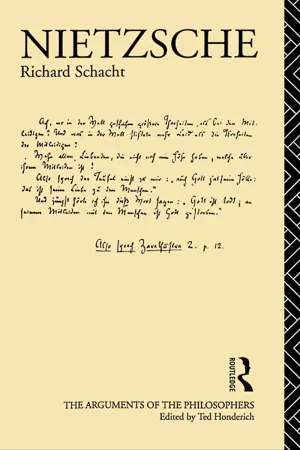
Few philosophers have been as widely misunderstood as Nietzsche. His detractors and followers alike have often fundamentally misinterpreted him, distorting his views and intentions and criticizing or celebrating him for reasons removed from the views he actually held. Now Nietzsche assesses his place in European thought, concentrating upon his writings in the last decade of his productive life.
- 572 pages
- English
- ePUB (mobile friendly)
- Available on iOS & Android
eBook - ePub
Nietzsche
About this book
Information
VI
Value and Values
No philosopher has been more intensely concerned with questions of value than Nietzsche was. Moreover, notwithstanding his radical critique and emphatic repudiation of much of what both traditionally and more recently has been taken to constitute morality, he devoted as much attention to it as almost any of the many philosophers before and after him who have viewed it more sympathetically. Indeed, it was his concerns along these lines, above all others, which supplied the main motivation for his explorations of the matters dealt with in previous chapters. His attention in his early works was drawn continually to evaluative questions posed but not resolved by the ancient and modern cultural phenomena with which he found himself confronted in his philological studies and in his own time. The investigations he went on to undertake, in the years prior to Zarathustra, were in effect efforts to place himself in a better position than either classical scholars or previous philosophers were to deal with these questions properly and adequately. The whole of Zarathustra revolves around evaluative and moral concerns; and the same is true of his subsequent Beyond Good and Evil and On the Genealogy of Morals.
To be sure, Nietzsche’s further reflections on other matters had a significant impact upon his thinking with respect to values and morality. The centrality and prominence of the latter throughout the whole course of his intellectual life, however, should be clear. It may be seen in The Birth of Tragedy, in which he seeks to convince us that ‘it is only as an aesthetic phenomenon that existence and the world are eternally justified’ (BT 5). And it is also reflected in the title he gives for the projected ‘work in progress’ to which he refers in Genealogy – ‘The Will to Power: Attempt at a Revaluation of All Values.’ Indeed, the ‘First Book’ of this projected work (namely, The Antichrist), which was among the last things he wrote, excoriates Christianity precisely on the ground that it ‘has turned every value into an un-value’ (A 62). I shall examine Nietzsche’s views with respect to value and values in this chapter, turning to a consideration of his treatment of morality in the next.
Toward a revaluation of values
I
Account should be taken at the outset of a difficulty confronting many philosophical readers, which at the same time has some significance of a positive nature for the interpretation of Nietzsche. It was observed in the Introduction that, while he could and often did write in a cool, dry, measured way, he also frequently expresses himself very strongly and colorfully. And he nowhere waxes more rhetorical, or indulges himself more freely in vehement and extravagant language, than in connection with the matters presently at hand. While no doubt at least in part a deliberately chosen tactic, intended to startle and unsettle and command attention, this tendency also is unquestionably a manifestation of the intensity of his concern with questions relating to value and morality, and shows it to be deeply and prominently normative (rather than merely analytical) in character.
To be sure, Nietzsche was quite disdainful of mere ‘moralizers’ and value-advocates who ‘do not dissect enough and preach all too much’ (WS 19), and remain complacently oblivious to (if not simply ignorant of) the wealth of moralities and value-systems, their histories, and their relation to other (e.g., psychological and social) phenomena in human life. ‘How remote from their clumsy pride,’ he writes, ‘was that task they considered insignificant and left in dust and must – the task of description – although the subtlest fingers and senses can scarcely be subtle enough for it’ (BGE 186). He considered it necessary to undertake this task, from a variety of angles, and to refrain from mere preaching. Yet he considered it no less important, and in the end a great deal more so, to proceed well beyond such description. And the tasks lying beyond it for him include not only the thorough deflation of the pretentions of previously established and commonly accepted moralities and values, but also the development of an evaluative scheme by reference to which a ‘revaluation’ of the things they prescribed and proscribed and commended and condemned could be carried out, and a new general direction of human life could be charted.
Nietzsche’s concern thus was above all to work out a new theory of value which would at once provide an interpretation and decisive reassessment of existing moral and evaluative schemes, and also fill the normative void which their mere ‘devaluation’ under critical scrutiny would otherwise leave. And it is worth stressing here, in view of the common supposition that Nietzsche ultimately was nothing more than a preacher after all in his normative moments, that he did aspire and lay claim to philosophical tenability in setting forth his theory of value and the fundamental standard of value and evaluation it incorporates. Thus he insists that his critique of moralities and his revaluation of values are mandated by ‘intellectual conscience’ and ‘honesty’ in philosophical thinking; and he at least means to measure up to the same standard when he goes on to develop the normative side of his theory of value and moral philosophy. He is no less concerned to work out a position on these matters that will stand up under critical examination, than he is to do so where the world, life, and human nature are concerned.
A number of considerations, pertaining both to things Nietzsche asserts and to the character of major portions of his philosophical activity, serve to reveal the fundamentally and strongly normative orientation of his value-theory. (They also should be borne in mind when one is considering what to make of the many passages in his writings in which he might appear to be saying or implying that all valuation has at most a social, psychological, or physiological significance.) This first is his oft-repeated contention that a ‘genuine philosopher,’ or at any rate the sort of ‘new philosopher’ he envisions, is one who does not simply ‘press into formulas . . . some great data of [former] evaluations’ (BGE 211), and is not merely a ‘critic’ either (BGE 210), but rather establishes values – which, at least in relation to previous values, will be ‘new’ ones. ‘Fundamental thought,’ he writes: ‘the new values must first be created – we will not be spared this task! For us the philosopher must be a legislator’ (WP 979). So he suggests that ‘there are two distinct kinds of philosopher: 1. Those who want to ascertain a complex fact of evaluations (logical or moral); 2. Those who are legislators of such evaluations’ (WP 972). The former, on his view, are mere ‘philosophical laborers’ (BGE 211) – or, if ‘critics,’ they are but ‘instruments of the philosopher and for that very reason . . . a long ways from being philosophers themselves’ (BGE 210). To be sure, Nietzsche’s remarks along these lines raise a number of large and important questions, concerning the character of such ‘legislation’ or ‘creation,’ and the status of the values which are thereby established. Whatever problems they may pose for him, however, they leave no doubt about his commitment to the idea that philosophy has a constructive as well as analytical and critical role to play in value inquiry.
Second, and on a much more general level, it is important to appreciate the fact that Nietzsche’s thinking on the matter of value initially had the fundamental character of a profound reaction against and response to Schopenhauer’s pessimism and radical condemnation of life; and that it developed as an intended counter to and supersession of what he came to see as the looming larger threat to mankind of the phenomenon he calls ‘nihilism.’ Thus in The Birth of Tragedy his basic concern was to try to understand how the Greeks could have found it possible to endure and indeed exuberantly embrace and affirm life, even though they shared Schopenhauer’s recognition of the ‘absurdity’ and ‘terror and horror of existence’ (BT 3) – and so to discover how we, bereft of the consolations of faith, might be able to do so as well. This ran directly counter to Schopenhauer’s inclination and intentions, as gradually dawned on Nietzsche. ‘Around 1876,’ he later wrote, ‘I grasped that my instinct went into the opposite direction from Schopenhauer’s: toward a justification of life, even at its most terrible, ambiguous and mendacious’ (WP 1005). His central proposition in The Birth of Tragedy had been that ‘it is only as an aesthetic phenomenon that existence and the world are eternally justified.’ And while this was but his first approach to the general issue of value, posed here only in the broadest terms, the view he expresses is one which he may have modified but did not abandon.
II
Nietzsche likewise did not abandon his determination to meet the challenge posed by Schopenhauer in favor of a nihilistic devaluation of all values. That would have been in effect to concede everything to Schopenhauer except the righteousness of his indignation with respect to the character of existence. ‘What does nihilism mean?’ Nietzsche asks, and answers: ‘That the highest values devaluate themselves’ (WP 2). His concern with nihilism and its overcoming loomed ever larger in his thinking in the course of the last decade of his productive life, as he came to regard ‘pessimism as a preliminary form of nihilism’ (WP 8), and nihilism as both a ‘necessary’ intellectual-historical development (WP P:4) and the gravest of dangers. He recognized that he himself had ‘hitherto been a thoroughgoing nihilist’ (WP 25), and speculates that ‘it could be a sign of a crucial and most essential growth, of the transition to new conditions of existence, that the most extreme form of pessimism, genuine nihilism, would come into the world’ (WP 112). But he came to see nihilism as ‘only a transitional stage’ (WP 7), and to view his philosophy as a step in the direction of a ‘countermovement’ to it, ‘regarding both principle and task; a movement that in some future will take the place of this perfect nihilism.’ He himself, he says, has ‘even now lived through the whole of nihilism, to the end, leaving it behind, outside himself (WP P:4).
‘Radical nihilism,’ as Nietzsche understands it, ‘is the conviction of the absolute untenability of existence when it comes to the highest values one recognizes’ (WP 3). And he suggests that it is not in some profound insight into the actual nature of existence, but rather ‘in one particular interpretation, the Christian–moral one, that nihilism is rooted’ (WP 1). Thus he refers to nihilism as a ‘consequence of moral valuation,’ which leaves us unprepared to ‘confer any value on that other sphere in which we live,’ while the ‘truthfulness’ it itself commands eventually dissipates ‘the sphere in which we have placed our values’ (WP 8). But this is a ‘consequence’ Nietzsche rejects. ‘Nihilism represents a pathological transitional stage (what is pathological is the tremendous generalization, the inference that there is no meaning at all)’ (WP 13). Thus he speaks of it as a ‘rebound from “God is truth” to the fanatical “All is false” ’ (WP 1). The problem, he contends, is that ‘we have measured the value of the world according to categories that refer to a purely fictitious world.’ Nihilism is the consequence, historically and psychologically if not logically, of ‘the realization that the overall character of existence may not be interpreted by means of . . . the categories “aim,” “unity,” “being” which we used to project some value into the world.’ These have ‘proved inapplicable’; and so, Nietzsche says, to those making this discovery ‘the world looks valueless’ (WP 12).
This leads him to remark that ‘a nihilist is a man who judges of the world as it is that it ought not to be, and of the world as it ought to be that it does not exist’ (WP 585A). And, in a more serious vein, it leads him to reflect, less with respect to his own newly won perspective than to ‘our’ situation prior to its supersession, that ‘the time has come when we have to pay for having been Christian for two thousand years; we are losing the center of gravity by virtue of which we have lived; we are lost for a while’ (WP 30). But Nietzsche is no less anxious to make the point, with respect to the above-mentioned interpretive categories, that ‘the demonstration that they cannot be applied to the universe is no longer any reason for devaluating the universe’ (WP 12). It may be that ‘the world does not have the value we thought it had,’ and that the ‘initial result’ is that ‘it seems worth less.’ But herein lies ‘the pathos that impels us to seek new values,’ rather than simply resigning ourselves to axiological nihilism. Indeed, he continues, ‘the world might be far more valuable than we used to believe,’ and we previously ‘may not even have given our human existence a moderately fair value’ (WP 32).
As shall be seen, Nietzsche holds that, strictly speaking, it is inappropriate to speak of and attempt to assess the value of life and the world in general; for he contends that there is no objective standard of value definable independently of their actual fundamental character by reference to which they can be evaluated. This reservation does not, however, lead him to halt merely with a critique of any sweeping negative value judgment pronounced upon ‘this world’ generally, and a typological inventory of forms of valuesystems which have emerged in the course of human history. For he believes it possible to ground a certain conception of value and standard of evaluation in a consideration of the fundamental character of reality, by reference to which it turns out to make sense after all to assign value to ‘our human existence’ and the world in which we find ourselves, and to privilege their affirmation over both their repudiation and an attitude of indifference toward them.
This belief finds expression in a number of Nietzsche’s most striking formulations. It is reflected, for example, in his embrace of the idea of the ‘eternal recurrence,’ and also in his proclamation of ‘amor fati’ as his ‘formula’ for ‘a Dionysian relationship to existence,’ which he takes to be ‘the highest state a philosopher can attain.’ ‘I want to cross over to the opposite of [a negation, a No],’ he says, ‘to a Dionysian affirmation of the world as it is.’ He goes on to say of this ‘highest state’ that ‘it is part of this state to perceive not merely the necessity of those sides of existence hitherto denied, but their desirability.’ And what he has in mind here is their ‘desirability’ not merely as useful or indispensable means to the attainment of various traditionally and commonly valued ends, ‘but for their own sake, as the more powerful, more fruitful, truer sides of existence, in which its will finds clearer expression’ (WP 1041). In this connection he speaks of ‘a Dionysian value standard for existence,’ which is ‘little obliged’ to prevailing modes of valuation, deriving rather from the above-mentioned apprehension of fundamental aspects of ‘existence’ which the latter are held to overlook or ‘deny’ (ibid.). It is this basic value standard which he seeks to formulate and undertakes to elaborate, and in terms of which he carries out his ‘revaluation of values.’
It is important to observe, however, that the value standard Nietzsche here terms ‘Dionysian’ is not one which he supposes is to be arrived at simply by ascertaining the nature of the ‘truer sides of existence’ to which he refers in their simplest and most pervasive forms. On the contrary, he employs the term ‘Dionysian’ not only to indicate the relation of this standard to them, but also to convey the idea of what he sometimes calls their ‘deification’ or qualitative transformation, and culminating in the ‘highest’ of ‘joys’ thereby attainable, ‘in which existence celebrates its own transfiguration’ (WP 1051). The ‘sides of existence’ he has in mind thus are not incorporated into this value-standard in the form of their lowest common denominator; for the ‘transfiguration’ of which they are capable and to which he takes them to tend is an essential feature of it. Here too, however, he holds this standard to reflect an aspect of the world’s actual character – ‘this, my Dionysian world of the eternally self-creating, the eternally self-destroying, this mystery world of the twofold voluptuous delight’ (WP 1067) – rather than to express a demand or preference of ours (or his) which is then imposed upon it.
Nietzsche’s ‘Dionysian value standard’ is thus no mere elevation of regularities of the sort which generally pass for ‘laws of nature,’ biological or other, to the status of norms of evaluative judgment. But it is intended to reflect what goes on in the world, as it goes on independently of any evaluative schemes which the likes or dislikes, wishes or desires, and reasonings or errors of particular human beings may lead them to hatch. And, no less importantly, it is intended to serve as a basis for evaluative judgments. ‘Dionysus is a judge!’ Nietzsche exclaims; ‘have I been understood?’ (WP 1051). If one fails to see this, one fails to understand him. And more specifically, one fails to understand his much-heralded ‘revaluation of values,’ in its double character as both a critique of former values and traditional modes of valuation, and also a development of a substantive alternative to them.
In speaking of a ‘revaluation of values,’ Nietzsche is employing the term ‘values’ in a way that should by now be quite familiar, to refer to those things which have long been taken by philosophers and others to be its primary referents. It thus has a descriptive use, and when so used should not be taken to convey his own endorsement of the significance and preeminence long accorded to these things. Its generality likewise should not be supposed to signify any thought on his part that a complete inventory of them would exhaust the full range of possible candidates for acknowledgment as supreme or intrinsic values (with the corollary that their dethronement would entail either complete relativism or axiological nihilism). A clearer restatement of his program of a ‘revaluation of values’ would thus be a ‘revaluation of those things which, traditionally or commonly, are supposed to be of greatest value.’And in p...
Table of contents
- Cover Page
- Title Page
- Copyright Page
- Preface
- Acknowledgments
- Reference Key
- Introduction
- I: Philosophers and Philosophy
- II: Truth and Knowledge
- III: Metaphysical Errors
- IV: The World and Life
- V: Man and Men
- VI: Value and Values
- VII: Morals and Morality
- VIII: Art and Artists
- Afterword
- Bibliography
Trusted by 375,005 students
Access to over 1.5 million titles for a fair monthly price.
Study more efficiently using our study tools.
Frequently asked questions
Yes, you can cancel anytime from the Subscription tab in your account settings on the Perlego website. Your subscription will stay active until the end of your current billing period. Learn how to cancel your subscription
No, books cannot be downloaded as external files, such as PDFs, for use outside of Perlego. However, you can download books within the Perlego app for offline reading on mobile or tablet. Learn how to download books offline
Perlego offers two plans: Essential and Complete
- Essential is ideal for learners and professionals who enjoy exploring a wide range of subjects. Access the Essential Library with 800,000+ trusted titles and best-sellers across business, personal growth, and the humanities. Includes unlimited reading time and Standard Read Aloud voice.
- Complete: Perfect for advanced learners and researchers needing full, unrestricted access. Unlock 1.5M+ books across hundreds of subjects, including academic and specialized titles. The Complete Plan also includes advanced features like Premium Read Aloud and Research Assistant.
We are an online textbook subscription service, where you can get access to an entire online library for less than the price of a single book per month. With over 1.5 million books across 990+ topics, we’ve got you covered! Learn about our mission
Look out for the read-aloud symbol on your next book to see if you can listen to it. The read-aloud tool reads text aloud for you, highlighting the text as it is being read. You can pause it, speed it up and slow it down. Learn more about Read Aloud
Yes! You can use the Perlego app on both iOS and Android devices to read anytime, anywhere — even offline. Perfect for commutes or when you’re on the go.
Please note we cannot support devices running on iOS 13 and Android 7 or earlier. Learn more about using the app
Please note we cannot support devices running on iOS 13 and Android 7 or earlier. Learn more about using the app
Yes, you can access Nietzsche by Richard Schacht, Ted Honderich in PDF and/or ePUB format, as well as other popular books in Philosophy & Epistemology in Philosophy. We have over 1.5 million books available in our catalogue for you to explore.