Two commissions within the Public Relations Society of America have recently defined courses in case-study analysis, research methods, and behavioral-science theory as central to an acceptable public relations curriculum. To date, these three "streams" within PR education have run independently of each other. The authors produced this volume because they believe that there is a growing demand for an integrative "applied theory" approach to the study of public relations cases.
The need for PR professionals to study the social, political, and economic contexts of public relations carefully had been apparent for some time as issues management and environment scanning emerged as focal points of modern public relations. Yet there was no systematic framework for such study. This volume, however, with its strong foundation in theory, provides just that framework and is highly suitable for graduate-level courses in public relations.
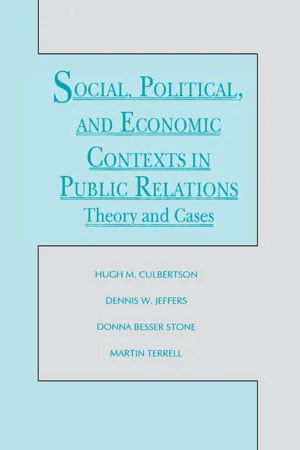
eBook - ePub
Social, Political, and Economic Contexts in Public Relations
Theory and Cases
- 336 pages
- English
- ePUB (mobile friendly)
- Available on iOS & Android
eBook - ePub
Social, Political, and Economic Contexts in Public Relations
Theory and Cases
About this book
Information
Subtopic
Communication StudiesIndex
BusinessI BACKGROUND
1
Introduction: Where This Book
Is Coming From
For at least 80 years, the public relations profession/vocation has struggled to define itself. One person often regarded as a co-founder of the field, Ivy Ledbetter Lee, based his practice largely on case-by-case application of certain basic principles such as the need for openness and for doing good works if one is to receive favorable publicity. By and large, these principles have to do with one-way communication from practitioner and client to key publics (Cutlip, Center, & Broom, 1985).
Another co-founder, Edward L. Bernays, argued that public relations could best develop as an applied social science. In his view, psychological and sociological insights aid in gathering and interpreting data about public relations, needs, and preferences. Such a process seemed essential if public relations was to become a two-way street that Bernays saw as essential in establishing a mutually supportive relationship between client and public (Grunig & Hunt, 1984, pp. 37–41).
EVOLUTION OF CASE-RELATED PUBLIC RELATIONS EDUCATION
As public relations education has evolved, professors and the case-related courses they teach have gravitated toward either of two clusters:
Some emphasize publicity writing and techniques as Lee urged. Such content sometimes gains coverage largely in practical public relations principles courses, creating a market for texts such as Seitel (1987) and Reilly (1981). In recent years, publicity writing and techniques course have multiplied as separate entities, often utilizing texts such as Newsom and Wollert (1988) and Bivins (1988), as well as worktexts like Simon (1983).
Others stress behavioral science theory as advocated by Bernays. Such a focus has been urged by two commissions of the Foundation for Public Research and Education (Commission on Public Relations Education, 1975; National Commission on Graduate Study in Public Relations, 1985, pp. 5–12). Also, in a recent survey of educators, Culbertson (1985) documented substantial and growing emphasis on communication theory among public relations educators, especially among the growing number with doctoral degrees. Further, such a trend is suggested by the apparent success of recent editions of principles texts (Cutlip, Center, & Broom, 1985; Grunig & Hunt, 1984) that focus heavily on social science theory and research.
Further, the previously noted commissions reported and endorsed a growth in courses on public relations problems and cases (Commission on Public Relations Education, 1975, p. 11) and management (National Commission on Graduate Study in Public Relations, 1985, p. 10). Such courses draw on the notion, derived in part from years of teaching and study at the Harvard Business School (Christiansen with Hansen, 1987), that one can best prepare for management and planning by looking holistically and in depth at particular problems studied within a broad context. Texts such as Canfield (1968) and Center and Jackson (1990) exemplify such an approach to public relations teaching.
As management-and-cases instruction has evolved, it has gravitated toward the Lee tradition (emphasizing publicity writing and application of widely accepted but intuitively based principles) rather than the social science focus of Bernays. Texts such as Canfield (1968) and Center and Jackson (1990) devote very little attention to social science concepts and research as applied to case analysis. Also, the previously noted principles texts and recent writings on public relations theory (Pavlik, 1987) seldom apply theory in depth to specific cases.
Why is there a lack of bridges between case analysis and theory in the field? Perhaps the relatively few scholars doing theory-building research feel compelled to build more and better theory before concentrating on ways to use it (Broom, Cox, Krueger, & Liebler, 1989). Certainly it seems reasonable to build a good mousetrap before one sells or tries to use it much! However, scholars have long argued that, in development of a body of knowledge, practice affects inquiry as much as inquiry affects practice (Conant, 1951, p. 39). Thus introduction of behavioral science theory into the analysis of specific cases seems apt to benefit both.
THE AUTHORS’ PERSPECTIVE
Against such a backdrop, the senior author has taught public relations principles at a major university for 26 years. In an attempt to define the class, he talked with and observed many successful practitioners who came to speak. As he listened to and questioned these people, he noted that the successful practitioners—and those most excited about their work—seemed widely read and able to analyze client problems and challenges in light of factors external to the client organization per se. Such practitioners had intellectual curiosity. They were really excited about looking at their clients and employers in broad social, political, and economic contexts.
Early on, the senior author began defining sensitivity to such contexts as a major goal of the principles course. How can people develop such a skill? He could offer few concrete suggestions beyond reading a lot and widely; interviewing leaders of the client organization and selected others in a detached, probing way; and looking for both aids and barriers to meeting publics’ needs and gaining their support. He offered examples. But mostly he sent students into uncharted waters as they wrote papers on client public relations postures and problems.
Things proceeded with little change until, in the mid-1980s, an especially bright, bold student challenged the author after class one day. “What is this SPE [social, political, and economic] context business?” the student asked. “Surely you can do better than give us a few examples, tell us to read a lot, and send us to the Reader's Guide for Periodical Literature.”
That response set the author to thinking and chatting with the second and third authors, both former advisees. Fortunately, all of us had been or soon would be doing applied research both to build and test theory and to help clients in concrete ways. We began trying to set down on paper what social science concepts helped us—sometimes without our realizing it—to design our research and interpret our data.
In 1989, the two senior authors presented a paper to the public relations division of the Association for Education in Journalism spelling out their use of several concepts within their own work. Three such notions had to do with the social context, two each with the political and economic contexts (Culbertson & Jeffers, 1992). Response to the paper suggested we'd struck a note in tune with what others were thinking. That, in turn, led us to invite our two colleagues to join us in writing this volume. They helped us expand the number of relevant concepts into the dozens and then to prune it so this volume would be of workable length.
As we write this, our definition of elements in the SPE context is still evolving. The number of potentially useful concepts is almost endless. We proceeded largely by groping—focusing on ideas that seem most useful to us.
As we studied, the social context occupied us more than the political and economic ones. Perhaps this stemmed in part from the fact that, on the whole, we were trained in communication and social psychology, not in political science or economics.
However, as we proceeded, we decided there was a deeper reason. Consideration of the political context focuses on gaining support from officials—on power relationships having to do with clients and the public at large. And economic context has to do largely with the distribution of resources.
Against this background, we pondered the oft-noted suggestions by Grunig and Hunt (1984, pp. 42–43) and Cutlip, Center, and Broom (1985, pp. 17–19) that twoway symmetric public relations offers more complete and generally fruitful service to society in most (not all) settings than do other types. This model involves great emphasis on:
Listening to clients, seriously and respectfully, with every bit as much effort as one exerts in speaking to them. One cannot simply read, chat with as many people as possible, and hope to understand fully how the client organization and its actual or potential programs are viewed from the public's perspective. This last phrase is crucial. The word symmetry, as used here, asserts that one must learn public viewpoints and needs and adjust client behavior and approaches to these. One cannot simply seek to bring the public around, through persuasion, to the client's own set of preferences, intentions, or points of view.
Doing research designed to clarify the public's needs as it defines them, not as it should define them in order to best serve the client organization. Such research differs in focus from that done in asymmetric approaches. There the primary goal is to develop and test persuasive appeals that may later bring the public around to the client's definition of the world (Grunig & Hunt, 1984, pp. 37–41).
In trying to apply these notions to definition of the SPE context, we found the social context to be paramount in understanding socially based public needs and how these can best be met. This required facilitating certain kinds of interaction between client and public. Economics and politics are important come planning and budgeting time, to be sure. But we argue that they generally have less to do, day to day, than the social context with studying publics, their needs, and how to meet them in creative, fruitful ways.
It seems necessary now to further justify focusing on the social, political, and economic contexts rather than slicing up the world in other ways.
Why the SPE Contexts?
To begin, the second word in the phrase public relations centers on ways in which people share meaning, take each other into account, influence others, and gain understanding as well as support and participation. Such social relations are focal points of social psychology. However, applied scholars and practitioners can best deal with them by borrowing from psychology, communication, and public-opinion research. These areas figure prominently in our analysis.
Public relations efforts deal to some degree with gaining resources and assessing their value to people. These resources include person power (time, skill, and willingness to behave in a certain way), money, and material goods. Questions of resource value are a major concern of economics. Of particular interest are the basic economic concepts of demand elasticity and marginal utility. Both deal with the amount a person is willing to pay for something in money or in labor and other inputs often assigned dollar-and-cent values.
Also of interest to practitioners is the question of how and where one obtains resources. Should they come from broad or narrow publics, and which ones? Do these publics actually have the resources to give? Can the client organization provide something in return so publics are willing to pay in some form? Are resources that the client needs controlled by bureaucrats or elected officials—analyzed basically as technocrats and politicians, respectively, in Bower's book, The Two Faces of Management (1983)? And is it most feasible and appropriate to seek support from government, from the private sector, or from both? These are but a few questions that economists can help answer.
Of course, economic analysis borrows profitably from social psychology. Two schools of thought in the latter discipline are especially useful here.
First, exchange theory in social psychology builds on the basic economic proposition that people normally work or pay only when they receive something in return that they see as justifying their inputs. And second, standard-of-comparison theory in psychology relates closely to the economic notion of diminishing marginal utility. Using the amount that Joan Smith consumed recently as a standard of comparison, theory suggests her third or fifth hamburger consumed at lunch will have less value than her first!
It is often said that resources translate into power and vice versa. And understanding power within an institutional setting is a major task of political science. Central here are questions of who has power, whether that power is based on coercion, persuasion, or exchange of material resources, and what processes and strategies figure in the gaining and losing of power.
Obviously, many of these processes and strategies have been examined by social psychologists. This points up, once again, the need for interdisciplinary study of public relations contexts. And it strengthens our argument in favor of the social context's centrality.
Issues Management: A Related Focus
Early on, we realized that management scholars had attempted to plan—and do research designed to support that effort—in ways that take broad organizational contexts into account. Carried out under such headings as “issues management” and “environmental scanning,” the work shows up in public relations (Chase, 1977; Cutlip, Center, & Broom, 1985, pp. 15–16). We review the literature in both public relations and management on these concepts in chapter 2.
This review supports two basic conclusions. First, issues managers and environmental scanners draw on social science concepts to evaluate client contexts in ways from which public relations people can profit. Second, however, writings on issues management such as Miles (1987) have an asymmetric ring not quite in tune with the symmetric approach advocated here for public relations. Issues managers consider audience needs, all right. But in many if not most cases, client needs seem in subt...
Table of contents
- Cover Page
- Half Title page
- Title Page
- Copyright Page
- Contents
- Foreword
- Preface
- Part I: Background
- Part II: A Theoretical Base
- Part III: Six Varied Cases
- Part IV: Conclusion
- Author Index
- Subject Index
Trusted by 375,005 students
Access to over 1.5 million titles for a fair monthly price.
Study more efficiently using our study tools.
Frequently asked questions
Yes, you can cancel anytime from the Subscription tab in your account settings on the Perlego website. Your subscription will stay active until the end of your current billing period. Learn how to cancel your subscription
No, books cannot be downloaded as external files, such as PDFs, for use outside of Perlego. However, you can download books within the Perlego app for offline reading on mobile or tablet. Learn how to download books offline
Perlego offers two plans: Essential and Complete
- Essential is ideal for learners and professionals who enjoy exploring a wide range of subjects. Access the Essential Library with 800,000+ trusted titles and best-sellers across business, personal growth, and the humanities. Includes unlimited reading time and Standard Read Aloud voice.
- Complete: Perfect for advanced learners and researchers needing full, unrestricted access. Unlock 1.5M+ books across hundreds of subjects, including academic and specialized titles. The Complete Plan also includes advanced features like Premium Read Aloud and Research Assistant.
We are an online textbook subscription service, where you can get access to an entire online library for less than the price of a single book per month. With over 1.5 million books across 990+ topics, we’ve got you covered! Learn about our mission
Look out for the read-aloud symbol on your next book to see if you can listen to it. The read-aloud tool reads text aloud for you, highlighting the text as it is being read. You can pause it, speed it up and slow it down. Learn more about Read Aloud
Yes! You can use the Perlego app on both iOS and Android devices to read anytime, anywhere — even offline. Perfect for commutes or when you’re on the go.
Please note we cannot support devices running on iOS 13 and Android 7 or earlier. Learn more about using the app
Please note we cannot support devices running on iOS 13 and Android 7 or earlier. Learn more about using the app
Yes, you can access Social, Political, and Economic Contexts in Public Relations by Hugh M. Culbertson, Dennis W. Jeffers, Donna Besser Stone, Martin Terrell, Hugh M. Culbertson,Dennis W. Jeffers,Donna Besser Stone,Martin Terrell in PDF and/or ePUB format, as well as other popular books in Business & Communication Studies. We have over 1.5 million books available in our catalogue for you to explore.