- 232 pages
- English
- ePUB (mobile friendly)
- Available on iOS & Android
eBook - ePub
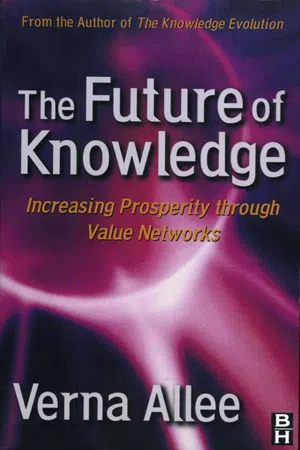
The Future of Knowledge
About this book
Verna Allee, whose groundbreaking book 'The Knowledge Evolution' helped usher in the exploding field of knowledge management, has brought her experience-tested insights into an exciting new synthesis, penetrating to the very heart of value creation. 'The Future of Knowledge' strips away traditional business thinking to reveal the new patterns of management thought and practice essential for success in a more complex world.
With a gift for making the complex simple and practical, Allee weaves together diverse threads such as business webs, communities of practice, knowledge technologies, intangibles, network analysis, and biology to show why organizations must be supported as living systems before their natural networked pattern of organization can emerge.
Embodying Allee's visionary approach, 'The Future of Knowledge' brings forward a practical view of new theories, frameworks, tools, and methods offering businesses a guide to managing the increasing levels of complexity within their organizations and in society at large.
'The Future of Knowledge' works on many levels:
* At the strategic level, the new tools are intangible scorecards and understanding value networks
* At the tactical level, the knowledge management tools for exchanging and applying knowledge are knowledge networks and communities of practice
* At the operational level, a wealth of new technologies is supporting the codification, storage and delivery of the knowledge people need to complete their routine tasks.
PART 1

The Shape of Things to Come
One
Introduction: The Center Keeps Moving
There is really only one management question: What do we need to pay attention to in order to be successful? One question, but one that has many facets. Business people knew what to pay attention to thirty years ago: profits, expenses, production, and labor. Today the answers, if we can find them at all, have changed enormously and lead to even more questions. Many of the same management words are still around but the surrounding language has evolved and expanded. Some familiar words have totally different nuances today, and we have a whole range of new ones to describe the digital world of business. Almost all our business and managing concepts have expanded, evolved into something else, or been replaced. Many of the old rules for creating value no longer apply. We now must pay attention to different things and learn new questions.
Yet, for the most part, we are still paying attention to the same things we used to, especially when it comes to thinking about organizations. We put our attention on the center and ignore the edges. Our focus isn’t really on business in general; it is on companies. The business press is filled with articles that feature a company as the central character in the great drama of business. Stories about companies also focus on the center within that center—the CEO and the leadership team. We have been focused on the parts instead of the whole system.
The corporation has been central to our thinking for a long time, but organizations have become so slippery now. They keep moving, changing, and morphing into other forms. The edges are blurred and fuzzy and seem to be spilling over into other organizations. It is getting harder to tell where one leaves off and another begins. This can be an advantage. Innovation almost always emerges from the in-between places, at the edges. Fuzzy boundaries create innovation spaces where new forms and practices are emerging.
Like a universe expanding, the reach of every company is expanding with the help of the Internet. The center of power is shifting out to the edges. Decisions are moving out from corporate headquarters to individual business units. Business units in turn distribute power and decision making to self-managed teams and profit centers. Production units and team members can be in any corner of the globe. Central control is not only impractical; it is becoming impossible. Instead of mandates passing through chains of command, we find streams of data and information flowing in every direction throughout the organization, so people can make their own decisions and adjust their actions.
How would we describe the world of business if we told the story from the edges, instead of from the center? What would we see if we stopped studying “the organization” or “the company” and focused instead on what is changing and how things are moving between the companies? What patterns and relationships would we see?
We can and are finding ways to shift our viewpoint so we can do just that. We are starting to look at the in-between places and the not-so-visible aspects of business relationships, focusing on knowledge, networks, intangibles, and emotional intelligence.
NEW FUNDAMENTALS ARE EMERGING
What do we need to pay attention to now? One has only to look at some of the hot management topics to find the learning edge for managers and leaders. Along with many of my colleagues, I have been talking with people from all over the world on these issues. Some of these conversations are with leaders and executives, but many are with middle managers and corporate support groups, including IT, finance, and human resources. They include not only people in companies and corporations but also those in nongovernmental organizations (NGOs), government agencies, and even the military.
We now know we need to pay attention to knowledge. We must understand how to better leverage organizational knowledge and intelligence to create value. The knowledge question has fired the imagination of people in every type of organization and at every level of community and government. It has swept every continent and nation from Canada to Brazil and Venezuela, from Japan and Korea through India and China, Australia, and New Zealand.
We now know that intangibles and intellectual capital need to be treated as true strategic assets. Thinking about intangible assets in business is far more revolutionary than was first apparent. Yet it makes sense that intangibles such as brand image and human competence are vital to success. Corporate citizenship and environmental responsibility are also becoming strategic concerns for companies everywhere. These too are intangible aspects of value that we are learning to pay attention to. Companies and economists struggle to develop new scorecards, metrics, and analytics that will provide leading indicators for how well a company or country is building capability for the future.
We now know that we must learn how to be better global citizens and business people. The diversity movement of the 1990s has expanded to embrace global diversity as we learn to work with and in different cultures around the world. Economic imbalances are being more closely scrutinized, with increasing pressure to seek cross-national policy solutions to trade issues, intellectual property rights, and security. We cannot afford to sit on the sidelines while policies affecting the future of all of us are up for discussion. We must find ways that the knowledge economy can usher in a new era of global prosperity.
We know too that every enterprise must pay attention to how the digital technology evolution is unfolding. E-business and the digital revolution are still “hot” focus areas, even after the bursting of the dotcom bubble. Every type of business has been impacted, and the current technology explosion is far from over.
These new issues that we are paying attention to are helping us learn to live successfully in a more complex world of globally enmeshed organizations. They are creative questions that will lead us to our future. A truly creative question is one that unfolds into new insights and understandings that are so powerful they usher us in to a new worldview and a new identity. They open the pathways we need for expanding our collective consciousness and intelligence to meet the challenges before us.
But how are we to make sense of all this? Hot management topics pop up with head snapping frequency. In a world where everything is important, how do we find what is most important?
A LARGER STORY UNFOLDING
We begin by finding the larger story. The larger story is about the changing nature, structure, and identity of organizations themselves. It isn’t about knowledge in organizations or about the digital revolution, although they are certainly aspects of what is happening. More important than either of these, though, is the fact that we are in the midst of a fundamental reinventing of business and economic models. It is about time. Our present accounting methods were developed during the Renaissance, and most of our management practices come from bureaucratic and military models that have dominated management practices for decades.
When we delve into questions of knowledge, intangibles, and true global prosperity, we find our assumptions about business and economics are knocked right off their foundations. Knowledge is an infinite resource that challenges the dominant economic models grounded in scarcity. Viewing intangibles as assets, as negotiable “goods,” and as deliverables could potentially make terms like “for profit” and “not-for-profit” obsolete. The old economic order has not been successful in bridging the gap between rich and poor. Traditional business models and structures are cumbersome, costly, and too slow.
We are finally realizing that those old enterprise models and management tools are simply inadequate for the world we are in now. As a whole society, we now need to hone our ability to live and thrive in a world where the adversarial stances between society, business, and political systems no longer make sense. We seek new foundations, new principles, and new tools that support sustainable economic success and bring true prosperity and well-being for all.
THE MORE THINGS STAY THE SAME, THE MORE THEY CHANGE
Are organizations really changing that much? Since Davidow and Malone heralded the arrival of the virtual corporation in 1992,1 people have predicted the end of the corporation and the rise of the network. However, a quick tour of labor statistics for the past ten years reveals that corporations are still very much alive and well.
The distribution of people employed by firms has held relatively steady since 1992. Far from jumping the corporate ship to become “free agents,” roughly the same number of people still collect regular paychecks from a company. People may be changing jobs more often, but they still work for a company. The self-employment rate actually dropped about one percent during the same period.2
There does not appear to be any large exodus from corporations, despite huge recessionary layoffs at giants such as Motorola and AT&T. There has been a slight dip in the number of people employed by companies with more than 1,000 employees, but the distribution mostly migrated to somewhat smaller companies.
Even the small business employment percentages have remained fairly stable overall, with small firms hovering at around half of the private sector economy. The stability of the number is due to some small firms becoming large firms and some large firms shrinking into small firms.
However, right alongside the relatively stable core of corporate America, the small business sector of the economy is proving to be an increasingly robust engine of growth. Small firms constituted about three-quarters of the employment growth and 90 percent of the new-business location growth during the 1990s.
The ratio of new companies to those going out of business has been showing a steady positive increase, attesting to the vitality of the small business sector. It is these smaller businesses, many without a payroll, that represent most of the growth in the economy.
An analysis by the U.S. Small Business Administration in year 2000 notes that most of the actual growth in employment is from small firms that grow large, while the largest decrease shows up in large business manufacturing.3 Large firms have stability, but they do not have nearly the degree of growth that small companies enjoy.
A NEW WORLD OF ORGANIZATIONS
So if employee distribution across corporations isn’t all that different, are things really changing or not? Yes they are changing—dramatically and fast. The networked economy is not a myth. A critical factor in the growth of a business is a firm’s ability to amplify and expand its influence via the Internet and digital technologies. Small businesses actively and deliberately enlarge their business networks, entering into strategic alliances that help expand their brands, strengthen capability, and help distribu...
Table of contents
- Cover
- Half Title
- Title Page
- Copyright
- Contents
- Preface
- Acknowledgments
- Part I: The Shape of Things to Come
- Part II: Operational Enterprise Knowledge
- Part III: Tactical Approaches for Sense Making
- Part IV: New Strategic Perspectives and Tools
- Part V: Principles for Prosperity
- Appendix: The Knowledge Complexity Archetype
- Glossary of Terms
- Bibliography
- About the Author
- Index
Trusted by 375,005 students
Access to over 1.5 million titles for a fair monthly price.
Study more efficiently using our study tools.
Frequently asked questions
Yes, you can cancel anytime from the Subscription tab in your account settings on the Perlego website. Your subscription will stay active until the end of your current billing period. Learn how to cancel your subscription
No, books cannot be downloaded as external files, such as PDFs, for use outside of Perlego. However, you can download books within the Perlego app for offline reading on mobile or tablet. Learn how to download books offline
Perlego offers two plans: Essential and Complete
- Essential is ideal for learners and professionals who enjoy exploring a wide range of subjects. Access the Essential Library with 800,000+ trusted titles and best-sellers across business, personal growth, and the humanities. Includes unlimited reading time and Standard Read Aloud voice.
- Complete: Perfect for advanced learners and researchers needing full, unrestricted access. Unlock 1.5M+ books across hundreds of subjects, including academic and specialized titles. The Complete Plan also includes advanced features like Premium Read Aloud and Research Assistant.
We are an online textbook subscription service, where you can get access to an entire online library for less than the price of a single book per month. With over 1.5 million books across 990+ topics, we’ve got you covered! Learn about our mission
Look out for the read-aloud symbol on your next book to see if you can listen to it. The read-aloud tool reads text aloud for you, highlighting the text as it is being read. You can pause it, speed it up and slow it down. Learn more about Read Aloud
Yes! You can use the Perlego app on both iOS and Android devices to read anytime, anywhere — even offline. Perfect for commutes or when you’re on the go.
Please note we cannot support devices running on iOS 13 and Android 7 or earlier. Learn more about using the app
Please note we cannot support devices running on iOS 13 and Android 7 or earlier. Learn more about using the app
Yes, you can access The Future of Knowledge by Verna Allee in PDF and/or ePUB format, as well as other popular books in Business & Business General. We have over 1.5 million books available in our catalogue for you to explore.