- 248 pages
- English
- ePUB (mobile friendly)
- Available on iOS & Android
eBook - ePub
About this book
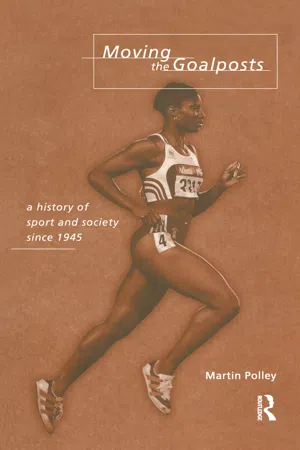
Martin Polley provides a survey of sport in Britain since 1945 and examines sport's place in British culture. He discusses issues of class, gender, race, commerce and politics, as well as analysing contemporary sport.
Chapter 1
Sport, politics, and the state
INTRODUCTION
Neil Macfarlane, Conservative Minister for Sport from 1981 to 1985, opened his memoirs of his time in office with the following observation on the relationship between sport and politics:
In the 1933 edition of the Shorter English Dictionary I keep on my bookshelf, politics are described as being ‘the science and art of government’, and sport as ‘participation in games or exercises, especially those pursued in the open air’.
I have no doubt that when the dictionary was being prepared by a Fellow of Corpus Christi, Oxford, he would have claimed with some justification that there was and should be no relation between politics and sport.1
He juxtaposed this time of apparent political neutrality for sport with the crises of his time in office, including the boycott of the Los Angeles Olympics of 1984, the debate over sporting links with South Africa, the Zola Budd affair, and the problems of football hooliganism. In following this rather simplistic and naive approach that ignored a full historical relationship between sport and politics, Macfarlane was expressing a widely held popular belief: that sport and politics did not naturally belong together. The assumptions underpinning this stance tell us a great deal about popular attitudes towards both sport and politics. It assumes, for example, that sport is a free voluntary activity that works beyond the constraints of the prevailing political economy; that sport is a private activity in which political agencies have no business; and that when political agencies do get involved, they invariably damage, corrupt, or pervert sport. What this view ignores is the long-term, structural relationship that exists between sport and political agencies at the local, regional, national, and international levels, and that political involvement is not the same as political intervention. Houlihan has astutely observed that ‘It is one of the common cliches associated with sport that “sport and politics should not mix”. Showing the naivity of such a distinction is fast becoming a sport in its own right’;2 and in the face of observations such as Macfarlane's, it is difficult not to participate in that sport. What is clear for the post-war period is that the relationship between sport and politics – using here the rather narrow sense of state structures and administration rather than the more inclusive definition of power relations and contestation of resources – is increasingly public and generally acknowledged. By exploring the main themes in the development of this relationship in the UK since 1945, we can establish a context for the current debate.
This subject has been the focus of a great deal of academic work, which we can largely link to its contemporary significance. The period since the early 1980s has seen ‘a considerable growth in interest in the relationship between politics and sport, the role of government in sport, and the way sport is organised’,3 which Hargreaves has linked specifically to the public debate over the 1980 boycott of the Moscow Olympics, which ‘was to make inroads into the ideologically important notion that sport is “non-political” in Britain’.4 Houlihan's main focus was contemporary, and we can see the growth he refers to exemplified in the essays collected by Allison in The Politics of Sport and The Changing Politics of Sport5 as Allison points out, the fact that the second book was ‘a sequel’ rather than ‘a mere new edition’ reflects the rate of change in the area.6 These deal with a diverse range of issues in sports politics, from Thomas's essay on hunting through to Allison's work on the environment.7 Surveys of the politics of leisure, whilst having a wider focus than just sport, have also been forthcoming, such as Henry's The Politics of Leisure Policy, which surveys the contemporary history of state involvement in leisure.8 We can also see the growth of interest in politics from the discipline of history. This has included wide surveys, such as Hargreaves’ Sport, Power and Culture, as well as micro-studies of specific events or themes, examples of which include Hart-Davis’ Hitler's Games and Hill's Horse Power.9 Finally, it is worth noting that a number of useful memoirs have been published since the mid-1980s, which serve not only to provide information on the careers of those directly involved in the relationship between state and sport, but also to formalise that relationship with the stamp of personal historical authority. Of particular interest here are the memoirs of two sports ministers, Denis Howell's Made in Birmingham and Neil Macfarlane's Sport and Politics, and the work of John Coghlan, a former Deputy Director-General of the Sports Council, whose Sport and British Politics since 1960 is a history heavily informed by his personal involvement.10 Add to this the increasing availability of primary sources from government archives through the annual opening of files under the 1968 Public Records Act,11 and we can see why state involvement in sport has become such an important area of study. There are, however, some gaps in this literature. While the establishment of the Sports Council and high-profile problems such as football hooliganism have been explored in depth, governmental involvement in international sport for diplomatic reasons has been underexplored. In part, this is because the official records of the highest profile events, such as the 1977 Gleneagles Agreement on sporting links with South Africa and the boycott of the 1980 Moscow Olympics, are still closed under the 1968 Act, and any study based on published sources alone will be incomplete without them. However, there is plenty of material on the earlier part of the period: such key issues as sport and the development of the Cold War, and British reactions to South Africa's sports policies in the late 1950s and early 1960s, are already open to researchers’ scrutiny. It is to be hoped that the historiography of sport and politics will soon embrace this aspect. Similarly, the issue of sport and the law has only belatedly been developed from an analytical academic standpoint, notably in the works of Foster and Grayson, and further historical research here will be beneficial.12
Despite these gaps, there is enough common ground in the existing historiography to allow us to see the emergence of a number of themes in the relationship between sport and the state since 1945. The basic issue is that, by the end of our period, the feelings expressed by Macfarlane were becoming increasingly difficult to support: such clear public examples of state involvement in sport as the existence of the Sports Council, the funding of sports projects with money from the National Lottery, the provision of sports amenities by local authorities, and the contested issues of sport and diplomacy over Moscow and South Africa could not be ignored. Whether we see this as a loss of innocence or simply a recognition that sport is about resources and representation and so inevitably falls into the state's remit is of secondary importance to the fact of a new public awareness and discussion. This is a view that is summed up well by Coghlan, who identified the ‘ever-increasing threat of governmental interference’13 as one of the dangers to the future of British sport, but appreciated that
Sport is a part of the social order of society and politics is very much about ‘social order’; the way in which we wish to live and organize our affairs. The question, therefore, is not whether or not politics should be involved in sport but rather ‘how’ politics should be involved.14
We can survey the period with an analysis of two main themes. First, we will look at the reasons for the development of a relationship between sport and state: what contexts caused the formalisation and public acknowledgement of a relationship that had traditionally been informal and, at times, covert? Second, we can look at the ways in which the relationship has developed, with concrete examples of the forms of involvement that have been forthcoming. These themes will give insights on the effects that the sport-state relationship has had on the way in which sport is played, watched, and administered by the mid-1990s. The aim is to help us step back from the everyday common-sense assumptions about the relationship between sport and politics, and think more constructively about the links. There is nothing natural about the conflict between anti-hunt protesters and a hunt, or in the state's provision of sports facilities to improve the population's health: these are historically specific political aspects. As well as helping to guide us through the historical period, this critical approach can help us avoid the polemical reactions that frequently accompany new sport and political crises, summed up in various sportsmen's defences of their contacts with South Africa. Boxer Frank Bruno retrospectively justified his 1986 fight against Gerry Coetzee by saying that the anti-apartheid issue was ‘a subject for politicians, not sportsmen’;15 while Mike Gatting's defence of the 1989 rebel cricket tour of South Africa was summed up in his observation that ‘what goes on in the townships has nothing to do with us’.16 As John Arlott wrote about an earlier run-in between English cricket and apartheid, those involved in politics ‘think in broad terms’, and see cricket as ‘no more than another facet of human relations, 17 tion that we can apply to all sports. Critical historical assessment OI why and how the state has a relationship with sport helps to maintain this broad view that is so necessary for historians.
Before pursuing this thematic survey, it is worth noting the precedents upon which the post-war relationship was based. Taking a long historical view, the regular banning of popular games by medieval monarchs probably ranks as the first major form of state intervention, while the suppression of leisure during the Commonwealth period and the nineteenth-century outlawing of animal baiting sports must be seen as continuations of this trend.18 Put simply, whenever sportive activity has posed social order problems, or has become identified with notions of indecent and uncivilised behaviour, it has found itself the subject of political action. As sport boomed in the first half of the twentieth century, so too did political involvement in sport. Various governments used sport for diplomatic purposes,19 popular gambling remained a contested area,20 and the state provision of amenities mushroomed. State involvement became more formalised with the establishment in 1935 of the Central Council of Recreative Physical Training (CCRPT) with state funding from the Ministry of Education to ‘provide a national comprehensive stimulus for post-school sport’.21 The National government extended its interest in these issues in 1937 with the Physical Training and Recreation Act, which formalised state grants to voluntary sporting and recreational organisations: this was ‘the first statute dedicated exclusively and specifically to [the] activities identified in its tide’.22 Moreover, non-governmental political organisations became increasingly involved in sport during this period, notably in the battle for ramblers’ rights that found its most famous public expression in the mass trespass on Kinder Scout in 1932,23 and in British anti-Nazis’ publicity on the politicisation of German sport as part of their wider campaign to isolate the Third Reich.24 However, while there may be nothing new about the fact of a relationship between sport and politics, the post-war period has seen some major developments in that relationship.
CONTEXTS AND CAUSES
Before considering the specific historical contexts of post-war Britain, it is useful to consider Allison's general model for state involvement, what he has called the ‘considerable and necessary politics of sport’.25 First, sport creates ‘politically usable resources’,26 such as physical health, social order, and local and national prestige, and as long as sport is organised on the basis of representation of clearly defined geopolitical entities, from village cricket eleven to national Olympic team, this aspect will be a part of sport. Second, linked to the question of organisation and ownership, Allison claims that ‘sport is divisive’:27 it arouses conflicts between different interest groups over wealth, group identity, access to resources, and even over problems of individual and public morality, as in the debate over the use of animals for human sport. These insights provide a good basis for analysis of our period. We can identify three main related reasons why the state, at central and local levels, has developed the relationship with sport: first, as part of the general growth in welfarism and collectivism; second, as a response to general social, economic, and demographic trends; and third, in response to specific crisis situations. Moreover, when we appreciate the amount of revenue that government raises from sport, we can see a basic argument for the state reinvesting in sport: 1986 estimates showed that VAT, betting duties, and other sports-related revenues were bringing central government £2.4 billion annually.28
In the immediate post-war period, the Labour government built on pre-war and wartime innovations and established the machinery of a welfare state, based around public sector health care, education, unemployment, and sickness insurance, and the nationalisation of selected industries and services.29 One of the underlying assumptions of this strategy was that the state had a right and a duty to attempt to improve individuals’ lives, and so the further development of leisure and sport provision was to be expected. As Henry has shown,30 from the mid-19408 through to the early 1960s, successive Labour and Conservative governments developed leisure policy based on welfarist principles, including the incorporation of the Arts Council in 1946 and the National Parks Commission in 1949. Sport and leisure became officially justified targets for public spending as ‘an appendage to an expanded welfare state’.31 Welfarism from then on increasingly embraced leisure, based on the predominant ideologies of the consensual collectivist state, and this is the key reason for the dramatic changes that have occurred in the sport-state relationship since 1945. However, this has obviously not been a static situation, and in line with changes in the politics of consensus associated with radical conservatism from the late 1970s, the contexts have changed. Under Thatcherism, collectivism as a predominant ideology has been replaced by a fragmentation of the welfare state and the privatisation of nationalised industries, and the development of neo-liberal and free-market strategies in welfare provision. Sport and leisure provision, as we shall see, has been affected by this new context.
However, the growth of welfarism alone is not sufficient to explain the reasons for the growth of the sport-state relationship: underlying trends in the social and economic structure of the UK, and in the UK's international position, were also responsible. With the structural changes in the workplace associated with a late industrial society and the reconstruction after the Second World War, increasing leisure time and expendable income were realities for many by the mid-1950s, setting up new kinds of demand on the sport and leisure infrastructures. In particular, the growth of private motoring, increased holiday time, and the development of television were impacting upon sport, with falling attendances at spectator sports but increasing participation rates in individual and family-based activities. In this climate, sports’ governing bodies through the renamed Central Council of Physical Recreation (CCPR) were calling for a greater co-ordination of provision to ensure that demands could be met. But other, less pleasing trends were also being observed by planners that helped to set up reasons for structured intervention. Most obvious was a growing youth problem, associated from the mid-1950s with Teds, and later with Mods and Rockers, which commentators linked not only to high levels of free time and disposable income amongst young males, but also to the end of conscription, which was wound down from 1957. In this context, a pressing need for sport to be more widely available was felt, relying on functionalist readings of sport as a means of social control, socialisation, cohesion, and discipline. These feelings were expressed most publicly in the Albemarle Report, The Youth Service in England and Wales, and the CCPR's Wolfenden Report, Sport and the Community, both of which were published in I960.32 Both reports assumed connections between the inadequacies of the existing provision of sport and leisure and the problem of idle juveniles. As Wolfenden put it, ‘there is a vast range of opportunity which is at present denied, especially to young people…. We want to see young people, particularly at the stage of adolescence, given the opportunity for tasting a wide range of physical activities.’33 This aspect has remained one of the reasons for government involvement in sport since that time, as perennial youth problems, both in times of full employment and high unemployment, have brought state attention to sports provision.
This debate in the late 1950s was also informed by a popular feeling of national decline in the international arena, brought home to the British by the related processes of decolonisation and the...
Table of contents
- Front Cover
- Half Title
- Title Page
- Copyright
- Dedication
- Contents
- Acknowledgement
- Abbreviations
- Introduction
- 1 Sport, politics, and the state
- 2 Sport, the nation, and the world
- 3 Sport, commerce, and sponsorship
- 4 Sport and gender
- 5 Sport, social class, and professional status
- 6 Sport and ethnicity
- Conclusion
- Appendix: the growing historical awareness of sport
- Notes
- Bibliography
- Index
Trusted by 375,005 students
Access to over 1.5 million titles for a fair monthly price.
Study more efficiently using our study tools.
Frequently asked questions
Yes, you can cancel anytime from the Subscription tab in your account settings on the Perlego website. Your subscription will stay active until the end of your current billing period. Learn how to cancel your subscription
No, books cannot be downloaded as external files, such as PDFs, for use outside of Perlego. However, you can download books within the Perlego app for offline reading on mobile or tablet. Learn how to download books offline
Perlego offers two plans: Essential and Complete
- Essential is ideal for learners and professionals who enjoy exploring a wide range of subjects. Access the Essential Library with 800,000+ trusted titles and best-sellers across business, personal growth, and the humanities. Includes unlimited reading time and Standard Read Aloud voice.
- Complete: Perfect for advanced learners and researchers needing full, unrestricted access. Unlock 1.5M+ books across hundreds of subjects, including academic and specialized titles. The Complete Plan also includes advanced features like Premium Read Aloud and Research Assistant.
We are an online textbook subscription service, where you can get access to an entire online library for less than the price of a single book per month. With over 1.5 million books across 990+ topics, we’ve got you covered! Learn about our mission
Look out for the read-aloud symbol on your next book to see if you can listen to it. The read-aloud tool reads text aloud for you, highlighting the text as it is being read. You can pause it, speed it up and slow it down. Learn more about Read Aloud
Yes! You can use the Perlego app on both iOS and Android devices to read anytime, anywhere — even offline. Perfect for commutes or when you’re on the go.
Please note we cannot support devices running on iOS 13 and Android 7 or earlier. Learn more about using the app
Please note we cannot support devices running on iOS 13 and Android 7 or earlier. Learn more about using the app
Yes, you can access Moving the Goalposts by Martin Polley in PDF and/or ePUB format, as well as other popular books in History & British History. We have over 1.5 million books available in our catalogue for you to explore.