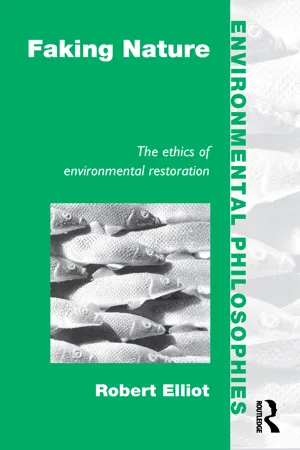
Faking Nature explores the arguments surrounding the concept of ecological restoration. This is a crucial process in the modern world and is central to companies' environmental policy; whether areas restored after ecological destruction are less valuable than before the damage took place. Elliot discusses the pros and cons of the argument and examines the role of humans in the natural world. This volume is a timely and provocative analysis of the simultaneous destruction and restoration of the natural world and the ethics related to those processes, in an era of accelerated environmental damage and repair.
- 192 pages
- English
- ePUB (mobile friendly)
- Available on iOS & Android
eBook - ePub
About this book
Information
1
THE NATURE OF NATURAL VALUE
A central claim of this book is that wild nature has intrinsic value, which gives rise to obligations to preserve it and to restore it. In other words, our obligations towards wild nature derive, in large part, from the intrinsic value that it possesses. Certainly many of our obligations concerning wild nature are only indirect obligations, being, in the first instance, obligations we have to other humans and to nonhuman animals. Thus the obligations that we have not to harm other humans or other creatures generally, let alone the more positive obligation we have to promote their interests, are likely by themselves to dictate the protection, preservation and restoration of wild nature (Clark 1979; Elliot 1984 and 1996; Singer 1976). Such human-centred and creature-centred considerations, however, nowhere near exhaust the bases of our obligations to wild nature. The intrinsic value wild nature possesses, that is, its value apart from satisfying human interests or even the interests of sentient creatures, is also an important basis of our obligations to preserve and restore wild nature. Much of the book’s argument reflects this claim, speaking, for example, of natural values, the value of wild nature generally and the value of particular natural items. The kind of value referred to in these contexts is certainly intrinsic value. As well, the claims made about obligations to preserve and restore wild nature answer back to the claim that wild nature has intrinsic value.
It is pertinent, therefore, to provide a theory of intrinsic value that describes its structure, its basis, evidence for its presence, and its relationship to duty, obligation and certain other so-called deontological concepts. It is appropriate, moreover, to begin with this theory of value in order to circumvent various critical questions that would otherwise arise: questions such as, ‘Where do these intrinsic values come from?’, ‘Are these so-called intrinsic values objective or are they merely your own subjective preferences?’, ‘What if other people don’t share these alleged intrinsic values?’ While some readers will certainly not find all aspects of the theory of environmental value and obligation satisfactory, it is best to have that theory out in the open at the outset. The theory of value developed is quite general. It is not specific to natural value, but applies wherever it is coherent to make judgements about intrinsic value. It has application even outside the domain of moral judgements, for example in the domain of aesthetic judgement. Indeed one of the issues to be pursued in a later chapter is the issue of whether natural value is better understood as aesthetic value than as moral value (Godlovitch 1989 and 1994; Lynch 1996).
The development of the theory of intrinsic value is an instance of meta-ethics. Meta-ethics does not itself, at least in the first instance, involve any attempt to establish particular normative judgements, such as judgements about what has value or about what actions should be carried out. Instead, meta-ethics investigates the framework within which the various claims of normative ethics are made. Some philosophers have claimed, though, that normative conclusions are fairly strictly entailed by meta-ethical considerations. For example, R. M.Hare thinks that the correct meta-ethical theory entails a normative theory known as preference utilitarianism. This particular normative theory says that the only intrinsic value is the satisfaction of preferences, and that the right, indeed obligatory, action is that action that maximizes the satisfaction of preferences (as in Hare 1981). Other philosophers might reject such a tight connection between meta-ethics and normative judgements and yet, as we shall see presently, urge that the correct meta-ethical theory interestingly restricts possible normative positions.
What, then, is meta-ethics? The best way of indicating its content is to list some of the questions it pursues. Thus it asks whether normative judgements can take truth values, that is, whether they can be true or false; it asks whether normative judgements are in any sense relative, for example to particular societies or groups, or whether they are universal; it asks whether, and in what sense, normative judgements are objective or open to rational adjudication; it asks whether there are any significant differences between moral beliefs and subjective preferences or desires; it asks whether there are moral facts which make moral judgements true and what the nature of those facts could be; it asks how normative judgements are connected with decisions to act; and it asks how normative judgements might be supported by evidence. Some of these questions are reminiscent, as one would expect, of the questions implicit in the previous paragraph. They reflect puzzlement about the form, as opposed to the content, of value judgements.
In contrast, normative ethics asks, for example, what kinds of things are good or bad, that is to say, what kinds of things have value or disvalue; what kinds of actions are right or wrong, permissible or obligatory; what it is that duty requires of us; what traits of character are virtuous or vicious. In other words, normative ethics is concerned with either making, or establishing the general principles for making, particular substantive ethical judgements. Thus we might make the meta-ethical claim that value judgements are really just expressions of attitudes of approval or disapproval, and we might make the normative judgement that slavery is wrong. The normative judgement offers a moral appraisal of a certain social institution, whereas the meta-ethical judgement offers an account of what is really going on when a value judgement is made. If we accept the meta-ethical theory described above, then we shall construe the judgement that slavery is wrong as the expression of disapproval of slavery in general.
As suggested above, there are differing views about how meta-ethical theories affect theories in normative ethics and vice versa. The theory of value argued for below assumes that the two domains of enquiry are relatively autonomous. In other words, it assumes that they are relatively independent of one another, with particular metaethical positions not overly restrictive of normative positions and particular normative positions not too often dependent on particular meta-ethical positions. It will be sufficient for present purposes, though, to show that the meta-ethical theory defended below is capable of supporting certain core normative claims in environmental ethics. As we shall see, one challenge that is sometimes issued to those who claim that wild nature has intrinsic value is that the claim is only interestingly sustainable if a particular kind of meta-ethical theory is assumed. It is then suggested that the meta-ethical theory, a version of what is called ‘objectivism’, is either false or incoherent. If this is so, then the relevant core claims of environmental ethics are unsustainable (see McCloskey 1980, and 1983:59–61; Mannison 1980a; Partridge 1986). One response is to attempt to rehabilitate the meta-ethical theory that is said to be false or incoherent (see Attfield 1987 and 1994; Crisp 1994; Rolston 1982, 1988 and 1994).
Another, related, challenge is that wild nature in general, or certain sorts of natural items in particular, are not the kinds of things to which intrinsic value can be coherently attributed. The suggestion is that core claims of environmental ethics, understood as moral claims, involve a category mistake. A variant of this view, already referred to, is the view that these sorts of claims could not involve moral judgements but must involve aesthetic judgements. Such claims would be analogous to the claims that Wednesday is spherical or that the number one is heavier than air or that the sum of two prime numbers is a cow. These claims do not compute, so to speak, because they apply descriptions to items that those descriptions not only do not fit but could not possibly fit. Such arguments as these, against the possibility of a radical environmental ethics, involve what we might call ‘the meta-ethical dependency thesis’. We shall come to the details later but suffice it to say that these meta-ethical dependency theses are shown to be false.1
It is common for a distinction to be drawn between axiological considerations and deontological considerations. The emphasis in this book is primarily on the axiological, although deontological issues are also addressed. Axiology is the theory of value. It attends to concepts such as ‘good’, ‘bad’, ‘evil’, ‘worthwhile’, Valuable’, all of which are used to rank objects, events, actions, and the like, on a scale of value ranging from the negative through the neutral, to the positive. Thus it might be claimed that happiness is a positive value or that pain is a negative value. Axiology has both normative and meta-ethical aspects. The meta-ethical aspect strives to provide accounts of the nature of value. It attempts to say what kinds of properties goodness, etc. are; for example, whether they are properties that things can have even if there are no valuers or whether their existence somehow depends on the existence of valuers. The normative aspect strives to provide an account of what kinds of things are good, bad, etc., or of the various properties things might have which justify particular value assessments of them. It should be noted that axiological approaches to assessments of nature and actions towards nature have been extensively criticized (Fox 1984; Naess and Rothenberg 1989; Weston 1985).
Deontology is concerned not with value or value concepts but with concepts such as ‘obligation, ‘permissibility’, ‘duty’, ‘right’ and ‘wrong’. Deontology also has both a meta-ethical aspect and a normative aspect analogous to those distinct aspects of axiology. Axiological and deontological considerations are not necessarily disconnected from one another. As we shall see, it is sometimes the case that a deontological assessment is grounded in an axiological assessment, as when something’s value is the reason for our being obliged to preserve it. This is most clearly the case with so-called maximizing consequentialisms. According to these views, deontological judgements are entirely functions of axiological judgements. For example, utilitarianism says that we have an obligation to perform that action that is most likely to maximize overall happiness. Here the utilitarian’s assessment of the good entirely determines her or his assessment of the obligatory. The connection may hold in the other direction as well, since sometimes axiological assessments flow from deontological assessments. Thus a state of affairs might have less value than it otherwise would have because it includes a wrong or impermissible action: here wrongness is bad-making. These connections will be explored and a theory of environmental obligation will be developed in the next chapter. Nor should it be thought that axiological and deontological considerations exhaust the perspectives from which moral judgements are made. One other perspective, virtue theory, will be considered later. Briefly, virtue theory provides evaluations of agents and actions in terms of the degree to which those agents and actions exemplify virtues or vices. First, the axiological theory of intrinsic value is developed.
INTRINSIC VALUE
The theory of environmental value and obligation argued for in this chapter is a special instance of an indexical theory of intrinsic value. The parameters of this indexical theory of intrinsic value may be helpfully introduced against the background of the theory of intrinsic value advanced by the G.E.Moore. One reason for choosing Moore’s theory is that it is the kind of theory that the first version of meta-ethical dependency thesis, described above, attempts to foist upon those who endorse strong environmentalist normative claims. Moore’s theory has three central components: (i) that to say that something has intrinsic value is to say that ‘it ought to exist for its own sake, is good in itself’ (Moore 1963:5); (ii) that to say of something that it has intrinsic value is to attribute to it a simple, unanalysable, non-natural property; (iii) that concerning the claim that something has intrinsic value, he held that ‘no relevant evidence whatever can be adduced…. We can guard against error only by taking care, that when we try to answer a question of this kind, we have before our minds that question only, and not some other…’. (ibid.).
The first of Moore’s components provides an account of what is meant by ‘intrinsic value’. It tells us that it is the kind of value that is worth securing for its own sake and that it is the kind of value that makes a thing good considered in itself. Perhaps the best contrast is with instrumental value, which is the value that something has in virtue of its usefulness, in virtue of what it leads to or contributes to, rather than the value it has in virtue of its own properties or characteristics. Thus a glass of wine might be said to have instrumental value in virtue of its capacity to bring into existence a sensation of pleasure. Or it might be claimed that a forest has instrumental value in virtue of the recreational and aesthetic pleasure it affords. In each case the instrumental value connects with a judgement about intrinsic value attaching to some other thing. Thus the instrumental value of the wine is based upon the intrinsic value of pleasure. Likewise in the case of the instrumental value of the forest. There is, by the way, no difficulty in the claim that instrumental and intrinsic value can attach to the very same object. Thus Jane’s happiness, which is intrinsically valuable, may be a cause of John’s happiness, and so be instrumentally valuable too. As we shall later see, accounts of intrinsic value can become quite complicated, and some commentators argue that to try to understand intrinsic value in terms of the contrast with instrumental value is to misunderstand it. This issue is pursued below.
The second component of Moore’s theory of intrinsic value establishes it as realist, objectivist and non-naturalist. It is realist because it entails that judgements about intrinsic value take truth values, that is to say it entails that judgements about intrinsic value can be true or false (Sayre-McCord 1988:5; Schiffer 1990:602). Moore’s theory is objectivist in that it denies that judgements about intrinsic value can be properly recast as judgements about the psychological states or properties of valuers. The contrast here is with subjectivist theories, which claim that judgements about intrinsic value can be recast in terms of judgements involving the psychological states of valuers. For example, a crude subjectivist might recast the claim that wild nature has intrinsic value as the claim that a particular valuer prefers that wild nature continue to exist. On Moore’s view, by contrast, the preferences of the valuer would have no bearing on the question of whether wild nature had intrinsic value. It is important to be very careful in framing the second component of Moore’s view. In particular, it should not be taken to deny that the existence of particular psychological states is of intrinsic value or, indeed, is the only thing that has intrinsic value. For example, Moore thought that experiencing pleasure had intrinsic value, and he presumably thought this because of the specific quality of such experiences. So the nature of a psychological state has a bearing on what has intrinsic value. However the judgement that the state in question does have intrinsic value does itself get recast in terms of some psychological state which takes the experiencing of the pleasure as its object—as, for example, the judgement that some particular valuer prefers to experience pleasure. The fact of intrinsic value attaching to the experiencing of pleasure is not, according to Moore, itself a fact about the psychological states of valuers. Although the presence of intrinsic value depends upon such facts, as we shall see below, it is a quite distinct property.
Moore’s theory is also non-naturalist, which is to say that the property of being intrinsically valuable is not a natural property of those things that have intrinsic value. It is difficult to characterize a natural property in contrast to a non-natural property. A starting point is to think of natural properties as properties detectable by the senses or through scientific investigation. Natural properties are, in other words, empirically detectable. Non-natural properties are difficult to characterize positively. We could simply say that they are the properties other than the natural properties but that is not very illuminating. A starting point is to say that non-natural properties are those that are discoverable only through the understanding, without recourse to sensations or experience, or through some non-sensory faculty. The properties of numbers are, arguably, non-natural properties in that they are discoverable only through the understanding: they are not discovered through the use of the senses or through empirical investigation. In the case of allegedly non-natural moral properties, the idea is that they are comprehended through some purely intellectual act or through the exercise of some special, non-sensory faculty of moral intuition. Some commentators, as a consequence of this difficulty of explaining what is involved in comprehending non-natural moral properties, have taken the view that there is something too mysterious and unacceptably spooky about them (see Mackie 1977). They do not fit with a scientific view of the world.
While Moore thinks that moral properties are non-natural properties, he accepts that we do not come to know them independently, in one sense at least, of our knowledge of natural properties. Moore takes this view because he believes that, for example, the non-natural property of being intrinsically valuable is not free-floating; in other words it is not a property that a thing possesses independently of other particular properties it possesses. Rather he believes that non-natural moral properties are resultants of, supervene upon, are necessarily connected with, or are otherwise systematically dependent on, other of a things properties. And clearly most of these other properties are natural properties. The reason for saying ‘most’ as opposed to ‘all’ is that it is at least conceivable that the property of being intrinsically valuable is dependent upon some other non-natural property, for example another non-natural moral property such as rightness or some non-natural property of a number such as the property of being prime. One of the problems Moore’s view faces is that of explaining the dependency relationship between moral properties and other, mostly natural, properties. This dependency operates at both the metaphysical and epistemological levels. In other words the dependency is a condition of the very existence of moral properties: moral properties cannot be instantiated unless other properties are instantiated. Furthermore, moral properties are only comprehended after we become aware of certain nonmoral properties. In attempting to establish whether some action is wrong we seem compelled to attend to and to note its various nonmoral properties. For example we might note that some act is an act of deception, an act of gratuitous violence, or a self-seeking act, and having grasped some such fact about it we come to understand that it is wrong.
The third component of Moore’s view concerns evidence for intrinsic value. The chief point is that judgements about a things intrinsic value are established through careful reflection on the thing in question, by attempting to understand, grasp or appreciate all of the thing’s characteristics. The idea is that something akin to a raw feel or affect is involved at the final stage in...
Table of contents
- ENVIRONMENTAL PHILOSOPHIES SERIES
- CONTENTS
- PREFACE
- ACKNOWLEDGEMENTS
- 1 THE NATURE OF NATURAL VALUE
- 2 ENVIRONMENTAL OBLIGATION, AESTHETIC VALUE AND THE BASIS OF NATURAL VALUE
- 3 FAKING NATURE
- 4 NATURALNESS, INTRINSIC VALUE AND RESTORATION ECOLOGY
- NOTES
- REFERENCES
- INDEX
Trusted by 375,005 students
Access to over 1.5 million titles for a fair monthly price.
Study more efficiently using our study tools.
Frequently asked questions
Yes, you can cancel anytime from the Subscription tab in your account settings on the Perlego website. Your subscription will stay active until the end of your current billing period. Learn how to cancel your subscription
No, books cannot be downloaded as external files, such as PDFs, for use outside of Perlego. However, you can download books within the Perlego app for offline reading on mobile or tablet. Learn how to download books offline
Perlego offers two plans: Essential and Complete
- Essential is ideal for learners and professionals who enjoy exploring a wide range of subjects. Access the Essential Library with 800,000+ trusted titles and best-sellers across business, personal growth, and the humanities. Includes unlimited reading time and Standard Read Aloud voice.
- Complete: Perfect for advanced learners and researchers needing full, unrestricted access. Unlock 1.5M+ books across hundreds of subjects, including academic and specialized titles. The Complete Plan also includes advanced features like Premium Read Aloud and Research Assistant.
We are an online textbook subscription service, where you can get access to an entire online library for less than the price of a single book per month. With over 1.5 million books across 990+ topics, we’ve got you covered! Learn about our mission
Look out for the read-aloud symbol on your next book to see if you can listen to it. The read-aloud tool reads text aloud for you, highlighting the text as it is being read. You can pause it, speed it up and slow it down. Learn more about Read Aloud
Yes! You can use the Perlego app on both iOS and Android devices to read anytime, anywhere — even offline. Perfect for commutes or when you’re on the go.
Please note we cannot support devices running on iOS 13 and Android 7 or earlier. Learn more about using the app
Please note we cannot support devices running on iOS 13 and Android 7 or earlier. Learn more about using the app
Yes, you can access Faking Nature by Robert Elliot in PDF and/or ePUB format, as well as other popular books in Philosophy & Ethics & Moral Philosophy. We have over 1.5 million books available in our catalogue for you to explore.