Building on a growing movement within developing countries in Latin America, Africa, and Asia-Pacific, as well as Europe and North America, this book documents cutting edge practice and builds theory around a rights based approach to women's safety in the context of poverty reduction and social inclusion. Drawing upon two decades of research and grassroots action on safer cities for women and everyone, this book is about the right to an inclusive city.
The first part of the book describes the challenges that women face regarding access to essential services, housing security, liveability and mobility. The second part of the book critically examines programs, projects and ideas that are working to make cities safer.
Building Inclusive Cities takes a cross-cultural learning perspective from action research occurring throughout the world and translates this research into theoretical conceptualizations to inform the literature on planning and urban management in both developing and developed countries. This book is intended to inspire both thought and action.
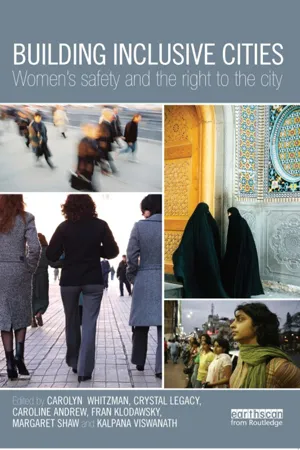
eBook - ePub
Building Inclusive Cities
Women’s Safety and the Right to the City
- 240 pages
- English
- ePUB (mobile friendly)
- Available on iOS & Android
eBook - ePub
Building Inclusive Cities
Women’s Safety and the Right to the City
About this book
Information
Chapter 1
Introduction
Challenges, opportunities and tools1
Edited By Margaret Shaw, Caroline Andrew, Carolyn Whitzman,, Fran Klodawsky, Kalpana Viswanath, and and Crystal Legacy
The movement to increase the safety of women in cities has been growing over the past fifteen to twenty years in many regions of the world. It involves a surprisingly varied range of people, of all ages, backgrounds, races and cultures, in large and small cities, and working in communities, organizations and governments. They have been very creative and innovative, exchanged ideas, and in turn been inspired by other groups, individuals and organizations. The concept of a safe city for women has become more sophisticated and tangible, to encompass much more than just the absence of violence in women’s lives. It has become more cross-disciplinary. The Third International Conference on Women’s Safety: Building Inclusive Cities, which took place in New Delhi India in November 2011, marks the significance of this growth and movement and formed the inspiration for this book. As the Background Paper for that conference puts it:
The Third International Conference on Women’s Safety provides an important opportunity to assess some of the current and emerging trends, achievements and challenges in building safe and inclusive cities for women and girls. It is grounded in a systemic rights-based approach to women’s safety that recognizes diversity. It emphasizes the need to work towards more equitable access to the opportunities cities can offer, regardless of age, gender, race, religion, sexual orientation, immigrant status, disability or any other factor, for all city dwellers, and it strongly reaffirms that solutions introduced by women to enhance safety will make cities safer for all.
(WICI and Jagori, 2010, p. 1)
The Delhi conference was the third in a series spanning the past decade, concerned with the growth in knowledge and networks about how to increase the safety of women and make more visible the role of women in this work. The First International Women’s Safety Seminar, ‘Making the links’, was held in Montreal, Canada, in 2002.2 The second conference, entitled ‘Safer Cities’, was held in Bogota, Colombia, in 2004.3 All three conferences have resulted in Declarations on women’s safety that have helped to set the agenda for national and local governments, international organizations, community-based women’s groups and civil society in general.
The Delhi conference brought together a wide range of people, from fortyfive countries and eighty-one cities, to consider how women and girls can live more equitable and fulfilling lives in the face of some rapidly changing patterns of life across the globe. These changing patterns include increasing urbanization, the growing migration of women to cities, and environmental disasters and climate change. Globalization and technological changes are impacting lives in both positive and negative ways, and, as always, their impact on women and girls differs from that on men and boys in some very significant ways.
The themes of the conference are also reflected in the new vision for UN Women, as outlined by Michelle Bachelet, the first Executive Director, in January 2011 (see Box below).
UN Women’s New Vision
UN Women’s new vision and 100-day action plan includes five main thematic areas:4
- 1 Expanding women’s voice, leadership and participation, working with partners to close the gaps in women’s leadership and participation in different sectors and to demonstrate the benefits of such leadership for society as a whole.
- 2 Ending violence against women by enabling states to set up the mechanisms needed to formulate and enforce laws, policies and services that protect women and girls, promote the involvement of men and boys, and prevent violence.
- 3 Strengthening implementation of the women, peace and security agenda, through women’s full participation in conflict resolution and peace processes, gender-responsive early-warning, protection from sexual violence and redress for its survivors in accordance with UN resolutions.
- 4 Enhancing women’s economic empowerment is particularly important in the context of global economic and environmental crises. UN Women will work with governments and multilateral partners to ensure the full realization of women’s economic security and rights, including productive assets and full social protection.
- 5 Making gender-equality priorities central to national, local and sectoral planning and budgeting, working with partners, UN Women will support national capacities in evidence-based planning, budgeting and statistics.
These priorities resonate strongly with the themes of the conference and the overall movement to increase women’s security and inclusion in cities: the combination of women’s leadership and voice; the importance of anti-violence work; and the focus on making sure that gender equality is seen as central to the issues of planning and budgeting across all levels of government.
This chapter provides a broad overview of some of the main global trends that are affecting women’s and girls’ lives, the implications of which are discussed in more detail in the subsequent chapters of the book. They can be seen as challenges, but equally as opportunities that can be exploited to further greater equality and access to the benefits of healthy urban life. Before exploring these, however, it is necessary to consider what we mean by the safety of women and girls.
Defining some terms: what do we mean by women’s safety and other concepts used in this book?
Defining terms is always important, even though not everyone is always in agreement about precise wording. This may apply to some of the authors in this book, and the following definitions are not intended to trump their own understandings but simply to encourage discussion and dialogue. Concepts and understandings also change over time. What is more important is to set down some of the key concepts that are currently being used around the world, to help understand trends and action, and to frame problems and perhaps solutions. In many cases, but not all, they are grounded in internationally agreed upon definitions.
Two of the most important are violence against women and genderbased violence. The 1993 Declaration on the Elimination of Violence Against Women was the first international human-rights instrument exclusively to address the issue of violence against women (VAW). It defines it in Article 1 as:
Any act of gender-based violence that results in, or is likely to result in, physical, sexual or psychological harm or suffering to women, including threats of such acts, coercion or arbitrary deprivation of liberty, whether occurring in public or private life.5
This definition has formed the basis for an enormous amount of action internationally, but has tended to be understood and acted upon primarily in relation to violence occurring in intimate or family settings – in private space.
To reflect the fact that violence against women results from an imbalance of power between women and men, and that women are subjected to it because of their gender, the term gender-based violence (GBV) in the definition has also come to be used widely at the international level over the past decade. The 1995 Fourth World Conference on Women (Beijing) recognized the elimination of gender-based violence as central to gender equality and the empowerment of women.6
As suggested above, in many countries, much of the work to eliminate violence against women focused initially on private or intimate violence. The fact that women were also at risk of violence and felt insecure about their safety in their daily lives outside the home and in public spaces remained unarticulated in policy terms. In part, this has reflected notions of women’s culpability in inviting violence, that they ‘asked for it’ or should have stayed at home, that they were somehow less respectable than ‘other’ women. Government advice in the 1980s and 1990s tended to place the burden of responsibility on women themselves in terms of how they dressed and when and where they went out. More recently, the disappearance of women from city spaces has been ignored or downplayed by police and governments, as is demonstrated by the numbers of missing and murdered Aboriginal women in Canada, or the femicide which has occurred in Mexican or Central American cities (Native Women’s Association of Canada, 2010; Prieto-Carrón et al., 2007, p. 35).
Thus, the concept of women’s safety grew out of this recognition that women have just as much right to go out and to use public spaces as men, and that their lives should not be restricted by fear or actual violence. It has been defined as involving ‘strategies, practices and policies with the goal of reducing gender-based violence and women’s fear or insecurity of violence’ (Shaw and Capobianco, 2004, p. 5; Shaw and Andrew, 2005). In practice, strategies around women’s safety focus on what can be done at the community and local level to increase their safety, and on the responsibilities of city governments and other sectors to take action, rather than blaming individual women.
What is useful about the concept of women’s safety is that it offers a positive paradigm that places more focus on communities and the role of cities, and encourages practical initiatives that help create safer cities. It underlines that there is a continuum between private and public violence that requires us to work on both (Sweet and Ortiz Escalante, 2010; Shaw, 2009). However, the concept of safety has, over the past few years, come to be seen as being about more than just violence: it has expanded to include freedom from poverty, financial security and autonomy, and having a sense of self-worth, as they are all inextricably linked (Falu and Segovia, 2008; Lambrick and Travers, 2008). The full diversity of women and the importance of intersectionality have been central to the movement for the creation of safer cities for women. Economic, physical and environmental security are all key, as are an absence of exploitation, exclusion and injustice (Moser, 2004; Falu and Segovia, 2008).
Two other concepts that are especially relevant to building safe cities for women are gender mainstreaming and the right to the city. Gender mainstreaming was defined by the UN in 1997:
Mainstreaming a gender perspective is the process of assessing the implications for women and men of any planned action, including legislation, policies or programmes, in all areas and at all levels.... The ultimate goal is to achieve gender equality.7
Gender mainstreaming initially had a difficult history. For some governments and policymakers, it was interpreted to mean that there was no longer a need to allocate specific funds and resources for women’s issues. The result was often a cutting of resources for women’s departments and committees, and a loss of focus on women’s issues in policies and practice. More recently, however, there has been renewed attention to what gender mainstreaming means and requires, together with the development of tools that help to ensure that it is happening. These include gender auditing and gender budgeting, which are discussed elsewhere in this book. In relation to women’s safety, gender mainstreaming aims to ensure that both women’s and men’s safety issues are separately taken into account at all levels of government and in all policies and interventions developed. This ranges from the routine collection of data on women’s and men’s concerns to the inclusion of women’s voices in policy and strategy development (Moser, 2008).8
What is often forgotten is that gender includes not just women and girls but also men and boys. One of the important developments in recent years has been the recognition that increasing the safety of women requires considerable work to change culturally accepted attitudes about women, including acceptance of violence and exploitation. A number of programmes and networks have begun to emerge around the world that place an emphasis on the need to change the cultural acceptance of violence, and offer alternative lifestyle choices to men and boys.
A more recent concept is that of the right to the city, which builds on the 1948 Universal Declaration of Human Rights among other international declarations. As set out in the World Charter on the Right to the City in 2004–5, the notion of the right to the city is concerned with the right of all individuals living in cities to liberty, freedom and the benefits of city life. It stresses transparency, equity and efficiency in the administration of cities, participation and respect in local democratic decision-making, recognition of diversity in economic, social and cultural life, and the reduction of poverty, social exclusion and urban violence (Brown and Kristiansen, 2009).9 The Charter has been endorsed by a number of countries and cities as a valuable normative framework that protects all types of human rights and fosters social inclusion in cities. This includes issues around urban development or renewal and the use of public and private space (Brown, 2010, p. 6). Expanding this still further, women’s right to the city is seen as including:
- • access to safe and healthy land and housing;
- • the prevention of homelessness and forced evictions;
- • access to essential services (water, sewage, waste disposal, roads, power etc.);
- • access to other public services (health care, education, recreation etc.);
- • the ability to move around the city in safety;
- • access to safe...
Table of contents
- Front Cover
- Building Inclusive Cities
- Title
- Copyright
- Contents
- List of figures
- List of tables
- Notes on contributors
- Acknowledgements
- List of abbreviations
- 1 Introduction: challenges, opportunities and tools
- Part I Challenges and opportunities
- Part II Interventions
- Part III Tools
- Index
Trusted by 375,005 students
Access to over 1.5 million titles for a fair monthly price.
Study more efficiently using our study tools.
Frequently asked questions
Yes, you can cancel anytime from the Subscription tab in your account settings on the Perlego website. Your subscription will stay active until the end of your current billing period. Learn how to cancel your subscription
No, books cannot be downloaded as external files, such as PDFs, for use outside of Perlego. However, you can download books within the Perlego app for offline reading on mobile or tablet. Learn how to download books offline
Perlego offers two plans: Essential and Complete
- Essential is ideal for learners and professionals who enjoy exploring a wide range of subjects. Access the Essential Library with 800,000+ trusted titles and best-sellers across business, personal growth, and the humanities. Includes unlimited reading time and Standard Read Aloud voice.
- Complete: Perfect for advanced learners and researchers needing full, unrestricted access. Unlock 1.5M+ books across hundreds of subjects, including academic and specialized titles. The Complete Plan also includes advanced features like Premium Read Aloud and Research Assistant.
We are an online textbook subscription service, where you can get access to an entire online library for less than the price of a single book per month. With over 1.5 million books across 990+ topics, we’ve got you covered! Learn about our mission
Look out for the read-aloud symbol on your next book to see if you can listen to it. The read-aloud tool reads text aloud for you, highlighting the text as it is being read. You can pause it, speed it up and slow it down. Learn more about Read Aloud
Yes! You can use the Perlego app on both iOS and Android devices to read anytime, anywhere — even offline. Perfect for commutes or when you’re on the go.
Please note we cannot support devices running on iOS 13 and Android 7 or earlier. Learn more about using the app
Please note we cannot support devices running on iOS 13 and Android 7 or earlier. Learn more about using the app
Yes, you can access Building Inclusive Cities by Carolyn Whitzman, Crystal Legacy, Caroline Andrew, Fran Klodawsky, Margaret Shaw, Kalpana Viswanath, Carolyn Whitzman,Crystal Legacy,Caroline Andrew,Fran Klodawsky,Margaret Shaw,Kalpana Viswanath in PDF and/or ePUB format, as well as other popular books in Architecture & Urban Planning & Landscaping. We have over 1.5 million books available in our catalogue for you to explore.