- 240 pages
- English
- ePUB (mobile friendly)
- Available on iOS & Android
eBook - ePub
About this book
Michael Littlewood's Landscape Detailing is now well established as a valuable source of reference for architects, landscape architects, other professionals and students designing external works. For this third edition it has been split into three volumes to give a greater
depth of coverage than ever before.
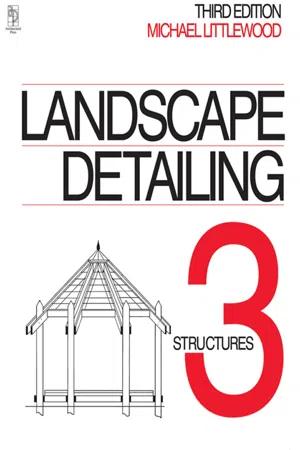
Volume 3 covers pergolas, arbours, arches, gazebos, summer houses, sheds, shelters, decks, footbridges, furniture and roofs. Each section begins with technical guidance notes on design and construction. This is followed by a set of drawn-to-scale detail sheets. These details can be traced for direct incorporation into the set of contract drawings. A list of relevant references, bibliography and a list of association and institutions indicate where further guidance can be obtained.
A ready reference for landscape designers and an indispensable time-saving tool, Landscape Detailing is an essential for the design office.
Information
Roofs
Design Factors
- Structural loadings
- Drainage
- Membrane
- Planting medium
- Irrigation
- Materials
- Features
- Services
- Safety
In designing a residential garden or a commercial landscape on a building above the ground there are special factors to be considered compared to ground level developments. These are:
Access – to the roof from the ground, especially during the construction phase and afterwards for maintenance.
Location – if the building and roof are very exposed on all sides considerable protection from wind and sun, as well as climatic extremes of hot and cold.
Roof – whether the existing roof is capable of having a garden or whether it can be amended to take the additional weight of a garden.
Drainage – there must be quick and positive surface and subsurface drainage to prevent flooding due to heavy rains. The weight of accumulated ice and snow must not exceed the weight limits of the roof’s structural system.
Planting Medium – this must be lightweight, long lasting, good water permeability, air retention capacity and root penetration, with a high water intake and storage followed by a slow and continuous supply of water to the plants.
Irrigation – this is essential to ensure the survival of plants in a hostile environment and must be allowed for in the design. Materials – it is essential that these are lightweight but robust to resist harsh climate conditions.
Features – the design of features must ensure the protection of the integrity of the roof and structure, particularly water.
Services – these are integral to the success of the roof garden/landscape and need to be considered at the outset.
Safety – the need for fire escape is a priority and the design of the roof landscape must ensure that there is not restriction of fire exits/ladders.
Protection of users going close to the edge is equally important.
1. Structural Loadings
Provision has to be made for the weight of soil, materials, plants and for people on a roof garden. A structural engineer should always be consulted before commencing any type of roof design.
Structural movement joints are one of the points likely to fail and should not be covered by any planters/plants. If it is unavoidable there are ways to design a solution to the problem.
2. Drainage
Adequate falls on the existing roof are necessary to ensure the removal of surplus water along with the appropriate number of drains. Roof drains, like all others used in the garden, should be designed to collect both surface and lateral subsurface drainage water.
This type of planting medium used on roofs ensures downward percolation of water direct to the sealed surface. Positive lateral drainage is then necessary through the subsurface of the soil to the drains.
There are a number of typical drainage details that can be used on roof landscapes and these are shown in illustrative form. Provision should be made for cleaning of the drains at periodic intervals.
3. Membrane
It is essential that the material chosen for the waterproof membrane is appropriate as there are for the project two types – continuous membranes and jointed membranes. For projects with a large area the only continuous membrane is asphalt. Smaller projects would use jointed membranes.
A typical section through a roof consists of the structural framing or reinforced concrete slab, sometimes a sloping layer of thin concrete to provide drainage to roof drains, a layer of waterproofing material, a layer of insulation, and a layer of lightweight concrete to protect the insulation and the waterproof membrane. This final layer of lightweight concrete is sloped to carry off surface drainage.
The most important consideration is to protect the roof and its waterproofing at all times and it is the designer’s responsibility to ensure that this is achieved. This starts with the bottom of the subdrainage layer to the finished roof.
4. Planting Medium
The critical factors in the formulation of a suitable planting medium for roof garden planting are lightweight, the ability to hold nutrients for plant growth, and the capability of developing a firm but easily drained soil structure.
There have been various mediums used in roof gardens. A base layer of lightweight clay granules topped with lightweight compost containing vermiculite, perlite or polystyrene with a 50/50 mix of loam and peat substitute is common. Grodan – a lightweight soil substitute produced from volcanic rock could be used; in addition to being a uniform growing substrate it has sound and temperature insulation qualities. It is available in slab form and placed over a reservoir of lightweight aggregates and, providing water is replenished regularly, capillary action ensures that the root zone is kept moist and the water/air balance constant.
Ready-mixed soils are available commercially, but a suitable soil mixture can be prepared for each project following the given formula per cubic metre:
½ m2 fine sand
½ m2 pine bark
500 gms calcium nitrate
1½ kg single superphosphate
500 gms sulphate of potash
3½ kg dolomite lime
When this mix is too heavy it may be lightened by substituting 3 parts expanded shale in No. 8 screen and 3 parts expanded shale No. 10 (texture of fine sand) for the sand elements. Expanded shale is commonly used in place of gravel in lightweight concrete and is generally available from suppliers of concrete materials.
Fine sand
The fine sand used in soil mixes is of critical importance in terms both of the soil’s drainage characteristics and of its ability to function without blocking the permeability of the filter blanket.
Soil Amendments
Organic materials such as fertilisers – particularly nitrogen, but also other minerals which go into solution – will gradually dissolve and be leached away by watering. Local public water supplies may also lack calcium, magnesium and sulphur. Thus, periodic replacement of these and other materials by surface application may be needed. At least once a year, soil tests should be made by a competent soils laboratory to determine deficiencies and to recommend additives.
Roof Weight Reduction
If optimum soil depths result in excessive weight on the structure, then lig...
Table of contents
- Cover
- Half Title
- Title Page
- Copyright
- Contents
- Foreword
- Acknowledgements
- Introduction
- Pergolas, arbours, arches and lych gates
- Shelters, gazebos and sheds
- Decks and boardwalks
- Pedestrian bridges
- Outdoor furniture
- Signs and information
- Roofs
- Appendix A
- Appendix B
- Appendix C
- Appendix D
Trusted by 375,005 students
Access to over 1.5 million titles for a fair monthly price.
Study more efficiently using our study tools.
Frequently asked questions
Yes, you can cancel anytime from the Subscription tab in your account settings on the Perlego website. Your subscription will stay active until the end of your current billing period. Learn how to cancel your subscription
No, books cannot be downloaded as external files, such as PDFs, for use outside of Perlego. However, you can download books within the Perlego app for offline reading on mobile or tablet. Learn how to download books offline
Perlego offers two plans: Essential and Complete
- Essential is ideal for learners and professionals who enjoy exploring a wide range of subjects. Access the Essential Library with 800,000+ trusted titles and best-sellers across business, personal growth, and the humanities. Includes unlimited reading time and Standard Read Aloud voice.
- Complete: Perfect for advanced learners and researchers needing full, unrestricted access. Unlock 1.5M+ books across hundreds of subjects, including academic and specialized titles. The Complete Plan also includes advanced features like Premium Read Aloud and Research Assistant.
We are an online textbook subscription service, where you can get access to an entire online library for less than the price of a single book per month. With over 1.5 million books across 990+ topics, we’ve got you covered! Learn about our mission
Look out for the read-aloud symbol on your next book to see if you can listen to it. The read-aloud tool reads text aloud for you, highlighting the text as it is being read. You can pause it, speed it up and slow it down. Learn more about Read Aloud
Yes! You can use the Perlego app on both iOS and Android devices to read anytime, anywhere — even offline. Perfect for commutes or when you’re on the go.
Please note we cannot support devices running on iOS 13 and Android 7 or earlier. Learn more about using the app
Please note we cannot support devices running on iOS 13 and Android 7 or earlier. Learn more about using the app
Yes, you can access Landscape Detailing Volume 3 by Michael Littlewood in PDF and/or ePUB format, as well as other popular books in Architecture & Urban Planning & Landscaping. We have over 1.5 million books available in our catalogue for you to explore.