The impetus for this book emerged from a conference that brought together publishers, and reading researchers and educators for the purpose of examining the best available research evidence about what we know -- and what we have yet to learn -- about the teaching of reading and about how children learn to read. The goal of the conference was to contribute to a sound research base upon which to develop classroom practices that will ensure that every American child will become fully literate.
Because the field is still so deeply divided over the best ways to translate belief into classroom practice, the editors decided to highlight rather than gloss over these divisions. It is hoped that the papers in this volume will promote thought and discussion that will lead to action in improving reading instruction for children, now and into the new century.
eBook - ePub
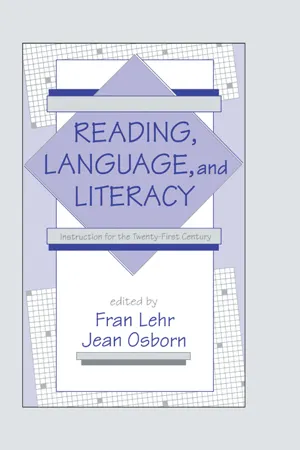
Reading, Language, and Literacy
Instruction for the Twenty-first Century
- 320 pages
- English
- ePUB (mobile friendly)
- Available on iOS & Android
eBook - ePub
About this book
Information
I
Learning About Print
| 1 | Phonics and Beginning Reading Instruction |
Bolt Beranek and Newman
and Center for the Study of Reading
Whatever one’s dreams and priorities for America’s future might be, finding ways to correct the shortcomings and unevenness of our children’s literacy education can only be recognized as an enormous and enormously complicated challenge. Although few cultural requirements are as important to a child’s life as that of becoming a reader, it is equally true that few are as complex.
But even while the education community may face no greater challenge in terms of urgency, scope, or importance, efforts toward progress have been broadly deferred to a dispute over a single set of subissues—the role of phonics instruction in beginning reading. Indeed, whether phonics should be taught at all is perhaps the most hotly debated, highly politicized, and divisive issue in elementary education. In essence, the objection to phonics centers on the claim that its instruction impedes development of the attitudes and abilities required for reading with pleasure and comprehension. If correct, this claim can only be seen as a wholly insuperable negative. After all, the very goal of reading instruction is precisely and inarguably to foster the disposition as well as the ability to read purposefully, reflectively, and productively. Rather than dismiss this objection, therefore, I have focused this chapter on its arguments and counterarguments.
Framing the Issues
Across the instructional literature, the value of phonics instruction has been demonstrated with sobering consistency across literally hundreds of studies— including small, well-controlled laboratory studies as well as large-scale method comparisons involving hundreds of classrooms and thousands of children. Collectively, these studies argue that, when developed as part of a larger program of reading and writing, phonics instruction leads to higher group achievement at least in word recognition and spelling, at least in the primary grades, and especially for economically disadvantaged and slower students (see Adams, 1990, Chapter 3).
Yet it would be hasty to act on this conclusion without closer analysis. First, neither the well-controlled laboratory studies nor the large-scale classroom studies allow us to pinpoint the source of the phonics advantage. Whereas the laboratory studies provide clean contrasts of whatever variables they were designed to assess, they leave one wondering about the would-be influence of all those factors that were constrained or absent through experimental control: How would the instructional contrasts have held up if the research had been conducted in a real classroom, in the context of a real reading curriculum, with real teachers and students, and over a reasonably realistic time course? The classroom studies, in contrast, offer real-world validity. In doing so, however, they leave one wondering about those many factors that, although unavoidably present, were uncontrolled or unmeasured: Who were the particular students? Who were the particular teachers? What about the specifics of the programs’ implementations?
These are not frivolous questions. The phonics advantage documented by this research is neither awesomely large nor comfortingly reliable. Even while the studies collectively affirm that phonics instruction is, on average, a positive component of early reading development, they also demonstrate that there are enormous differences in the outcomes of any program depending on the particular schools, teachers, children, and implementation vagaries involved. In particular, even where phonics has been taught, even where it has been taught under the watchful eye of researchers, there have remained many children who nonetheless have experienced difficulty in learning to read.
Why? How can we explain this variability? One possibility is that the effectiveness of phonics instruction depends on individual characteristics of the children. After all, not all children are alike. Some, it has been argued, are global perceivers by nature, and some are analytic; some are auditorily attuned by nature, and some are visual. Phonics, it has been suggested, may well be a good thing for those children who are analytically and auditorily oriented, but what about the others? With global visual predispositions, would they not be fettered, even frustrated and discouraged, with a phonic approach? More generally, would it not be wise to design instructional processes and materials to accommodate such differences in children’s perceptual styles or dominant modalities?
In fact, this argument has been quite broadly advocated and adopted. Although today its allure is saliently evidenced by the large following that Carbo, Dunn, and Dunn (1986) have attracted, they did not start it. In a mid 1970s study of special education teachers in Illinois, Arter and Jenkins (1977) found that 95% were familiar with the argument. Of those familiar with it, 99% believed that modality preferences should be a primary consideration in devising instruction for children with learning difficulties.
Arter and Jenkins also found that nearly all the teachers who were familiar with this argument believed it to be well supported by research. But it is not. Over the years, many, many, empirical studies have been conducted on this issue. Despite the energy thereby invested, however, the hypothetical interaction between program effectiveness and preferred modalities is not supported by the data. Instead, working knowledge of phonics seems an asset for all young readers (see Stahl, this volume). Research persistently indicates that weaknesses in basic decoding skills are the most common and can be the most pervasive and debilitating source of reading difficulties (see, e.g., Perfetti, 1985; Stanovich, 1986; Vernon, 1971; Williams, 1991).
The implication, once again, is that there is something about phonics—or, at least, about the knowledge and abilities that phonics is intended to foster—that is of general, substantive, and long-lasting value to all young readers. If so, then the iffiness of its effectiveness would seem to lie in its realization. One clear problem is that phonics is, by no means, all there is to learning to read. Beyond that, however, there exist literally hundreds of “phonic” programs and thousands of “phonic” techniques, and the differences among them are substantial (see, e.g., Aukerman, 1971, 1984). Across instructional programs, for example, the phonic strands differ in starting point as well as stopping point. They differ in the methods, materials, procedures, and progression for everything taught in between. And they differ in fundamental strictures and assumptions about what to and what not to teach, about when to and when not to teach, and about how to and how not to teach. Moreover, whereas some of the differences between programs are just differences, others stand as genuine conflicts and incompatibilities.
Necessarily, then, to ask more precisely why phonics is worthwhile, I must back off one level of abstraction. Instead of focusing on the effectiveness or theoretical promise of particular programs, materials, or techniques, I instead probe the basic assumption that underlies all: namely, that instruction on spelling-sound correspondences is valuable toward helping children learn to read. But neither is this a simple assumption. At the grossest level of analysis, the issues it presupposes are minimally: (a) it is useful for readers to become familiar with the letterwise spelling of words; and/or (b) it is useful for young readers to appreciate the correspondences between spellings and sounds; and (c) it useful to provide instructional support to young readers in these domains. In the balance of this chapter, I examine each of these assumptions in turn.
Is it Useful for Readers to be Familiar with the Letterwise Spellings of Words?
To the extent that our system of writing is alphabetic, its basic symbols—letters, graphemes, or letter patterns—represent phonemes, and its words are represented in their concatenation. To the extent that our system of writing is not alphabetic, words are nonetheless designed by specific and specifically ordered collections of letters. Either way, it would seem, prima facie, that learning to recognize words ought to involve learning to recognize their letterwise composition.
Rational analysis aside, however, this hypothesis is in some deep sense highly counterintuitive. When reading with comprehension and fluency, skillful readers neither look nor feel like they process text in any letter-by-letter fashion. Instead, it is the meaning and message of the text that captures and tracks their attention. Indeed, it is the effective precedence of meaning over mechanics that has fueled virtually every antiphonics movement in history.
In the most recent bout of the “Great Debate,” phonics has been held rival to a vision of reading most fully developed by Frank Smith in his seminal book, Understanding Reading (1971). Importantly, Smith wrote this book some 20 years ago. At the time, relevant data were scarce. In addition, the dominant theoretical framework of the day was simple and flat; that is, within that prevailing and deeply entrenched framework, and whether working with learning, memory, or perception, the mind was held to work through the pieces one at a time, in series.
Smith’s essential thesis was that fluent reading could not be explained within that one-at-a-time serial framework if its units of analysis were either individual letters or individual words. If skilled readers’ units of analysis were either single letters or words, he argued, their progress would be far too slow; their memories would too quickly be overloaded; they would be led astray by the unreliability of English spelling-sound correspondences and garden-pathed by the multiple uses, meanings, and pronunciations of the words. Moreover, he argued, if the mind can attend to only one level of processing at a time, then reading must be focused, in process as in outcome, on the meaning and message of the text.
The conclusion, Smith offered, was that skillful readers must work not with letters, not with words, and not even with the left-to-right sequence of print on a line, but with idea units. The speed and cogency of fluent reading could only be explained, he argued, if readers worked from visual features directly to meaning. And he meant this quite literally. Skillful reading does not, he insisted, involve reading just one word in four or one in ten. Instead, he believed, skillful readers utilize just a fourth or a tenth of the information available from every word; they take in several lines of text at once as they have developed the ability to recognize meaning from the scantiest and most efficient sampling of graphic detail.
But what, specifically, could these most useful visual features of text be? Smith (1971) argued that they were necessarily far too diffuse and complex to be consciously known much less taught:
In one sense, of course, the teacher does “know” what these critical rules of featural and orthographic redundancy are; otherwise, he could not be a fluent reader himself. But this special information about redundancy is not accessible to our awareness, we acquire and use it quite unconsciously, with the unfortunate result that not only can we not pass it on verbally, but we often fail to realize how important it is. And therefore a child may not get the opportunity to acquire a knowledge of redundancy by the only route that is open to him—by experience in reading. (p. 225)
In taking this position, Smith effectively dismissed not only the utility of word- and letter-level instruction but of direct instruction more generally. Children, he concluded, will best learn to read “by experience in reading”—through ample, direct, and unmediated engagement with meaningful text.
To the great benefit of the field, research on meaning and comprehension flourished in the years following publication of Smith’s book. On the other hand, many in the instructional field evidently sought something more concrete to grab hold of, and, quite naturally perhaps, what they very often grabbed was whole words. Reading methods texts began to present routines for developing children’s strategic ability to use contextual cues (such as syntax, semantics, and pictures) along with the physical envelopes of words (e.g., the words’ lengths, shapes, and initial and final letters) so as to “read” them without worrying about their spellings.
To be sure, this focus on words was a compromise, but in many ways it was an uncomfortable kind of a compromise, neutral to the two positions mostly in failing to respect the fundamental issues and claims of either. Against the wisdom of thus displacing attention to phonics are the facts that research has repeatedly shown that word envelopes (for review, see Woodworth, 1938) and context (for review, see Schatz & Baldwin, 1986) just plain do not provide enough information to permit reliable word identification. And on the other side, such focus on word identification is anathema to Smith’s position as well. Indeed from within Smith’s framework, such recommendations can be seen to amount to an escape from the theoretically unseemable through the theoretically unseemable: Given a flat and serial model of information processing, there can be no mechanism for handling such parallel, multilevel, interactive cues—that, after all, was Smith’s basis for dismissing the possibility that reading involved identification of letters and words. And, ultimately, there lay the problem: with the theory.
In fact, Smith was correct in arguing that skillful reading could not proceed through one-at-a-time identification of letters or words. Yet, instead of casting aside the linear one-at-a-time model of behavior and thought that prevailed, he had reached for informational chunks (Miller, 1956)—idea units—big enough to be handled with adequate speed and efficiency within it (note, too, that George Miller was Smith’s graduate advisor). Even in retrospect, Smith’s analysis of the reading process was tremendously insightful. And, given his starting assumptions, his theory was bold, broad, and creative. But it was also of the day; it was in a real sense a casualty of its own making. Thanks in part to technology, in part to the increased sophistication of the science, but in no small measure to research that Smith’s argument provoked, we now know that in skillful reading the mind works interactively and in parallel with as many cues as it can recognize as relevant—and that integrally includes words and their spellings.
Over the last 20 years, research has demonstrated that, for normal adult readers, meaningful text—regardless of its ease or difficulty—is read through what is essentially a left-to-right, line-by-line, word-by-word process. True, the scanning process is somewhat sensitive to the redundancy or predictability of text in the sense that those words that readers do skip over tend to be short function words, such as in, of, and, to, and the (McClelland & O’Regan, 1981). Nevertheless, when readers skip, they almost never skip more than one word in a row. In the end, many function words and the vast majority of content words receive the reader’s direct gaze (Just & Carpenter, 1987).
Moreover, research has demonstrated repeatedly and through a host of different paradigms that skillful readers visually process virtually every letter of every word they read. They do so whether they are reading isolated words or meaningful connected text. They do so regardless of semantic, syntactic, or orthographic predictability of what they are reading. Furthermore, their eye movements indicate that, even in the absence of conscious awareness, the visual system tends to notice the slightest misspelling, even when it involves a visually similar letter and is buried deep in the middle of a long word that is highly predictable from context ...
Table of contents
- Cover
- Half Title
- Title Page
- Copyright
- Contents
- Preface
- Part I: Learning About Print
- Part II: Whole Language
- Part III: Children, Adults, Books: Interactive Reading
- Part IV: The Rediscovery of Literature in the Curriculum
- Part V: Reading Research: Implications for Teachers, Policymakers, and Publishers
- Part VI: Publishers’ Perspectives
- Author Index
- Subject Index
Trusted by 375,005 students
Access to over 1.5 million titles for a fair monthly price.
Study more efficiently using our study tools.
Frequently asked questions
Yes, you can cancel anytime from the Subscription tab in your account settings on the Perlego website. Your subscription will stay active until the end of your current billing period. Learn how to cancel your subscription
No, books cannot be downloaded as external files, such as PDFs, for use outside of Perlego. However, you can download books within the Perlego app for offline reading on mobile or tablet. Learn how to download books offline
Perlego offers two plans: Essential and Complete
- Essential is ideal for learners and professionals who enjoy exploring a wide range of subjects. Access the Essential Library with 800,000+ trusted titles and best-sellers across business, personal growth, and the humanities. Includes unlimited reading time and Standard Read Aloud voice.
- Complete: Perfect for advanced learners and researchers needing full, unrestricted access. Unlock 1.5M+ books across hundreds of subjects, including academic and specialized titles. The Complete Plan also includes advanced features like Premium Read Aloud and Research Assistant.
We are an online textbook subscription service, where you can get access to an entire online library for less than the price of a single book per month. With over 1.5 million books across 990+ topics, we’ve got you covered! Learn about our mission
Look out for the read-aloud symbol on your next book to see if you can listen to it. The read-aloud tool reads text aloud for you, highlighting the text as it is being read. You can pause it, speed it up and slow it down. Learn more about Read Aloud
Yes! You can use the Perlego app on both iOS and Android devices to read anytime, anywhere — even offline. Perfect for commutes or when you’re on the go.
Please note we cannot support devices running on iOS 13 and Android 7 or earlier. Learn more about using the app
Please note we cannot support devices running on iOS 13 and Android 7 or earlier. Learn more about using the app
Yes, you can access Reading, Language, and Literacy by Fran Lehr,Jean Osborn in PDF and/or ePUB format, as well as other popular books in Education & Education General. We have over 1.5 million books available in our catalogue for you to explore.