eBook - ePub
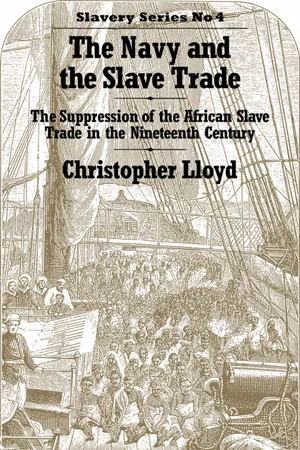
The Navy and the Slave Trade
The Suppression of the African Slave Trade in the Nineteenth Century
- 344 pages
- English
- ePUB (mobile friendly)
- Available on iOS & Android
eBook - ePub
The Navy and the Slave Trade
The Suppression of the African Slave Trade in the Nineteenth Century
Chapter I
The Abolition of the English Slave Trade
THE last English slaver, the Kitty’s Amelia, sailed from the port of Liverpool on July 27, 1807. When her master, Captain Hugh Crow, reached the Slave Coast on the Gulf fo Guinea and told the King of Bonny that Britain had abolished the trade, the latter was undisguisedly depressed. But he soon brightened; for, said he, “We tink trade no stop, for all we Ju-Ju-men tell we so, for dem say you country no can niber pass God A’mighty.”*(1)
Certainly for the next half-century it looked as if the King’s Ju-Ju-men were right. It was no small achievement on the part of Wilberforce and his fellow abolitionists to persuade their own countrymen to prohibit the trade, and later generations have duly honoured them for it. But it was a far greater task to suppress the trade of other nations and to persuade other peoples of the iniquity of the traffic in human flesh. Yet remarkably little gratitude has been shown to those responsible for this great service to humanity. The patient diplomacy carried out for decades at the Foreign Office, the dangerous and arduous work of the Royal Navy necessary to achieve this disinterested purpose, have gone virtually unrecognised.
The trade in slaves from the west coast of Africa began in consequence of the voyages inspired by Henry the Navigator early in the fifteenth century. In 1481 Elmina, the first Portuguese fort on that coast, was established, and Henry’s successor assumed the title of “Lord of Guiney.” Already firmly established by the date of the discovery of the New World, the trade soon assumed a cosmopolitan character: after the Portuguese came the Spaniards, the British, the French, the Dutch, the Danes, the merchants of the Hanseatic League and those of Genoa. Forts and factories of all nations were established along the coasts bordering on the Gulf of Guinea.
The British interest may be said to have begun with the voyage of John Hawkins of Plymouth in the year 1562. Earlier British merchants like Hawkins’s own father were more interested in the precious metals of the Gold Coast and in the possibilities of general trade with Africa; but it soon became apparent that Black Ivory, in the shape of negro slaves, was a better proposition. The trade was not regularised until Charles II granted a monopoly to the Company of Royal Adventurers of England Trading with Africa, for whose use the first “guinea” was stamped from Guinea gold in 1663. Similar African merchants were still trading (though not in slaves) on the Gold Coast as late as 1843, when the Crown finally took over their interests. What made the Atlantic Slave Trade a predominantly British concern in its later stages was the acquisition of the “Asiento,” or Spanish monopoly in slaves, under the terms of the Treaty of Utrecht, whereby Britain undertook to supply annually vast numbers of negroes to the Spanish colonies in America.
The extent to which Africa was depopulated by this traffic must always remain a matter of conjecture. One historian estimates that forty million negroes were transported between the fifteenth and the end of the eighteenth centuries; a more likely figure is five million. “Though historians may hesitate to judge their ancestors by the standards of their own day,” writes Sir Reginald Coupland, “it is difficult not to regard this treatment of Africa by Christian Europe, following Moslem Asia, as the greatest crime in history.” The trade was indicted in the same terms by almost every Prime Minister from Pitt to Palmerston. Peel declared that it engendered more misery and crime than any other public act committed by any nation; and Palmerston’s words in 1844 express that deep sense of guilt which was the chief motive in the long process of abolition: “If all the crimes which the human race has committed from the creation down to the present day were added together in one vast aggregate, they would scarcely equal, I am sure they would not exceed, the amount of guilt which has been incurred by mankind in connection with this diabolical Slave Trade.”(2)
It was because Englishmen played so great a part in this inhuman traffic that the national conscience of Britain was the first to be stirred. It is to the eternal honour of the Non conformists and the Evangelicals that the publicity thrown by their unremitting efforts compelled their countrymen to realise how deeply they were involved in this crime against Africa. Their share may be estimated from the following figures quoted by Bryan Edwards in his History of the British West Indies, first published in 1798. At the time of the outbreak of the French Revolution he states that the number of slaves exported annually by the British was 38,000, by the French 20,000, by the Dutch 4,000, by the Danes 2,000 and by the Portuguese 10,000; total 74,000. The accepted Foreign Office figure for the annual average in the later eighteenth century was 100,000.(3)
The fortunes of Bristol and Liverpool were thus built upon the bodies of tens of thousands of negroes. Of the 192 vessels sailing for the Slave Coast from British ports in 1771, 107 sailed from Liverpool, 58 from London, 23 from Bristol, and 4 from Lancaster. The profits of the Round Trip, as it came to be called, made it the most paying of all the regular trade routes. It was commonly divided into three “passages.” On the outward passage the cargo consisted of textiles, hardware, alcohol and antiquated firearms. These were traded on the coast for slaves, who were shipped to America and the West Indies on the notorious Middle Passage. The principal cargoes taken on there for the homeward passage were sugar, tobacco and rum. The prevailing winds—outward with the North East Trades, and homeward with the Gulf Stream and the Westerlies—made the voyage as easy as it was profitable.
By way of illustration let us consider the story of one of the hundreds of British ships thus engaged in the eighteenth century. On August 16,1783, Messrs. Fox, Croft and Co. despatched “the Good Ship Bloom (Robert Bostock, master) towards Africa, America and back to Liverpool.” At Cape Mount, just south of the newly established settlement for liberated slaves at Sierra Leone, the Bloom took on board 307 slaves, who were sold by auction at Antigua for £35–£45 a head. (Frequently as much as £50 was paid for a male slave in prime condition.) Having loaded a cargo of molasses and tobacco, the Bloom returned home, making a profit to her owners of £9,635 9s. 7d. of which the captain’s commission amounted to £360 14s. 3d. Five years later we are not surprised to learn that Captain Bostock was accounted “a very considerable African merchant”—for it was possible to net as much as £60,000 on a single voyage.(4)
Such facts make it easy to understand why the work of the Abolitionists, the Quakers, the Evangelicals, the Wesleyans, and, in the nineteenth century, the work of Britain as a nation, was so bitterly opposed by the slave trading interests. Slavery had acquired a prescriptive right to its existence. Since the institution was sanctioned from time immemorial, since the profits extracted by those concerned were so stupendous, and above all since the whole business was transacted far away out of the sight of ordinary civilised people, living in happy ignorance of the barbarities it involved, slavery as an institution was energetically defended, and even the Slave Trade itself regarded as a perfectly legitimate form of commerce. If it was right to sell Manchester cottons, it was equally right to receive Black Ivory in exchange. Of course it was all wrong for the Moor to enslave Christian mariners captured off the coast of Barbary; but it was all right for Europeans to barter for slaves in Africa in order to sell them in America. The point of view of the eighteenth century can only be appreciated if it is remembered that black slaves were not regarded as human beings in the sense that their masters were. On Saturday, January 2, 1790, readers of the Jamaican Daily Advertiser could read the following advertisement, which Cubans and Brazilians (not to mention Virginians and other “southern Gentlemen”) regarded as perfectly natural fifty or sixty years later.(5)
Kingston, January 1, 1790
NOW ON SALE
At the Store of the SUBSCRIBERS
133
Choice Young Coromantes, Fantee and Ashantee
NEGROES
viz.
| 39 Men | 33 Women |
| 20 Men boys | 20 Women girls |
| 12 Boys | 9 Girls |
Messrs. Rainford, Blundell and Rainford.
The popular point of view is best expressed by Boswell. “To abolish a status which, in all ages, God has sanctioned and man has continued, would not only be robbery to an innumerable class of our fellow-subjects, but it would be extreme cruelty to the African savage, a portion of whom it saves from massacre or intolerable bondage in their own country, and introduces into a much happier state of life, especially now when their passage to the West Indies, and their treatment there, is humanely regulated. To abolish the trade would be to
‘Shut the gates of mercy on mankind’.”
We may note, however, that his idol did not agree with this view, for it is recorded that Johnson once startled a company of “very grave men” at the University of Oxford by drinking a toast to “the next insurrection of the Negroes in the West Indies.”(6)
It is quite possible, though by no means logical, to condemn the Slave Trade, as indeed Bryan Edwards did, and yet defend Slavery on the plantations. In the enthusiasm of their propaganda the Abolitionists habitually exaggerated the barbarities of both. In modern times coolie or indentured labour is an economic necessity in the tropics. In the course of the suppression of the trade, slaves liberated by British intervention were often shipped to the West Indies as indentured labour. Nominally this was done on a voluntary basis; but it is not surprising that the Americans regarded the practice as just another example of British hypocrisy. Not all planters were fiends in human shape, and by no means all slave traders were callous to the sufferings of their cargoes. In condemning the horrors of the Middle Passage we must allow for the conditions of the voyage, the build of the particular vessel employed, the character of the captain and his crew. As the net thrown over the traffic by the Navy tightened, conditions probably deteriorated, because more desperate men became engaged in the trade and fewer brokers would provide seaworthy ships. It became a question of slave running, not slave trading. But at all times there were those who prided themselves on commanding a clean ship, and even in the period of suppression it obviously paid a captain to deliver his cargo in the best possible condition. The dangers of generalising about the Middle Passage may be illustrated by comparing the description of it given by Bryan Edwards in the second volume of his History, with the summary of the findings of a Committee on the subject contributed by the anonymous abolitionist who wrote the fourth volume of the 1819 edition. On the one hand we are told that men were only manacled together when taken on board, and that women and children (never more than a third of the shipment) were exempted from this; that slave decks were clean and well ventilated, fumigated and sprinkled with vinegar; that slaves were permitted to go stark naked because of the heat, to wash twice a day, to eat as much as they liked, to drink rum on cold days, smoke a pipe whenever they desired, and to divert themselves with music and dancing between meals. On the other hand, reputable witnesses declared that no slave was allowed more than a space measuring 5 ft. 6 in. by 16 in. in which to lie between decks often less than 4 ft. apart; that they were often manacled on their sides so that more could be packed tighter; that 10 per cent, died of suffocation, apart from deaths due to a hundred types of disease and infection; that their food consisted of yams and beans twice a day, with one pint of stinking water; that they were imprisoned between decks for sixteen hours out of twenty-four; and that the famous dancing “consisted of jumping in their irons for exercise, and that they were whipped when they refused to do it.”(7)
Naturally the characters of the masters of such vessels differed greatly. Captain Collingwood of the Zong threw his cargo of 132 diseased slaves overboard in order to claim the insurance which would not have been payable if they had died a natural death. Captain Crow of the Kitty’s Amelia, with honest humanity, regarded the trade as “a necessary evil” ordained by Providence. The Act of 1807, in his opinion, merely “caused the trade to be transferred to other nations, who, in defiance of all that our cruisers can do to prevent them, carry it on with a cruelty to the slaves, and a disregard of their comfort and even of their lives, to which Englishmen could never bring themselves to resort.” As for himself—and we may well believe him—“I took pains to promote the health and comfort of all on board by proper diet, regularity, exercise and cleanliness.” Well might he regret the days when one could buy a negro on the coast of Bonny for £25 worth of barter, comprising a piece of cloth, twenty-five kegs of powder, two bags of shot, two knives, four iron pots, four cutlasses, four hats and fourteen gallons of brandy! Unfortunately, for this type of argument, Collingwood also was an Englishman. What Crow and other apologists did not realise was the anarchy wrought on the coast of Africa by bartering such articles and demanding such numbers of slaves, apart from the impossible task of humanising the behaviour of all slave captains to his own high standard.(8)
The consequences of the curse of Africa have been even more serious in the sociological problems created in the New World. It is unnecessary to remind the reader how signally the United States has failed to solve the negro problem. In the nineteenth century, the period under review in this book, the chief offenders were Cuba and Brazil. An attempt has been made by the Brazilian historian, Gilberto Freyre, to show that Brazil alone has succeeded in synthesising the racial elements of Indian, European and African. The reason why the rancour and guilt due to racial feeling are so largely absent in that country is the amount of miscegenation which has taken place, so much so that the negro has been absorbed into the nation to an extent unknown elsewhere. “The terrible slave driver,” writes Freyre, “who came near transporting from Africa, to America, in filthy vessels that could be recognised from afar by their stench, an entire population of Negroes, was, on the other hand, the European coloniser who best succeeded in fraternising with the so-called inferior races.” He appears to have done this, according to Freyre’s own account, by systematically debauching the imported slaves in domestic prostitution (an institution condoned by the Portuguese tradition of mixed marriages in view of the comparative absence of white women) and by the natural rights of the master over the slave. Whereas in the Spanish colonies such rights were at least theoretically limited by the laws of Church and State, the Portuguese colonies grew up more independently of the mother country, and the slaves there were consequently more exposed to the whims of the plantation owner. This was particularly the case in the new empire of Brazil. The owner often treated his slaves generously, freeing them by the terms of his will or rewarding the illegitimate progeny of his concubines with bequests of land. But the effects of slavery were as deleterious to the master as to the slave, here as in all slave-holding communities: “slothful but filled to overflowing with sexual concerns,” writes Freyre, “the life of the sugar-planter tended to become a life that was lived in a hammock.”(9)
An important claim adduced in the defence of the British Slave Trade was the naval argument that it was essential for the preservation of maritime supremacy. The number of vessels engaged in it made it, next to the fisheries, the most valuable nursery of seamen upon whom the Navy could call in time of emergency. Admiral after admiral, men like Rodney and St. Vincent, raised this point in the debates on Abolition; Barrington indeed went so far as to make the fatuous statement that “the slaves appeared to him so happy that he often wished himself in their station.” This argument was effectively refuted when Wilberforce showed that the Slave Trade was not so much the nursery as the graveyard of seamen, since the mortality on board slave vessels was beyond all comparison greater than that on board vessels engaged on other trades, and the hardbitten seamen pressed from that type of ship were more of a hindrance than a help on board a man-of-war. Another “professional” argument against this “horrid Trade” occurs in the papers of Admiral Lord Barham, where it is criticised on the grounds that it “destroys our seamen by thousands, makes bankrupts of those employed in it, and is chiefly applied to the improvement of the French sugar colonies, which are the best nursery of their navy.”(10)
The story how Granville Sharp, Clarkson and Wilberforce carried their crusade to a triumphant conclusion is no part of our subject here. Looking back on the Abolitionist Movement, one can see that it was one of the greatest feats of propaganda in history, and it was carried through with a degree of unselfish persistence which has no parallel. It may be said to have begun with the famous judgment of Lord Mansfield in the Somerset case in 1772, when it was laid down that as soon as...
Table of contents
- Cover
- Half Title
- Title Page
- Copyright
- Contents
- Acknowledgments
- Introduction
- Part I
- Part II
- Appendix
- References and Bibliography
- Index
Trusted by 375,005 students
Access to over 1.5 million titles for a fair monthly price.
Study more efficiently using our study tools.
Frequently asked questions
Yes, you can cancel anytime from the Subscription tab in your account settings on the Perlego website. Your subscription will stay active until the end of your current billing period. Learn how to cancel your subscription
No, books cannot be downloaded as external files, such as PDFs, for use outside of Perlego. However, you can download books within the Perlego app for offline reading on mobile or tablet. Learn how to download books offline
Perlego offers two plans: Essential and Complete
- Essential is ideal for learners and professionals who enjoy exploring a wide range of subjects. Access the Essential Library with 800,000+ trusted titles and best-sellers across business, personal growth, and the humanities. Includes unlimited reading time and Standard Read Aloud voice.
- Complete: Perfect for advanced learners and researchers needing full, unrestricted access. Unlock 1.5M+ books across hundreds of subjects, including academic and specialized titles. The Complete Plan also includes advanced features like Premium Read Aloud and Research Assistant.
We are an online textbook subscription service, where you can get access to an entire online library for less than the price of a single book per month. With over 1.5 million books across 990+ topics, we’ve got you covered! Learn about our mission
Look out for the read-aloud symbol on your next book to see if you can listen to it. The read-aloud tool reads text aloud for you, highlighting the text as it is being read. You can pause it, speed it up and slow it down. Learn more about Read Aloud
Yes! You can use the Perlego app on both iOS and Android devices to read anytime, anywhere — even offline. Perfect for commutes or when you’re on the go.
Please note we cannot support devices running on iOS 13 and Android 7 or earlier. Learn more about using the app
Please note we cannot support devices running on iOS 13 and Android 7 or earlier. Learn more about using the app
Yes, you can access The Navy and the Slave Trade by Christopher Lloyd in PDF and/or ePUB format, as well as other popular books in History & African History. We have over 1.5 million books available in our catalogue for you to explore.