Gender and Archaeology is the first volume to critically review the development of this now key topic internationally, across a range of periods and material culture. ^l Roberta Gilchrist explores the significance of the feminist epistemologies. She shows the unique perspective that gender archaeology can bring to bear on issues such as division of labour and the life course. She examines issues of sexuality, and the embodiment of sexual identity. A substantial case study of gender space and metaphor in the medieval English castle is used to draw together and illustrate these issues.
- 208 pages
- English
- ePUB (mobile friendly)
- Available on iOS & Android
eBook - ePub
About this book
Information
Chapter 1
Gender archaeology
Beyond the manifesto
Gender may be understood as the cultural interpretation of sexual difference: its qualities can be conflicting, mutable and cumulative, contingent upon personal and historical circumstances. The archaeological study of gender in past societies has emerged over the last fifteen years, until today distinctive traditions can be discerned in the practice of gender archaeology. This book aims to assess the place of gender studies within archaeology, charting the changing definitions, concerns and methods of gender archaeology, and its impact on the wider discipline. Such a survey requires a critical consideration of the study of gender within the intellectual histories of both archaeology and feminist theory. While not all gender archaeology is allied with feminism (or conducted by feminists, or even by women), it has evolved symbiotically with feminist thinking. Together with many of the social sciences, archaeology is experiencing a paradigm shift that has resulted from feminism. This transition may be traced from the ungendered (or male biased) narratives that characterised most archaeology up to the 1970s, through the greater concern for visibility of women in publications of the 1980s and early 1990s, to today’s focus on the feminine and masculine. Attention to equality of recognition, and representation of women and men in the past, is being replaced by an interest in gender differences between, and among, men and women.
This chapter examines the catalysis from equality to difference that is taking place in gender archaeology, and sets it within the much wider expansion of perspectives from ‘second’ to ‘third’ wave feminisms. Changing definitions of gender are examined, with particular reference to debates on the biological versus social construction of gender, and the challenges to prevailing perceptions that have resulted from critiques as diverse as cognitive science and queer theory.
Feminism and gender archaeology: making waves
In common with feminism, gender archaeology is represented by a plethora of approaches. Broad parallels can be traced, however, between the evolution of gender studies in archaeology and the progression of feminism. Here, the background to feminist theory is outlined briefly in order to place gender archaeology within a wider intellectual framework. Its origins can be located in the concerns of what has been termed ‘second wave’ feminism, while its present aims correspond more closely with those of the ‘third wave’. Further, gender studies can be seen to have diverged within the discipline, with particular philosophical aims more typical of Americanist versus European gender archaeology.
All feminism is characterised by a political commitment to change existing power relations between men and women, but feminist thought is perceived as having advanced in three separate waves. There is some disagreement amongst feminists as to the precise breakdown of these stages; one common definition is outlined here (after Humm 1995; Brooks 1997). ‘First wave’ refers to the suffrage movements, between roughly 1880 and 1920, through which women achieved public emancipation and greater rights in the realms of politics, education and employment. The late 1960s saw the emergence of ‘second wave’ feminism, which focused more on personal issues of equality in relation to sexuality, reproduction, and fulfilment in public and private spheres (Deckard 1975). The intellectual movements that grew out of the second wave were concerned with identifying the root causes of women’s oppression: in particular, the theory of patriarchy provided a universal, explanatory framework. ‘Third wave’ feminism has emerged over the last decade, as feminist theorists have embraced elements of postmodernist thought and shifted their interests to more cultural and symbolic approaches. Significantly, the universalist meta-narratives of second wave feminism have been replaced by greater pluralism, while the emphasis on addressing inequality between men and women has been superseded by the imperative to understand gender ‘difference’ (Brooks 1997).
Second wave feminists were united by the theory of patriarchy: power relations which structure the subordination of women, through institutions such as the family, education, religion and government. Patriarchal relations are assumed to be structural, operating at an institutional level, rather than resulting from personal intentions. Particular schools of feminist thought emerged that promoted their own universal explanations for patriarchy (see Gunew 1991; Tong 1989). Among the most prominent is socialist feminism, which perceives gender as socially produced and historically changing. In contrast, radical feminism generally proposes a trans-historical definition of gender, in which patriarchy operates through the medium of the family as a social institution that oppresses women. Radical feminists focus more on the biological differences between women and men, and are frequently criticised for promoting an essentialist view of womanhood, in which all women share similar identities and experiences, despite differences in class, race or cultural situation. Marxist feminism, eminating from Engel’s assertion that the oppression of women was rooted in the origins of private property (Engels 1884), has also viewed women as a single class, united by the appropriation of their labour and sexuality by capitalist systems of production. More epistemologically based is standpoint feminism, which attempts to construct theories informed by the perspectives of women’s lives (Harding 1986, 1991). As part of the second wave, feminist scholars examined the way in which inequalities and male bias had impacted on their own disciplines, with critiques of androcentrism – male bias – in the study of history, anthropology, primatology and the natural sciences (Kelly-Gadol 1976; Rosaldo and Lamphere 1974; Haraway 1989; Keller 1984).
The third wave, sometimes referred to as postmodernist feminism, or even postfeminism, has been influenced by poststructuralism and postcolonialism (Weedon 1987; Brooks 1997). This body of thought rejects the idea of an essential character or experience which typifies men or women. Here the emphasis is on difference: the differences between men and women, or among men and women of contrasting sexualities, ethnicities or social classes. Postmodernist feminism is concerned broadly with examining the creation of subjectivity, through approaches such as psychoanalysis, discourse analysis or deconstruction. Influenced particularly by the works of Michel Foucault, postmodernists contend that each human agent or subject draws meaning and experience from competing, multiple discourses, and that this complex constitution of the subject develops continuously throughout the lifetime. Postmodernist and standpoint feminisms reject universal laws of human experience: their perspectives are characterised by cultural relativism, the assertion that a reasonable observation of one society’s tendencies cannot be projected onto another. The contrasting concerns of second and third wave feminism have been identified as a ‘paradigm shift’ within feminism, as the major objective has moved from a concern with equality to one of difference (Barrett and Phillips 1992).
Archaeological historiography has begun recently to explore the impact of the first wave of feminism on our own discipline. Prominent women, such as Hannah Rydh in Sweden, and Amelia Edwards and Margaret Murray in Britain, can be highlighted for their concern with both the emancipation of their female contemporaries and the archaeological recognition of women in the past (Díaz-Andreu and Sørensen 1998). Second wave feminism took at least a decade to cause scholastic ripples in the deep waters of archaeology. Although by the 1970s a small number of female archaeologists in Scandinavia had begun to consider the more active role that women had played in prehistory (Bertelsen et al. 1987; Dommasnes 1992), the first feminist critique of male bias in archaeology was not published until 1984. In a ground-breaking article, American archaeologists Margaret Conkey and Janet Spector argued that archaeology was perpetuating a ‘gender mythology’ by employing gender stereotypes uncritically. Despite their claims of objectivity, archaeologists were failing to consider historical variations and cultural diversities in gender relations.
When archaeologists employ a set of stereotypic assumptions about gender, how it is structured, and what it means – what might be called a gender paradigm – a temporal continuity of these features is implied. Even when this paradigm is ‘merely’ a cultural backdrop for the discussion of other archaeological subjects (e.g. what an artefact was used for), there is a strong presentist flavour to archaeological inquiry: presentist in the sense that the past is viewed with the intent of elucidating features that can be linked with the present.
(Conkey and Spector 1984)
By drawing implicitly on contemporary gender stereotypes, archaeologists were implying a long-standing cultural continuity of gender roles, a linear evolution connected intrinsically with the biological functions of women and men.
The women’s movement had demonstrated that it was possible for transitions in gender relations to occur within a very brief timespan; moreover, historians and anthropologists were providing insights to the cultural specificity of gender, the way in which relations between men and women, divisions of labour, and attitudes to sexuality, all varied between cultures. Thus, feminist archaeologists sought a more explicit study of gender in past societies.
We argue that the archaeological ‘invisibility’ of females is more the result of a false notion of objectivity and of the gender paradigms archaeologists employ, than of an inherent invisibility of such data.
(Conkey and Spector 1984)
In order to accomplish this, however, it was necessary to identify and remedy the mechanisms by which biases were introduced to archaeological enquiry. Eventually, the second wave of feminism heralded attention to issues of equity in archaeological employment (Nelson et al. 1994; du Cross and Smith 1993), a critique of gender bias in the presentation of the past to the public (Figure 1.1) (Jones and Pay 1990; Moser 1993; Gifford-Gonzalez 1993; Hurcombe 1995), and a concern with exploring women’s contributions through more critical historiographies of archaeology (Claassen 1994; Díaz-Andreu and Sørensen 1998). These distinct strands share some of the goals of gender archaeology. They are not concerned specifically with the interpretation of archaeological evidence, however, and therefore fall outside the parameters of this book.
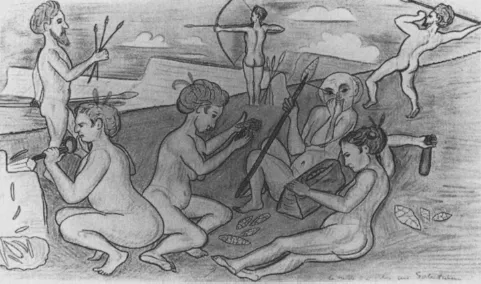
Figure 1.1. ‘Flint chipping in Upper Palaolithic times’. Despite the gender stereotyping of many contemporary reconstructions of prehistoric life (see Moser 1993), the eminent prehistorian Abbé Breuil published a series of vivid colour drawings showing both men and women engaged in hunting and stone tool production, in addition to a more representative picture of age ranges, including the older woman shown here making a spear. His illustrations anticipated the feminist critique by four decades, and were inspired by a sojourn in South Africa during the Second World War. They were dedicated to ‘the children, to the adolescents’ (Breuil 1949: 16).
Source: Breuil 1949: scene 10, 54. Copyright retained by Gawthorn Press.
Feminist critiques in archaeology have developed from merely identifying male bias, to examining the processes by which knowledge becomes gendered (see Chapter 2). Here, second wave feminism has joined with postmodernist themes to challenge claims about knowledge, objectivity and truth – issues crucial to the development of the whole discipline of archaeology. The study of gender in past societies has been influenced in turn by the second and third waves. Today their impact may be felt more as a deluge, with at least 500 articles and an increasing number of books devoted to the subject. It has been argued that gender archaeology has not been allied expressly to feminism, but results from a more grassroots movement that is concerned with reclaiming the past for women, and highlighting their contributions and visibility, in a discipline that has previously focused on the male (Hanen and Kelley 1992: 98). In contrast, I would argue that the impact of the two waves can be detected very clearly in the aims and methods of gender archaeology.
Traditions of anthropology and archaeology have been influenced overtly by second wave feminism, and in particular the search for universals to explain women’s subordination. The work of anthropologists Sherry Ortner and Michelle Rosaldo, for example, stimulated a persistent interest in supposedly universal binary oppositions of culture/nature, public/private and male/female (Ortner 1974; Rosaldo 1974; for discussion see pp. 32–5). Within American gender archaeology this tendency has prompted a strong motivation to explore the sexual division of labour in specific historical contexts, and to examine the connection between reproductive and gender roles (Chapter 3). This concern with labour roles has been personified by a search for universals (such as the inherent proposition that women gathered, cooked, potted and wove), in addition to an interest in female agency and women’s contributions to innovation and change (e.g. Gero and Conkey 1991; Wright 1996; Claassen and Joyce 1997; Kent 1998). Such approaches are consistent with the second wave’s concern with equality and with the aim of producing explanatory meta-narratives. They have also achieved the integration of a wider range of evidence in American gender archaeology, including environmental sources and osteology. Although exceptions may be cited, of course, this type of gender archaeology has predominated in North America, and has fitted comfortably with the objectives of both processual archaeology and a more ‘grassroots’ movement.
European gender archaeology has focused more generally on the symbolic and cultural manifestations of gender, with lesser regard for gender roles and the sexual division of labour (e.g. Moore and Scott 1997). It is marked by a greater concern for the individual, manifested through study of gender identity, sexuality and the body, and with the representation of gender through forms of signification such as art, space and grave goods (Chapters 4 and 5). European gender archaeology has largely omitted the broader corpus of environmental evidence that has been harnessed by American studies. The examination of gender in European archaeology has been represented to date predominantly by British and Scandinavian approaches. Alternative perspectives include Marxist feminist work in Spain (Colomer et al. 1994), while other regions are more characterised by their complete absence of gender archaeology. In Italy and Greece, for example, national traditions have been empirically driven and lacking in more theoretical concerns that might have encouraged work on gender (Vida 1998: 15; Nikolaidou and Kokkinidou 1998: 253). A similar lacuna in French archaeology has been attributed to the supposed reluctance of French feminists to isolate women as a category for analysis (Coudart 1998: 61).
The distinctions between American and European traditions result from several factors, including the greater impact of second wave feminism on the American academy. The explicitly political objectives of feminism have been explored more determinedly in American archaeology, resulting in a marked concern for cultivating feminist networks and programmes of research and teaching, a tendency shared with feminist archaeology in Scandinavia and Australia (see, for example, the journal Kvinner i Arkeologi i Norge [‘Women in Archaeology in Norway’] and publications of the series of Australian conferences on women in archaeology: du Cross and Smith 1993; Balme and Beck 1995). At the same time, European archaeologists have been more dissipated in their political objectives, but more receptive to structuralist and symbolic anthropology, such as that of Mary Douglas (Douglas 1966, 1970), and to poststructuralist, largely Foucauldian approaches (Foucault 1981). Thus the advent of structuralist, contextual and postprocessual archaeology (Hodder 1982, 1987; Shanks and Tilley 1987) has fostered in gender archaeology the greater plurality that is associated with the third wave. These contrasting traditions are teased out in the chapters that follow, with the case studies in Chapters 2 and 3 dominated by the work of American archaeologists, and those in Chapters 4 and 5 predominantly European. Although parallel concerns are increasingly evident, it seems that contrasting epistemological traditions of gender archaeology have emerged.
Recent feminist work in many disciplines is embodied by an interest in ‘difference’, although this term is used inconsistently. Generally, the acknowledgement of difference has resulted from critiques of second wave feminism by Third World feminists, women of colour and lesbians (Brooks 1997: 16). In this sense, ‘difference’ refers to the alternative positions that have challenged the essentialising tendencies of second wave feminism and its theories about global female experience. ‘Différence’ also carries the connotations of French feminist deconstruction, for example the work of Luce Irigaray, who argues that philosophy and language are phallocentric discourses that mask the positive qualities of difference that emerge from the sexualised female body (Irigaray 1985). This type of gender difference does not result from essential biology, but from the experiences of culture, sexuality and gender that make men and women distinctive.
‘Difference’ is also promoted by queer theory, especially by Judith Butler, who has confounded the concept of gender identity and the notion of fixed categories of gender and sexuality (Butler 1990, 1993). In some respects Butler is the new orthodoxy: she is an American feminist philosopher and the doyenne of queer theory, to the extent that a fan magazine, Judy!, has been devoted to her. She aims to destabilise the apparent coherence and centrality of heterosexual gender identities by examining the processes by which such identities are created. She suggests that through ‘performance’, the repetition of cultural acts associated with gender, difference is emphasised (see pp. 13–14, 82). Yet for archaeology, the most important considerations of ‘difference’ may be those emanating from feminist anthropology. A shift of focus has occurred in anthropology, from considerations of hierarchical power and differential prestige between men and women (e.g. Ortner and Whitehead 1981), towards attention to gender difference. In this context, gender difference may be understood as the social and symbolic metaphors that create the complementarity between men and women that is necessary for the functioning of a particular society (e.g. Strathern 1988; Moore 1994).
Consistent with the plurality and ‘difference’ of the third wave is an emergent masculinist perspective in archaeology, one which perhaps reacts against the woman-centred tendency of much existing gender archaeology. Ironically, the masculinist outlook may prove vital in achieving the ultimate aims of gender archaeology, and should not be rejected by feminists on the grounds of gut reaction. ‘Gender mythology’ in archaeology has masked the contributions and experiences of both women and men in the past. Masculinist theory challenges nomothetic, essentialist views of the male; for instance that men in all societies are aggressive, uninterested in nurturing child...
Table of contents
- Cover
- Title
- Copyright
- Dedication
- Contents
- List of illustrations
- Preface
- Acknowledgements
- Glossary
- 1 Gender archaeology: beyond the manifesto
- 2 Strange bedfellows: feminism and archaeology
- 3 Gendered hierarchies? Labour, ‘prestige’ and production
- 4 Experiencing gender: identity, sexuality and the body
- 5 Performing the past: gendered time, space, and the lifecycle
- 6 The contested garden: gender, space and metaphor in the medieval English castle
- 7 Coda: the borders of sex, gender and knowledge
- Further reading
- Bibliography
- Name index
- Subject index
Trusted by 375,005 students
Access to over 1.5 million titles for a fair monthly price.
Study more efficiently using our study tools.
Frequently asked questions
Yes, you can cancel anytime from the Subscription tab in your account settings on the Perlego website. Your subscription will stay active until the end of your current billing period. Learn how to cancel your subscription
No, books cannot be downloaded as external files, such as PDFs, for use outside of Perlego. However, you can download books within the Perlego app for offline reading on mobile or tablet. Learn how to download books offline
Perlego offers two plans: Essential and Complete
- Essential is ideal for learners and professionals who enjoy exploring a wide range of subjects. Access the Essential Library with 800,000+ trusted titles and best-sellers across business, personal growth, and the humanities. Includes unlimited reading time and Standard Read Aloud voice.
- Complete: Perfect for advanced learners and researchers needing full, unrestricted access. Unlock 1.5M+ books across hundreds of subjects, including academic and specialized titles. The Complete Plan also includes advanced features like Premium Read Aloud and Research Assistant.
We are an online textbook subscription service, where you can get access to an entire online library for less than the price of a single book per month. With over 1.5 million books across 990+ topics, we’ve got you covered! Learn about our mission
Look out for the read-aloud symbol on your next book to see if you can listen to it. The read-aloud tool reads text aloud for you, highlighting the text as it is being read. You can pause it, speed it up and slow it down. Learn more about Read Aloud
Yes! You can use the Perlego app on both iOS and Android devices to read anytime, anywhere — even offline. Perfect for commutes or when you’re on the go.
Please note we cannot support devices running on iOS 13 and Android 7 or earlier. Learn more about using the app
Please note we cannot support devices running on iOS 13 and Android 7 or earlier. Learn more about using the app
Yes, you can access Gender and Archaeology by Roberta Gilchrist in PDF and/or ePUB format, as well as other popular books in Social Sciences & Archaeology. We have over 1.5 million books available in our catalogue for you to explore.