- 128 pages
- English
- ePUB (mobile friendly)
- Available on iOS & Android
eBook - ePub
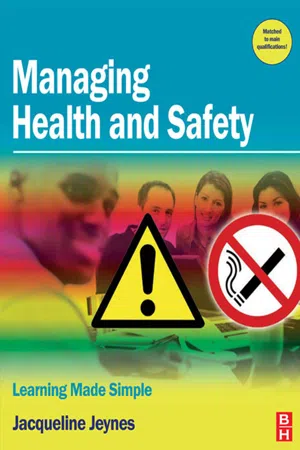
Managing Health and Safety
About this book
Learning Made Simple books give you skills without frills. They are matched to the main qualifications and written by experienced teachers and authors to make often tricky subjects simple to learn. Every book is designed carefully to provide bite-sized lessons matched to readers' needs.
Using full colour throughout and written by leading teachers and writers, Learning Made Simple books build on a rich legacy of over 50 years as leading publishers helping to learn new skills and develop their talents.
Whether studying at college, training at work, or reading at home, aiming for a qualification or simply getting up to speed, Learning Made Simple Books will give readers the advantage of easy, well-organized training materials in a handy volume you can refer to again and again.
These titles will be promoted direct to training companies and learners, and individuals will be urged to buy them not only by college lecturers but also by trainers at work. These titles will be core stock for years to come.
The books are written by experienced HR trainers and will be typeset by PK McBride (an experienced teacher and author of several Learning Made Simples himself). PK McBride has a thorough understanding of the ethos of the LMSs books and his involvement will insure that all titles have a layout and style consistent with the brand.
Jacqueline Jeynes has run her own Management Consultancy business Opal Services,for 19 years, providing a wide range of management skills training across all industry sectors. She has appeared as an expert on 10 BBC TV programmes on H&S for small firms. She has regularly published articles in professional journals. She was a Commissioner on the Independent Inquiry into Drug Testing in the Workplace 2005 and been a member of many national and European Commission committees. A member of IBA and IOSH, she has just been awarded Specialist Business Adviser of the Year 2006-7. Currently a business adviser, tutor on Durham University MBA and supervisor-tutor for Aston University undergraduates on work placement year. She has published two books with Butterworth-Heinemann.
Information
1 Start here
Introduction
Managing health and safety
People covered by OH&S law
The stakeholders
Introduction
Many people refer to Health & Safety as commonsense and say there is too much regulation. To some extent, this is a reasonable statement, but it is also true that one person’s commonsense is not the same as another’s – it develops over time as you experience life at home and at work.
Everyone perceives risk in a different way, depending on age, life experiences, health and safety expertise, skills and, in some cases, gender.
Case study
In January 2007 several companies were found guilty of failing to ensure the safety of a worker who fell to his death through a roof light when working on a fragile asbestos cement roof.
The HSE (Health and Safety Executive) brought the prosecution, stating: “It was only Mr Moran’s second day and he had not worked on a site before. He had been given no training or protection and was paid cash in hand. It was a shambles of a job.”
If you run a business, or work for a company where you have some responsibility for health and safety, you cannot rely on the presumed commonsense of others to keep everyone safe from harm or injury.
Health and Safety Management covers the main principles of good occupational health and safety (OH&S) management including risk assessment, responsibilities and typical ways to record your findings.
There may be particular hazards in your workplace that need more formal assessment by a specialist – for example, air monitoring or fibre sampling and testing – but the basic principles should allow you to establish a sound system for managing OH&S risks in your workplace.
Managing health and safety
When we talk about managing health and safety effectively, we are really talking about making sure people are protected from harm or injury when they are at work, whether they are workers or visitors to the workplace. Because it relates to work activities, it is often referred to as occupational health and safety (OH&S).
H&S regulations do not apply to domestic premises unless you are:
• A professional carer or peripatetic worker (someone who travels to see clients in their own premises).
• A homeworker for a company that requires you to work away from your normal workplace at times, e.g. performing administrative tasks via a networked computer system.
• A homeworker (sometimes called an outworker) paid solely on the basis of carrying out tasks from your own home premises, e.g. making clothing or packing individual greetings cards.
• A self-employed individual who is working in someone else’s domestic premises, or works from home.
Some domestic staff may be covered by the regulations, although members of the family working in a business may not be. The law is a bit confusing in these circumstances, so you should check the legal position on an individual basis.

To manage OH&S effectively, you need to:
• Take a structured, logical approach to identify risks.
• Decide the best way to control these risks.
• Establish systems and procedures to record and monitor how you are managing risks so that you can demonstrate this to others.
People covered by OH&S law
The law is there to protect people from injury or harm when at work, and anyone who may be affected by work activities. This includes:
• Employees of the firm, including full-time or part-time, temporary or permanent staff and casual workers.
• Volunteers who work alongside paid staff, e.g. in a charity shop.
• Students or young people on work experience.
• Contractors and sub-contractors.
• Self-employed individuals including those working on their own behalf as sole traders (who may employ other people).
• Peripatetic workers not based in one location.
• Drivers and transport staff.
• Clients or customers in your premises.
• People in the surrounding area who may be affected by the work activities – e.g., noisy processes, toxic emissions, or transporting potentially harmful materials.
• Other visitors to your premises, whether they are legally entitled to be there or not, such as intruders on an old, unsafe roof.
Insurance
Your insurance provider may want to see records of accidents, injuries, previous claims, staff training, fire drills and other documents related to how you control risks before they decide the premium to charge. If you supply goods or services to other businesses, they may want to see evidence of your OH&S management system before they will enter into a contract with you.
The stakeholders
All the different groups of people listed represent the stakeholders in your business, the people who have a stake in (might be affected by) the way you choose to deal with OH&S risks. Other stakeholders who want to know that you are managing the risks effectively include:
• the regulators, inspectors from the Health & Safety Executive (HSE) or Environmental Health Officers (EHO);
• your insurance provider, particularly if you work in an industry with a high risk of accidents, such as agriculture or construction;
• Trades Union representatives and other worker representatives who need to ensure their members are adequately protected.
Basically, you need to show them that you:
1 have identified the current situation;
2 have identified problem areas that need to be addressed;
3 have dealt with them appropriately;
4 can demonstrate what actions have been taken;
5 are in control of the situation.
Activity: The benefits of managing OH&S effectively
Think about the following questions for a moment.
Q1: Why is it important to be seen to manage health and safety effectively?
Q2: What are the consequences likely to be if you get it wrong?
If you have little or no experience of dealing with OH&S, it can seem a daunting task to establish a system for managing risks on a day-to-day basis. However, there are likely to be some elements of a system in place already, so it is more a case of drawing these together in a coherent way rather than starting from scratch. However small your organisation, the EHO or HSE inspector will expect to see evidence of an OH&S system.
I don’t know why we have to do risk assessments…

Case study
A substantial fine was imposed on a theme park owner after an all-terrain vehicle rolled over and passengers were thrown into a river. Health and safety management was poor. The driver had only been shown how to drive the vehicle the day before, the route had not been checked for dangerous conditions following bad weather, the vehicle was not sufficiently padded to cushion the impact, seatbelts were found to be ineffective, and height restrictions for children were not adhered to. Such bad publicity will hit sales, as customers will not feel safe. Future insurance premiums will also be affected.
Answers to questions (page...
Table of contents
- Cover
- Halftitle
- Title
- Copyright
- Contents
- Preface
- 1. Start here
- 2. The initial review
- 3. Identify hazards
- 4. Controlling risks
- 5. Fire risks
- 6. Managing risks
- 7. Your H&S policy
- Industry sector examples
- Glossary
- Index
Trusted by 375,005 students
Access to over 1.5 million titles for a fair monthly price.
Study more efficiently using our study tools.
Frequently asked questions
Yes, you can cancel anytime from the Subscription tab in your account settings on the Perlego website. Your subscription will stay active until the end of your current billing period. Learn how to cancel your subscription
No, books cannot be downloaded as external files, such as PDFs, for use outside of Perlego. However, you can download books within the Perlego app for offline reading on mobile or tablet. Learn how to download books offline
Perlego offers two plans: Essential and Complete
- Essential is ideal for learners and professionals who enjoy exploring a wide range of subjects. Access the Essential Library with 800,000+ trusted titles and best-sellers across business, personal growth, and the humanities. Includes unlimited reading time and Standard Read Aloud voice.
- Complete: Perfect for advanced learners and researchers needing full, unrestricted access. Unlock 1.5M+ books across hundreds of subjects, including academic and specialized titles. The Complete Plan also includes advanced features like Premium Read Aloud and Research Assistant.
We are an online textbook subscription service, where you can get access to an entire online library for less than the price of a single book per month. With over 1.5 million books across 990+ topics, we’ve got you covered! Learn about our mission
Look out for the read-aloud symbol on your next book to see if you can listen to it. The read-aloud tool reads text aloud for you, highlighting the text as it is being read. You can pause it, speed it up and slow it down. Learn more about Read Aloud
Yes! You can use the Perlego app on both iOS and Android devices to read anytime, anywhere — even offline. Perfect for commutes or when you’re on the go.
Please note we cannot support devices running on iOS 13 and Android 7 or earlier. Learn more about using the app
Please note we cannot support devices running on iOS 13 and Android 7 or earlier. Learn more about using the app
Yes, you can access Managing Health and Safety by Jacqueline Jeynes in PDF and/or ePUB format, as well as other popular books in Psychology & Business General. We have over 1.5 million books available in our catalogue for you to explore.