- 355 pages
- English
- ePUB (mobile friendly)
- Available on iOS & Android
eBook - ePub
Cybermarketing
About this book
'Cybermarketing' is a no-nonsense structured guide to using the Internet for marketing and is essential reading for all marketers and managers who need to know how to use the Internet to promote and sell their product.
This new edition both follows on the success of and adds significantly to the first edition by:
* Increasing the up to date case material
* Having a live Internet site to support the book
* Adding a collection of key URLs for market research purposes
* Adding a new section on marketing information systems
* More coverage on electronic direct and 1 to 1 marketing
* Covering intranets for Marcomms in more depth
* Building on 'Justifying the Business Case'
* Updated and expanded information on pricing and branding.
This new edition, confirms 'Cybermarketing' as both the most comprehensive and accessible guide to the net for marketing professionals at all levels.
Chapter 1
Marketing with the
Internet
Who is this book for?
This book has been written to help marketing professionals understand and use the Internet. It covers everything from market research to delivering goods sold over the net. It is a practical book, and is aimed at two groups.
- If you are new to the net, and have never written a website, set up an e-commerce facility or had to work out how the Internet fits in to your wider marketing strategy, this book will explain from first principles what you can do, and how you do it.
- If you do have some Internet experience, but feel you are not seeing the full benefits, this book will provide you with a set of powerful concepts which will help you improve your Internet results. We provide a series of models that explain, for example, how to analyse your market, prepare a marketing mix that works online and make judgements about online selling that will allow you to improve the results you get from the net.
We have also designed this book to help experienced marketers and non-marketing professionals alike. Whenever we introduce a core marketing concept (like ‘segmentation’, preparing a ‘marketing mix’, or ‘developing a marketing information system’) we explain from first principles what these ideas mean, why they are so powerful, and how they can be used. Readers new to marketing as well as seasoned professionals will be able to follow the advice and guidance we have developed. You do not need to understand the jargon of marketing and the Internet to use this book!
In this chapter we begin with a framework of the marketing planning process and we outline how the rest of the book has been structured.
Introduction to marketing
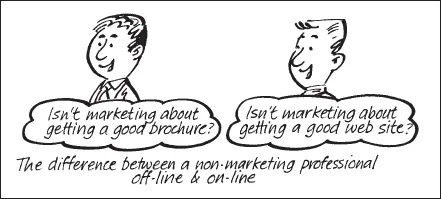
The term ‘marketing’ has become established in our everyday vocabulary, but unfortunately it is loosely used with many different interpretations. Many people associate marketing with, or confuse it to mean advertising, selling, packaging or public relations. It is not surprising therefore, to find that many proprietors, managers and employees in organizations invariably quote the words advertising and selling to mean marketing.
This misunderstanding can be explained by the fact that all of us, as employees, businesspeople or consumers are constantly exposed to media advertising and selling techniques by large multinational and retailing organizations. We have all been sold something: either in a store; on the doorstep; over the telephone; at work by a sales representative; through direct mail advertising or even via the Internet. So it is quite natural for employees and the general public to assume that marketing is something to do with advertising, selling or creating a company image.
The explosion in interest in the Internet as a new marketing medium has been accompanied by a plethora of articles, books, guides and online publications on ‘How to market your business on the Internet’. Most of these publications have fallen into the classical trap of interpreting marketing to mean advertising, selling, online direct marketing and creating home pages to enhance the company's corporate image. Even some seasoned marketing professionals are seeing the Internet only as another means of promoting the company and its products around the globe. One possible reason for this narrow view is that much of the material published on the subject has been written by technocrats. Equally, many of the ‘Internet marketing services agencies’ that have mushroomed recently are managed by IT and computer specialists who have little understanding or experience of the marketing function.
In order to gain maximum benefit from the new communications medium, it is essential that marketing and non-marketing professionals are reminded of the essence of the marketing function prior to getting into detailed explanation of how to use the Internet as a marketing tool.
This chapter presents the ‘big picture’ and has two sections. We begin with the basic question: ‘What is marketing?’ by examining the purpose of any business organization and by explaining the marketing concept. Then we provide an overview of the marketing process, and highlight how the Internet can be used to provide access to valuable information and customers around the world.
Section 1 What is marketing?
The purpose of any business
When asked the question: ‘What is the purpose of an organization?’, the most common response is to make a profit. Obviously, firms must make profits in order to survive by reinvestment and by providing return to shareholder capital, but it is important to understand that profit comes from sales turnover. There is only one source of sales turnover, and that is from the firm's customers. Even in the non-profit-making and the public sector, the revenue generated is directly proportionate to the number of ‘customers’ served. The purpose of any business organization is much more than simply to make a profit by the manufacture and selling of goods or services.
Peter Drucker (1954) first proposed that the purpose of an organization is to create a customer or a customer base, and expressed it in the following terms:
If we want to know what a business is, we have to start with its purpose, and its purpose must be outside the business itself. In fact, it must be in society, since a business enterprise is an organ of society. There is one valid definition of business purpose: to create a customer.
Levitt (1986) reinforced this message by emphasizing that ‘the purpose of business is to create and keep a customer’.
In reality, the ideal organizations are the market-orientated businesses, large and small, that create and meet the needs of the ‘customer’. The customer is created by means of identifying needs in the marketplace, finding out which needs the organization can profitably serve, and developing and offering to convert potential buyers into customers of the firm. It is only through providing customer satisfaction that organizations can achieve their goals, such as survival, maximize profits or the attainment of other social objectives. Drucker's definition of the purpose of the business in society can be extended to provide an overall explanation of what is meant by the term marketing.
What is marketing?
There are numerous formal definitions of marketing. In the UK, the following definition, developed by the Chartered Institute of Marketing, is accepted as one that encapsulates the essence of the marketing function.
Marketing is the management process responsible for identifying, anticipating and satisfying customer requirements profitably.
In addition to being an important business function, marketing is an organizational philosophy – a concept, an approach or an attitude to the way in which the organization is directed and managed. The marketing concept is a business philosophy that Kotler (1984) has expressed in the following terms:
The marketing concept is a management orientation that holds that the key task of an organization is to determine the needs, wants and values of target markets and to adapt the organization to delivering the desired satisfaction more effectively and efficiently than its competitors, and to make a profit.
This somewhat long definition can be broken down into four key components (those highlighted above) and explained more fully.
(a) Management orientation
The starting point of understanding the marketing concept is that it is a management orientation. This means that in order to successfully apply the marketing philosophy, an organization must be headed and managed by individuals who are themselves orientated towards meeting the needs of the customer. This attitude, or approach, to running the business must then permeate throughout the organization to ensure that it can survive and grow in a competitive environment.
Most organizations operate on the basis of one of the following three orientations:
- Production orientation: Making what the firm can or is best at and selling to whoever will buy it.
- Selling orientation: Placing major emphasis on advertising and selling to ensure sales.
- Marketing orientation: Place major emphasis on prior analysis of the needs of target markets and adapting products and services to meet those needs, if necessary.
Davidson (1987) has argued that in the UK, marketing orientation is an exception rather than the rule. This applies both in large and smaller firms. In smaller firms, the owners and/or partners represent the top layer of management and are agents for giving the organization its orientation and direction. But because most small firms are established by individuals with skills, crafts or ideas, the most common orientation and direction for the business operations is towards production and selling. Such production and sales-orientated businesses fail to create the necessary customer base to survive for very long in highly competitive markets.
The very successful businesses are those headed by entrepreneurial and marketing orientated chief executives. Alan Sugar (Amstrad), Richard Branson (Virgin) and Anita Roddick (Body Shop) are amongst the well known entrepreneurs who have built successful businesses by focusing their efforts on meeting the needs of their customers. Now, as larger organizations, these individuals still provide the management orientation and direction for the business operations, but have marketing directors and other marketing personnel to implement their corporate plans.
Management orientation is a starting-up point of implementing the marketing concept and can be summarized as an attitude of mind, and approach or a philosophy of running a business organization that regards the customer or the consumer as a focal point around which all other decisions revolve.
Depending upon the size and nature of a business concern, a typically marketing oriented organization has a marketing director, and middle and junior marketing management personnel. The appointment of marketing personnel is no longer confined to fast movi...
Table of contents
- Front Cover
- Cybermarketing
- Books in the CIM series
- Title Page
- Copyright
- Contents
- Acknowledgements
- Read this first!
- 1 Marketing with the Internet
- 2 Finding out about your world and your market
- 3 Researching your markets on the Internet
- 4 Making your information system work
- 5 Segmentation – establishing a niche in the global market
- 6 Exploiting your global niche – the best marketing mix
- 7 Promoting yourself online
- 8 Producing your promotional materials online
- 9 E-commerce – selling online
- 10 Where is all this taking us?
- Appendix 1 What is the Internet – give me the background
- Appendix 2 Get me onto the Internet
- Appendix 3 Tell me about e-mail accounts
- Appendix 4 Tell me things I need to know – netiquette
- Appendix 5 How do I search for things?
- Appendix 6 Technical terms for the Internet
- Appendix 7 News groups
- Index
Trusted by 375,005 students
Access to over 1.5 million titles for a fair monthly price.
Study more efficiently using our study tools.
Frequently asked questions
Yes, you can cancel anytime from the Subscription tab in your account settings on the Perlego website. Your subscription will stay active until the end of your current billing period. Learn how to cancel your subscription
No, books cannot be downloaded as external files, such as PDFs, for use outside of Perlego. However, you can download books within the Perlego app for offline reading on mobile or tablet. Learn how to download books offline
Perlego offers two plans: Essential and Complete
- Essential is ideal for learners and professionals who enjoy exploring a wide range of subjects. Access the Essential Library with 800,000+ trusted titles and best-sellers across business, personal growth, and the humanities. Includes unlimited reading time and Standard Read Aloud voice.
- Complete: Perfect for advanced learners and researchers needing full, unrestricted access. Unlock 1.5M+ books across hundreds of subjects, including academic and specialized titles. The Complete Plan also includes advanced features like Premium Read Aloud and Research Assistant.
We are an online textbook subscription service, where you can get access to an entire online library for less than the price of a single book per month. With over 1.5 million books across 990+ topics, we’ve got you covered! Learn about our mission
Look out for the read-aloud symbol on your next book to see if you can listen to it. The read-aloud tool reads text aloud for you, highlighting the text as it is being read. You can pause it, speed it up and slow it down. Learn more about Read Aloud
Yes! You can use the Perlego app on both iOS and Android devices to read anytime, anywhere — even offline. Perfect for commutes or when you’re on the go.
Please note we cannot support devices running on iOS 13 and Android 7 or earlier. Learn more about using the app
Please note we cannot support devices running on iOS 13 and Android 7 or earlier. Learn more about using the app
Yes, you can access Cybermarketing by Pauline Bickerton,Matthew Bickerton,Upkar Pardesi in PDF and/or ePUB format, as well as other popular books in Business & Business General. We have over 1.5 million books available in our catalogue for you to explore.