This is a third edition of Meeting Customer Needs, a diploma level book in the Chartered Management of Institute series. This particular title meets the specific requirements of those taking the Unit DM45 entitled Customer Focus, Marketing and Planning.
A new website available for use with the text to provide revision notes and lecturers' notes. This book is ideal for managers seeking to establish or improve customer service and customer focus standards. It includes action plans, sample communications and checklists for managers to adapt for their own purposes. Real examples and new case studies are used throughout to illustrate points in a practical context.
- 240 pages
- English
- ePUB (mobile friendly)
- Available on iOS & Android
eBook - ePub
Meeting Customer Needs
About this book
C H A P T E R
1
First, know yourself
Even those who think they know everything about their organization and what it produces or provides need to revisit, review and re-examine. Before they can improve, change or stay on track they need to know themselves. What does the organization produce/provide, what is the path to customers, who are the players involved in the process, how does their department fit into the process, what is success and how is it measured, who are the competitors, and so on?
Starting a new job, even one in a department or organization you have been working for some time, teaches you that you have a lot to learn about both the job and the organization or department. The new position and the perspective it provides usually changes the familiar. You soon see that the role is defined as much by the context as it is by the functions you are required to perform.
Changing into someone who is ‘customer facing’ can be like taking on a new job. Helping a department to do this may change it into a new department. Imagine what it can do to a whole company!
This chapter covers some of the fundamentals. To meet customer needs you will certainly have to develop a much greater understanding of your customers. You will also have to gain a greater insight into how you and your organization do and see things.
The simple message here is:
To meet customer needs you do not change your customers; you have to change yourself!
So as you learn about your customers you must also strive to learn more about yourself.
Customers? Who are They?
There are a number of ways of looking at customers but here is a simple outline we can use to describe what a customer is.
A customer is an individual or group of individuals to whom you supply one or more products or services. You may receive goods or services in return or be paid or compensated for this provision through a third party who may also be your customer. These exchanges happen in a number of ways and can form a series of links in a chain which joins with other chains and drives not only organizations but industries and economies.
In purely economic terms each transaction must contain sufficient benefits to each party for the exchange to take place and be sustainable. It needs to be at a price which is acceptable to the customer and which provides you, the supplier, with sufficient rewards (or profits) to induce you to continue with the enterprise. In the non-profit, or voluntary sectors, and in other sectors such as public services and internal markets, profit may not be definable in monetary terms. However, there must still be a satisfactory balance of benefits for both parties.
This will be explored further in following chapters, but you should also consider the following here:
You are a customer inside your organization – As the definition suggests, you are a customer within your own organization. You receive goods and services from other departments and individuals and these transactions form part of the internal customer chain. You need to consider how good your experience as a customer is. Is the exchange a fair one and, if it is not, who is paying the higher price and why? What does your experience as an internal customer tell you about how you serve your own internal customers and what can you learn that will help you when you think of external customers?
You are a customer of (possibly) your own and (certainly) other organizations – Being a customer of your own organization will depend on what it does, but we are all customers of other organizations. It is likely that we will be a customer for everything we consume, use, wear, watch and hear every day. Now is the time to begin to use that accumulated knowledge and experience. If you have never really considered your life as a consumer relevant to how you serve your customers, now is the time to start thinking. Rather than trying to put yourself in the position of the customer, consider this: you are the customer.
ACTION BOX 1.1
Under the heading ‘My organization’ draw two columns. Give the first column the title ‘Customers’ and the second, ‘What they get’. Now try to list the different customers and what they get from your organization. Try the same exercise with the heading ‘My department’ and then with ‘My position’. Make a note of every customer that appears in more than one list. What do they get out of each relationship and what do you think that means?
You are a Stakeholder
Part of the balancing process you will face as a manager is being able to meet customer needs while ensuring that the other interests and objectives of the organization are also being met. Part of that balance will be to consider how your actions affect the interests of the organization’s stakeholders. Stakeholders include all those with a vested interest in the organization. So, if your organization has shareholders, they would be regarded as stakeholders. However, there is usually a wide range of stakeholders with different interests involved in any organization and most of them have little or no direct financial investment in it. These could include people who hope to be able to use your organization’s services one day, those who benefit from your organization’s location in a particular town or neighbourhood and so on. Naturally, an organization’s employees may have a vested interest in its continued success, regardless of share or any other form of ownership in it.
ACTION BOX 1.2
Who has a vested interest in the success of your organization and what can they expect to benefit from this? Make two columns and head them ‘Stakeholders’ and ‘Benefits gained’. Make your list as broad-based as possible. Now go through the list and identify and highlight those who have a direct influence in the organization, those who have some indirect influence and those with no apparent influence.
As a last exercise draw a line beneath the list and put a new heading in the stakeholder column, titled ‘Negative stakeholders’. How many people or groups can you identify as having a vested interest in the failure or demise of your organization? Competitors are the obvious ones to list but can you think of any others? Write down what they would gain.
Barriers to Understanding Your Customers
Figure 1.1 shows some of the common barriers between you and your customers.
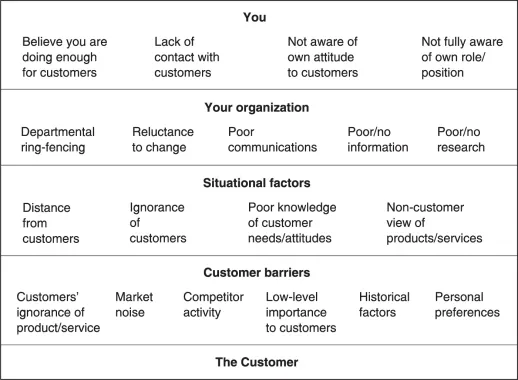
Figure 1.1 Common barriers between you and your (external) customers.
You will note that there are issues relating to you, your department and colleagues, your organization as a whole, the environment you operate in and the way in which communications work (or fail), and the issues and problems facing your customers. Read this carefully and consider how the barriers you face may not be those faced by your colleagues. Part of your success as a manager is in how good you are at appreciating not only your own problems but also those of your staff and colleagues. In the remainder of this chapter we will explore some of the issues relating to these barriers and help you begin to understand what you need to address in order to manage the process of meeting your customer needs.
ACTION BOX 1.3
Put together your own set of barriers but leave space at the bottom – you may want to add to this list even as you cross out earlier ones.
How Organizations Relate to Customers
The list in Figure 1.1 above illustrates that the type of organization and what it provides helps to determine how it might relate to its customers. For example, companies selling goods directly to other companies will have a different relationship to its customers than a household products’ manufacturer in a mass market.
Customer-facing organizations are unlikely to be perfect. Their customers may not be 100 percent satisfied with what they are getting but the organization will be aware of this and determined to listen to their customers, and will continually try to improve things. An organization with very poor levels of customer satisfaction is on seriously dangerous ground and if this is coupled with a general conviction within the organization that they are doing well and do not need to do better it is either an arrogant monopoly or an organization on the edge of failure.
Consider Figure 1.2. Where does your organization lie within the matrix? Unlike most diagrams of this sort, the optimum position is not in the top right-hand corner but at the point marked ‘X’. Think about the implications of being in the top right-hand corner. Is the only way down? Of course not! Life is not restricted to a box and you must challenge yourself and your colleagues to find ways of continuing to improve while revisiting your measures of customer satisfaction. Are you so convinced of your perfection that you are forcing your customers to say they are very satisfied even when they are not? How relevant is your measure in the eyes of the customer?
Now consider Figure 1.3. We will look at this in more detail later, but it is clear from this matrix that we need to please and surprise those customers we wish to win over and fully justify those customers already committed to our products or services. There is no room for complacency in a customer-facing organization.
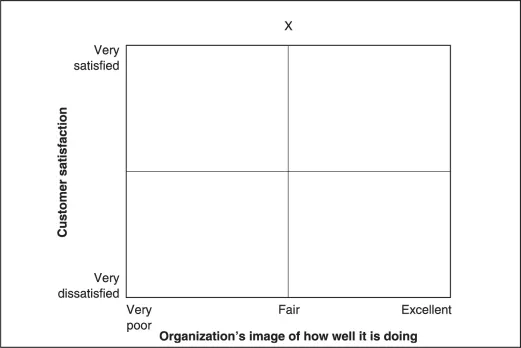
Figure 1.2 Customer satisfaction versus the organization’s self-image.
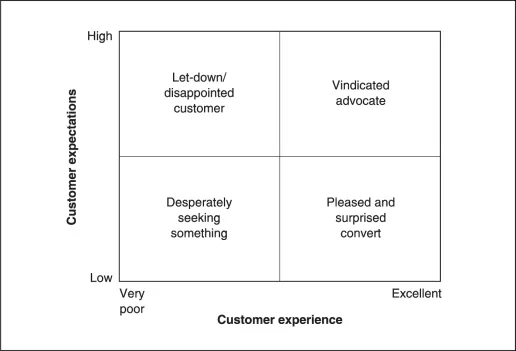
Figure 1.3 The effects of experience against expectation.
ACTION BOX 1.4
Write down your honest assessment of how well your organization is satisfying its customers and what would be the most significant improvement it could make. Now select the top three customers you and your department serve. How well are they served and what would improve their experience of you and your department?
Routes to th...
Table of contents
- Cover
- Half Title
- Title Page
- Copyright
- Contents
- Series adviser’s preface
- Introduction
- 1. First, know yourself
- 2. Customers: who do they think they are?
- 3. The route to your customers
- 4. Competitors and how to make the most of them
- 5. Starting the planning process – where do you want to be?
- 6. Marketing – the tools for understanding and analysing
- 7. Marketing – conversing with customers
- 8. Marketing – measuring all that is important
- 9. Virtuous cycles
- 10. Revisiting your plans
- Conclusions: Not the end, this is just the start!
- Index
Trusted by 375,005 students
Access to over 1.5 million titles for a fair monthly price.
Study more efficiently using our study tools.
Frequently asked questions
Yes, you can cancel anytime from the Subscription tab in your account settings on the Perlego website. Your subscription will stay active until the end of your current billing period. Learn how to cancel your subscription
No, books cannot be downloaded as external files, such as PDFs, for use outside of Perlego. However, you can download books within the Perlego app for offline reading on mobile or tablet. Learn how to download books offline
We are an online textbook subscription service, where you can get access to an entire online library for less than the price of a single book per month. With over 1.5 million books across 990+ topics, we’ve got you covered! Learn about our mission
Look out for the read-aloud symbol on your next book to see if you can listen to it. The read-aloud tool reads text aloud for you, highlighting the text as it is being read. You can pause it, speed it up and slow it down. Learn more about Read Aloud
Yes! You can use the Perlego app on both iOS and Android devices to read anytime, anywhere — even offline. Perfect for commutes or when you’re on the go.
Please note we cannot support devices running on iOS 13 and Android 7 or earlier. Learn more about using the app
Please note we cannot support devices running on iOS 13 and Android 7 or earlier. Learn more about using the app
Yes, you can access Meeting Customer Needs by Ian Smith in PDF and/or ePUB format, as well as other popular books in Business & Customer Relations. We have over 1.5 million books available in our catalogue for you to explore.