- 400 pages
- English
- ePUB (mobile friendly)
- Available on iOS & Android
eBook - ePub
Practical DV Filmmaking
About this book
Written for the beginner, Practical DV Filmmaking guides you thorough the process of making a film with low-cost digital equipment: from development through to production, post-production and distribution. While the technical tools you need are fully explained, the book concentrates on filmmaking principles throughout, illustrating how these tools can be used to achieve stylistic approaches for innovative filmmaking.
The book assumes no background knowledge in either technology or filmmaking and is divided into four key areas:
*DEVELOPMENT: turn your idea into a workable script, storyboard and schedule.
*PRODUCTION: develop skills to shoot original short films and turn a zero-to-low budget to your advantage.
*POST-PRODUCTION: learn basic editing techniques to enhance your original idea using iMovie, Premiere and other popular tools.
*DISTRIBUTION: set up a website and use the internet to promote your film. Includes numerous links to useful websites. Plus, top tips for how to enter a film festival and a new chapter on developing a career.
Projects enable you to master each step of the process taking you through different aspects of filmmaking today. Gradually you will find out where your strengths lie and how to make the most of them. The book also encourages stylistic development by intruding theoretical approaches to filmmaking. A glossary of terms plus an appendix of resources make this guide a one-stop essential handbook to DV filmmaking practice for beginners and student filmmakers.
Information
1 Overview
1. Think big
‘Four years ago, if you had a video and you wanted people to see it, you had to invite them all over to your house for a beer. With the web, it's possible to produce a movie with almost no budget and get a million people to watch it.’David Trescot, group product manager at Adobe, giving his view about the ease with which you can now go out and make movies
There is no doubt that with a camcorder and an Internet connection you have one of the most powerful tools for communicating. If you have the energy and the will you can shoot a short movie on any subject, in your own unique style, show it to a global audience, and promote and advertise it yourself. You are more in control of the filmmaking process than any previous generation, and furthermore have less need for the established industry than ever before. Changes to the film industry as entertainment and as an art form are here to stay, and simply by possessing an Internet connection, a camcorder and basic editing software you are a part of it.
This is a great opportunity, but you may now be getting a sense of the problem that goes with it. Although inspiring, for many this is daunting. As the spotlight moves your way the need to have developed yourself as a filmmaker is profound; you need to find out what kind of films you make, how to come up with ideas good enough to film and how to get the knowledge that makes other people take you seriously. Your only obligation is to stand out from the crowd, do your own thing, don't emulate what everyone else is doing when the whole world starts making movies. Take advantage of this moment and start getting to know what it is that a movie by you looks like.
This isn't a new phenomenon even if the technology is in its infancy. Some of the finest directors have started their careers making films on no budgets, with no help from big studios. David Lynch made the classic film Eraserhead (1976) at weekends over a number of years while holding down a day job; within five years of its release he was being offered the chance to direct Return of the Jedi. George Romero made his seminal zombie film Night of the Living Dead (1969) with almost no funds, relying on the commitment of friends willing to be part-time zombies, but without being paid. Robert Rodriguez went from making a film with a borrowed camera — El Mariachi (1992) — to making hit films such as From Dusk Till Dawn (1995) and Spy Kids (2001).
The difference for today's filmmakers is that you can go further. Not only can you get hold of good cameras capable of broadcast quality images, but you can edit these films at home without having to endure the budget-crippling prices of the rent-by-the-hour edit unit. When it's finished you can show it on one of the many web cinemas, short film festivals or TV access slots. The potential is there to place your short movies in millions of homes around the world.
Digital video has affected the independent, low-budget filmmaker more than any other part of the film industry. These self-financing, ultra-resourceful people would make movies whatever it cost them and however long it takes. But it is now a realistic aim to say that you want to make movies and do so without mortgaging your soul. All you need is a camcorder, a computer, a limitless imagination and the desire to tell it your way.
2. The filmmaking process
To begin with, it would be useful to get to grips with the process of making a film as a whole. What do these people actually do? Why does it take so long between thinking of the film and getting down to shooting it?
The whole project starts life as an idea, in your imagination or as a response. You may have a story you wish to tell or a theme you want to work with. Whatever it is, it starts in darkness, probably a collection of images you see appearing in the film, played out in no real order in your mind's eye. Most directors favour getting as much material on paper as you can at this stage to establish the detail of an idea. Others suggest more idiosyncratic approaches. Robert Rodriguez recommends you ‘stare at a blank projection screen. See your film, watch it from start to finish.’ Whatever your initial idea, it is crucial to get to know it at this early stage as clearly as possible. Even though you have only a broad outline of the project you do have the initial spark: the images, atmosphere or look of the film. It is this that you should try to pin down and keep, as it will become the main creative thrust of the project, seeing you through the obstacles and possible wrong turns to come.
Stage 1: Planning
The first stage of making a movie is centred on getting the film developed as much as possible before you start shooting. Substantial changes during shooting are expensive and disrupt continuity, or worse can result in a discordant and messy film. Good planning means that when you start shooting you go through a smoother process. You will encounter surprises and have to make changes here and there, but planning means you encounter more of the right sort of surprises and know how to solve the less welcome ones. The aim is to let your ideas grow and develop to a point at which you know every aspect of the project better than anyone else. You know the relative significance of each part of the story, the kinds of motifs and ideas that are running through it, and the kind of atmosphere that is to dominate. In a sense, when you commit your ideas to paper you are taking them out of the comforting darkness of the imagination, where you don't notice the loose ends and rough structure of a film, and exposing them to light. Some aspects of your ideas survive, some don't, but it is better that the project changes now than later. Work on paper is cheap but work on film is expensive. An hour of scriptwriting can save you a day of shooting and a week of editing later in the process.
Visual blueprints
In planning your film you will make detailed written and visual blueprints of how the film will look and sound from the first to the last moment. Step 1 involves a written outline in the form of a short story. Even if your film does not rely on plot at all, you need basically and simply to write down all the scenes that you envisage in the order that you think they may occur. Getting to that stage may involve noting down all the elements of the film and producing several different versions of an outline. This rough draft we can call a treatment. Following that, you will produce a range of material which will trace the steps you take as you develop and grow the film.
Early visualizations
If you have ever found yourself doodling with a pen and paper then you will have some idea of what this stage of work involves. To some people what you draw when doodling is a true reflection of the natural inclinations of your mind; some people draw closed-in little boxes, tightly stuck together, others draw blossoming spirals or crystal-like structures. It doesn't take a certificate in psychology to work out the meanings of the things we find ourselves drawing; what you are doing is reflecting the current inner architecture of your thoughts, not the thoughts themselves as such but the shape they take. Whatever your doodles look like — dark and angular, bold and bright — these can be viewed as potential design notes for a film. Of course, this is only relevant if you are determined to find and display your own personal world view, as opposed to following the needs of a client or audience focus group.
In a practical sense, what you are doing when drawing visualizations is a long set of small sketches, perhaps each the size of a cigarette packet. Each one is a quick outline of a possible scene from the film. These are drawn in no particular order, but the order you draw them does say something about the relative importance of each to you. Each sketch should be quick and uncomplicated, showing the main elements in the shot and hinting at the kind of light in the frame. The aim is not to correct them or judge them in any way until you've gone through the whole exercise, with as many frames as possible on paper. Following this, you can then start to group your sketches together and compare the overall style of each frame.
Storyboard
The storyboard is used to explain the detail of the visual side of the film to a crew and allow those people working on a film to plan essential equipment and work schedules effectively. Working on a low budget with just yourself and a few friends does not excuse you from this process; it offers a chance to refine both the look and structure of your film and pare it down, stripping it of elements that divert from the idea, making it a project that fulfils the specific aims you had in mind right at the start.
In preparing a storyboard, you will draw frames on one vertical column of the paper with corresponding dialogue, notes or sound written next to it. This document is the most detailed visual and written description of the whole film, the single blueprint that you try to stick to throughout the shooting process.
Although storyboarding was rigidly adhered to by directors such as Alfred Hitchcock, for the most part it is simply the most accurate plan you have at this point, ready to be challenged and altered during filming.
Script
In films where you have a story, a script is going to be the only way to prepare it and iron out the inconsistencies. Even in films where there are no speaking roles you may find it useful to prepare a script showing only director's notes, as it gives yet another opportunity to hone your idea, add to it or subtract.
The importance of each stage of planning is relative to the sort of film you are making. Abstract, theme-based movies will demand more consideration of visual aspects, while character studies with intense dialogue will need more attention paid to the script. All films, however, need to go through an intense period of planning in order to emerge fully formed before a camera starts showing up the faults. Know your film.
Stage 2: Shooting
Shooting is to some a time where the film takes on a whole life of its own, to others a simple regurgitation of a paper storyboard. In practical terms, it seems simple enough: plan out a series of shots, go and shoot them just as you planned on paper, tick off the scenes one by one and go home. In an ideal situation this is more or less what happens, but since this is an art form it is natural to assume that the creative process continues throughout the project, through planning, shooting and editing (even through to marketing, but more of that in Chapter 9). So, you should expect to encounter obstacles and temptations along the way. Obstacles in the form of challenges to your plans and temptations in the sense of other seemingly better ideas that come up, possibly deviating from the original one. Great planning for a film is about giving you the confidence to know your idea inside out, giving you the commitment to get round problems and the confidence to know the good from the bad when new ideas come up.
Another important point to realize about filming is how nothing ever works out the way you imagine it will. Every good filmmaker needs to have a plan B available constantly, followed by C and so on.
Figure 1.1 Acclaimed animator Phil Dale on the set of his short live-action film The Census Taker.
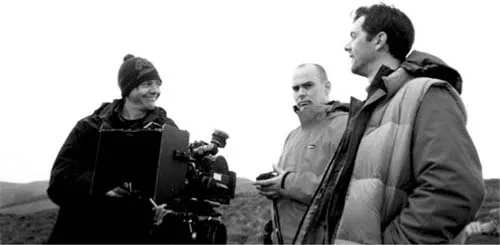
When working on a low budget this is more likely because you have to rely more on goodwill, on people helping you out and lending you equipment. But you will also find that a shot that looks perfect on paper just isn't possible for real. You may want the bank to be seen from the telephone box and it may be really crucial for the scene, but when you get there it becomes obvious that that tree in full leaf is going to get in the way. The answer is improvisation: the ability to think fast and clearly on set so that you stay on track with your plans, coming up with ideas that can solve a problem. If you don't do this, your crew and actors will quickly realize there is a power vacuum and start arguing about the best way forward. So, plan to improvise.
Stage 3: Editing
Priorities
In editing a film you will add a further layer of development to the whole creative act as your footage — all those tapes accrued over days or weeks of filming — is cut together in a way which best resembles your plans. Editing brings your film out of the uncertainty that is the initial idea and out of the scramble that is filming. It is about order, priorities, structure, pace, timing, accuracy. But it is also about play, spontaneity and creativity. Knowing how to place your clips in the right order is perhaps a triumph of instinct over expertise and, given the range of technical trickery on offer even in mid-level editing software, one of the hardest skills to learn is knowing when to stop editing. If you know what you want you are less likely to get side-tracked by the powerful influence of all that wonderful technology.
Skills you need
When you look back over the process of making your first production you may find that the skills you thought were essential to filmmaking — those centring on the technical aspects of the medium — were secondary to the more esoteric. Some filmmakers talk about the ability to remain both in control and open to new ideas; to negotiate your way through problems; to see all aspects of the process, however mundane, as having some creative contribution to the project, that nothing is purely technical; to think of a low budget as less a hindrance to realizing your imagination than a way towards doing so more artfully, more ingeniously.
The Crunch
- Know what it is you want to make clearly
- Planning the film will save you time and money later
- Enjoy surprises
- Handle the pressure — it's worth it to have your name at the end of the film
- Improvise to get you out of trouble
- Be prepared ...
Table of contents
- Cover
- Full Title
- Copyright
- Contents
- Acknowledgements
- Introduction of the second edition
- How to use this book
- Chapter 1 Overview
- Chapter 2 Inside video
- Chapter 3 Films and how they work
- Chapter 4 Pre-production
- Chapter 5 Production tools
- Chapter 6 Production aesthetics
- Chapter 7 Post-production tools
- Chapter 8 Post-production aesthetics
- Chapter 9 Careers and distribution
- Chapter 10 Mapping the industry
- Glossary of film and video terms
- Bibliography
- Index
Trusted by 375,005 students
Access to over 1.5 million titles for a fair monthly price.
Study more efficiently using our study tools.
Frequently asked questions
Yes, you can cancel anytime from the Subscription tab in your account settings on the Perlego website. Your subscription will stay active until the end of your current billing period. Learn how to cancel your subscription
No, books cannot be downloaded as external files, such as PDFs, for use outside of Perlego. However, you can download books within the Perlego app for offline reading on mobile or tablet. Learn how to download books offline
Perlego offers two plans: Essential and Complete
- Essential is ideal for learners and professionals who enjoy exploring a wide range of subjects. Access the Essential Library with 800,000+ trusted titles and best-sellers across business, personal growth, and the humanities. Includes unlimited reading time and Standard Read Aloud voice.
- Complete: Perfect for advanced learners and researchers needing full, unrestricted access. Unlock 1.5M+ books across hundreds of subjects, including academic and specialized titles. The Complete Plan also includes advanced features like Premium Read Aloud and Research Assistant.
We are an online textbook subscription service, where you can get access to an entire online library for less than the price of a single book per month. With over 1.5 million books across 990+ topics, we’ve got you covered! Learn about our mission
Look out for the read-aloud symbol on your next book to see if you can listen to it. The read-aloud tool reads text aloud for you, highlighting the text as it is being read. You can pause it, speed it up and slow it down. Learn more about Read Aloud
Yes! You can use the Perlego app on both iOS and Android devices to read anytime, anywhere — even offline. Perfect for commutes or when you’re on the go.
Please note we cannot support devices running on iOS 13 and Android 7 or earlier. Learn more about using the app
Please note we cannot support devices running on iOS 13 and Android 7 or earlier. Learn more about using the app
Yes, you can access Practical DV Filmmaking by Russell Evans in PDF and/or ePUB format, as well as other popular books in Media & Performing Arts & Film & Video. We have over 1.5 million books available in our catalogue for you to explore.