- 303 pages
- English
- ePUB (mobile friendly)
- Available on iOS & Android
eBook - ePub
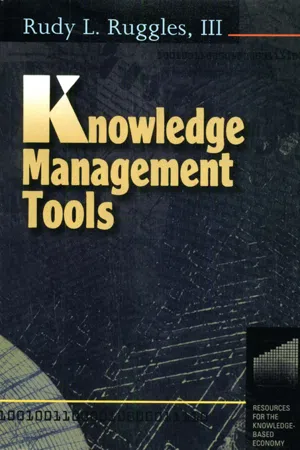
Knowledge Management Tools
About this book
The third in the readers series Resources for the Knowledge-Based Economy, Knowledge Management Tools analyzes the use of knowledge management tools in the past, present and future. It helps managers and companies utilize what they know.
The selections in this volume were carefully chosen to represent the strengths and weaknesses, and pros and cons of using technology to support knowledge-based activities. They acknowledge that, although tools alone are not the answer to the difficult questions surrounding knowledge management, if utilized effectively tools can open up new realms of innovation and efficiency for today's knowledge-driven businesses.
1
Tools for Knowledge Management: An Introduction
Man is a tool-using animal… Without tools he is nothing, with tools he is all.
—Thomas Carlyle (Essayist & historian, 1795–1881)
Knowledge Management
For thousands of years, humans have been discussing the meaning of knowledge, what it is to know something, and how people can generate and share new knowledge. It is interesting to consider, therefore, that despite the pervasiveness of epistemological discussions throughout history, it is only in the past few years that the world of business has begun to recognize the importance of knowledge as a resource. Individual and organizational knowledge has been invisible on balance sheets, overlooked in reward and incentive systems, and allowed to flow out of companies en masse, unrecognized and uncaptured.
Recently, however, knowledge has come into its own in the business world. Some companies, like Skandia AFS for example, have begun to produce supplementary annual reports reflecting their intellectual capital. Balanced scorecard performance measurement plans capture the value of intangibles and financials simultaneously to provide a more complete picture of organizational health. Some organizations, Ernst & Young LLP among them, have instituted Chief Knowledge Officers and whole knowledge management processes and infrastructures. Firms have realized that, while managing data and information is important, true competitive advantage lies in leveraging the unique, powerful knowledge of the organization.
Knowledge management covers three main knowledge activities: generation, codification, and transfer. Other books in this series of readers cover these areas in more detail, but a brief description of each is in order here. Although there are many definitions of knowledge in the world, with several varieties represented even within this book, the working definition I use is that knowledge is a fluid mix of contextual information, values, experiences, and rules. It comes in many forms, including process knowledge (how-to), catalog knowledge (what is), and experiential knowledge (what was). All of these types are similarly generated, codified, and transferred.
Knowledge generation includes all activities which bring to light knowledge which is “new,” whether to the individual, to the group, or to the world. It includes activities such as creation, acquisition, synthesis, fusion, and adaptation. Knowledge codification is the capture and representation of knowledge so that it can be re-used either by an individual or by an organization. Knowledge transfer involves the movement of knowledge from one location to another and its subsequent absorption. Generation, codification, and transfer all occur constantly, so management itself does not create these actions. The power of knowledge management is in allowing organizations to explicitly enable and enhance the productivity of these activities and to leverage their value for the group as well as for the individual.
This compendium is an integral part of this series about knowledge. Combined, the books of this series reflect the many facets of knowledge management, expressed through the works of individuals from a wide variety of fields and disciplines. This volume has a very specific place in this collection: it reflects the wide variety of thoughts and perspectives on the use and usefulness of tools in managing knowledge in organizations. It is my intention, as the editor of this volume, for readers of this book to be able to make better decisions about how to gain greater results in managing their organization’s knowledge by effectively and appropriately leveraging the potential power of tools.
Tools
Tools are defined, for the purposes of this work, as technologies which support the performance of activities or actions. As reflected by the quotation which begins this chapter, man is a tool-user from way back. According to anthropologist Jane Lancaster, “An estimation of two million years of tool use prior to handaxe cultures and Homo erectus is undoubtedly conservative.”1 In fact, human tool use has often been cited as one of the primary drivers of human evolution! Theorists and scientists from Engels to Darwin maintain that one of the main reasons that humans walk upright is because their hands were specialized over time primarily for the job of using tools, with ambulation relegated to the legs alone. It was mankind’s ability to create and use tools which leveraged the ability of the human mind, the only competitive advantage humans had over animals in the fight for survival. In turn, many scholars also link tool use to the evolution of the human cognitive and behavioral capacities as well.2 If utilizing tools to enable more efficient manual activities has had these effects on humans so far, one wonders at what the evolutionary impact of tools enabling intellectual activities might be as this human-tool co-evolution moves into the knowledge age. In fact, humans have moved tools so far beyond the initial sticks and rocks that they are able to embed a certain amount of intelligence, and some would argue knowledge, into the tools themselves. With this rise in intelligence, comes a new relationship with such tools. “Interactive” has become a prime descriptor of the new generation of technology, indicating a move from humans using tools to humans conversing with tools.
It is important to realize however, that this human-tool conversation does not itself create more efficiency, greater effectiveness, or better innovations, the primary objectives of most tools. This is particularly true in the world of computers. Many studies of workplace productivity show no real increase in efficiency or effectiveness due to the use of computers. Often, people spend a great deal of time and energy fitting their computers to their jobs and their jobs to their computers. The fascination with advancing technologies occasionally overshadows the human element in the interaction. This is what happens in the human-tool co-evolution when the humans evolve much more slowly than the tools. As expressed by Donna Haraway, author of A Cyborg Manifesto, “Our machines are increasingly lively, and we are increasingly inert.” Our challenge is to keep pushing the human capacity in parallel with the technological capabilities, so that neither will hold the other back for any length of time. This is the realm of knowledge tools.
Knowledge Tools
Knowledge management tools are technologies, broadly defined, which enhance and enable knowledge generation, codification, and transfer. As with any tools, they are designed to ease the burden of work and to allow resources to be applied efficiently to the tasks for which they are most suited. It is important to note that not all knowledge tools are computer-based, as paper and pen can certainly be utilized to generate, codify, and transfer knowledge. For the purposes of this work however, the tools covered are primarily the technological ones due to their quick evolution, dynamic capabilities, and organizational impacts. They are also the most expensive tools, and are worthy of the closest scrutiny.
True knowledge management tools are not data or information management tools with a 1990s title. They do different things. Data management tools allow organizations to generate, access, store, and analyze data, usually in the form of facts and figures, which can be considered “raw material.” Examples include data warehouses, data search engines, data modeling, and visualization tools. Information management tools enable the manipulation of information (i.e., data which informs in and of itself). Examples of these tools include automated information search and retrieval agents (or ‘bots), basic decision support technologies, many executive information systems, and document management technology. All may be useful for the jobs they do, but such tools do not capture the complexity of context and the richness of knowledge. While knowledge management tools may indeed also handle data and information, the other types are not robust enough to truly facilitate knowledge management. Think about what it is to know a thing, versus simply having information about that thing. It is the difference between reading a description of the Mona Lisa and seeing the painting itself. Knowledge tools can help us see the paintings.
In the world of knowledge management, the role of the tool in the work is an even more difficult concept than it would initially appear. The crux of decades of discussion as to whether or not technologies can be used to help manage knowledge was captured as recently as the March 25, 1996 Time magazine cover article: Can machines think? If one answers yes, or possibly yes, the tools themselves can (may) generate, codify, and transfer knowledge. If not, the role of the tool is purely enabler, with the onus on the humans to conduct knowledge activities. The debate over the answer to this question, usually the domain of the field of artificial intelligence (AI), is continued in this volume to the extent that it applies to knowledge management.
This book also reflects my belief that no matter what an individual’s answer to this question, focusing on the technology as the key to managing knowledge organizationally or individually neglects the economic, political, and social issues which are the keys to effective knowledge management. Too often people look to technology to solve the hard questions, when in fact the tools are the easiest part. A Stradivarius violin sounds just as terrible as a dimestore fiddle in the hands of a novice. The key is putting the right tools in the hands of people who know how to use them. Anyone who has heard Itzhak Perlman or the London Symphony Orchestra knows the results can be quite incredible. Business is no different.
The Selections
I have assembled the enclosed articles and chapters from a wide variety of perspectives, including the fields of sociology, economics, computer sciences, and cognitive psychology, to create a discussion about knowledge tools. The first sections present issues and implications in various aspects of using tools in knowledge generation, codification, and transfer. Following these are descriptions of implementation and application considerations, and then a glance at what tools may look like in the future. These selected readings present a wide range of pertinent issues, creating a fertile field for continued discussion and deep and broad exploration.
Knowledge and Technology
In the first section, three articles reflect the debate over whether technology can indeed duplicate, or at least replicate, human thought. The first selection comes from Nobel Laureate Herbert Simon, who has long defended the possibility, in fact the actuality, that computers process information in ways which parallel human thought. Although the article is over 30 years old, its well thought through reasoning and straightforward approach present an interesting argument for the ability of the machine to duplicate human cognition, even when considering the significantly more primitive computing tools of the 1960s. Simon lays the groundwork for many of the arguments in this collection which stand in support of the ability of technological tools to capture, and in some cases replicate and even generate, knowledge.
Hubert and Stuart Dreyfus’ article, “Why Computers May Never Think Like People,” serves as the appropriate counterpoint to the notion that technology can cogitate. Without the ability to make intelligent decisions, without being able to incorporate “know-how” along with “know-what,” computers can be no more than conduits of human intelligence, devoid of context, distinctions, or true judgment. While technology may enable humans to manage their knowledge better, the Dreyfus’ maintain that knowledge can never reside within the machine. In their view, the answer to Time’s question is no, and the knowledge activities will always rest squarely with the humans.
To provide a third perspective in this conversation, I have included a chapter from a book by Daniel Crevier, a chronicler of artificial intelligence’s history of successes and failures, discussing why machines have such a difficult time dealing with knowledge, despite their advancing processing power. By detailing the scale and scope of the human brain’s processing power, he paints a vivid picture of the gap which exists between today’s most sophisticated and powerful computers and the cerebral cortex. However, he balances the views of the section’s previous writers by allowing that this huge gap is being spanned, if slowly. It is this progress which makes the rest of the articles in this volume even more interesting.
Knowledge Generation
The section on generation tools begins with an article by David Bawden on whether information systems can actually contribute to knowledge generation. While the direct case used concerns research and development, the concepts apply to all whose job includes generating new ideas. This article squarely addresses when information systems, and more generally information environments, can contribute to knowledge generation. The focus is on technology as enabler. This is a good example of people leading the knowledge work, utilizing the tools at hand to support their own internal generation processes.
This is contrasted with the chapter from George Johnson’s book, Machinery of the Mind, which describes interesting cases where the tools, the computers, actually create new objects and ideas themselves. Stories such as these open the discussion as to what sorts of knowledge work can, or should, be automated. This, to me, leads to a deeper discussion important in understanding the human-tool relationship: Will people trust a machine’s creation/synthesis/perspective? Instead of NIH (not invented here) syndrome, will we hear more about NIBH (not invented by human) syndrome? Many organizations are already trusting neural networks and genetic algorithms to solve optimization problems in operations, financial services, and environmental scanning, but how far will this trust extend? As tool sophistication increases it is likely that decisions about their use will focus less on whether technological tools should be used at all, but more on whether they will be used to augment (enable) or to automate (do) the work of people. The power of advanced technological capability can be alluring, but unless the result contributes value accepted by the whole system, the tool is useless.
Knowledge Codification
One of the most hotly contested area of knowledge management involves codification, i.e., putting knowledge in various forms that can be leveraged and transferred. The field of artificial intelligence has long involved so-called “knowledge elicitation” and “knowledge engineering” in the development of expert systems. The section on codification begins with a chapter from Patrick Wilson’s book Second-Hand Knowledge describing the interesting question of cognitive authority, i.e., how much trust there is in the validity of the knowledge. Also, is all knowledge captured for later sorting or is it pre-screened? In either case, who determines knowledge quality? Wilson looks at these questions through the eyes of library science, a field which has long dealt with these exact concerns. The activities of the librarian (e.g., establishing information sorting, cataloging, and retrieval mechanisms) are now required far beyond the bounds of the library, coming to rest on the shoulders of most every member of the information economy. Workers today, faced with the internet, Lotus Notes databases, organizational knowledge maps, etc., realize that they have much to learn from library sciences’ experience with codified knowledge.
In the second chapter in this section, an article by Harry Collins explains how utilizing the idea of behavior-specific action in captur ing knowledge can help us get closer to striking a balance between symbol-type (explicit) knowledge and so-called “encultured” (tacit) knowledge. While Wilson talks about how to organize what you know you have codified, Collins describes how to codify what you have a hard time even recognizing. Through greater understanding of the differences Collins points out, the place of technology in capturing and handling all types of knowledge becomes clearer.
Knowledge Transfer
Knowledge transfer has received a tremendous amount of publicity recently with advances in groupware and networking tools, designed to enable the flow of knowledge among groups and individual...
Table of contents
- Cover
- Half Title
- Title Page
- Copyright
- Table of Contents
- Acknowledgments
- 1. Tools for Knowledge Management: An Introduction
- Part One Knowledge and Technology
- Part Two Knowledge Generation
- Part Three Knowledge Codification
- Part Four Knowledge Transfer
- Part Five Implementation
- Part Six What Next?
- Index
Trusted by 375,005 students
Access to over 1.5 million titles for a fair monthly price.
Study more efficiently using our study tools.
Frequently asked questions
Yes, you can cancel anytime from the Subscription tab in your account settings on the Perlego website. Your subscription will stay active until the end of your current billing period. Learn how to cancel your subscription
No, books cannot be downloaded as external files, such as PDFs, for use outside of Perlego. However, you can download books within the Perlego app for offline reading on mobile or tablet. Learn how to download books offline
Perlego offers two plans: Essential and Complete
- Essential is ideal for learners and professionals who enjoy exploring a wide range of subjects. Access the Essential Library with 800,000+ trusted titles and best-sellers across business, personal growth, and the humanities. Includes unlimited reading time and Standard Read Aloud voice.
- Complete: Perfect for advanced learners and researchers needing full, unrestricted access. Unlock 1.5M+ books across hundreds of subjects, including academic and specialized titles. The Complete Plan also includes advanced features like Premium Read Aloud and Research Assistant.
We are an online textbook subscription service, where you can get access to an entire online library for less than the price of a single book per month. With over 1.5 million books across 990+ topics, we’ve got you covered! Learn about our mission
Look out for the read-aloud symbol on your next book to see if you can listen to it. The read-aloud tool reads text aloud for you, highlighting the text as it is being read. You can pause it, speed it up and slow it down. Learn more about Read Aloud
Yes! You can use the Perlego app on both iOS and Android devices to read anytime, anywhere — even offline. Perfect for commutes or when you’re on the go.
Please note we cannot support devices running on iOS 13 and Android 7 or earlier. Learn more about using the app
Please note we cannot support devices running on iOS 13 and Android 7 or earlier. Learn more about using the app
Yes, you can access Knowledge Management Tools by Rudy Ruggles in PDF and/or ePUB format, as well as other popular books in Business & Business General. We have over 1.5 million books available in our catalogue for you to explore.