- 240 pages
- English
- ePUB (mobile friendly)
- Available on iOS & Android
eBook - ePub
Leading for a Change
About this book
Bringing together the best practices of many of the most highly
respected organizational thinkers shaping the future landscape of
business, Leading for a Change finally answers the question of how to make leadership success a reality.
This book is relevant for all leaders within the organization-from the shop floor, to those pushing the envelop with e-commerce to walnut row. The book's "5 Challenges of Organizational Leadership" enables readers to concentrate on specific tasks crucial to creating a unified, visionary and dynamic organization. The author's unique Leader's Map framework lays out the five universal challenges facing today's leaders: reframing the future, developing
followership, teaching and learning, building community, and balancing paradox. The book's leadership "roadmap" and diagnostic surveys help readers assess their organization's current and emerging
leadership challenges and devise new adaptable and anticipatory strategies. Drawing from the works of such luminary business gurus as Kouzes & Posner, Senge, Covey, Bennis, Hamel and others, the author has translated their wisdom into practical tools that bring clarity to the order and rhythm of what it takes to be a successful leader. Leading for a Change is straightforward and free from jargon. The unique underlying principles of the book are:
Leadership can be learned, thus it is less art and mostly practice
Leadership need not be a solo act. Leaders support each other to
accomplish organization objectives
The most successful leaders focus on using their strengths effectively
Effective leaders learn to use leadership tools in ways that are natural to them
CHAPTER 1
The Leader's Challenges
On a Saturday morning in early fall, a small group of successful leaders gathered, not for the purpose of discussing their organizations, but to examine their roles. It soon became apparent that, although they came from different industries and with different professional preparations, they had much in common. They approached their leadership roles with a great sense of responsibility, believing that their corporation's success rested in large measure on their ability to do the job. Unfortunately, despite previous successful educational and professional experiences, they were ill prepared for the challenges that confronted them. Many struggled to define their jobs. Existing job descriptions were out of date or they listed a series of tasks that were irrelevant. Many of the leadership books they had read described what they were supposed to be, but not what they were supposed to do. In the absence of a meaningful compass, many relied on past accomplishments, hoping that what had worked in the past would once more help them succeed.
One leader synthesized five themes from the stories she had heard. As she spoke, a silence fell over the room. Every person present shared the same leadership challenges and frustrations. The most personal was also the most common. The five themes offered the leaders a way to describe their jobs in a meaningful way. They also gave the participants hope that their leadership challenges could be more adroitly addressed.
The Five Key Leadership Challenges
Whether you are a manager of a department wanting to improve service to internal customers, the project leader of a team focused on solving a thorny organizational problem, or the president of a company undertaking major change, the five challenges are important components of your leadership role. Some of these challenges may be more critical than others. Understanding the five challenges will allow you to create an agenda of what you must accomplish. Once people better understand your leadership function and your objectives, they will be more likely to follow.
1. Reframe the Future
Leaders have many opportunities to develop a broad perspective of their organizations. They understand the relationships between the dynamics in the marketplace and the dynamics in the organization. They anticipate critical changes in such areas as technology and finance, and understand the limitations of their organizations. Thus, they are able to view the business from several perspectives and can see the potential for new realities to emerge.
Reframing the future challenges leaders to develop a new set of possibilities. It provides an opportunity to rethink assumptions and relationships, and develop a new way of doing business. The result is not an operating budget for the next fiscal year, not an extension of an existing product, nor a way to reduce the cost of doing business. Reframe the future focuses on the need to refute the assumptions that bind the organization to the past. By asking the unthinkable, a leader creates the potential for a totally different kind of organization. What would happen if we partnered with our competitors? What if we used an old technology in new ways? What if we adopted a new technology to make our product or service obsolete? What if we moved from being a product manufacturer to being a service provider? What product or service would excite our customers, even make them ecstatic?
The outcome of reframing the future is your vision of a new way to add value for customers, which could enhance your organization's position in the marketplace, its productivity, or its profit picture. Your enhanced relationships with others outside the organization could lead to a significant strategic advantage. The creation of an exciting and meaningful set of possibilities is a requisite first step in developing your ability to influence change. Once the direction is established, you must convince the critical stakeholders.
2. Develop Commitment
When things go wrong in the organization, fingers point to the leaders. When things go right, fingers point to the vast majority of members of the organization. There can be no leadership without committed followers. Followers, in turn, determine that leaders will be effective. In developing commitment, leaders create clear intellectual links and active behavioral links between themselves and followers.
In our society, few people seek to be labeled as a “follower.” To most people, being a follower means doing what one is told. According to our definition, followership is much more active and fulfilling. Devoted followers act with intelligence, know what to do without being told, and operate interdependently with courage and strong ethics. They distinguish when it is appropriate to follow orders, when to come back with different ideas, when to operate as individuals, and when to act as members of a unified team. In essence, they behave as if they own the business. Most leaders want such followers.
Indeed, at any particular moment a leader may recognize that an individual has a greater ability to get the job done, and assume the role of follower of that person. Thus, the leadership function may flow between people as the situation warrants.
Developing a cadre who are capable of engaging in complex relationships can be a daunting task for a leader. To become followers, people need to get something from their relationship with the leader. As Kelly notes, “Do followers, while being served, become wealthier, wiser, freer, more autonomous?”
Some followers expect perfection from their leaders. They become critical when they see weaknesses, which in turn enables them to feel less than accountable for their own performance. Better, more skilled and motivated followers understand the strengths and the weaknesses of their leaders and fill in the gap to make both parties more whole. The result is an organization with fewer hierarchical layers, a greater action orientation, and more productive dialogue. Commitment has been attained when the leader has developed a critical mass of people who are willing to address changes eagerly, honestly, and openly.
3. Teach and Learn
Teaching and learning sit at the juncture of several processes necessary to developing new concepts, developing greater competence, and implementing change. Teaching and learning is essential for organizational change to occur. They help individuals overcome the fear of taking on new challenges. They develop the competence to undertake new tasks. For these reasons, encouraging learning is a leadership function.
Progress is based on the ability of people to anticipate and plan for the future, to develop new ways of operating, to learn from each other and the past, and to implement plans swiftly and effectively. Without consciously attempting to teach and learn, people will operate as they always have. They may not be able to make the changes that will ensure their organization's long-term survival.
It is the leader's role to encourage learning throughout the organization—beginning with the leader's own learning. Effective leaders know that they cannot rely only on their innate capabilities. Rather, they hone their skills by seeking feedback, reflecting on the success of earlier actions, participating in learning forums, and surrounding themselves with those whose strengths complement their weaknesses.
Leaders ensure that sufficient competencies exist in the organization to take new ideas forward and turn them into reality. Leaders support others in seeing the world differently, in developing the competence to do their work better, in discovering how to work together more effectively, and in learning how to serve customers in ways never before imagined.
Effective teaching and learning result in your gaining new knowledge about yourself and what it is possible to accomplish.
4. Build Community
An organization requires commitment, not only from its leaders, but also from all the other members who compose it. Our focus thus far has been on the relationships between leaders and followers. Relationships that link members together in a meaningful way must also be fostered. Build Community requires leaders to consider three distinct organizational components.
Culture
Shared values provide much of the glue that holds people and their work together. Shared values can more readily be seen in the actions of employees than in the corporate handbook. Shared values indicate what people are permitted to discuss, what constitutes risk, how decisions are made, who becomes involved in making decisions, and the relative worth of stakeholder groups. Leaders who are conscious of the values they promote through their actions have a unique opportunity to influence the culture.
Infrastructure
Roads, sewers, water mains, police forces, and so on, sustain a community. Buildings, office furniture, and computer systems sustain an organization. Organization infrastructures establish the link between functions, processes, and people that ensure essential communication. Establishing firm, positive, communication links is the special responsibility of leaders. For example, leaders determine how meetings are conducted, how performance expectations are established and how performance is evaluated, how the corporate agenda is created, how teams are formed and maintained, and how everyday work is performed. Without infrastructure, leaders will have insufficient leverage to ensure that the work of the organization is communicated and performed.
Governance
Leaders clearly understand what others expect of them. They manage the expectations of key stakeholders. Leaders ensure that followers know how to measure their success, that feedback is continuously sought and given, and that reward systems are designed to recognize the desired processes and results. Leaders not only ensure performance, they also ensure that ethical practices, governmental regulations, and internal policies and procedures are enforced.
Evidence of community can be seen in the spirit and the vitality of members’ relationships as they achieve the goals laid out in Reframe the Future.
5. Balance Paradox
Leaders know they have encountered a paradox when they feel as if they are “damned if they do, and damned if they don't.” During the course of building community, the leader encounters reality. The real world is where critical choices must be made. Balancing paradox explains why the leadership role is often a lonely and unpopular one. The leader's and others’ decisions may propel the organization to great success or bring it to its knees. In balancing paradox the true mettle of a leader is tested.
Chapter 6, “Balance Paradox,” helps leaders understand how to focus on creating short-term profits while simultaneously building the capacity to compete in the long term. The leader may decide to lay off some employees and ask the remaining employees to be loyal. The leader may decide to continue a currently unprofitable core business. The leader may seek the advice of many people and yet be the only one who makes a difficult decision. The leader may not feel competent to act and yet may know that the opportunity of the moment will be lost if no action is taken.
Traditional problem-solving methods are inadequate for handling paradoxes. Professional training is also typically inadequate. Successful leaders learn to cope with paradox by rising to higher, more balanced views of situations.
The Leader's Map
Together, these five key challenges represent the heart of the leader's role. They represent what to think about as you strive to affect your organization. They are not five separate and independent challenges; all exist in a fluid interrelationship that will guide your work. These relationships are depicted in the Leader's Map in Figure 1-1.
Leaders know that much is expected of them. At any time they may analyze, define, and imagine possibilities; determine hard realities; sell, tell, and gain consensus; anticipate; demand perfection or be understanding; receive feedback and give feedback; be courageous; be authentic; be out front, but not too far out front; and follow the rules or go around them. A very confusing job description!
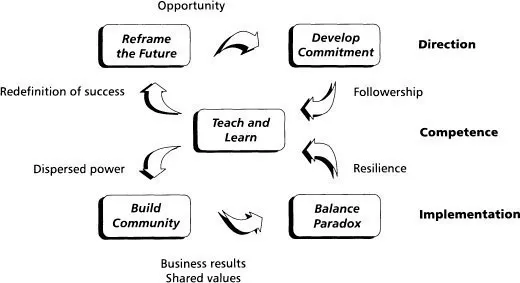
Figure 1-1: The Leader's Map
There are appropriate times for each of these leadership behaviors. Knowing what to do when is not obvious. Just as the navigator on a ship uses a sextant to determine its position so that alterations in speed, sail, and rudder can be correctly made, so leaders use tools to determine their positions and identify necessary courses of action. The Leader's Map is a sextant, a tool for understanding the need to implement a change or take a new course. Using the Leader's Map ensures that the leader does not overemphasize one challenge at the expense of the others. Using the Map helps define the broad range of required leadership actions.
For example, a leader's first exploration of opportunities is too soon to seek consensus in the organization. Those most likely to be affected may feel threatened by undefined opportunities. Once the opportunities have been defined, the leader must listen to others’ concerns, for they hold nuggets of truth worth considering. There is an appropriate and an inappropriate “season” for each leadership behavior.
The Leader's Map enables you to consider a broad range of behaviors. We believe that if you know where you are on the map, you are more likely to take effective action. For example, leaders who more readily command will know when they must listen. Those who more readily seek consensus before acting will know when they must give specific direction.
Digitex: A Successful Navigation of the Leader's Map
During the late 1980s, the company that made the largest and fastest computers in the world, Digitex (fictitious name), imploded. Unable to adroitly react to the pressures of competing foreign and emerging companies, the corporation found itself financially unstable. Initially the company divested its less profitable operations and raised additional capital. These actions were insufficient to return the organization to health.
Facing Paradox
In 1990, Harry Peterson became Digitex's chief executive officer. Harry ignored his mother's advice to turn down the job, because he felt that he was the only member of the management team capable of building a bridge to the future. The path before him was laden with risk, but Peterson's father had taught him that there would be no ceremony for those who gave up.
To create a corporate future, P...
Table of contents
- Front Cover
- Advance praise for Leading for a Change
- Half Title
- Title Page
- Copyright
- Dedication
- Contents
- Preface
- Introduction
- Chapter 1 The Leader's Challenges
- Chapter 2 Reframe the Future
- Chapter 3 Develop Commitment
- Chapter 4 Teach and Learn
- Chapter 5 Build Community
- Chapter 6 Balance Paradox
- Appendix A
- Appendix B
- Bibliography
- Index
Trusted by 375,005 students
Access to over 1.5 million titles for a fair monthly price.
Study more efficiently using our study tools.
Frequently asked questions
Yes, you can cancel anytime from the Subscription tab in your account settings on the Perlego website. Your subscription will stay active until the end of your current billing period. Learn how to cancel your subscription
No, books cannot be downloaded as external files, such as PDFs, for use outside of Perlego. However, you can download books within the Perlego app for offline reading on mobile or tablet. Learn how to download books offline
Perlego offers two plans: Essential and Complete
- Essential is ideal for learners and professionals who enjoy exploring a wide range of subjects. Access the Essential Library with 800,000+ trusted titles and best-sellers across business, personal growth, and the humanities. Includes unlimited reading time and Standard Read Aloud voice.
- Complete: Perfect for advanced learners and researchers needing full, unrestricted access. Unlock 1.5M+ books across hundreds of subjects, including academic and specialized titles. The Complete Plan also includes advanced features like Premium Read Aloud and Research Assistant.
We are an online textbook subscription service, where you can get access to an entire online library for less than the price of a single book per month. With over 1.5 million books across 990+ topics, we’ve got you covered! Learn about our mission
Look out for the read-aloud symbol on your next book to see if you can listen to it. The read-aloud tool reads text aloud for you, highlighting the text as it is being read. You can pause it, speed it up and slow it down. Learn more about Read Aloud
Yes! You can use the Perlego app on both iOS and Android devices to read anytime, anywhere — even offline. Perfect for commutes or when you’re on the go.
Please note we cannot support devices running on iOS 13 and Android 7 or earlier. Learn more about using the app
Please note we cannot support devices running on iOS 13 and Android 7 or earlier. Learn more about using the app
Yes, you can access Leading for a Change by Ralph D. Jacobson in PDF and/or ePUB format, as well as other popular books in Business & Business General. We have over 1.5 million books available in our catalogue for you to explore.