eBook - ePub
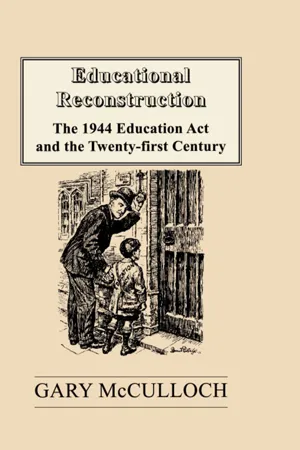
Educational Reconstruction
The 1944 Education Act and the Twenty-first Century
- 216 pages
- English
- ePUB (mobile friendly)
- Available on iOS & Android
eBook - ePub
About this book
This book presents a clear overview of the debates that surrounded the making of the 1944 Act, which affected every aspect of education in this country. It gives a detailed account of the tripartite divisions into 'three types of child' that were sanctioned in the reforms of the 1940s. At the same time, it also emphasises the idea of education as a civic project which underlay the reforms and which was such an important part of their lasting authority.
The education policies of the past decade and the current attempts to shape a new education settlement need to be interpreted in a long-term historical framework and in particular, in relation to the aims and problems of the last great cycle of reform in the 1940s. This book makes an important contribution to the development of such a framework and the social history of education policy in this country.
Information
1
Peace-maintenance
'Upon the education of the people of this country the fate of this country depends.' With these famous words of Benjamin Disraeli, the White Paper Educational Reconstruction, published in July 1943, opened its case for reform. During the half-century that has elapsed since then, ideas about the most suitable ways of 'educating the people' have changed appreciably. In spite of such changes, the basic contention about the central role of education in determining the 'fate of the country' remains strong, and continues to be used to justify far-reaching and systematic educational reform.
This book focuses on the cycle of educational reform of the 1940s that was advanced so eloquently through the 1943 White Paper and reached its culmination in the Education Act of 1944. In this specific sense, it seems particularly apt for the title of the work to evoke the ideal of 'educational reconstruction'. In a broader spirit, too, such a note is apposite in suggesting the general theme of educational reform and renewal that runs throughout this book. While giving extended and detailed treatment to the reforms of the 1940s, it also explores their relationship to recent and contemporary changes in education.
This more general notion of 'educational reconstruction', related both to the past and to the present, echoes the American historian Michael Katz who has tried to show 'how the reconstruction of America's educational past can be used as a framework for thinking about the present'.1 Katz reminds us that the 'historical products' created over time were generally contested between different groups during their formation, among a number of discrete alternatives. Moreover, he adds, they should be seen as 'neither inevitable nor immutable', and perhaps may 'no longer even be appropriate'.2 In a profound sense, Katz would argue, thinking about the past can help us to rethink our ideas not only about the present, but also about the future. In Britain also, the educational historian Brian Simon captures such an aspiration most trenchantly when he insists: 'There is, perhaps, no more liberating influence than the knowledge that things have not always been as they are and need not remain so.'3
Establishing the dynamic connections between past, present and future that are suggested here implies first an approach to educational history that is explicitly 'present-minded'. The history seeks to provide explanatory leverage towards a greater under standing of the problems and possibilities of the present. It is also, of course, 'futures-minded', evoking the unresolved dilemmas and potential frameworks of development that may help to inform our ideas about education in the years that lie ahead. This latter theme is particularly resonant in the final decade of the twentieth century. 'Preparing for the twenty-first century', to make use of Paul Kennedy's phrase, has become a common objective that is likely to become especially widespread as we approach the millennium.4 Education is already proving to be popular territory for such plans and prognostications.
In academic discourse relating to education, the promise of the future symbolised in the dawn of a new century has helped to encourage discussion of how education should respond to the changing needs of what is often described as a 'post-modern' society.5 Educational policies have also given much attention to this idea, if only as a rhetorical device to rationalise the need for reform. In Britain, the approach of the twenty-first century has been used to help justify a new cycle of radical reconstruction of the education system. According to Kenneth Baker, who as Education Secretary was chiefly responsible for the Education Reform Act of 1988, it was especially important at this time not to be 'baulked' by disagreements on how to tackle the problems afflicting education: 'For a variety of reasons the education system needed radical change if it was to match the needs of twenty-first century Britain. If this meant foregoing the usual snail's pace at which reform in education was conducted, then so be it.'6
The idea of planning for a new century also seemed to encourage the design of blueprints for the future that were intended to cast aside 'out-of-date' barriers and distinctions. In 1991, a Government White Paper entitled Education and Training for the 21st Century sought to establish not only a new set of institutions, but also fresh thinking about how they should be envisaged.7 The following year, the White Paper Choice and Diversity began with the idea of 'Schools into a new century', and emphasised the need to articulate a 'vision for education in the 21st century'.8 Indeed, the 1992 White Paper concludes with a chapter, albeit of less than one page in length, that envisages 'A New Century of Excellence'. Plans being developed in the early 1990s, it reminds us, 'will take at least a decade to work through: a child tested at the age of 7 this year will not be taking GCSE [examinations] until 2001'.9 As a result of these changes, it hopes, 'The education system of the 21st century will be neither divisive nor based on some lowest common denominator. Diversity, choice and excellence will be its hall marks, with each child having an opportunity to realise his or her full potential, liberating and developing his or her talents.'10 Another recent report, that of the independent National Commission on Education in 1993, is no less enthusiastic in thrusting its ideals forward into the twenty-first century, for example in its notion of 'twenty-first century teachers': 'In our vision, a teacher in the twenty-first century will be an authority and enthusiast in the knowledge, ideas, skills, understanding and values to be presented to pupils.'11 Such idealisations of education in the twenty-first century again underline the imperfect state of the current education system to encourage radical reform.
Much of this literature focusing on the assumed needs of the twenty-first century tends to disregard or play down the importance of understanding the nature of education as it has developed over the past hundred years. In recent policy initiatives, in particular, there has been a general emphasis on a technical or managerial approach to problems that fails to address more profound or long term cultural, social, and historical issues. Sometimes, it appears that the history is despised or overshadowed because it represents the 'problem', whereas the future represents the 'solution'. In these circumstances, it is especially crucial to develop a greater awareness of the relevance of the historical dimension in under standing contemporary dilemmas. The reforms of the 1940s would appear to be at least potentially an important example in demon strating such links.
In what ways may one conceptualise such 'relevance'? It is important, first of all, to develop frameworks for understanding. In Chapter 2, some general issues involved in this process are discussed in detail, especially in relation to the kinds of problems that may be encountered, and some specific approaches to estab lishing long-term historical frameworks. Chapter 3 seeks to locate the reforms of the 1940s within the context of successive waves or cycles of educational reform, relating them to the institutions that had been introduced in the nineteenth century, and also to the changes that were later to be promoted in the 1960s and in the 1980s/1990s. Chapter 4 then examines the continuing influence of the 1944 'settlement' over the following half-century, and the changing visions of what 1944 represented, to suggest an important 'historical' dimension in even the most ahistorical of education policies.
The following chapters proceed to discuss particular aspects of the reforms of the 1940s within a broader historical framework. In Chapter 5, the 'tripartite' nature ofthe reforms, their emphasis on identifying three different types of child, is explored. Chapter 6 investigates the civic idealism that helped to motivate and justify the reforms, and which gave them so much of their lasting authority. Chapter 7 highlights conflicting notions of the secondary school curriculum that underlay the reforms of the 1940s, and which continued to exert a lasting influence. Chapter 8 discusses the position of school teachers in these reforms, especially in relation to assessment and examinations. Chapter 9 then examines the influence of the reforms that took place in Britain, upon those 12,000 miles away in New Zealand. The concluding chapter attempts to draw some provisional 'lessons' from this historical study, and again looks forward to assess the prospects for the current cycle of educational reform in the 1990s and beyond.
It should be emphasised, perhaps, that this work does not seek to give the 'final word' on the 1944 Act and its relationship with present and future change. Nor does it attempt to work towards closure on the many issues involved. Rather, it envisages open and continuing debate. Many themes other than those developed in this book also deserve exploration in much greater depth, and it is hoped further research will begin to do so in the years ahead. If we approach the 1944 Act not simply as a fixed and finished piece of legislation, nor even in terms of its unresolved issues and ambiguities, but in a thematic fashion that highlights its multiple realities as is the case in the present work, we must expect no less.
NOTES
1. Michael Katz, Reconstructing American Education (London: Harvard University Press, London, 1987),p.l.
2. Ibid.
3. Brian Simon, 'The history of education', in J.W. Tibbie (ed.), The Study of Education (London: Routledge & Kegan Paul, 1966), p.92.
4. Paul Kennedy, Preparing for the Twenty-First Century (London: Harper Collins, 1993).
5. E.g. P. Schlechty, Schools for the Twenty-First Century (San Francisco: Jossey-Bass, 1990), p.39.
6. Kenneth Baker, The Turbulent Years: My Life in Politics (London: Faber & Faber, 1993), p.169.
7. Department of Education and Science, Education and Training for the 21st Century, 2 vols. (London: HMSO, 1991).
8. Department for Education, Choice and Diversity (London: HMSO, 1992), paragraph 1.21.
9. Ibid., paragraph 15.1.
10. Ibid., paragraph 15.7.
11. Report of the National Commission on Education, Learning to Succeed: A Radical Look At Education Today and a Strategy for the Future (London: Heinemann, 1993), pp.196-7.
2
Lessons from the Class of 1944?
The passage of the 1944 Education Act accompanied some of the most dramatic events of the Second World War. The debate on its Second Reading in the House of Commons coincided with D-Day, as Allied troops invaded occupied France. The Committee stage began soon after a major strike by a flying bomb in West London. Delayed over the summer, the Bill did not receive Royal Assent until 3 August.1 And yet it was by no means a mere sideshow to the main drama. On the contrary, understanding the hopes that were attached to the 1944 Education Act gives us a vital clue to the vigour of the British war effort. And when the dust of war had settled, the Education Act remained, a lasting monument to sacrifice and a foundation stone for a society at peace.
Fifty years on, in the midst of a new set of reforms designed to replace those of the 1940s, it seems very suitable for us to revisit the 'class of 1944'. As we do so, it may be possible to understand the aims of the educational reforms that culminated in the Education Act of 1944. These represented a remarkable cycle of reforms that affected every aspect of education in England and Wales. At the same time, they helped to consolidate many features of educational provision that had already become characteristic. They attracted broad support for their main principles from across the political spectrum, and established a settlement in education that endured for a generation. It is crucial to understand the vision of reform that underlay these developments.
Interpreting the 1944 Act
The present work interprets the Education Act of 1944 not simply in terms of the final, carefully negotiated text that became law in August 1944, but in a way that encompasses the processes and aspirations that contributed to its formation. This involves a multi dimensional approach to the problem. It demands a detailed examination of the Act and of its contribution to educational change. It also entails understanding how the Act was constructed, and the role of key individuals and groups in its formation. Further to this, it requires investigation into how the Act related to the several major education reports that surrounded it. These included the Spens Report on secondary education (1938), the so-called 'Green Book' of 1941, ...
Table of contents
- Cover Page
- Half Title page
- Other Title
- Title Page
- Copyright Page
- Dedication
- Contents
- Peace-maintenance
- Lessons from the Class of 1944?
- Cycles of Reform
- Visions of 1944
- Three Types of Child
- Education as a Civic Project
- Contesting the Curriculum
- Teachers and Testing
- Antipodean Echoes
- Educational Reconstruction?
- Appendix I
- Appendix II
- Appendix III
- Select Bibliography
- Index
Trusted by 375,005 students
Access to over 1.5 million titles for a fair monthly price.
Study more efficiently using our study tools.
Frequently asked questions
Yes, you can cancel anytime from the Subscription tab in your account settings on the Perlego website. Your subscription will stay active until the end of your current billing period. Learn how to cancel your subscription
No, books cannot be downloaded as external files, such as PDFs, for use outside of Perlego. However, you can download books within the Perlego app for offline reading on mobile or tablet. Learn how to download books offline
Perlego offers two plans: Essential and Complete
- Essential is ideal for learners and professionals who enjoy exploring a wide range of subjects. Access the Essential Library with 800,000+ trusted titles and best-sellers across business, personal growth, and the humanities. Includes unlimited reading time and Standard Read Aloud voice.
- Complete: Perfect for advanced learners and researchers needing full, unrestricted access. Unlock 1.5M+ books across hundreds of subjects, including academic and specialized titles. The Complete Plan also includes advanced features like Premium Read Aloud and Research Assistant.
We are an online textbook subscription service, where you can get access to an entire online library for less than the price of a single book per month. With over 1.5 million books across 990+ topics, we’ve got you covered! Learn about our mission
Look out for the read-aloud symbol on your next book to see if you can listen to it. The read-aloud tool reads text aloud for you, highlighting the text as it is being read. You can pause it, speed it up and slow it down. Learn more about Read Aloud
Yes! You can use the Perlego app on both iOS and Android devices to read anytime, anywhere — even offline. Perfect for commutes or when you’re on the go.
Please note we cannot support devices running on iOS 13 and Android 7 or earlier. Learn more about using the app
Please note we cannot support devices running on iOS 13 and Android 7 or earlier. Learn more about using the app
Yes, you can access Educational Reconstruction by Gary McCulloch in PDF and/or ePUB format, as well as other popular books in Education & Education General. We have over 1.5 million books available in our catalogue for you to explore.