- 361 pages
- English
- ePUB (mobile friendly)
- Available on iOS & Android
eBook - ePub
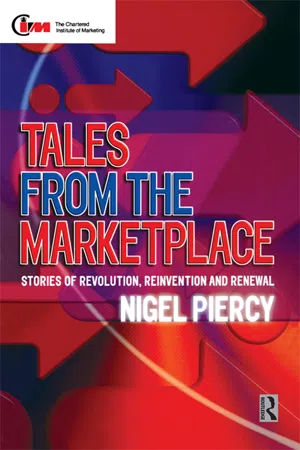
Tales from the Marketplace
About this book
'Tales from the Marketplace: Stories of Revolution, Reinvention and Renewal' is a highly innovative approach to building an understanding of the realities of market-led strategic change in companies. It provides an engaging, honest, and effective understanding of real market strategy in major organizations by focussing on the forces behind value-driven strategy.
Nigel Piercy provides new and incisive insights into strategy and marketing through business "stories" that are contemporary and provocative. These new "stories" depict how major organizations have experienced revolution in their traditional markets - created by new types of competitors with new business models. The search for superior value is overtaking traditional brand and relationship strategies. The challenge to companies is reinvention and renewal and the alternative is obsolescence and decline. After all, did the major banks really expect to be competing with supermarkets, car companies, Virgin and internet-based companies to provide retail bank services?
The book is based on the author's view that:
· Business is exciting, turbulent and unpredictable - the "stories" we read and study should be too!
· From Dell Computers and easyJet to Amazon.com and Skoda Cars, it is the most innovative companies that have most to teach us about reinvention and new business models
· The inflexible analytical frameworks of the past no longer apply - "stories" of reinvention and renewal show the creative strategies developed by companies to cope with threats and exploit opportunities around them.
'Tales from the Marketplace' is essential, timely and designed to be highly readable for managers. It also provides an innovative approach for undergraduate and MBA level teachers and students, and for participants on executive programmes in marketing and strategic management.
PART I Stories and Strategies
Chapter 1 Why a book of stories for managers?
DOI: 10.4324/9780080573960-1
I hope that the contents of this book will be of interest to a number of different audiences:
- Perhaps most important of all, I hope that the book will be useful and stimulating to managers> who want to read about the experiences of many different organizations in developing strategies to cope and achieve success in a rapidly changing world. ‘read about the experiences of many different organizations in developing strategies to cope and achieve success in a rapidly changing world’
- I hope also that the book will be useful to management trainers and teachers in providing them with up-to-date examples and teaching material for use with management students. However, they should know from the outset this is not a conventional decision-oriented ‘case study’ book. The reasons for this perversity are explained below.
- Thirdly, I hope that stories included here will be of interest to management students, providing them with the chance to compare the real world with the theory they learn, and with examples and illustrations for their projects.
But most of all, I hope that the stories told here will be a good read for anyone who is genuinely interested in the excitement of business and the fascinating revolution taking place in so many markets throughout the world.
As a general rule, I loathe case study books in management and marketing. They are mind-blowingly boring and tedious. People do not choose to read books like that. They have them imposed by management teachers and trainers, who seem to think that things are not ‘academic’ unless they are incredibly boring. There is no reason why the fantastic excitement of the marketplace should be made boring. One of the recurring themes in the stories is that managers who create revolution are inspiring, and they seem to have great fun in doing what they do.
I will win no friends in some academic quarters, when I say that I have come almost to despise those who use ‘Harvard cases’ and their ilk, as a way of filling time in courses for managers and students, and as a substitute for doing something more useful which might involve making more effort. It may be that some managers like these sessions and find them entertaining, but the point is — what do they learn from them that will directly change how they run their own businesses? Experience and observation suggests that many participants in training and education courses find cases shallow, time-wasting, and too artificial to have any real instructive value. It does not have to be this way. Incidentally, this is not how the superb Harvard Business School uses cases — far from it. At Harvard, people learn from cases big time. However, some are critical even of this pinnacle of case teaching in management education. John Hunt of London Business School writes:
Nearly a century ago, Harvard Business School tried to overcome the problem of linking theory and practice by stealing the case method from its law school. Cases simulated the real world of managing and subsequently every business school around the world copied this method for discussing managerial decision-making. And although 90 students sitting in a tiered lecture theatre discussing a pre-written, post-event case and being graded simultaneously for their contribution to an inconclusive discussion may not be ideal, it was certainly more popular with the students… than yet another lecture. (Hunt, 1998)
However, for those of us who are not at Harvard, and who may be more concerned with impacting on how managers think and act instead of just entertaining and grading them, I am changing the rules in the following ways.
First, I refuse to use case material with managers that consists of thirty or so densely packed pages of obscure historical facts and figures, where the main goal seems to be that the reader benefits in some obscure way from playing the game of teasing out the story that the case writer has hidden away in the middle of the facts and figures. This is just plain silly, and largely a waste of time. It is also wrong-headed. In the real world, the big problems tend to be blindingly obvious — they do not have to be discovered from a mass of irrelevancy. I think this is one of the reasons people are fed up with conventional cases. I am especially unenthusiastic about management teachers who use cases that are twenty-five years old because they ‘make a point’ that nothing newer does — this may very occasionally be true. However, if that is what you say, my suspicion is that you have not bothered to look for something more up to date that makes that point, or the point in question is no longer worth making.
‘In the real world, the big problems tend to be blindingly obvious — they do not have to be discovered from a mass of irrelevancy’
Second, I see no reason why the stories of how different industries and markets are re-shaping and how companies are coping (or not) should be made inaccessible to readers. This book does its best to provide interesting stories that people can read just because they are interesting stories.
Third, my further observation is that executives and students alike positively prefer to read and hear about companies doing interesting things and facing interesting challenges, that they have actually heard of before. At its simplest people seem to get value from reading, talking and thinking about a fascinating company such as Dell, rather than an obscure mid-western engineering company in the USA, the yak industry in Outer Mongolia, or the sale of human urine to drug users to beat employer drug testing (just in case you wondered, these are all case studies published to instruct managers in strategy). Not least among the reasons for this preference, I suspect, is that there is more real revolution and reinvention in places such as Dell or Amazon than most others.
This leads to my fourth point. I truly believe that we do managers a huge disservice by giving them rigid, conventional ‘structures’ to analyse case studies (let alone rigging case data so that they conveniently fit some analytical tool). The challenge to managers is to reinvent businesses, design new business models, create revolution in their industries, and cope with massive step changes in how things are done to create value for customers and shareholders, as the only way to survive. I suggest that clinging to inflexible, analytical frameworks to analyse the past to death has a somewhat limited value for managers or students. People: the issue is the future, and the future is not contained in the Boston Matrix or anything similar. Yet worse is the idea that there is a ‘right’ answer, or even a ‘right’ approach to looking at company strategy. Generation X managers think differently and more creatively to develop radically new business designs because they know about Generation Y customers. This is the real challenge to us all.
‘the really devastating competition for a company or product does not come from the expected and anticipated sources — it comes from someone you never even heard of’
Increasingly the really devastating competition for a company or product does not come from the expected and anticipated sources — the traditional, ‘me-too’, same-technology competitor — it comes from someone you never even heard of, let alone thought could take your business away from you. Do we think that the banks really expected to be competing with supermarkets, car companies, and Internet-based operations? Do we think that traditional booksellers really expected Amazon.com to happen and to work? Providing managers with rigid, mechanical structures for strategy and competitive analysis does not seem a good way to prepare for strategic surprises like these — in fact, quite the reverse.
A similar point has been made much better recently by Thomas Stern of New York University, about conventional approaches to cases and management development in strategy:
They are all addicted to left brain number crunching, but we won't need our financial MBAs twenty years from now. Managers of the future must be systems thinkers, who see patterns and loops; who do not just think in a linear way. (Thomas Stern in Bradshaw, 1997)
So, why ‘stories’, not case studies? I think we started talking about ‘cases’ in business to sound as ‘academic’ and ‘professional’ as doctors and lawyers. I prefer the word ‘stories’ for a number of reasons. Stories provide us with examples, which are useful for all sorts of things. We tend to use examples all the time. In talking about management issues in a company, in writing about management, in trying out new business theories, in trying to understand our own problems better — the first thing most of us do is to try to think of real-life examples. Even more important, when we are trying to argue the case for something with managerial colleagues, we usually try to convince people by giving them some real examples — even if we call them models, reference sites, or pilots.
Actually, this book is really just a bunch of stories and examples. I hope they will be useful to teachers, trainers and lecturers in exploring things with people by reference to real, topical company experiences. I hope they will be useful to management students in writing papers and projects, and in testing the relevance of the theories they are learning, but there is a much bigger test of whether the book works or not. That test is whether the book provides a ‘good read’ for managers — maybe on the train or plane rather than just on the training course. Passing this test would suggest that I had succeeded in writing a set of stories about business that were interesting and insightful, and this is the real goal of the book.
Incidentally, I was truly shocked recently by an academic colleague in the USA who innocently inquired if I was writing a book for British managers. I was so surprised, I had no answer. In fact, I do not see the value in management thinking that is restricted by international boundaries — I find it hard to believe that anyone still believes that they matter and protect you from ‘foreign’ competition. Such beliefs from the past seem a good way to blind managers to competitive invasion by people they never even considered as competitors. National identity was not an issue in choosing the stories for this book. The book is for managers everywhere.
So, finally to answer the question posed at the start of this chapter — why a book of stories for managers? We look to business stories for a number of possible insights: they may tell us about the strategic dilemmas faced by companies, from which we may learn more about our own companies’ problems. Stories illustrate the revolutions taking place in markets driven usually by innovative rule-breaking business models, and how some companies decline and others reinvent the way they go to market to succeed in those same markets. Stories provide us with compelling evidence to win the support of others in the decision-making process in a company, and to defy colleagues to ignore the changes that are taking place around them.
‘Stories illustrate the revolutions taking place in markets driven usually by innovative rule-breaking business models’
The structure of the remainder of the book is as follows. The next chapter is a brief discussion of the new era of market-based strategic management, driven by the search to create superior value, as some of us see it. This leads to the core of the book: a set of stories about markets and companies, grouped into stories of revolution and reinvention, and tales of obsolescence in conventional business models and the search by companies for renewal. The last part of the book is my commentaries on the stories — my thoughts about the major strategic questions that each story raises and illustrates.
My suggestion is that if you are reading the book just for the heck of it (and I hope many readers are doing just that), read a story and then have a look at the commentary to see if we agree about what can be learned from that company's experiences. On the other hand, if you are using the book on a management development or education course — the commentaries provide a basis for discuss...
Table of contents
- Cover Page
- Frontmatter Page
- Series Page
- Title Page
- Copyright Page
- Table of Contents
- About the author
- Preface
- PART I STORIES AND STRATEGIES
- PART II STORIES OF REVOLUTION AND REINVENTION
- PART III STORIES OF OBSOLESCENCE AND RENEWAL
- PART IV REFLECTIONS ON THE STORIES
- Index
Trusted by 375,005 students
Access to over 1.5 million titles for a fair monthly price.
Study more efficiently using our study tools.
Frequently asked questions
Yes, you can cancel anytime from the Subscription tab in your account settings on the Perlego website. Your subscription will stay active until the end of your current billing period. Learn how to cancel your subscription
No, books cannot be downloaded as external files, such as PDFs, for use outside of Perlego. However, you can download books within the Perlego app for offline reading on mobile or tablet. Learn how to download books offline
We are an online textbook subscription service, where you can get access to an entire online library for less than the price of a single book per month. With over 1.5 million books across 990+ topics, we’ve got you covered! Learn about our mission
Look out for the read-aloud symbol on your next book to see if you can listen to it. The read-aloud tool reads text aloud for you, highlighting the text as it is being read. You can pause it, speed it up and slow it down. Learn more about Read Aloud
Yes! You can use the Perlego app on both iOS and Android devices to read anytime, anywhere — even offline. Perfect for commutes or when you’re on the go.
Please note we cannot support devices running on iOS 13 and Android 7 or earlier. Learn more about using the app
Please note we cannot support devices running on iOS 13 and Android 7 or earlier. Learn more about using the app
Yes, you can access Tales from the Marketplace by Nigel F. Piercy in PDF and/or ePUB format, as well as other popular books in Business & Business General. We have over 1.5 million books available in our catalogue for you to explore.