The question of whether there can be a distinctively female ethics is one of the most important and controversial debates in gender studies, philosophy and psychology today. Rethinking Feminist Ethics; Care, Trust and Empathy marks a bold intervention in these debates and bridges the ground between women theorists disenchanted with aspects of traditional ethics and traditional theories that insist upon the need for some ethical principles.
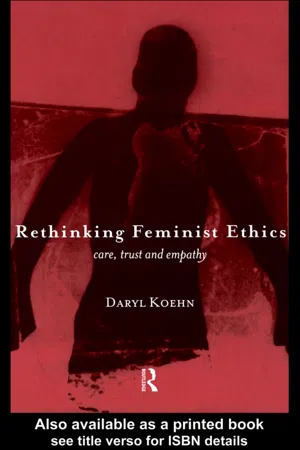
- 224 pages
- English
- ePUB (mobile friendly)
- Available on iOS & Android
eBook - ePub
About this book
Information
1
AN ETHIC OF CARE
The world is full of care, much like unto a bubble; Women and care, and care and women, and women and care and trouble.
(Nathaniel Ward, quoting a lady-in-waiting at the Court of the Queen of Bohemia)
It is tempting to begin a book on female ethics by hearkening back to the first female ethicist. This temptation must be resisted. Who qualifies as a precursor depends upon how one conceives of the event or activity in question and upon what one takes to be the crucial or relevant issues. In this sense, Borges is quite correct:
The word “precursor” is indispensable in the vocabulary of criticism, but one should try to purify it from every connotation of polemic or rivalry. The fact is that each writer creates “precursors.” A writer’s work modifies our conception of the past, as it will modify the future.1
It thus would be misleading to pretend that any one woman thinker has originated female ethics. Gilligan’s work In A Different Voice unquestionably helped to crystallize many women’s frustrations with traditional ethics. But the frustrations clearly were already there. Indeed, her work and that of Nel Noddings2 gained such quick prominence, in part, because women found they readily understood these two women’s critiques. Women readers made Gilligan and Noddings into “precursors.” Noddings’ and Gilligan’s ethic of care is not, therefore, a necessary starting point for a critique of female ethics. Their care ethic is, nevertheless, a useful starting point because Gilligan and Noddings are so intent upon distinguishing the care ethic from traditional modes of ethical analyses that they tend to overstate their claims and to overlook difficulties with their own approach. Since this book aims to put important insights of female ethics on surer ground, this overstatement is useful for separating the dross from those insights that are pure gold.
Since my analysis is focussed on the question of whether female ethics are themselves ethically good, this chapter on the care ethic addresses four interrelated questions: What are the central tenets of an ethic of care? What precisely is meant by “care”? What exactly is the basis for the assertion that we should care for each other? Are these claims sustainable? This last question, in turn, has four interrelated elements: (1) Are those acts which we are told we should do actually possible? (2) Are the recommended acts and attitudes consistent with female ethics’ own insistence upon hearing the distinctive voices of individuals? (3) Are the recommended acts and attitudes consistent with justice understood roughly as that virtue or practice that enables potentially violent individuals with differing views of what is good to share a life together as members of a community? and (4) Does the framework have any power to resolve practical difficulties, dilemmas or crises in a non-arbitrary manner? I shall show that an ethic of care, in its present form, fails all of these tests.
Tenets of care ethics
Both Gilligan and Noddings contrast their ethical stance of care with that of principled, male ethics of justice (e.g. Immanuel Kant’s; Lawrence Kohlberg’s).3 Justice ethics seek to discover and then apply universal rules or laws of justice to situations. Often this application requires that some rule “trump” other rules or points of view. To take one of Gilligan’s examples: a traditional male ethicist might argue that a pharmacist”s right to make a profit from inventory he owns “trumps” a sick person’s claim to a drug she needs to stay alive but cannot afford.4 The care ethicist, by contrast, resists applying universal rules in a hierarchical fashion.5 She thinks the justice approach falsifies moral dilemmas by abstracting those features of the situation to which the rules are most easily applied.6 By contrast, her caring “moves to concretization where [the agent’s] feelings can be modified by the introduction of facts, the feelings of others, and personal histories.”7 So, while Kant condemns suicide as immoral because it violates the demands of universal reason; and while he dismisses the effect of suicide on others and the particular situation of the victim as irrelevant, the care ethicist wants to hear the personal tales of the victim and of those affected by the act. Before she judges the suicidal act, she wants to learn of their feelings and their thinking as part of perceiving the act in all its conceptual and emotional fullness. Her “moral judgment is more contextual, more immersed in the details of relationships and narratives.”8
The care ethic places great weight on the importance of listening. An agent single-handedly can apply Kantian or Rawlsian rules of justice or perform utilitarian calculations to determine what act or rule will maximize pleasure.9 He need not consult with others in the applications of these principles. Precisely because these male ethics are non-consultative, Gilligan and Noddings argue that the concerns and reasoning of others tend to be overlooked or shunted to the side. The principles are applied in a manner disrespectful of individuals because the distinctive and individualizing concerns of other parties never enter into the agent’s deliberations. Traditional ethics thus fail their own ethical standard of respecting the individual. The care ethic, by contrast, requires us to become “engrossed” in one another.10 We must “move” toward the other at least to the extent of trying to really hear what other people are saying. We need not endorse the other’s motives or projects. But we do need to still our inner voices and objections enough to “receive” the other in his or her otherness.11 The truly caring, ethical agent lets the conversation with the other supply the relevant categories for judgment. She does not come into the conversation with a fully formed set of categories or rules for judgment which she then applies. She has a high tolerance for ambiguity.12 The caring person even may act in a fashion that appears to more rule-bound people to violate the principles of justice.13
True caring involves “receiving” the other person in the manner just described and then seeking to preserve a connection with him or her. Beyond that, we cannot say much more concrete about caring, for every act of caring is unique.14 What is universal about caring is not its form but rather the demand upon each of us to be caring. We remember having been cared for when we were young; this warm, pleasant memory leads us to long for goodness and motivates us to care for others. According to the care ethicist, the desire to act well is rooted in the desire to return to this state.15 This state is only possible if we care for others because it is caring that engenders caring. On this view, we create the world in which we live through our actions. Only if our actions are motivated by an ideal of caring can we live once again in the world we loved as a child.
In a sense, the care ethic is quite selfish. Agents care in order to live in a world they find desirable. There is no requirement in this ethic that agents be self-sacrificing.16 On the contrary, the agent is bound to find her own voice and to speak for herself. As Gilligan puts it, the ethical woman stops letting her boyfriends or her parents speak for her. She learns to speak for herself and to exhibit a “caring with autonomy.”17 Only when she does so is she fully a member of the world created through people speaking their concerns. The ethical agent listens well to others but takes time to speak for herself, too. She must do so because her perceptions are unique, born of her roles, her experiences, her history, etc. Unlike the Kantian who purports to know that all rational beings are alike and, therefore, must will the same course of action, the care ethicist takes seriously the idea of individualism. She insists both upon speaking her own concerns and upon hearing others speak their feelings and ideas because, strictly speaking, only the individual can properly express his or her own concerns. She suspects any analysis of compassion or caring which talks about party “A” acknowledging “B” through the force of some shared capacity. This type of analysis treats individuals as if they were interchangeable people whom we can know and talk about without ever having to talk with them.18
The care ethic has an existential dimension lacking in male ethics. In the care ethic, the moral world is not already “there,” fully formed in its rationality.19 If the world is to be good, the caregiver must make it so through her acts in accordance with her personal ideal of herself as a caring person. Since no one can specify necessary and sufficient conditions for an act to be caring, the caregiver is finally thrown back upon herself to assess the goodness of her acts.20 Positive response from the cared-for may be a sign she has been behaving well; but the cared-for party may be deceived or may respond negatively to a genuinely caring act for some private reason. As caregivers, we must live with the anxious question: have we done everything our ideal of caring demands of us? All we can do in response is to receive other people as best we can and see if we find we can live with ourselves under the circumstances.
We are not bound to love everyone. However, we are required, on this view, to care for those who come within our purview. The hungry man or animal who shows up on our doorstep has a call upon our resources and attention.21 It may be that we have no food to give. Still, we are bound by our commitment to our world-creating ideal to care for these creatures as best we can. In the case of a person, such caring might involve explaining that we have no food. Or we may refer the hungry man or woman to the farmer down the road who raises potatoes. We cannot say what exactly constitutes a caring response. All we can say is that, if we do not receive another person (or animal) sufficiently so as to experience anxiety, then we have not cared. This questioning and anxiety, though, are a private matter. No universal, uninvolved, rational spectator of the sort usually presumed in male ethics of justice can legitimately judge us for not caring (or praise us for doing so).
Is it ever legitimate to confront and blame somebody within this ethic? The care ethic does not say that the agent cannot judge. It does maintain, however, that there is “no place for fear, anger, hatred”22 or any emotion or stance that interferes with receiving someone in all of his or her individuality. Agents are to listen to those they find objectionable. Ethical selves never demonize the other person by seeing him or her as being totally unlike themselves.23 Instead, the agent’s response should be therapeutic.24 If a stance is unacceptable, the caring person will talk with the other party to find out why she holds this stance. According to the care ethic, it is legitimate for the caregiver to try to persuade the cared-for party to alter her stance. However, he must examine his own beliefs as well. Perhaps he is implicated in whatever dynamic is producing the standoff. He, too, may have to change.
The care ethic’s definition of care
Gilligan never offers a definition of care, and Noddings’ idea of care as receiving others (or, at least, wanting to receive them) on their terms is not very rigorous. Still, we can tease out some threads from their analyses and refine them into something like a working definition of care. It is clear, for example, that both think ethical caring—i.e. caring we should engage in— goes beyond mere concern for or about a person or thing. In the first place, concern per se does not qualify as true care unless it is active.25 We properly wonder about the genuineness of people’s concern if they claim to care for the environment but refuse to recycle their garbage, compost, dispose of hazardous materials properly, or do anything that is currently thought to help protect the environment. The proof of care is in the activity.
Yet ethical care is more than active concern for an object. A teacher might be actively concerned to manipulate one of her students into sleeping with her. Or some group may take an active interest in seeing that all convicted rapists receive stiff penalties. The group cares that the convicts remain in prison for many years. Yet, their zeal for their cause may make them insensitive to the feelings and rights of the convicts and may lead, at the extreme, to possible miscarriages of justice. The active concern must be of a certain type. What type is this?
Care, as conceived of by Gilligan and Noddings, is less a matter of being concerned that something will happen and more a matter of being attentive to another’s well-being and of being willing to act to promote it. Thus care is best conceived as an active, interpersonal, mutual reciprocity. On this view, the Chief Executive Officer (CEO) can care for his employees but not, strictly speaking, for the corporation because the corporation is merely a legal fiction incapable of reciprocity. Only people can respond to each other’s needs and concerns. While it might be argued that caring includes everything that maintains or repairs our world and environment,26 the care ethic of Noddings and Gilligan treats caring as most manifest when we strive to meet the needs of our fellow human beings. Humans can and do individuate themselves to a high degree. Since this individuation can be properly appreciated only by listening to their individual voices discussing their particular needs, interpersonal caring stretches all of our listening skills to the maximum. The wife who is so attuned to her dying husband’s needs that she can tell from a mere gesture that he needs his pillow adjusted and who plumps the pillow exhibits care in the strong interpersonal sense of that term.
Of course, nurses, too, provide comfort for their patients. The care ethicist, however, deprecates this sort of professional attention. The concern of a doctor, lawyer, or cleric is quasi-impersonal, extending to all patients, litigants, or penitents as such. (Receiving pay for caring may also be a problem insofar as the agent may not be acting out of a desire to be in a caring relation but rather to earn a living.) Professionals’ concern is mediated by their professed commitment to the end occupying the moral center of their practice (health in the case of medicine; salvation in the case of the ministry). This kind of caring is principled insofar as it takes its bearings from a known commitment to a particular, narrow end. Care ethicists suspect these commitments to principles. Noddings goes so far as to claim that caring is opposed to fixed rules or principles of any sort27 and that professions should not be analyzed in terms of any formal requirements arising from the practice of a particular activity but rather in terms of caring itself.28 Professional commitments, antedating the encounter with particular individuals, can distort our relations and prevent us from appreciating the “total person.”29 Persons with whom we are interacting may get reduced to a “representative type” and thereby lose the very uniqueness responsible for making them the individuals they are.
In general, the more principled the attention paid to another human being, the less it qualifies as genuine caring in the eyes of the care ethicist.30 Principled attention frequently degenerates into “tending,” a kind of “domestic labour performed on people.”31 Thus, if a person visits his friend in the hospital because he has calculated that the general happiness will be maximized by this action, his act displays a strange coldness in a situation in which warmth and spontaneity are desirable.32 A wife does not want her husband to make love to her because he thinks it is his duty: Thursday night, bowling for him; Friday night, sex for her. These cases trouble the care ethicist because the agent neatly packages the relation and confines it to certain (allegedly) known dimensions. The agent decides the case by subsuming it under some principle or some role-responsibility instead of allowing the relevant terms of judgment to spontaneously evolve out of interaction with the party in question.33 When we think this way, we fail to put ourselves into play. For the care ethicist, true caring—or at least caring in the highest and most interesting sense—is an affective stance in which both the caregiver and cared-for put themselves at risk as part of a process of committing to the forging of a shared self.34 This is the kind of caring one sees...
Table of contents
- Cover
- Title
- Copyright
- Contents
- Acknowledgments
- Introduction
- 1. An ethic of care
- 2. An ethic of broad empathy
- 3. An ethic of trust
- 4. A dialogical ethic
- Conclusion
- Notes
- Bibliography
- Name Index
- Subject Index
Trusted by 375,005 students
Access to over 1.5 million titles for a fair monthly price.
Study more efficiently using our study tools.
Frequently asked questions
Yes, you can cancel anytime from the Subscription tab in your account settings on the Perlego website. Your subscription will stay active until the end of your current billing period. Learn how to cancel your subscription
No, books cannot be downloaded as external files, such as PDFs, for use outside of Perlego. However, you can download books within the Perlego app for offline reading on mobile or tablet. Learn how to download books offline
Perlego offers two plans: Essential and Complete
- Essential is ideal for learners and professionals who enjoy exploring a wide range of subjects. Access the Essential Library with 800,000+ trusted titles and best-sellers across business, personal growth, and the humanities. Includes unlimited reading time and Standard Read Aloud voice.
- Complete: Perfect for advanced learners and researchers needing full, unrestricted access. Unlock 1.5M+ books across hundreds of subjects, including academic and specialized titles. The Complete Plan also includes advanced features like Premium Read Aloud and Research Assistant.
We are an online textbook subscription service, where you can get access to an entire online library for less than the price of a single book per month. With over 1.5 million books across 990+ topics, we’ve got you covered! Learn about our mission
Look out for the read-aloud symbol on your next book to see if you can listen to it. The read-aloud tool reads text aloud for you, highlighting the text as it is being read. You can pause it, speed it up and slow it down. Learn more about Read Aloud
Yes! You can use the Perlego app on both iOS and Android devices to read anytime, anywhere — even offline. Perfect for commutes or when you’re on the go.
Please note we cannot support devices running on iOS 13 and Android 7 or earlier. Learn more about using the app
Please note we cannot support devices running on iOS 13 and Android 7 or earlier. Learn more about using the app
Yes, you can access Rethinking Feminist Ethics by Daryl Koehn in PDF and/or ePUB format, as well as other popular books in Philosophy & Ethics & Moral Philosophy. We have over 1.5 million books available in our catalogue for you to explore.