eBook - ePub
Net Work
About this book
Patti Anklam provides a guide for leaders and participants to work within and lead purposeful social networks "in the world." Awareness of "networks" and "networked organizations" has reached the mainstream of the business publishing world, as evidenced in the increasing number of articles in such publications as the Harvard Business Review and the Sloan Management Review. Many graduate business school programs now teach social network analysis and network theory. Networks exist outside of corporations as well – everyone participates in multiple networks, including the informal family, community, work, and their purely social networks of friends. Formal networks include civic organizations like Rotary International, alumni groups, and business and professional groups. The latter have all evolved distinct governance models, norms for joining and participating, legacy databases, membership rolls, and very public identities. There is yet another class of network that is not yet well defined, and for which the norms and governance models are emerging--networks such as inter-company and intra-company learning and collaboration networks; independent consultants who share common interests and passions who want to remain independent but work collaboratively and consistently with like-minded others. They can be geographically local business networks; web-based virtual learning groups and communities; or global action networks destined to make the world a better place. The purpose of this book is to provide a taxonomy and guidebook to these "emergent" networks, with a specific focus on helping leaders and participants to create and sustain successful networks. It will address the need for articulating a governance model and norms, selecting and using appropriate tools, and expectations for how the network will grow and change over time.
Chapter 1
THE NATURE OF NET WORK
What does it take to make a network work? If you are asking that question, then I hope that you will find that you have come to the right place—this book. If you haven't asked the question? Well, I hope you find a network perspective that you've not seen elsewhere— insights, tools, and practical examples of how thinking in network terms can enhance your ability to manage relationships. Why? Because we live in a networked world and a networked economy and the path to success—for ourselves and our world—requires that we understand networks. That's what this book is about: the work required to understand, sustain, and work effectively in networks, net work.
A spate of books on the science of networks appeared on the scene between the years 2002 and 2004; at the same time, our collective consciousness was trying to make sense of the terrible power of a seemingly loosely connected network of terrorists. Just a few years after the attacks of 9/11, the beneficent power of relief networks met the challenges of tsunami and hurricane: self-organizing relief networks flooded areas of disaster with medical and food supplies, helping hands, and support that surpassed the abilities of hierarchical government agencies. The science of networks brought analytic tools to the understanding of mapping the terrorist networks (to find and disrupt the bad guys)—and of connecting the relief networks (to help the good guys do better).
A dozen years earlier, management scientists started to see network forms of organization emerging in specialized economic sectors. They noted that hierarchical and vertically integrated companies were beginning to segment and distribute the work of the corporation among partnerships, alliances, coalitions, and consortia. They speculated on how leaders were adapting management styles to accommodate less control and more collaboration. At the same time, however, reengineering disrupted patterns of knowledge flow and eliminated many of the connectors, mavens, and salesmen who were in middle-management jobs in many of those same companies.
Later, the dot-com bust sent tens of thousands of knowledge workers into a free-agent nation, where, encouraged by placement agencies, many of them dutifully attended local “networking” events to make connections to find jobs. Others created and joined formal and informal business networks to connect as entrepreneurs to start new companies.
This imperative to network started to take hold at a time when broadband and wireless Internet access connected us to a real, live, worldwide network of hubs, switches, and routers. This “Internetwork” (as the Internet was first called) enabled us to make connections beyond the boundaries of home, business, community, nation, and geography.
We have always known that we had networks: families, clubs, groups of friends, coworkers, and former classmates. But in less complex, less globally inter-networked, times, we took these networks for granted. We now know that we have tools and methods to examine networks and that these tools and methods can help us make networks more valuable and more meaningful. Just as a photographer might use a wide angle lens to see a duck floating across a beautiful pond, that same photographer might use a telephoto lens to focus on the spot on the duck's head that identifies it as a Buffle-head. And just as the photographer's lenses let us see both context and detail in nature, tools from network science let us see—with the network lens—both context and detail in our networks.
This chapter summarizes a set of emerging principles about the nature of networks that come from my work and that of my own network in applying the network lens to organizations, businesses, communities, and groups. These principles lead to the mindful practice of net work, which is the theme of this book. Three of the networks I studied for this book provide useful starting points for illustrating these principles.

These three examples of groups of people who connect for a common purpose don't carry the term “network" in their name. But we can call them networks and we can use them to understand a few fundamental principles.
Principle #1. If it's a network, you can draw it.
If you can see potential relationships in any collection of two or more people, groups, or organizations, and if you can identify something that they have in common, then it's a network and you can represent it by drawing dots and lines.
Consider the two drawings in Figure 1.1. On the left-hand side are three groups of two or three dots. Consider that these dots (which we call nodes) represent people, groups, or organizations and that the lines between them represent a relationship of some kind (we call these lines ties). At this point it's not a well-connected network; but look what happens when A sees a potential common purpose with nodes B and C. If node A creates two ties, then the whole network looks more connected, right away.
Viewing our relationships with the network lens empowers us to seek and discover others like ourselves and to make connections. One person reaching out to two others enhances the potential of the whole network.
Principle #2. Every network has an underlying purpose, and every network creates value.
A collection of people and groups may be a potential network but will need a purpose to keep together. The purpose relates to the value that the network creates, which may not always be articulated, but can always be discovered. The knowledge management groups that formed in different cities each discovered a shared interest in KM and continue to serve the network's purpose of shared learning, practice, and fellowship.
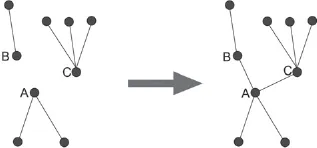
Figure 1.1
If it's a network, you can draw it
Principle #3. Once we learn to distinguish and identify the unique and individual characteristics of networks we can create, examine, and shape their properties, boundaries, and environment.
This book categorizes the facets of a network in terms of purpose, structure, style, and value. Within each facet are multiple elements and dimensions that illuminate choices in network design. The unique characteristics of any network determine how it creates value and just what that value is. For example, each of the three networks introduced in this chapter are structured differently; each has selected a structure that best meets the needs of the network and its constituents. Membership criteria provide boundaries. The leadership of NEHI selects members very carefully. YPO is open only to individuals who fulfill very strict membership criteria. Knowledge management meetings are open to any like-minded person who wants to show up. All three networks plan meetings and events carefully to fit the purpose and style so as to produce value consistently.
Principle #4. Because networks are systems of human relationships, we can best understand them using lessons from the study of complex adaptive systems.
A complex adaptive system is one that consists of elements, called agents, whose relationships may be changing all the time. Consider a flock of birds or a school of fish. The system (the flock, the school) itself has an identity, but the precise relationships among individuals at any given point in time cannot be completely known. Within the boundaries of a system, agents are capable of self-organizing, often following a simple set of rules. Even though its whole is not know-able, a complex system does exhibit patterns; from the patterns, we can sometimes understand the rules by which the system self-organizes and often can understand, after the fact, what particular patterns resulted in a given outcome. For example, the members of the knowledge management groups, attracted to a set of ideas, self-organized independently in three cities at different times, but the resulting group structures and styles have very similar patterns.
Principle #5. Everyone in a network influences the relationships in and the outcomes of the network.
Any change in a complex system, no matter how small, can have a far-reaching and potentially unexpected consequence. In any network, different people show up for any given meeting, thus altering the overall system of relationships in a way that cannot be predicted or controlled.
The development of personal relationships within the network—as when A in Figure 1.1 connects with B and C—may similarly alter the structure of the network as well as its style, purpose, or value.
Principle #6. A leader's work is to create and maintain the conditions that enable productive and innovative relationships.
Leaders may excel at traditional tasks of management, but they can never manage all the relationships in a network, nor direct all of its activities to predictable outcomes. Leaders can and must, however, provide an environment in which relationships produce innovative and productive outcomes for its members, stakeholders, shareholders, clients, and (in some cases) the network itself.
The network must be one that has clear norms for how people engage in interactions and acknowledge the contributions of others; it is the leadership that establishes and provides a role model for these norms.
Leadership in the knowledge management groups, for example, is typically shared among a core group; all members contribute ideas and topics for members to share and mutually explore, thus enhancing an environment that reinforces continuous innovation. NEHI and YPO network leaders design and structure events that provide continuous acknowledgment of individual and network accomplishment and foster the development of rich and trusting relationships.
Principle #7. Successful networks are reflective and generative.
Networks are complex, not chaotic. Chaos occurs when all the existing patterns and norms have broken down. When you live in or lead a network, and are grounded by these principles of net work, the network engages in both creative and reflective activities that maintain self-awareness and provide boundaries within which the unknown and unexpected can be welcomed and managed.
Successful personal business networks like YPO periodically survey their membership to ensure that they are meeting members‚ needs, using the results to generate positive change. Leaders of learning networks like the knowledge management groups welcome the opportunity to meet in a teleconference and talk easily with each other as they reflect on their past experiences and the possibilities for improving the value they bring to their members.
Net work is about balancing. As you‚ll see in Chapters 3 through 6, there are dynamic tensions across the facets of purpose, structure, style, and value. But we are in network...
Table of contents
- Front Cover
- Half Title
- Title Page
- Copyright
- Dedication
- CONTENTS
- FOREWORD
- PREFACE
- ACKNOWLEDGEMENTS
- Chapter 1: THE NATURE OF NET WORK
- Chapter 2: THE CONTEXT OF NET WORK
- Chapter 3: PURPOSE
- Chapter 4: STRUCTURE
- Chapter 5: STYLE
- Chapter 6: NETWORKS AND VALUE CREATION
- Chapter 7: NET WORK: DESIGN
- Chapter 8: NET WORK: EXAMINATION
- Chapter 9: NET WORK: CHANGE AND TRANSITION
- Chapter 10: THE NET WORK OF LEADERSHIP
- AFTERWORD
- Appendix: THE TECHNOLOGIES OF NET WORK
- INDEX
- ABOUT THE AUTHOR
Trusted by 375,005 students
Access to over 1.5 million titles for a fair monthly price.
Study more efficiently using our study tools.
Frequently asked questions
Yes, you can cancel anytime from the Subscription tab in your account settings on the Perlego website. Your subscription will stay active until the end of your current billing period. Learn how to cancel your subscription
No, books cannot be downloaded as external files, such as PDFs, for use outside of Perlego. However, you can download books within the Perlego app for offline reading on mobile or tablet. Learn how to download books offline
Perlego offers two plans: Essential and Complete
- Essential is ideal for learners and professionals who enjoy exploring a wide range of subjects. Access the Essential Library with 800,000+ trusted titles and best-sellers across business, personal growth, and the humanities. Includes unlimited reading time and Standard Read Aloud voice.
- Complete: Perfect for advanced learners and researchers needing full, unrestricted access. Unlock 1.5M+ books across hundreds of subjects, including academic and specialized titles. The Complete Plan also includes advanced features like Premium Read Aloud and Research Assistant.
We are an online textbook subscription service, where you can get access to an entire online library for less than the price of a single book per month. With over 1.5 million books across 990+ topics, we’ve got you covered! Learn about our mission
Look out for the read-aloud symbol on your next book to see if you can listen to it. The read-aloud tool reads text aloud for you, highlighting the text as it is being read. You can pause it, speed it up and slow it down. Learn more about Read Aloud
Yes! You can use the Perlego app on both iOS and Android devices to read anytime, anywhere — even offline. Perfect for commutes or when you’re on the go.
Please note we cannot support devices running on iOS 13 and Android 7 or earlier. Learn more about using the app
Please note we cannot support devices running on iOS 13 and Android 7 or earlier. Learn more about using the app
Yes, you can access Net Work by Patti Anklam in PDF and/or ePUB format, as well as other popular books in Business & Business General. We have over 1.5 million books available in our catalogue for you to explore.