- 268 pages
- English
- ePUB (mobile friendly)
- Available on iOS & Android
eBook - ePub
About this book
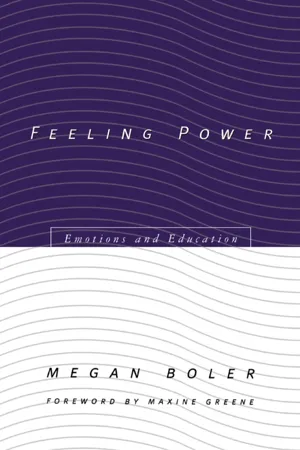
First published in 1999. Megan Boler combines cultural history with ethical and multicultural analyses to explore how emotions have been disciplined, suppressed, or ignored at all levels of education and in educational theory. FEELING POWER charts the philosophies and practices developed over the last century to control social conflicts arising from gender, class, and race. The book traces the development of progressive pedagogies from civil rights and feminist movements to Boler's own recent studies of emotional intelligence and emotional literacy. Drawing on the formulation of emotion as knowledge within feminist, psychobiological, and post structuralist theories, Boler develops a unique theory of emotion missing from contemporary educational discourses.
Information
CHAPTER ONE
FEELING POWER
Theorizing Emotions and Social Control in Education
We refuse to be
what you wanted us to be
we are what we are
and that’s the way it’s goin’ to be.
You can’t educate us, with no equal opportunity
(Talkin’ bout my freedom, people’s freedom and liberty.)
what you wanted us to be
we are what we are
and that’s the way it’s goin’ to be.
You can’t educate us, with no equal opportunity
(Talkin’ bout my freedom, people’s freedom and liberty.)
—Bob Marley1
INTRODUCTION
TWO EXAMPLES OF resistance to education from popular culture evidence how emotion and power are intertwined. Bob Marley’s popular songs consistently express his passionate protests against injustice. In this song, “Babylon System,” he expresses on behalf of the colonized people of the African Diaspora a collective refusal and resistance to the rhetoric of “equal opportunity education,” which he recognizes has not, in fact, led to his people’s freedom and liberty. Marley’s call for revolution is conveyed through strong emotions—anger, empathy, hope, and joy, as he envisions a better world. Marley expresses what have been called “outlaw emotions”— emotions such as anger that are perceived as threatening by the dominant culture.
In a different popular representation of refusal, a Calvin and Hobbes cartoon, Calvin hands a book back to his mother and says, “I read this library book you got me.” She responds, “What did you think of it?” Scratching his head, he answers, “It really made me see things differently. It’s given me a lot to think about” In the last frame, Calvin’s mother says, “I’m glad you enjoyed it,” and Calvin, walking away, says, “It’s complicating my life. Don’t get me any more.” Calvin’s refusal is meant to be humorous: We may identify with Calvin’s desire not to “complicate his life” by reading books; we may identify with his mother in our role as parent, educator, or friend who wants to encourage others to engage in critical inquiry about how they “see their world.”
How is Calvin’s resistance to “seeing the world differently” shaped by his emotional investments? Is his resistance “political,” like Marley’s? Social theorists such as Paolo Freire, Frantz Fanon, and Albert Memmi would likely answer yes: Calvin’s resistance can be interpreted as his “fear of freedom,”2 but unlike Marley’s expresses the desire to remain within the “comfort-zone” of unquestioned beliefs. Calvin’s refusal is the mirror-side of Marley’s call for revolution: Calvin likes things the way they are.3
Some may say, “Give Calvin a break! It’s not that he’s afraid of changing his comfortable worldview. He just doesn’t like books, doesn’t like to think, or is resisting his mother like any normal child does!” But why might we see Calvin’s resistance as simply his “individual preference,” as a “normal” child’s behavior, when we see Marley’s resistance as angry and political? Calvin’s resistance to change represents an invisible conformity to the status quo, though it is nonetheless an expression of resisting education. In contrast Marley’s resistance to education is seen as angry, visible, and potentially threatening.
These introductory examples are meant to evidence that the relationship between a person and their educational experience is fraught with different emotions and histories. Certain emotions are culturally classified as “natural,” benign, and normal, while others are seen as outlaw forms of political resistance. The determination of the normalcy and deviance of emotions can be generalized to some extent according to social class, gender, race, and culture, but are also highly determined by particular social contexts and power dynamics between given subjects in a situation. This highlights the impossibility of generalizing about emotional expressions: Resisting education, for example, means different things in different contexts.
Throughout this book, I question the Western philosophical and psychological tendencies to think of emotions as “natural,” “universal” responses, located solely within the individual. Rather, in each case an emotion reflects the complex dynamics of one’s lived situation. The two resistant responses above each reflect particular reasons and perceptions; and we understand the significance of the two different situations by understanding the different “histories” of resistance (anger, passion, fear, rigidity) that shape the emotional expressions. Emotions are inseparable from actions and relations, from lived experience. On the whole, education is impoverished in both theory and practice in accounting for the particularities of emotions in relation to lived power relations.
Resistance to change is only one example of the complicated emotional terrain of educational work. One can think of myriad other examples, including the following:
- The inevitable fears of judgment that occur in a competitive climate of grades and evaluation.
- The joy and Eros that are part of inquiry and interaction with others.
- Self-doubt and shame, common especially to women’s experience within higher education: women with Ph.D.s who experience the “imposter” syndrome and continue to be plagued with doubts regarding their intellectual authority.
- Anger, alienation, and hopelessness experienced by those who don’t “conform” and who thus emerge as “losers” in the education game.
- The “emotional baggage” we all carry into the classroom, stemming from our different cultural, religious, gendered, racialized, and social class backgrounds.
While one might want to speak in generalized terms about how emotion and education intersect, each of these examples would need to be examined in its culturally and historically specific context, which would include accounting for the idiosyncratic differences of each person. Emotions are slippery and unpredictable, as educators have long recognized.4 In the early decades of this century, social scientists and educators crusaded the “mentalhygiene movement,” in which they targeted the “labile” student (she or he who did not emotionally conform) as the cause of society’s troubles. Despite their efforts, they didn’t succeed with a prescription for the social control of emotions. It is perhaps this slipperiness which in part contributes to education often evading the subject of emotion.
In this chapter, I begin by stating my approach to understanding emotions in relation to power relations. I summarize why a theory of emotions and power is needed for theorizing education and developing effective pedagogies. I then turn to feminist theories from different disciplines that contribute to a theory of emotions and power. I summarize why it is particularly difficult to develop “histories of emotion.” Finally, I outiine concepts borrowed from post-structuralist thought which inform my approach to the study of emotions and education.
“FEELING POWER”
A PROMISING AND underexplored approach to this muddy undertaking is a study of how emotions are a site of social control. Feeling power means at least two things: Feeling power refers to the ways in which our emotions, which reflect our complex identities situated within social hierarchies, “embody” and “act out” relations of power. Feeling power on the other hand also refers to the power of feeling—a power largely untapped in Western cultures in which we learn to fear and control emotions.
Feeling power suggests an approach to the question of social control. Behavioral and expressive conduct is developed according to socially enforced rules of power. How does one learn not to express anger at one’s boss, or that doing so is a very risky business? How are people taught to internalize guilt, shame, and fear as ways of guiding “appropriate” social conduct?
Feeling power, on the other hand, directs us to explore how people resist our oppression and subjugation. For example, what gives women the courage to publicly challenge sexual harassment? If we choose to resist the social control of emotions as part of the fight for freedom and justice, we are challenged to understand when and how that resistance and courage arise. But resistance, as a version of feeling power, takes many forms. Education is an environment governed by rules of power and authority. Ironically, one may discover that students (like Calvin) may resist the educator’s suggestions, no matter what that suggestion is. The parental cliché “Do what I say because I know what’s best for you” is in part an invitation for the young person to rebel and say “No, I’ll decide what’s best for me!” In education, then, resistance is complicated as young people find themselves in a climate where one of their few spaces of power available to them is to resist authority.5 Thus however well-meaning or liberatory one’s educational directive, sometimes the most creative option for students is to resist. To analyze the emotional dimensions of resistance in education thus poses an exceptionally complicated question.
A challenge within education is to provide creative spaces to develop flexible and creative modes of resistance involving emotional breadth and exploration that are not prescriptive. In Feeling Power I call for collectively self-reflective, historically-traced understandings of our emotions as part of a public process—a project that involves the educator as well as the student undertaking the risky process of change.
Approaching the Labile Terrain
An interdisciplinary approach to emotions and education serves a particular purpose. It helps to illuminate how emotions are visibly and invisibly addressed within education, and how emotions reflect particular historical, cultural, and social arrangements. Thus rather than exhaustively studying one view of emotions and education,6 I am interested in how different views of emotion and education reflect distinct social and political agendas, related to the language and discourses available at any given historical moment.
In the philosophy of education we find emotions most consistently addressed in the aesthetic realm,7 sometimes addressed in the moral realm, and less frequently addressed in the cognitive realm. In my interdisciplinary map, the approaches to emotions through moral or aesthetic education each represent different philosophical discourses and historical moments. While my work is strongly shaped by these philosophies of education, I am interested in how different educational schools of thought conceptualize emotion.8 What conception of emotion underlies any given educational agenda?9
The specific focus of my study is how affect occurs in the specific site of the classroom, as mediated by ideologies and capitalist values and its entailed gendered forms. What I contribute that has not been offered before is a detailing of the specific historical logic of this education of emotions, as it has met the needs of Western capitalist cultures over the last century.
I am specifically interested in a theory of emotions and education that begins from an examination of power relations: how structures and experiences of race, class, and gender, for example, are shaped by the social control of emotion, and how political movements have resisted injustice by drawing on the power of emotions. Rather than attempt to summarize the traditions of philosophy and emotion, I begin from analyses of power. Analyses of power that bear most directly on theorizing emotion are found in feminist theories developed over the last three decades, and most systematically from the 1980s to the present.
TENSIONS BETWEEN “POWER” AND “EMOTIONS”
Emotion has most often been theorized as a “private,” “natural,” and individual experience that is “essentially” located in the individual.10 Despite the increasing embrace of emotions over the last two decades as “socially constructed,” the view of emotion as individualized is deeply embedded in our language and conceptual frameworks. As a result, I fear we still do not have a theory of emotions that adequately understands them as collaboratively constructed terrain.
The primary objects of study throughout Feeling Power are “discourses.” Rather than assuming that utterances and language are transparent or selfexplanatory, “discourse” refers to the culturally and historically specific status of a particular form of speech, and to the variable authority and legitimacy of different kinds of languages or utterances. I analyze specific discourses on emotions, and how they are contested.
These range from media discourses like television and news, to institutionalized discourses like medicine, literature, and science. Discourses are structured and interrelated; some are more prestigious, legitimated, and hence more “obvious” than others, while there are discourses that have an uphill struggle to win any recognition at all [such as feminism, civil rights, etc]. Thus discourses are power relations. (O’Sullivan et al. 1994:94)
For example, I examine texts, or classroom incidents, in terms of which contesting discourses of emotion inform the assumptions or interactions. I focus on discourse because I want to understand how emotions are not simply located in the individual, are not simply biological or privately experienced phenomena, but rather reflect linguistically-embedded cultural values and rules and are thus a site of power and resistance.
In attempting to understand emotions in relation to power and culture, we are immediately confronted with an unresolved tension embedded in our everyday language and scholarly discourses. This is a tension between studies of “structures” and forces of power (economic, political, and legislative), on the one hand; and accounts of individualized, “intrapsychic” experience, on the other. If we adopt, for example, a Marxist perspective that emphasizes how capitalism shapes who we are, it becomes challenging to account for how and when individuals resist capitalism, and how people choose to act on their own will and resist dominant social forces. If on the other hand one focuses on the agent, or the person, there is a tendency to explain people’s choices without accounting for how choices are powerfully influenced by social forces.11
Feminist theories offer some of the most pioneering approaches to understanding emotions as collective and collaborative terrain. The success of feminist approaches has to do with challenges to the divisions of “public” and “private” spheres. Both “women” and “emotions” have historically been relegated to the private and domestic spheres of the home, of caring for others—spheres outside the province of the politically governed, public spaces constructed and inhabited by men.
These theories assist in rethinking emotions as collaboratively constructed and historically situated, rather than simply as individualized phenomenon located in the interior self. This approach requires analysis of Western “binary oppositions”—such as emotion vs. reason, private vs. public, bad vs. good—as well as simultaneously understanding the gendered dimensions of these divisions. Feminists have had a particular interest in critiquing binary divisions, because “women” and everything associated with women falls on the “bad” side of the binary.
The shift in thinking about emotion as public rather than simply private allows us to glimpse the relationship between social control, hegemony,12 and emotions. Examples of material force include enforcing gender roles that keep women in the domestic sphere; requiring that people work full-time, which exhausts them and prevents them from creatively challenging the status quo or having the energy for revolution; keeping people in poverty, which breeds hopelessness. This social control is achieved as well though “shaping” or “winning” the consent of the oppressed.
Ideologies, necessary to achieving hegemony, consist of accepted ideas which appear as “natural,” outside history. By appearing natural, these ideas, which profit capitalism and patriarchy for example, do not seem to reflect the intere...
Table of contents
- Cover Page
- Title Page
- Copyright Page
- Foreword
- Preface
- Acknowledgments
- Chapter One
- Chapter Two
- Chapter Three
- Chapter Four
- Chapter Five
- Chapter Six
- Chapter Seven
- Chapter Eight
- Bibliography
Trusted by 375,005 students
Access to over 1.5 million titles for a fair monthly price.
Study more efficiently using our study tools.
Frequently asked questions
Yes, you can cancel anytime from the Subscription tab in your account settings on the Perlego website. Your subscription will stay active until the end of your current billing period. Learn how to cancel your subscription
No, books cannot be downloaded as external files, such as PDFs, for use outside of Perlego. However, you can download books within the Perlego app for offline reading on mobile or tablet. Learn how to download books offline
Perlego offers two plans: Essential and Complete
- Essential is ideal for learners and professionals who enjoy exploring a wide range of subjects. Access the Essential Library with 800,000+ trusted titles and best-sellers across business, personal growth, and the humanities. Includes unlimited reading time and Standard Read Aloud voice.
- Complete: Perfect for advanced learners and researchers needing full, unrestricted access. Unlock 1.5M+ books across hundreds of subjects, including academic and specialized titles. The Complete Plan also includes advanced features like Premium Read Aloud and Research Assistant.
We are an online textbook subscription service, where you can get access to an entire online library for less than the price of a single book per month. With over 1.5 million books across 990+ topics, we’ve got you covered! Learn about our mission
Look out for the read-aloud symbol on your next book to see if you can listen to it. The read-aloud tool reads text aloud for you, highlighting the text as it is being read. You can pause it, speed it up and slow it down. Learn more about Read Aloud
Yes! You can use the Perlego app on both iOS and Android devices to read anytime, anywhere — even offline. Perfect for commutes or when you’re on the go.
Please note we cannot support devices running on iOS 13 and Android 7 or earlier. Learn more about using the app
Please note we cannot support devices running on iOS 13 and Android 7 or earlier. Learn more about using the app
Yes, you can access Feeling Power by Megan Boler in PDF and/or ePUB format, as well as other popular books in Éducation & Éducation générale. We have over 1.5 million books available in our catalogue for you to explore.