eBook - ePub
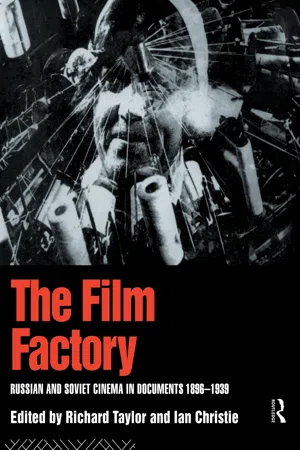
The Film Factory
Russian and Soviet Cinema in Documents 1896-1939
- 484 pages
- English
- ePUB (mobile friendly)
- Available on iOS & Android
eBook - ePub
The Film Factory
Russian and Soviet Cinema in Documents 1896-1939
About this book
The Film Factory provides a comprehensive documentary history of Russian and Soviet cinema. It provokes a major reassessment of conventional Western understanding of Soviet cinema. Based on extensive research and in original translation, the documents selected illustrate both the aesthetic and political development of Russian and Soviet cinema, from its beginnings as a fairground novelty in 1896 to its emergence as a mass medium of entertainment and propaganda on the eve of World War II.
Information
Notes
Notes to Introduction
1 | Bryher [Annie Winifred Ellerman]. Film Problems of Soviet Russia (Territet 1929), p. 11. |
2 | L. Trauberg, Speech to All-Union Creative Conference of Workers in Soviet Cinema. Document no. 138. |
3 | See for example G. Huaco, The Sociology of Film Art (New York 1965), which analyses these three movements as paradigmatic of ‘film art’. |
4 | This argument is advanced in M. Pleynet, ‘The “Left Front” of Art: Eisenstein and the Old “Young Hegelians’”, Cinéthique, 1969, no. 5; translated in Screen, 1972, vol. 13, no. 1 (Spring), pp. 103ff. |
5 | A catch-phrase originating with the 1925 Central Committee resolution addressed to writers, used as the title of two articles by Trauberg and by Eisenstein and Alexandrov, both in 1929; see Documents nos 98 & 101. |
6 | This is not to imply that the ‘myth’ of modernism is essentially false, any more than is that of Soviet revolutionary cinema, but that the received versions of both are highly selective and serve to rationalise the past according to the ideological needs of the present. For a plausible, if rhetorical, comparison of Soviet and American modernisms see A. Michelson, ‘Camera Lucida/Camera Obscura’, Artforum, January 1973, pp. 30–7. |
7 | The canon consists of Eisenstein, Vertov, Pudovkin and Dovzhenko; and the canonicfilms, with the exception of Alexander Nevsky, Ivan the Terrible, Enthusiasm and Three Songsof Lenin, are all silent. The most frequentlydiscussed films during the last fifteen years havebeen October and The Man With the MovieCamera. Kuleshov and Medvedkin have enteredthe canon intermittently. |
8 | The hagiographie treatment of Eisenstein startedearly and reached its apotheosis with M. Seton, Sergei M. Eisenstein (London 1952); the martyrological mode reached its nadir with H. Marshall, Masters of Soviet Cinema, subtitled Crippled Creative Biographies (London 1983). |
9 | For example, S. Crofts and O. Rose, ‘An Essay Towards The Man With the Movie Camera’, Screen, 1977, vol. 18, no. 1 (Spring), pp. 9–58; and S. Crofts, ‘Ideology and Form: Chapayev and Soviet Socialist Realism’, Film Form, 1976, vol. 1, no. 1, pp. 65–77. |
10 | I. Sokolov, ‘The Legend of “Left” Cinema’, Document no. 113. |
11 | Kuleshov’s The Extraordinary Adventures of Mr West in the Land of the Bolsheviks (1924) shrewdly and ironically started from the premise of widespread Western curiosity about life under the Soviet regime, and a corresponding gullibility due to ‘Red scare’ anti-Soviet propaganda. In the film, Mr West falls victim to a gang of Moscow crooks who offer to defend him against the Bolshevik caricatures which they have created to fit his preconceptions. |
12 | V. Kepley, Jr. ‘The Workers’ International Relief and the cinema of the Left 1921–1935’, Cinema Journal, 1983, vol. 23, no. 1 (Fall), pp. 9–12. D. Hartsough, ‘Soviet Film Distribution and Exhibition in Germany, 1921–1933’, Historical Journal of Film, Radio and Television, 1984, vol. 5, no. 2, pp. 132–6. |
13 | Hartsough, pp. 142–4; also D. Macpherson (ed.), Traditions of Independence (London 1980). |
14 | The confusion over historical veracity in early Soviet films dealing with the revolutions of 1905 and 1917 began early. Sequences from Potemkin, October, The End of St Petersburg and the Lenin cycle of the mid-1930s have now acquired a quasi-documentary status, especially in the Soviet iconography. |
15 | When Close Up published a portfolio of stills from Potemkin in February 1928, the accompanying caption acknowledged the difficulty of actually seeing Potemkin in Europe at this time, while noting that ‘the story, if not the film, is familiar by now to most followers of the cinema’. For details of the censorship which obstructed public screening of most Soviet films in the late 1920s, see Hartsough, pp. 139–40; Macpherson, pp. 108–15; V. Petrić, Soviet Revolutionary Films in America 1926–35, PhD. thesis, New York University, 1973, ch. 3; B. Hogenkamp, ‘Film and the Workers’ Movement in Britain, 1929–39’, Sight and Sound, 1976, vol. 45, no. 2 (Spring), pp. 68–76. |
16 | D. McDonald, ‘Soviet Cinema, 1930–1940, A History’, On Movies (Englewood Cliffs, NJ 1969), pp. 192–248; a slightly abbreviated synthesis of three articles first published in Partisan Review, July and August-September 1938, Winter 1939. |
17 | Stalin’s presence, either in person or portrayed by an actor, in many films of the... |
Table of contents
- Cover Page
- Title Page
- Copyright Page
- Contents
- Illustrations
- General Editor’s Preface
- Preface
- Preface to the Paperback Edition
- Introduction
- Translator’s Note
- 1896–1921: Introduction
- 1896
- 1911
- 1913
- 1915
- 1917
- 1918
- 1919
- 1920
- 1922: Introduction
- 1923: Introduction
- 1924: Introduction
- 1925: Introduction
- 1926: Introduction
- 1927: Introduction
- 1928: Introduction
- 1929: Introduction
- 1930: Introduction
- 1931–4: Introduction
- 1931
- 1932
- 1933
- 1934
- 1935: Introduction
- Postscript: 1936–41
- 1936
- 1937
- 1938
- 1939
- Abbreviations
- Notes to Introduction
- Appendices
- Appendix 1 Films: Russian and Soviet
- Appendix 2 Films: Foreign
- Appendix 3 People: Russian and Soviet
- Appendix 4 People: Foreign
- Index
Trusted by 375,005 students
Access to over 1.5 million titles for a fair monthly price.
Study more efficiently using our study tools.
Frequently asked questions
Yes, you can cancel anytime from the Subscription tab in your account settings on the Perlego website. Your subscription will stay active until the end of your current billing period. Learn how to cancel your subscription
No, books cannot be downloaded as external files, such as PDFs, for use outside of Perlego. However, you can download books within the Perlego app for offline reading on mobile or tablet. Learn how to download books offline
We are an online textbook subscription service, where you can get access to an entire online library for less than the price of a single book per month. With over 1.5 million books across 990+ topics, we’ve got you covered! Learn about our mission
Look out for the read-aloud symbol on your next book to see if you can listen to it. The read-aloud tool reads text aloud for you, highlighting the text as it is being read. You can pause it, speed it up and slow it down. Learn more about Read Aloud
Yes! You can use the Perlego app on both iOS and Android devices to read anytime, anywhere — even offline. Perfect for commutes or when you’re on the go.
Please note we cannot support devices running on iOS 13 and Android 7 or earlier. Learn more about using the app
Please note we cannot support devices running on iOS 13 and Android 7 or earlier. Learn more about using the app
Yes, you can access The Film Factory by Ian Christie,Richard Taylor,Professor Richard Taylor in PDF and/or ePUB format, as well as other popular books in Medios de comunicación y artes escénicas & Historia rusa. We have over 1.5 million books available in our catalogue for you to explore.