- 180 pages
- English
- ePUB (mobile friendly)
- Available on iOS & Android
eBook - ePub
About this book
Increasing numbers of adults are enroling in doctoral programmes, but their earlier college lives often do not prepare them for the rules of the academic game. Many have no idea what a dissertation looks like, how it gets that way, or what options are available to them.
This book is a practical guide for students who need help in progressing from the decision to write a dissertation to the planning, writing and defending of it. It includes samples of proposals and dissertations that have been accepted and data drawn from a number of sources, including focus groups with doctoral students and graduates and responses to an open-ended questionnaire from doctoral students across the United States.
Information
Part I
Getting a Sense of the Terrain
1 Comparing a Dissertation to a Long Term Paper
I affirmed that I can achieve a goal I set for myself by using intelligence, a combination of prior experience, hard work, determination, and focused effort.
Writing a dissertation is not a difficult task once you have established your priorities and have the desire to complete it. I had the desire and made writing the dissertation a priority in my life. My will and determination helped me along the way.
Nothing you have done in your academic career is quite like writing a dissertation. But there are resemblances – to term papers, for example. Drawing on your wealth of experiences with term papers will expedite your dissertation writing. You have considerable familiarity with writing term papers. With those proficiencies in place, it is now useful to bring them to a level of consciousness.
Writing a term paper entails not only writing per se, but necessitates extensive reading and learning – prior to and during the writing process. The same holds true for your dissertation writing. Your learning and understanding of the topic you are studying will be magnified many times in the process of writing your dissertation. Writing a paper promotes learning, as does writing a dissertation. In the process of writing your dissertation you will learn many things:
• You will learn more about your discipline.
• You will learn more about writing to an audience beyond the one professor who taught the course, extending to your dissertation committee and ultimately your academic discipline globally.
• You will learn to organize large chunks of information.
• You will learn to do original research.
• You will learn to organize your time so that you are as productive as you want to be.
Most dissertation writers find this experience amazing in retrospect. Writing a dissertation is a true learning experience writ large. A contrast between the term papers you’ve written and the dissertation is useful.
Clearly you have been successful in your paper writing. The successes you have accumulated over the span of your academic career on smaller projects provide the confidence that you can meet this new challenge of writing your dissertation.
You know that a dissertation is a lengthy document which is written by a graduate student in the process of completing a doctoral degree. You also know that writing a dissertation includes: reporting on research, working with a committee and a chair, and having “orals.” But beyond these vague labels, there is generally little understanding of this virtually invisible activity within universities. Chances are that one of your strengths as a student has been your ability to write acceptable, even highly praised, term papers. You appropriately expect to draw on that experience in your dissertation writing.
You might assume that the coursework preceding your dissertation prepares you for writing your dissertation, particularly thinking of all the term paper writing required in your courses. Clearly those experiences will be useful, but it’s important to understand that writing a dissertation is both different from and similar to a term paper.
Writing a Dissertation
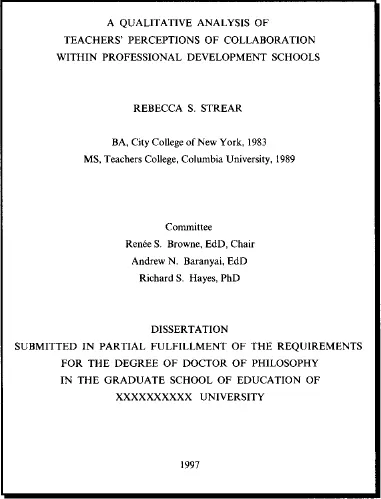
If we look at just the title page of a dissertation, we will have access to additional information about dissertations. The title page gives us useful insights into the total document if we examine it very closely. As you study Figure 1.1, consider the information which you can infer from this one page and jot these down.
Now that you’ve had a chance to think about some inferences, we can identify some of the information explicitly and implicitly provided on the title page of Rebecca Strear’s dissertation:
• The spacing of information on the page suggests the dissertation is a formal document with a prescribed format, distinct from most other writing we have seen.
• The use of technical terms in the title (e.g. “Professional Development Schools”) suggests the text is addressed to a small subset of our society which is familiar with the technical language.
• The title of the dissertation is highly focused. From the title we can identify unique characteristics:
• There is an analysis of data. (A special type of analysis will be reported; a qualitative analysis will be reported.)
• The source for the data which informs the study is identified. (The perceptions of teachers will be studied.)
• The research reports on a highly focused issue. (Only the issue of teacher perceptions of collaboration will be investigated, excluding, for example, any documentation of their collaborations.)
Figure 1.1 Title page from dissertation: sample A
• The data are collected in a restricted setting. (The site for these collaborations is restricted to places identified as “Professional Development Schools.”)
• The academic history of the degree candidate is documented.
• The dissertation is the product of collaboration among “the Committee,” along with Strear.
• Each member of the committee holds a doctoral degree.
• One of these individuals on the committee is identified as “Chair.”
• The dissertation is not the only requirement for the doctoral degree; there are additional requirements.
• A word processor or computer is used in the writing or at least in the presentation of the dissertation.
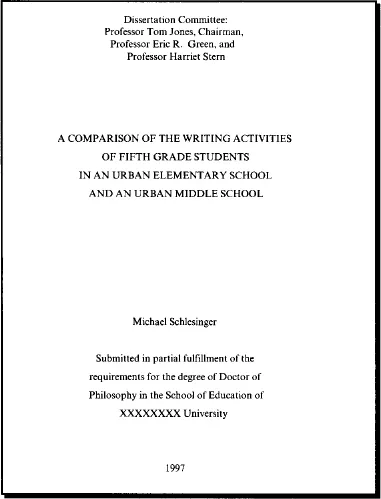
Just from studying the title page, one slice of data, we have identified important elements of a dissertation. But this is only one source. We need to compare this with other data before we make any hasty generalizations or assumptions. And so, let’s look at another title page from a dissertation completed at a different university, as presented in Figure 1.2.
We can compare Figures 1.1 and 1.2. They both have lengthy, descriptive titles, names of committee members, and a statement about the “partial fulfillment of requirements” for a degree. They both have a formal, professional presentation style. On some level they look fairly similar, with relatively minor variations. Jot down any additional information you can infer about dissertations from these two samples before reading my interpretation.
Combining our insights from samples A and B, we know that:
• these are title pages from dissertations, not dissertation proposals or term papers;
• dissertations may use different research methodologies; and
Figure 1.2 Title page from dissertation: sample B
• the style of the presentation suggests a required format rather than a unique one created by each individual student.
There are also several contrasts, some of which might indicate subtle differences in the relationship between the student and the committee. These nuances may have little import for you, or they may suggest a specific stance which you should consider adopting in your conversations with your committee, for example.
• The role of the committee is not clear. In sample A the committee members are listed below the student’s name, implying that they supported the student’s work, whereas in sample B the positioning of the committee on the top of the page may suggest that the committee directed the dissertation.
• The prominence of the student’s name differs: in sample A the doctoral student’s name is all in upper case letters, equivalent to the emphasis given to the title of the dissertation. In sample B the name appears in upper and lower case letters, similar to the listing for the committee.
• In one institution, the doctoral degrees (EdD or PhD) held by the committee members are noted, whereas the other institution seems to emphasize the fact that the committee is comprised of professors.
• Only in sample A is there a notation of the degrees previously awarded to the doctoral candidate.
These sample title pages offer us an initial sense of the many issues involved in writing a dissertation.
Writing a Term Paper
In writing your term papers, you followed what your professor directed you to do, in the main. Your professors monitored your pace. Many, if not all, of the sources which you referred to in your paper were suggested by your professor. The topic of your paper was probably predetermined by your professor and you had a deadline to meet. Your term paper usually comprised one element in a total evaluation of your work in the course, eventually resulting in the professor entering a grade with the registrar which indicated that you had successfully completed the course. Whether you received a grade of B or A may have been the most important outcome for you. For most, the completion of that requirement yielded great relief and satisfaction. Few concerned themselves with making sense of the course in the context of their other studies.
At this time we have sufficient information to document our growing understanding of some of the differences and similarities between term papers and dissertations. In addition to the insights we have developed from these brief analyses, there are several other related issues which become noteworthy in our comparison.
• When writing a dissertation, you are expected to “break some new ground.” You are expected to contribute to the evolving knowledge base of a discipline through your dissertation. In a term paper you may explore some areas in depth; there is little need to determine if others have gone this route before. In fact, everyone in your class may be writing on the same topic. In writing your dissertation, you conduct an intensive data search, insuring that the project you are mounting is different from what has “already been done.” You will bring a new perspective. You will study with new lenses, becoming aware of different phenomena. Your study will contribute to the expanding literature in your field.
• When you write a term paper, you are aware of a professor’s biases and you probably deal with these in the writing of your paper. When writing your dissertation you have many more readers of your work – potentially readers with different, conflicting theoretical orientations. It will be essential for you to deal with this potential conflict, discussing competing theories and ideas. Ultimately, your interpretation of your data will need to reflect an understanding of multiple viewpoints.
• In contrast to your term papers, which probably drew on sources recommended by your professor, your dissertation will reflect your resourcefulness at identifying pertinent sources. In fact, in the process of writing your dissertation, you become the expert, in contrast to your term papers where your professor typically was more knowledgeable than you on the topic.
• A term paper is returned to the student, with no record of that paper remaining at the institution. Certainly it is not freely available to those within and outside the university. Your dissertation, however, will be available to the entire academic community through Dissertation Abstracts International and through Interlibrary loan, for example.
• It is very important to acknowledge that your relationships with the members of your dissertation committee will influence the progress you make. While a course has a fixed conclusion date, your dissertation does not. When writing...
Table of contents
- Cover
- Halftitle
- Title
- Copyright
- Dedication
- Contents
- List of figures and tables
- Preface
- Acknowledgments
- Part I Getting a sense of the terrain
- Part II Preparing for your study
- Part III Doing your study
- Appendix A: A doctoral students’ experiences: expectations of doctoral studies
- Appendix B: Suggested readings on the doctoral dissertation
- Appendix C: Suggested reading on the academic world
- Appendix D: Suggested reading on research methodology
- Appendix E: Sample checklist of activities
- References
- Index
Trusted by 375,005 students
Access to over 1.5 million titles for a fair monthly price.
Study more efficiently using our study tools.
Frequently asked questions
Yes, you can cancel anytime from the Subscription tab in your account settings on the Perlego website. Your subscription will stay active until the end of your current billing period. Learn how to cancel your subscription
No, books cannot be downloaded as external files, such as PDFs, for use outside of Perlego. However, you can download books within the Perlego app for offline reading on mobile or tablet. Learn how to download books offline
Perlego offers two plans: Essential and Complete
- Essential is ideal for learners and professionals who enjoy exploring a wide range of subjects. Access the Essential Library with 800,000+ trusted titles and best-sellers across business, personal growth, and the humanities. Includes unlimited reading time and Standard Read Aloud voice.
- Complete: Perfect for advanced learners and researchers needing full, unrestricted access. Unlock 1.5M+ books across hundreds of subjects, including academic and specialized titles. The Complete Plan also includes advanced features like Premium Read Aloud and Research Assistant.
We are an online textbook subscription service, where you can get access to an entire online library for less than the price of a single book per month. With over 1.5 million books across 990+ topics, we’ve got you covered! Learn about our mission
Look out for the read-aloud symbol on your next book to see if you can listen to it. The read-aloud tool reads text aloud for you, highlighting the text as it is being read. You can pause it, speed it up and slow it down. Learn more about Read Aloud
Yes! You can use the Perlego app on both iOS and Android devices to read anytime, anywhere — even offline. Perfect for commutes or when you’re on the go.
Please note we cannot support devices running on iOS 13 and Android 7 or earlier. Learn more about using the app
Please note we cannot support devices running on iOS 13 and Android 7 or earlier. Learn more about using the app
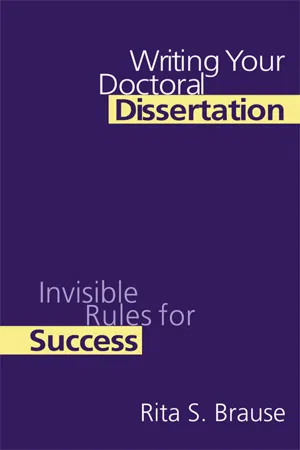
Yes, you can access Writing Your Doctoral Dissertation by Rita S. Brause in PDF and/or ePUB format, as well as other popular books in Education & Education General. We have over 1.5 million books available in our catalogue for you to explore.