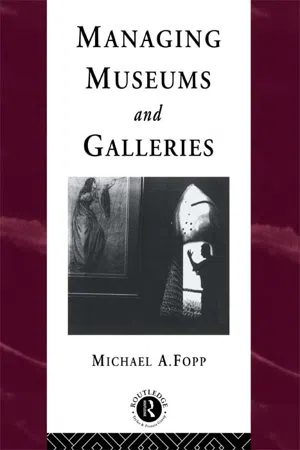
The current economic climate, coupled with an all embracing desire for museums to be respondent to 'the market' make a proper grounding in management essential. The 'bottom line' is one of the most powerful measures of management performance. Museums and galleries invariably have a neutral bottom line, they are not set up to make a profit and many of them are constrained by governmental accounting rules and charity legislation. Managing these organisations is difficult and this book tackles the issues that make it easier.
Managing the Museum examines the highly sophisticated principles and techniques of modern business management from the perspective of museums and galleries and delineates their practical application. This volume surveys the day-to-day issues of time management, delegation and recruitment to the problems of strategic planning and initiating and controlling conflict and change. This study incorporates the needs of both the independent and national sectors and discusses the links between the museum and commerce.
- 256 pages
- English
- ePUB (mobile friendly)
- Available on iOS & Android
eBook - ePub
Managing Museums and Galleries
About this book
1
The history of management and the museum context
Before we can move into the practical area of acquiring skills which will assist us to be effective managers it is appropriate that we first look at the theories of management and how they have been explained over the past century or so. We will follow the chronology of management thinking and how that thinking has affected museums and galleries for very few museum professionals have had specific management training, but their empirical solutions to management problems have been described by theorists over many years.
The study of managers at work has been undertaken for nearly a hundred years in an effort to distil the principles and practices of good management, and thereby improve the average manager if not to the highest level, then at least to a better level than he/she would otherwise achieve. From such studies have emerged several schools of thought concerning management, each with its own characteristic view of what management is about. The value to the museum profession of being aware of these different approaches is that they provide an alternative perspective on the way museums may be managed, and point to possible solutions for the problems that museums are more frequently being called upon to face.
SCIENTIFIC MANAGEMENT
‘Scientific Management’ is the term used to describe the principles relating to the management of production work and the theories behind these principles were formulated by an American engineer, Frederick Winslow Taylor (1856–1915). His view was that a manager should:
1 Develop, through scientific analysis and experiment, the best methods of performing each task.
2 Select and train workers to use the best methods.
3 Co-operate with workers and view management and productive work as two equal components in an enterprise.
Taylor described his theory as: ‘The principle object of management should be to secure the maximum prosperity for the employer, coupled with the maximum prosperity for each employee’ (Taylor, 1947, p. 31). Taylor's views were extended and developed by his colleague, Henry Lawrence Gantt (1861–1919) famous today for the charting process which is used for project planning, and by the industrial engineer Frank Bunker Gilbreth (1868–1924) and Lillian Evelyn Moller Gilbreth (1878–1972) who laid the foundations of the modern science of ‘work study’. Work study is the activity or process of systematically examining, analysing and measuring methods of performing work that involves human activity in order to improve those methods. This has often been termed ‘time and motion study’.
Taylor's theories were first presented in 1903 when he wrote a paper ‘Shop management’, for the Transactions of the American Society of Mechanical Engineers. The name ‘Scientific Management’ seems to have been coined in 1910 during discussions between Taylor and others about decisions to argue before a tribunal that American railway operators should not be allowed to raise their fares because they were so inefficient. It was argued that if the railways followed Taylor's methods of ‘Scientific Management’ they could save $1 million a day. The case aroused enormous public interest and, in 1911, Taylor published a book called The Principles of Scientific Management and thereafter his theories were part of the foundation of management studies. His work was also known as ‘Taylorism’.
Taylor's quest seems to have been the pursuit of the fundamental principles of efficiency and underlining his search was a belief that there was ‘one best way’ of doing any job. He insisted that it was management's task, using careful experimentation and observation, to identify the one best method, and to develop standardised procedures and standardised tools for implementing it. Managers should select the workforce very carefully choosing only persons entirely suited for the job and then train them to use only the best method. In this way, production could be improved and costs reduced. Workers would share in the resulting benefits by being rewarded for a fair day's work, their assigned goals being carefully determined by stopwatch study. Taylor acknowledged that this could lead to higher wage costs, but he argued that management should be concerned less with labour costs than with the overall cost per unit, and that his methods would lead, through increased output, to a reduction in unit costs. He called upon management to improve working conditions and to reduce physical effort and fatigue, in order to increase the output per worker.
Many listened to, or read of, Taylor's theory and believed his principles to be sound; however, some considered that his view was dangerous and that he attempted to reduce men to the status of machines. It is not likely that the total concept of Scientific Management has ever knowingly been practised by the museum and gallery profession for it is much more suited to businesses concerned primarily with production than the service-orientated areas within which museums operate. His theories are relatively simple yet they form an imperfect solution to a very complex problem and in isolation they may seem to have a great many benefits. They over-simplify quite intricate issues by suggesting that extra money alone will motivate many to work harder and they ignore the inevitable conflict of aims between the labour force and management. Indeed, the variety of human relations, goal-seeking and role elements of everyday life within museums and galleries would seem to run counter to nearly all of Taylor's theories, particularly the rather authoritarian attitude which may have been acceptable at the beginning of the century.
However, it is appropriate to break down Taylor's theory into its component parts; museums have incorporated some of his philosophy but, as is the case throughout management, have also taken substantial elements from others. Taylor's desire to improve efficiency is a concern held by most managers, not least those who work in museums. His wish to achieve the one best way of doing a job is not to be dismissed as an impossibility in museums. For many years the profession has been encouraging its own form of regulated training for curators. Whilst this could never achieve the robotic results wished for by Taylor, it was and is an attempt to standardise training to an extent where all will have had the same professional start. Indeed, the Museum Training Institute is now developing standards for the whole museum profession, from its lowest level to its highest. Taylor's view that selecting the best person to do the job is as valid today as ever it was and his pioneering comments regarding conditions of work still hold great weight. His theory does not take into account (for how could it) the vast changes in the attitudes of workers and the higher standard of general education. The biggest flaw in seeing any useful parallel in museums for the furtherance of Taylor's theories is that his single-minded attitude, and lack of flexibility could not work in the open, educated, task-motivated world of museums. Nevertheless, there are still a few examples of museums being run by authoritative managers in a way somewhat similar to that proposed by Taylor. Museums have to look to other methods of describing their approach to management – the ‘scientific approach’, using Taylor's theories, does not seem to be the ideal. Taylor should not be dismissed as an ogre, for his ideas have left a legacy of principles and beliefs, some of which are still implemented today.
THE QUANTITATIVE APPROACH
During the 1960s and 1970s the Quantitative Approach to management gained strength and grew into what is now generally known as Management Science. In its simplest form it can be described as the application of scientific techniques, research and results to the problems of management. It is virtually synonymous with ‘Operational Research’ (OR) which is the activity, process or study of applying scientific methods to the solutions of problems involving the operation of a system. It is sometimes suggested that Management Science is concerned with general theories whilst operational research is concerned with solving particular problems. The reliance on detailed study and experimentation point this approach towards Taylor's theories of Scientific Management and there is no doubt that the Quantitative Approach can be traced back to those principles. However, a more recent antecedent has been the implication of quantitative techniques to the analysis of wartime operations (hence the name of one of the main ingredients – operations research) which led to similar techniques being applied to the business problems of peacetime. This approach has gained impetus from the increasing availability of computers to handle the storage of data in management information systems and to manipulate the complex mathematical models which are used to simulate business activities and predict outcomes. Whilst this approach has little relevance to the broad spectrum of management problems, it has profound effects on our ability to organise and make decisions which then have a greater chance of being pragmatic, particularly those decisions that relate to financial information or project planning.
Museums have, unwittingly, been adopting the Quantitative Approach in their decision-making for many years for it is in the nature and training of the curator to be scientific in his/her approach to the management of a museum's collection. It is doubtful, however, whether these principles have much to offer senior museum staff primarily exercising a management role. The Quantitative Approach does have merit in evaluating options in a scientific way; there is little doubt that this element of the overall theory is helpful to the museum profession. In areas of financial decision-making, coupled with the availability of low-cost computer hardware and software, museum staff can now apply quantitative techniques that would have demanded considerable time and expertise a few years ago.
The principle task with the Quantitative Approach is to build a mathematical model of a situation using data that is readily available. This model is then input into a computer and the likely outcomes of a variety of options can be calculated quickly. As we become more aware of the power of these methods and the relative ease with which computers can be used to perform immensely complicated manipulations of a model, then the Quantitative Approach will have a place in museums and galleries. That place will never be of prime importance as an overall system, for the Quantitative Approach has serious limitations as an all-embracing set of management principles. However, there are now, and always will be an increasing number of museums who use the application of quantitative techniques. It is generally known that spreadsheet, project analysis and financial applications are existing software packages used by managers within museums throughout the profession. They therefore apply quantitative techniques, examples of which are:
1 ‘ What if…?’ problems
With a suitable computer model, one can quickly answer the ‘What if…?’ type of question. What if funding levels change? What if visitor targets are not achieved? What if costs escalate? One can vary these parameters and leave the computer to calculate the likely effects on performance. Naturally, the accuracy of the model will influence the reliability of its predictions but these calculations are being used (or should be being used) in museums at present.
2 Sensitivity problems
In a very similar way, one can identify those parameters to which a proposed course of action is most sensitive. The computer might reveal, for instance, that a large variation in visitor numbers would have little effect on earned income while a relatively small variation in salary costs might have a dramatic effect on revenue costs. Sensitivity tests of this kind could alert managers to those aspects of an operation which they most need to monitor so that corrective action can be taken as soon as it is needed.
3 Goal-seeking
The manager specifies the results he/she wants to achieve (e.g. a level of admission income) and the computer model will work backwards to determine, for example, the levels of admissions (including ratios of specific admission categories) that are needed to achieve it.
4 Mixing problems
Linear programming is a mathematical technique for determining the best possible mix of factors to attain the required outputs and is used, for example, in the petro-chemical industry to calculate optimum mixes of very complex resources. It is only relevant to museums with significant project or resource problems. Linear programming could conceivably be used to plan a major refit or the introduction of new systems for, say, the cataloguing of collections.
5 Bottlenecks
Models can be developed to represent, for instance, new shop or exhibition layouts. By running the model one can detect where queues and bottlenecks tend to occur, and one can test alternative options to find the best solution.
Some managers in museums are already using techniques of a quantitative nature for solving ‘what if’ problems and the step forward to other techniques is not far away. Training is the key, particularly in these management techniques and in the use of computers not merely as information storage devices, but also as complex calculating machines. Once again, it is difficult to see the Quantitative Approach being relevant as a complete management system either in business or commerce or within the museum and gallery context. There are elements of the approach that do have a place, but in the limited ways already described.
THE CLASSICAL APPROACH
Classical management has its roots in the writings of Henri Fayol seventy years ago. Fayol's analysis of the functions of management still form the basis of one of the most frequently adopted views, so much so that it has been called the Classical Approach. It is also widely known as the Process School because it uses management as a process and examines the component parts of the process separately.
Fayol defined management along the following lines: To manage is to forecast and plan, to organise, to command, to co-ordinate and to control’ (Fayol, 1949, p. 22). He developed a framework for a unified doctrine of administration that he hoped would hold good wherever management was exercised. He was one of the first to stress the importance of the organisation chart, which, with his insistence on job descriptions, still remains a chief instrument of business management. He was a firm advocate of the view that management could and should be taught; this was a revolutionary idea in 1908 when he first put it forward.
There have been many attempts to improve on Fayol's theory. For example, the idea of a manager ‘commanding’ has a strangely old-fashioned ring about it and it has often been replaced by words such as ‘directing’ or ‘leading’, though even ‘leading’ can sound dated in the modern world with its concern for ideas of participative management and industrial democracy. The word ‘motivating’ is often preferred, perhaps because it sounds less militaristic. This is certainly the case in museums and galleries where a consultative approach to management is employed in the most successful organisations. However, top-level museum professi...
Table of contents
- Front Cover
- Half Title
- The Heritage
- Title Page
- Copyright
- Contents
- List of figures
- Preface and acknowledgements
- Introduction
- 1 The history of management and the museum context
- 2 Managing yourself: the ‘player manager’
- 3 Managing other people
- 4 Choosing your team
- 5 Developing staff
- 6 Communication
- 7 Leadership
- 8 Strategic planning and the management of resources
- 9 Managing organisations
- 10 Organisation structure
- 11 Structural patterns and the division of work
- 12 Culture, conflict and change
- 13 Total Quality Management in museums and galleries
- 14 Conclusions for museum managers
- Appendix: Code of Financial Practice example
- Glossary
- Useful addresses
- Bibliography
- Index
Trusted by 375,005 students
Access to over 1.5 million titles for a fair monthly price.
Study more efficiently using our study tools.
Frequently asked questions
Yes, you can cancel anytime from the Subscription tab in your account settings on the Perlego website. Your subscription will stay active until the end of your current billing period. Learn how to cancel your subscription
No, books cannot be downloaded as external files, such as PDFs, for use outside of Perlego. However, you can download books within the Perlego app for offline reading on mobile or tablet. Learn how to download books offline
Perlego offers two plans: Essential and Complete
- Essential is ideal for learners and professionals who enjoy exploring a wide range of subjects. Access the Essential Library with 800,000+ trusted titles and best-sellers across business, personal growth, and the humanities. Includes unlimited reading time and Standard Read Aloud voice.
- Complete: Perfect for advanced learners and researchers needing full, unrestricted access. Unlock 1.5M+ books across hundreds of subjects, including academic and specialized titles. The Complete Plan also includes advanced features like Premium Read Aloud and Research Assistant.
We are an online textbook subscription service, where you can get access to an entire online library for less than the price of a single book per month. With over 1.5 million books across 990+ topics, we’ve got you covered! Learn about our mission
Look out for the read-aloud symbol on your next book to see if you can listen to it. The read-aloud tool reads text aloud for you, highlighting the text as it is being read. You can pause it, speed it up and slow it down. Learn more about Read Aloud
Yes! You can use the Perlego app on both iOS and Android devices to read anytime, anywhere — even offline. Perfect for commutes or when you’re on the go.
Please note we cannot support devices running on iOS 13 and Android 7 or earlier. Learn more about using the app
Please note we cannot support devices running on iOS 13 and Android 7 or earlier. Learn more about using the app
Yes, you can access Managing Museums and Galleries by Michael Fopp in PDF and/or ePUB format, as well as other popular books in Business & Human Resource Management. We have over 1.5 million books available in our catalogue for you to explore.