- 224 pages
- English
- ePUB (mobile friendly)
- Available on iOS & Android
eBook - ePub
About this book
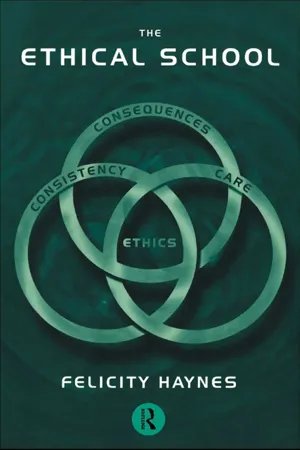
Conflicts often arise between regulations, making it difficult for school management teams and teachers to resolve situations with appropriate dignity and respect for all concerned. This book discusses provocative actual case studies to help teachers to reflect on their own ethics, guiding them to make more reasonable decisions in their schools, and thereby gradually transforming schools into more cohesive and caring communities. A model of consequences, consistency and caring, each aspect based on traditional ethical theories provides a scientific base - a rational and a responsive base for ethical decision-making. This work covers such everyday problems as censorship, inclusivity, school uniform, punishment, personal gain and confidentiality, and argues that care and respect for others, equity, rational autonomy and concern for long-term benefits are more important for a school community than short-term power and control.
Information
Chapter 1
Introduction
The unexamined life is not worth living.
Socrates
Socrates
WHAT MAKES A SITUATION UNFAIR?
Most of us can remember a situation in our own educational experience that made us feel angry or upset because it seemed so unfair. It may have been someone punished when they did not deserve it, or someone not punished when others similarly misbehaving had been. Reflect on that situation and ask yourself what it was about it that made you see it as unfair. How did you know it was unfair? Many of the situations that are perceived to be unfair involve the unequal distribution of goods or power. Others involve a requirement of consistency or equal treatment. Some appear to lack consideration for other people and are seen to be unfair because they are selfish actions, or abuse a power relation. Others may depend on unequal recognition of merit. The features that you consider significant or salient may well reflect your basic ethical position.
If you ask other people around you to discuss their own memory of a case of unfairness and ask what their situation has in common with yours, you may find it very difficult to find core concepts that tie together a notion of unfairness. The word is an ethical one and is one of those words that, like the rules of our native language, we acquire without understanding the rules for using it. We start from a shared understanding of fairness and try to imagine a different conception of the same situation. The reflective teacher must have enough intellectual awareness to stand aside from personal subjectivity and analyse the possible different responses to the situation.
As professionals, teachers are faced with such a plurality of cultural, professional and political injunctions, each jostling the other for priority and each providing counter-defences against the other, that there is no time for them to reflect on what they ought to do in a given situation. Nor even if they have time to reflect do there seem to be any objective standards of ethics or fairness to which they can appeal. It is easy for them to escape into a belief that objective standards, either in the subjects that they are teaching, or in ethical behaviour, are nothing but historical artefacts and slide from that into a relativism that allows every person to have their own set of ethical values over which there can be no resolved discussion.
Relativism has its values. We can use it to tolerate anything and everything. In this multicultural mass-media global culture, we are encouraged to make space for previously marginalized voices, to value identities other than that of the colonizer. We can use relativism to dismiss difference as irrelevant to our own world-view. It can lead to a cynicism available only to the economically self-sufficient and the politically comfortable that shuts itself away from recognizing oppressive practices. It can lead to a terror of exercising independent judgement, so that one takes refuge in the rules of others, the dominant local conventions. The most dangerous, and most common, reaction is that teachers faced with making an ethical decision are unable to react spontaneously to such a situation. They are paralysed by what Derrida has called an aporia, of not knowing how to go on. There is often a retreat to the conventional rules, the sanctions of the system.
Ironically ethics is often considered irrelevant to any large system, whether corporations or state education departments, in which accountability counts profits, efficiency and performance criteria as the measures of efficiency and effectiveness. Ethics surfaces in documents of social justice and anti-discrimination legislation but there is little attempt to tie these into other aspects of education policy such as increased class sizes, or punishment. Ethics is often invisible within an economic rationalist framework of increased efficiency and control. Yet a view of ethics as professional power-sharing lies at the heart of devolution. With the growing size and diversity of schools and school systems, the increased possibility of law suits and the increased demand for public accountability, there is a need to reaffirm that education is continually about human beings interacting responsibly with each other rather than about those with power controlling others or those without power acting like automata with neither time nor incentive to make autonomous decisions.
REFLECTING ON ETHICS IN SCHOOLS
I am not going to present a single philosophical theory of ethics in this book. I do not intend to analyse the ethical views of great philosophers such as Aristotle, Plato, Augustine, Hume, Locke, Mill, Kant, Moore or Wittgenstein, and offer only an extremely brief résumé of their writings in the final chapter. Many philosophers have discussed the matter and I have provided a glossary at the back to help with unfamiliar terms that I have borrowed from their discussions. According to Strike and Ternasky (1993:4), philosophers have in the past worried more about the structure of ethical arguments or the meaning of ethical terms than about what is right and what is wrong. Readers will need neither philosophical nor legal training to mount arguments about the correct way to proceed morally. This is a philosophical book only in that it encourages critical reflection about the way persons interact and what it means to be a good person. I want readers to develop a disposition to reflect on their own situation, to draw up their own structures to fit their activities and strivings into a pattern that will allow them to see and understand the old components of their lives differently, and perhaps to understand where their own ethical values come from, so that they can react confidently and appropriately to ethical situations in schools.
It sounds a little harsh to say, with Socrates, that the unexamined life is not worth living. However, as Nozick (1989:15) reminds us, when we guide our lives by our own pondered thoughts, then it is our life that we are living, not someone else’s. In this sense, the unexamined life is not lived as fully. Reasons are essential to that reflection, but as we have seen in thinking about the unfair situations we have experienced, feelings also play an important part. It is often difficult to know how to reflect critically. I present my own reflections for consideration, but I do not aim thereby for the reader’s consent—I ask simply that they be considered. I use this book to argue that ethics is relevant to anyone who ever asks the question ‘what ought I to do?’ or ‘would this be right?’ It is of relevance to anyone who ever makes moral judgements about others, who ever praises or condemns other people’s actions. It is of particular importance in education because not only are teachers and administrators beset with moral questions, but now, more than ever, they are responsible for the moral well-being and education of their pupils, the future generation.
However, it may not be useful to urge teachers to pay attention to ethics if I cannot explain what holds all those different notions of unfairness together. I cannot offer a systematic ethical theory without running the risk of being labelled modernist, dogmatic or insensitive to other cultures. Just as teachers of English struggle with the imposition of Standard English and the literature they grew up with and loved on complex multicultured classes, so anyone who tries to impose a systematic frame of values runs the risk of unethically excluding minority groups. This book offers a framework consistent with postmodernism within which educational administrators can develop their own reasonable structure. This structure will help them to argue from their own moral point of view with those who would normally dismiss ethical considerations as irrelevant to their concerns.
WHAT OUGHT I TO DO?
I said that ethics is relevant to anyone who ever asks the question ‘what ought I to do?’ or ‘would this be right?’ To ask the question indicates that there can be no morality without a choice between alternatives: there would be no moral problems if a person’s behaviour were completely determined by external agencies. Morality concerns values. A moral choice is a decision for the better alternative; an immoral choice is a decision for the worse alternative. Morality is not concerned with the behaviour of floods or behaviour towards bricks and mortar (Barrow 1981:169). It is concerned with behaviour that is the result of a decision about conduct among and in relation to sentient persons.
When we say ‘you ought to do something’ or ‘I should do something’ there is always a value component embedded in the statement, but it may be a legal value rather than an ethical value. Law and morality are distinct, particularly from an ethical point of view. It may be legal to insist that all children ought to attend class, but is it ethical when one child is in mortal fear of being bullied by the teacher? A legal act, for all the moral intentions underlying its framing, may be immoral in its execution. It is illegal for a 10-year-old child to stay away from school without permission, but there may be circumstances in which it is ethical, for instance if that child is the sole care-giver of an ill parent. Whether any law is ethically significant is a separate question. This disjunction does not mean that the law carries no moral weight. Laws are usually sanctioned on moral grounds. Compulsory education is legislated to prevent exploitation of children and truancy.
The ‘What ought I to do?’ question may also be a prudential one. A prudential decision usually considers what is in my best interests. T ought to lose weight’ has no consequences for anyone else other than me, nor does it fit easily under the general principle of benevolence or non-maleficence, unless at the same time I donate the money I save by eating less to the starving children in Africa. If redistributing unequal wealth is my reason for losing weight, then dieting can take on a moral dimension, but once again, the ethics of the action have a different significance from the prudence of the action. Ethics presumes that in considering what I ought to do, I take into consideration the rights and interests of others.
IS THERE A DIFFERENCE BETWEEN ETHICS AND MORALITY?
In ordinary language, morality is often associated with personal life, particularly sexual habits and rules. Most philosophers use the word ‘ethics’ to mean the philosophical study of morality, making it a higher order of reflection. Ethics is usually held to differ from morality in going beyond asking the practical question ‘What ought I to do here and now?’ to examine such moral questions within a broader, more schematic or theoretical perspective. That is one way of making the distinction between ethics and morality. Ricoeur (1992:169–239) distinguishes between the ethical aim and the moral norm. The first is based on an Aristotelian heritage in which ethics is defined by its aiming at the ‘good life’ and the second by a Kantian orthodoxy where morality is defined by the obligation to respect the norm. He (Ricoeur 1992:170) argues that
- in order to be moral one must first be ethical;
- the ethical aim must pass through the ‘sieve’ of the norm; and
- whenever the norm leads to impasses in practice, it is legitimate to appeal to the aim.
Ethics on Ricoeur’s distinction is not a ‘science of morality’. It does not pretend to answer questions, nor to lay down a comprehensive rule of conduct, but to examine moral questions with a view to determining the good life. The first and last chapters of this book are mainly concerned with ethics, and the intervening chapters are concerned with moral practices in schools that raise ethical questions, often by presenting impasses or confronting our moral assumptions. Throughout the book, ‘ethics’ and ‘morality’ can be seen as two interconnecting ends of the same spectrum, starting with the general abstractions and moving through the immediate and practical back to the theoretical, so that the reader can judge current norms against current aims, to consider ways of improving them for a more ethical society.
CONCEPTS AND CONCEPTIONS OF ETHICS
‘Persons’ is a cultural construct linked to legal, political and ethical concerns. In earlier centuries slaves or women were regarded more as possessions than persons, and were similarly excluded from ethical or legal rights. Consider whether animals could be said to behave morally or ethically. Would they have to be considered persons? Self-aware? Rational? Do you consider that all the people in your school have an equal right to personhood? Normal citizen rights are denied to criminals and psychotics, but not to students under 18 or animals. Should this be the case? Imagine that you are organizing an international culture tour and a student comes up saying that they cannot go because they cannot get a passport. An Australian hermaphrodite was denied a birth certificate, and therefore voting rights and a passport, because the doctors could not call her/him either a male or a female. This essentially denies that individual the rights of personhood and, interestingly enough, removes him/her from the province of state control.
A great deal of what it means to be a person is to understand that there are good and bad ways to share the world with other persons, whose intentionality is like our own in that they too have world-views, self-concepts, projects, needs, desires, claims and so on. The sophistication required to see oneself as separate from and yet similar to others would seem to require at least language and a basic rationality that connects the concepts. Our languages are also ways of making sense of shared practices, and over time, abstract concepts evolve which bind those understandings and practices together so that, for instance, societies develop a word ‘murder’ to distinguish intentional and sanctioned killing (as in war, capital punishment or euthanasia where it is allowed) from that which is not sanctioned, or ‘bullying’ to identify certain intimidatory processes that go beyond playful tussles.
These very concepts themselves make some basic presumptions that good and bad are in some way distinguishable, and that such a distinction ought to be maintained and constantly refined (Kovesi 1978). As humans who command language, we set up schemata or frames or structures of meaning which represent the objective world, and tie things in that objective world together formally through rational connections. In ethics, we build up a rational frame composed of concepts such as good, honesty, justice, merit, blame and bullying, which help us to see connections between certain types of action and practices and for which often tacitly we generalize rules for good and bad behaviour through social agreements.
If you find Ricoeur’s distinction between ethics and morality a little confusing, a related idea was expressed by John Rawls (1971) as the basis of his theory of justice. He proposed that ethics, the study of moral rules to determine the good life, is best understood as a concept embodied in a number of alternative conceptions. Even the a-rational and non-verbal newborn baby pulls together various sensations to develop notions of hunger, discomfort and pain. Humans seem to share a concept of fairness, even across cultures. But as you may have discovered when discussing different cases with colleagues, what we mean by ‘fairness’ differs from person to person. We need concepts to pull our ideas together. Conceptions, in a nicely punning way, are the concepts made flesh, the way we use them everyday. Some concepts, like ‘furniture’ or ‘vegetables’, tie physical things together; others, like ‘intelligence’, may tie together other concepts or ideas, such as ‘cleverness’ and ‘success’ — but in both cases they gain their meaning in experiential contexts.
Rawls argues that the concept of justice transcends cultural traditions, but its conceptions do not. Because conceptions of justice are so tightly connected with practices, they vary from one culture to the next, and sometimes within the same culture. Conceptions are sets of beliefs and motivations that more or less systematically cohere around a few central properties or core features that need not be the same for every person, place or era. What the several conceptions of fairness have in common is not their core features, but only the overall function of the concept. I would not be tempted, as Lawrence Kohlberg was, to go out and seek empirical evidence that ethical concepts such as justice are universal, but it does make sense to assume that humans generally have a social need to divide actions into fair and unfair actions, and to that extent moral concepts are universal. A notion of honesty, for instance, is a logical and practical prerequisite of language. If we could not assume that people could normally be trusted to tell the truth, then speech would be useless.
Kovesi (1978) discusses at some length the place of these moral notions in our language, dividing all our concepts into formal and material elements. What makes an action ‘bullying’ as opposed to ‘exerting power’? The material act of exerting power over someone need not be defined as bullying; if it happens in a socially sanctioned setting such as sport, or the classroom, even if the behaviour is in each case equal. There has to be an element of coercion for the moral term to be used appropriately. Kovesi (1978:14) would say that the element of moral disapproval, that is, an appeal to the concept of ‘not-good’, is the necessary formal element of bullying, while the material act of exerting power is necessary but not sufficient to provide the ethical element. The simple way of saying this is that ‘bullying’ is a moral notion, while exerting power over another person is not. There are even formal elements of moral disapproval in the word ‘dirt’ which in our culture make the same material element of sand ‘dirt’ when it is on the floor, but not when it is on the beach, or custard ‘dirt’ when it is on your shirt but not when it is in a full plate. To put this another way, ‘dirt’ and ‘bullying’ are abstracted ethical concepts, tied to culturally specific specifications of behaviour or practice called ‘conceptions’ which are linked to ...
Table of contents
- COVER PAGE
- TITLE PAGE
- COPYRIGHT PAGE
- DEDICATION
- CASE STUDIES
- ILLUSTRATIONS
- PREFACE
- CHAPTER 1: INTRODUCTION
- CHAPTER 2: BEYOND POWER
- CHAPTER 3: ENDS AND MEANS
- CHAPTER 4: EQUITY AND THE CONSTRUCTION OF DIFFERENCE
- CHAPTER 5: WHAT IS A RIGHT?
- CHAPTER 6: MAXIMIZING GOOD
- CHAPTER 7: COMMUNITY AND LOYALTY
- CHAPTER 8: CENSORSHIP AND CURRICULUM
- CHAPTER 9: OMISSIONS AND COMMISSIONS
- CHAPTER 10: MAKING PROGRESS IN ETHICAL JUDGEMENT
- APPENDIX A: WHAT OUGHT I TO DO?
- APPENDIX B: CODE OF ETHICS—AUSTRALIAN COLLEGE OF EDUCATION (REVISED NOVEMBER 1987)
- GLOSSARY
- BIBLIOGRAPHY
Trusted by 375,005 students
Access to over 1.5 million titles for a fair monthly price.
Study more efficiently using our study tools.
Frequently asked questions
Yes, you can cancel anytime from the Subscription tab in your account settings on the Perlego website. Your subscription will stay active until the end of your current billing period. Learn how to cancel your subscription
No, books cannot be downloaded as external files, such as PDFs, for use outside of Perlego. However, you can download books within the Perlego app for offline reading on mobile or tablet. Learn how to download books offline
We are an online textbook subscription service, where you can get access to an entire online library for less than the price of a single book per month. With over 1.5 million books across 990+ topics, we’ve got you covered! Learn about our mission
Look out for the read-aloud symbol on your next book to see if you can listen to it. The read-aloud tool reads text aloud for you, highlighting the text as it is being read. You can pause it, speed it up and slow it down. Learn more about Read Aloud
Yes! You can use the Perlego app on both iOS and Android devices to read anytime, anywhere — even offline. Perfect for commutes or when you’re on the go.
Please note we cannot support devices running on iOS 13 and Android 7 or earlier. Learn more about using the app
Please note we cannot support devices running on iOS 13 and Android 7 or earlier. Learn more about using the app
Yes, you can access The Ethical School by Felicity Haynes in PDF and/or ePUB format, as well as other popular books in Education & Education General. We have over 1.5 million books available in our catalogue for you to explore.