Residential Open Building, the result of a CIB Task Group 'Open Building Implementation', provides a state-of-the-art review of open building, fundamental principles, recent developments, and international coverage of current projects on both the public and private arena.
Open Building is a highly flexible and economical method of building which has far reaching advantages for urban designers, architects, contractors, developers and end users.
- 320 pages
- English
- ePUB (mobile friendly)
- Available on iOS & Android
eBook - ePub
Residential Open Building
About this book
Information
Part One
A Residential Open Building Primer
1
Introduction
1.1 The Open Building Movement
Developments toward residential Open Building are widespread and accelerating. They accompany change: in environmental structure, in production and construction methods, in the market for services and products, in product technology, and in the demand for suitable housing. However, unlike many new products or methods, Open Building was not invented. It has not developed in a unified fashion. Nor has it been aggressively marketed or promoted by multinational corporations, governments or associations. Rather, OB has emerged gradually in response to evolving social, political and market forces, to prevailing conditions and trends in residential construction and manufacturing, and to many other factors that demand more effective and responsive practices.
Developments toward residential Open Building respond to many of the same long-term environmental and social shifts that have affected non-residential architecture. Realized OB projects build on concerted long-term research, development and implementation activities conducted by individuals, corporations, associations, industries and government agencies. Yet even more, these projects and research activities reflect direct advocacy - of consumer choice and tenants’ rights, of rationalized production of housing and building systems, of long-term environmental coherence or of sustainable architecture.
Parallel trends emerging across professions and regions have taken decades to recognize. More continue to appear. Residential Open Building advocacy now constitutes an international phenomenon. Gradually, groups and individuals - from industrial component manufacturers to real estate developers and contractors, from tenants’ rights advocates to architects, and from sustainability advocates to government regulators — have come to recognize that they face similar problems, share similar beliefs about how to build (though frequently for different reasons), and have developed parallel or complementary — albeit not identical - responses to similar conditions. Above all, they understand that buildings are built and maintained through the concerted efforts of many parties operating at many different levels. It therefore makes sense to structure the interfaces of parts and of decision-makers in ways that improve the responsiveness of buildings to end users, while at the same time increasing efficiency, sustainability and capacity for change, and dramatically extending the useful lives of residential buildings.
1.2 Trends Toward Open Building
The broadest environmental trend leading professionals toward Open Building practice is the reemergence of a changeable and user-responsive infill (fit-out) level. Infill represents a relatively mutable part of the building. The infill may be determined or altered for each individual household or tenant without affecting the Support or base building, which is the buildings shared infrastructure of spaces and built form. Infill is more durable and stationary than furniture or finishes, but less durable than the base building.
Also noteworthy is the trend toward increasing building project complexity in terms of size, regulatory processes, systems coordination, production and management processes. Historically - until perhaps 75 years ago - patterns of residential development, decision-making, construction and control were relatively constant. Now they are rapidly shifting. As one result, any direct or substantive participation in decision-making by the end user or inhabitant is now frequently removed from the building process.
By contrast, within commercial office buildings, rights and responsibilities for selecting and maintaining major components of building and equipment subsystems is shifting toward the tenant. Investment is steadily moving to the fit-out and furniture levels - where it becomes the end users’ personal property — rather than to the level of the base building — which constitutes real property with very different constraints and business drivers (Ventre, 1982). Building procurement and service subcontracting are rapidly evolving, differentiating and transforming to match these changes in investment patterns.
Many other broad environmental trends are aligned with developments toward residential Open Building. Among the technical trends, an increasing number of high-value-added subsystems are being introduced into buildings with ever-increasing frequency. Multiple and highly complex utility supply systems are being extended into every space within the home. Industrially-produced technical supply systems and building products increasingly proliferate, become physically entangled on-site and then become obsolete and abandoned, like piping for gas lamps or rooftop antenna leads.
In terms of project finance, the rate of investment in refurbishing and maintaining existing building stock is sharply rising. Renovation now accounts for more than half of the construction market in many developed nations. Yet the relative capacity of buildings to adapt to changes in infill systems, use or user preferences has greatly diminished. The average life span of new buildings has plummeted, from 100 years to as few as 20 or 30. Developers and contractors are also keenly aware of yet another long-term global trend: construction dollars are flowing away from site construction toward prefabricated (made for use) and industrially-produced (made for stock or trade) subsystems.
1.3 How Open Building Works

Fig. 1.1 Decision-Making Levels in Open Building. Diagram courtesy of Age van Randen.
Organizationally, Open Building lends formal structure to traditional and inherent levels of environmental decision-making, while offering design methods based on new insights and supported by current applied research. OB projects are structured to subdivide technical, aesthetic, financial and social decisions into distinct levels of decision-making. Urban level decisions address the wider public realm, including the establishment of urban patterns of built form and space, placement of streets, parking and utility networks, setbacks and ‘street furniture.’ They may further address the character of building facades, the location of public buildings, and the distribution of activities (land uses) within the more enduring spatial and formal order of the urban tissue.
Within that urban structure, independent decisions on the Support (base building) level involve the parts of a building which are common to all occupants, those parts which may endure for a century or more. To use multi-family housing as an illustration: the base building may be comprised of the load bearing structure, plus the building’s common mechanical and conveyance systems and public areas, as well as all or most of its outer skin. Individual tenant changes can - and should - leave the Support unaffected.
Systems and parts associated with the infill (fit-out) level tend to change at cycles of 10–20 years. Transformation may be occasioned by occupants’ changing requirements or preferences, by cyclical need for technical upgrade or by changes in the base building. The infill typically comprises all components specific to the dwelling unit: partitioning; kitchen and bathroom equipment and cabinets; unit heating, ventilating and air conditioning systems; outlets for power, communications and security; and all ducts, pipes and cables which individually service facilities in each unit. In detached houses, OB distinguishes changeable interior fit-out from more durable structure and skin.
In open architecture, these infill parts may be independently installed or upgraded for each occupant in turn. To make that possible, the base building must be kept as physically distinct as possible from its less permanent infill. To enable the independence of the infill, buildings cannot be built as single integrated ‘bundles’ of technical products or decisions. The separation intrinsic to an open architecture invests additional value, possibility and durability in the Support. Which is to say, the Support structure builds in valuable capacity for lower level change. Infill systems and parts will inevitably have to be changed many times throughout the life cycle of the building in which they are located. Therefore, they are designed and installed for optimal freedom of independent layout, construction, subsequent transformation and eventual replacement. At the same time, common systems and long-term durable parts shared by all occupants - for instance, foundations, structure, utility trunk lines, public corridors and stairs - are left viable and undisturbed.
In terms of decision clusters, Open Building therefore advocates disentangling specific parts of buildings and their sub-assemblies: minimizing interference and conflict between subsystems and the parties controlling them; and enabling the substitution or replacement of each part during design, construction and long-term management. These principles apply to work at each environmental level. They also apply to both residential and non-residential architecture. Disentangling and standardizing interfaces in residential and commercial architecture alike enables broad consumer choice in laying out, equipping and finishing spaces. The use of residential fit-out systems has begun to restructure residential construction, which is consequently emerging as a new kind of consumer market.
In one current example of state-of-the-art Open Building practice, households work with an infill architect to custom design their own dwelling units according to their functional, aesthetic, budget and other preferences. The future inhabitants decide where to place walls, kitchen and bathroom. They select cabinets, appliances, fixtures and finishes. A few weeks later, they can move into their newly constructed and code-approved custom dwellings. The consumer-grade utility systems and their connections and interfaces, rather than the particular installation, have received code-approved product certification, streamlining local jurisdiction inspections. As one result, occupants are free to subsequently relocate electrical, data and communications outlets at will. Such entirely custom dwellings, using advanced infill technology, information systems and logistics, need not cost more than conventional units.
Principles and practices such as these are transforming conventional practice in urban design, architecture and construction. They are also reshaping the processes of designing, manufacturing and installing building subsystems and parts. New processes and forms of organization in the design and construction professions are taking shape around OB, and new building technologies and materials are being produced to suit it. Building standards, regulations, financing and management are adjusting in ways compatible with Open Building practice.
2
Incubators of Open Building
2.1 The Netherlands
2.1.1 John Habraken and Supports
In 1961, N.J. Habraken, a young Dutch architect, published De Dragers en de Mensem het einde van de massawoningbouw, a slender volume subsequently translated as Supports: An Alternative to Mass Housing (1972). In Supports, Habraken observed that mass housing (MH) had begun to disrupt an age-old ‘natural relation’ between human beings and their built environment. Although the brutalist forms of mass housing might be embraced or villified, there was far more at stake than style: as one by-product of the reorganization of the housing process, mass housing was creating a disruptive imbalance among forces which, in healthy environment, operate in dynamic equilibrium. Largely implicit processes had hitherto created, sustained and enriched built environment for millenia, based on slowly evolving themes and variations. Now those processes were being brought to a halt.
In the traditional process of habitation, each household had of necessity acted directly to take charge of the act of dwelling. Within a block of Amsterdam canal houses, for example, there existed a clear and common typology (and in fact, a collective urban structure of high coherence). Yet each inhabitant or owner independently managed and altered his or her own dwelling. Every stoop, every facade, every window and every plan was therefore different, a unique and vital variation of a broadly shared environmental theme. Mass housing had utterly excluded such participation and responsibility of individual households, entirely eliminating inhabitants from the housing process. In the new post-WWII building order, everything was professionally decided, professionally designed and professionally managed and maintained. Built environment as a collective artifact embodying people in all of their individuality and uniqueness was dying. Habraken perceived that dwellings could not be understood as products or manufactured objects. Dwelling was, rather, a fundamentally human process. And the issue was not aesthetics, nor even industrialization, but rather unified institutional control of what had been an activity shared collectively by members of society.
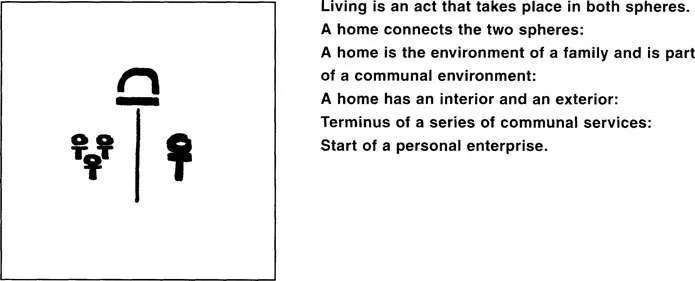
Fig 2.1 The Two Spheres of Housing, from Three R’s For Housing by N.J. Habraken. Reprinted with permission.
Habraken believed it was possible to reinstate the natural relationship or process within built e...
Table of contents
- Cover
- Half Title
- Series Page
- Title
- Copyright
- Contents
- What is residential Open Building?
- Acknowledgments
- PART ONE A RESIDENTIAL OPEN BUILDING PRIMER
- PART TWO A SURVEY OF MILESTONE PROJECTS
- PART THREE METHODS AND PRODUCTS
- PART FOUR ECONOMIC AND ADDITIONAL FACTORS
- PART FIVE SUMMARY AND CONCLUSIONS
- Appendices
- Glossary
- Index
Trusted by 375,005 students
Access to over 1.5 million titles for a fair monthly price.
Study more efficiently using our study tools.
Frequently asked questions
Yes, you can cancel anytime from the Subscription tab in your account settings on the Perlego website. Your subscription will stay active until the end of your current billing period. Learn how to cancel your subscription
No, books cannot be downloaded as external files, such as PDFs, for use outside of Perlego. However, you can download books within the Perlego app for offline reading on mobile or tablet. Learn how to download books offline
Perlego offers two plans: Essential and Complete
- Essential is ideal for learners and professionals who enjoy exploring a wide range of subjects. Access the Essential Library with 800,000+ trusted titles and best-sellers across business, personal growth, and the humanities. Includes unlimited reading time and Standard Read Aloud voice.
- Complete: Perfect for advanced learners and researchers needing full, unrestricted access. Unlock 1.5M+ books across hundreds of subjects, including academic and specialized titles. The Complete Plan also includes advanced features like Premium Read Aloud and Research Assistant.
We are an online textbook subscription service, where you can get access to an entire online library for less than the price of a single book per month. With over 1.5 million books across 990+ topics, we’ve got you covered! Learn about our mission
Look out for the read-aloud symbol on your next book to see if you can listen to it. The read-aloud tool reads text aloud for you, highlighting the text as it is being read. You can pause it, speed it up and slow it down. Learn more about Read Aloud
Yes! You can use the Perlego app on both iOS and Android devices to read anytime, anywhere — even offline. Perfect for commutes or when you’re on the go.
Please note we cannot support devices running on iOS 13 and Android 7 or earlier. Learn more about using the app
Please note we cannot support devices running on iOS 13 and Android 7 or earlier. Learn more about using the app
Yes, you can access Residential Open Building by Stephen H. Kendall,Jonathan Teicher in PDF and/or ePUB format, as well as other popular books in Architecture & Professional Practice in Architecture. We have over 1.5 million books available in our catalogue for you to explore.