Sustainable design requires that design practitioners respond to a particular set of social, cultural and environmental conditions. 'Vernacular Architecture and Regional Design' defines a set of strategies for understanding the complexities of a regional setting. Through a series of international case studies, it examines how architects and designers have applied a variety of tactics to achieve culturally and environmentally appropriate design solutions.
• Shows that architecture and design are inextricably linked to social and environmental processes, and are not just technical or aesthetic exercises. • Articulates a variety of methods to realise goals of socially responsible and environmentally responsive design. • Calls for a principled approach to design in an effort to preserve fragile environments and forge sustainable best practice.
'Vernacular Architecture and Regional Design' will appeal to educators and professional practitioners in the fields of architecture, heritage conservation and urban design.
Dr. Kingston Wm. Heath is Professor and Director of the Historic Preservation Program at the University of Oregon. Previously he was Professor of Architecture at the University of North Carolina, Charlotte where he taught seminars on vernacular architecture and regional design theory. He holds graduate degrees from the University of Chicago and Brown University. In addition to numerous articles in scholarly journals, he is the author of Patina of Place, and winner of the Abbott Lowell Cummings Award from The Vernacular Architecture Forum for excellence in a scholarly work. He has earned an international reputation in the field of vernacular architecture and has directed field schools in Italy and Croatia.
Part One People – Improving the Human Condition Through Design
4 Finding patterns within the local building culture, and preserving the continuity of tradition through participatory housing and community development
DOI: 10.4324/9780080939841-4
Discussions between clients and professionals remain abstract and general. They are not about the product, but instead about the 'values,' or 'needs,' or 'functions.' The professional goes away and designs the product with these abstractions 'in mind' - but essentially by his own lights and according to his own habits. Within such a situation, the whole corpus of existing tradition is ignored - it is after all only a 'product' - and then buildings are built that neither client nor professional love or admire.
Howard Davis, David Week, and Paul Moses inArchitecture &Design(March-April 2003), 53-54.
Project: Housing Initiative for Rickshaw Drivers and their Families, Vellore, Tamil Nadu, India
Location: Vellore, Tamil Nadu, India
Design team_ Informal organization called The Center for People's Housing/Tamil Nadu (ILLAM)
Official participants:
Howard Davis, Professor of Architecture, Center for Housing Innovation, University of Oregon David Week, Director of Pacific Architecture, Sydney, Australia
M. Nelson, Founder and Director, Center for Development (CEDMA), Tamil Nadu, India Thomas Kerr, Architect, Field Recorder Paul Moses, Director of Architecture South in Madras and Site Manager
Time frame: 1990-1995
Introduction
By exploring the specific living patterns of a particular user group, Howard Davis demonstrates how such information can contribute to our cultural perceptions of a landscape - particularly life ways beyond the architect's realm of personal experience. Willing to listen, observe, and question, he and the design team acknowledge the useful role of a cultural outsider to provide valuable insights without controlling every aspect of the design process.
This case study offers an alternative to a singular reliance on formal analysis or stylistic reference in addressing place-based design concerns. Instead, Davis and the design team explore buildings and their settings from interrelated sets of human behavior. Design seen in this manner supports the notion of social regeneration. New ideas fold into familiar ways of doing things, allowing for the continuance of social practice amidst improved living conditions.
Project description
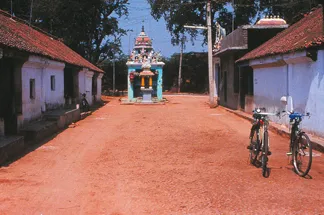
A team of architects, social workers, and members of the community set out to collaborate on designing a participatory housing initiative for 130 rickshaw drivers and their families living in Vellore, India. Howard Davis and David Week employed the principles of a pattern language (the site layout procedure builds on work developed by Christopher Alexander1). By undertaking extensive fieldwork on existing settlement patterns in Vellore and surrounding villages, team members Thomas Kerr and Paul Moses developed about thirty-five specific observations that had implications for the site layout. Davis points out, 'These observations constitute, in effect, a translation describing significant differences between the language of the local building culture, and a language more familiar to us as modern professionals.' These characteristic living patterns and street layouts were incorporated into the final site plan. Recording relationships with camera, sketchpad, and computer (that is, 'always a temple' as in Figures 4.3 and 4.4, or 'women usually fetch water at least twice a day ... The well or pump is usually located at a road widening or intersection' as in Figure 4.5), critical design elements began to emerge and were discussed with the intended users for verification.
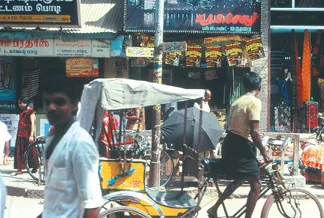
Figure4.1 Detail of a bicycle rickshaw and driver in Vellore, India. (Photograph courtesy of Howard Davis.)
Figure4.2 Location of the site. (Map courtesy of US Central Intelligence Agency, World Fact Book, l996.)
The narrative of the settlement plan, as articulated by Davis, reads like thesocial mappingof a site by a vernacular scholar dedicated to revealing culture through careful site analysis of the smallest informal sector activities. Here, vernacular studies and contemporary design process find a fruitful balance.
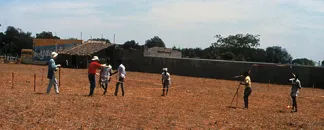
The government-donated tract was laid out by the design team who worked alongside the future residents (Figure 4.6);room configurations were decided upon;enough latitude existed for the addition of elements that reflected personal identity and local custom. In the end, current conditions, a collaborative spirit, and a collective will enabled permanent homes and businesses to take root. Beyond the specific project definition of providing improved housing and developing a mechanism for self-sufficiency for a politically marginalized group through collaborative strategies, the broader issue was 'to understand how development may be possible while preserving the continuity of tradition.' In other words, how can positive social and economic changebe balanced with culturalcontinuity?
Before the project began, team members visited other housing projects laid out by local firms and based on Western planning ideas and building standards. This exercise set the tone for a design strategy that reacted against imported design ideas. The design team asked the questions, 'What can we learn from the local condition? How can we come up with actual patterns from thelocalbuilding culture?'
Design intent
In clarifying the role of professionals in helping to provide housing in the developing world, Davis and Week wanted people to take responsibility for the layout and design of the houses they were going to inhabit. This attitude corresponded with CEDMA's philosophy toward self-help, preferring to encourage the city's urban poor to take charge of their own lives. Accordingly, emphasis was placed on the socialprocessofthe building initiative, rather than on theproductas an end in itself. The effort to improve the housing conditions of the rickshaw drivers, it was understood, must also be linked to changing the drivers' own perception of their power relations within the community as it related to their economic development. The architects were not there as 'foreign experts transferring expertise,' Davis notes. 'We were there simply to offer another point of view' in the effort to empower individuals through improving their living situation.
Figure4.3 'Always a temple' - this pattern element is a small temple located in its traditional position within the community. The layout is recorded by camera. (Photograph courtesy of Howard Davis.)
Figure4.4 Observations of the various temple's spatial relationships and physical features were recorded in field notes by Kerr and Moses. (Photograph by Howard Davis.)
Figure4.5 Site locations (top), street sections, and field notations (below) by Kerr and Moses. These social and spatial patterns are related to collecting water in the village. (Photograph of drawing courtesy of Howard Davis.)
Design process
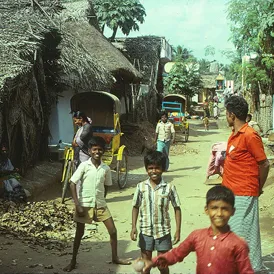
In the five years that the project took to complete (1990-1995), Howard Davis traveled to India six times. Over the years, his regional knowledge increased, and he gained the trust of the client. Gradually, social worker Nelson (the client) revealed more of himself and his organization's work with disenfranchised groups in India over the past twenty-five years that included education, employment generation, job training, human rights advocacy, rural sanitation, housing, and small-scale manufacture. Together, the architects and client collaborated with the formal association of the Rickshaw Drivers' Association in Vellore. Nelson organized mostly Hindus (many of them untouchables), who had migrated relatively recently from rural villages and were, therefore, new to city life. While they were mostly lower caste, they were not among the poorest. They had started their own rickshaw business and paid loans, but were relegated to living in slums with their rickshaws (Figure 4.7).
CEDMA went about helping the rickshaw drivers to carry out several stages of development: to free themselves from the financial exploitation of the rickshaw owners for whom they worked, CEDMA helped the drivers to obtain loans to own their own rickshaws. The rickshaw drivers were then encouraged to assert claims for land. On behalf of the rickshaw association, CEDMA next went about initiating house financing and self-construction in order to build houses on their land.
In 1991, the government purchased land from local farmers and made it available for the CEDMA self-help building project. At this point, architect Howard Davis became involved in this international collaboration project. By the spring of 1992, investigations of local settlement patterns were completed;136 house sites had been laid out on the ground (Figure 4.8);the site plan had beenapproved by the district surveyor;and an experimental building was under construction. This collaborative spirit among all participants, according to Davis, 'forced [Davis and Week] to put aside normal attempts to control the process. Yet all the participants, despite their differing perspectives and experiences, were able to work with remarkable synergy and fluidity to get quite a bit done.'
Figure4.6 A site-marking ceremony at the start of the house construction. Each lot was exactly 13.5 square meters. (Photograph courtesy of Howard Davis.)
Figure4.7 A site-marking ceremony at the start of the house construction. Each lot was exactlExisting housing in Tamil Nadu, where bicycle-rickshaw drivers and their families lived prior to the completion of the new project in Vellore. (Photograph courtesy of Howard Davis.)
Figure4.8 Vellore community members walking the perimeter of the site. (Photograph courtesy of Howard Davis.)
As discussions with the community continued (Figure 4.9), a commonly understood and accepted product that embodied people's values and ways of life began to emerge. The image of things to come served as a touchstone, Davis recalls, that drove the process. As members of the design team put it, 'Our experience...
Table of contents
Cover Page
Half Title Page
Title Page
Copyright Page
Contents
Dedication
Acknowledgements
Foreword: on the study of ‘regional architecture’
Preface – Regionalism reconsidered
List of illustrations
Section One Exploring the Nature of Place
Section Two From regional theory to a situated regional response
Part One People – Improving the Human Condition Through Design
Part Two Locale – Interpreting and Accommodating Characteristics of an Evolving Landscape
Part Three Environment – Appropriate Technologies and Design Tied to the Dynamics of Place
Index
Trusted by 375,005 students
Access to over 1.5 million titles for a fair monthly price.
Study more efficiently using our study tools.
Frequently asked questions
Yes, you can cancel anytime from the Subscription tab in your account settings on the Perlego website. Your subscription will stay active until the end of your current billing period. Learn how to cancel your subscription
No, books cannot be downloaded as external files, such as PDFs, for use outside of Perlego. However, you can download books within the Perlego app for offline reading on mobile or tablet. Learn how to download books offline
Perlego offers two plans: Essential and Complete
Essential is ideal for learners and professionals who enjoy exploring a wide range of subjects. Access the Essential Library with 800,000+ trusted titles and best-sellers across business, personal growth, and the humanities. Includes unlimited reading time and Standard Read Aloud voice.
Complete: Perfect for advanced learners and researchers needing full, unrestricted access. Unlock 1.5M+ books across hundreds of subjects, including academic and specialized titles. The Complete Plan also includes advanced features like Premium Read Aloud and Research Assistant.
Both plans are available with monthly, semester, or annual billing cycles.
We are an online textbook subscription service, where you can get access to an entire online library for less than the price of a single book per month. With over 1.5 million books across 990+ topics, we’ve got you covered! Learn about our mission
Look out for the read-aloud symbol on your next book to see if you can listen to it. The read-aloud tool reads text aloud for you, highlighting the text as it is being read. You can pause it, speed it up and slow it down. Learn more about Read Aloud
Yes! You can use the Perlego app on both iOS and Android devices to read anytime, anywhere — even offline. Perfect for commutes or when you’re on the go. Please note we cannot support devices running on iOS 13 and Android 7 or earlier. Learn more about using the app
Yes, you can access Vernacular Architecture and Regional Design by Kingston Heath in PDF and/or ePUB format, as well as other popular books in Architecture & Architecture General. We have over 1.5 million books available in our catalogue for you to explore.