![]()
Exploring the Internal Customer Mind-Set of Marketing Personnel
Felicia G. Lassk
Northeastern University
Karen Norman Kennedy
University of Alabama–Birmingham
Jerry R. Goolsby
Loyola University
SUMMARY. With a traditional focus on external customers, marketing personnel could be expected to provide a leadership role in bringing an internal customer focus to the organization. In this study, we focus on the internal customer mind-set (ICMS) of marketing personnel and how this might impact the organization. We present a theoretically driven model that integrates current human resources literature by representing ICMS as a mediator of job satisfaction/organizational commitment and job performance/turnover intentions. The most notable results are found between ICMS and job performance, through both direct and indirect effects. Future research and study limitations are discussed.
[Article copies available for a fee from The Haworth Document Delivery Service: 1–800–HAWORTH. E-mail address: <[email protected]> Website: <http://www.HaworthPress.com> © 2004 by The Haworth Press, Inc. All rights reserved.] KEYWORDS. Internal marketing, internal customers, customer mind-set, marketing professionals, job performance, job satisfaction
Traditionally, marketing personnel have been the champions of the external customer within their organization, a role that has lead these professionals to focus on the external environment of the firm (Kohli and Jaworski, 1990; Kotler, 2000; Borden, 1964). As organizations realize the importance of employees as internal customers, the needs of the external, paying customer must be linked ever closer to the workers within the firm, producing a chain-of-customers cascading through the organization (Gummesson, 1991; Schonberger, 1990). Gummesson (2002) explains “[a]n employee's ability to influence and satisfy the needs of others inside the organization is considered an antecedent to external customer satisfaction. Only if internal customer relationships work can the quality of the outcome be excellent, thus creating satisfied, or even better, delighted external customers” (pp. 45–46).
For this high level of customer satisfaction to occur, the needs of external customers must be tightly coupled with an organization's internal efforts. Supporting this alignment, a culture of internal and external customer service must be present in which marketing personnel extend their external, boundary spanning responsibilities to include a greater understanding of internal customers and processes. To investigate the extent to which customer oriented beliefs have permeated an organization's culture, Kennedy, Lassk, and Goolsby (2002) examined individual workers’ adoption of both internal and external customer focus or customer mind-set (CMS) by assessing employee beliefs, an important element of organizational culture. The notion that employees believe that they must understand and satisfy internal and external customers in order to perform their job effectively is the central element of CMS. Built upon the foundations of the marketing concept (customer focus, interfunctional coordination, and long-term goal attainment), CMS is conceptualized as two components: external customer mind-set (ECMS) and internal customer mind-set (ICMS) (Kennedy, Lassk, and Goolsby, 2002).
In this study, we focus on the internal customer mind-set of marketing personnel. While previous research has examined the importance of internal customers and studied related employee behaviors (i.e., Brown et al., 2002; Gronroos, 1981; 1990; Gummesson, 1991; Hurley and Hult, 1998; Mohr-Jackson, 1992; Slater and Narver, 1995), we investigate marketing personnel's beliefs and link those beliefs to important job outcomes at the individual level. As we have noted, marketing personnel have historically been externally focused and we would expect these professionals to rate their beliefs about understanding and satisfying external customers as quite high with little variation in the group. With this traditional focus on external customers, marketing personnel could be expected to provide a leadership role in bringing an internal customer focus to the organization. Therefore, our contribution in this manuscript is examining the role of an internal focus for marketing personnel and how that might impact the organization. For these reasons, we believe the study of marketing personnel to be especially important.
We present a theoretically driven model that integrates current human resources literature by presenting ICMS as a mediator of job satisfaction/organizational commitment and job performance/turnover intentions. Specifically, we (1) explicate a theoretically supported model that presents ICMS as a mediator of job outcome relationships, (2) discuss our empirical findings and (3) close with suggestions for future research.
A MEDIATING MODEL OF ICMS
Historically, the impact of employee beliefs on job outcomes has been modeled through a direct effects model. Recently, however, more complex mediating models have been presented, in which certain beliefs are hypothesized to intervene between job characteristics and job outcomes (Judge et al. 2001, Linden, Wayne and Sparrowe 2000; Onne 2001; Yousef 2000). In our investigation of internal customer mind-set (ICMS), we examine its mediating effect on the relationships between two independent variables (job satisfaction and organizational commitment) and two dependent variables (job performance and turnover intentions).
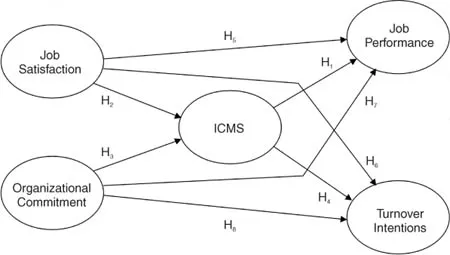
A mediating model suggests that ICMS mediates the relationship between two job factors, because ICMS could be expected to enhance the effect of one variable on another. For example, while it is logical that anyone who is satisfied with his/her job should be more committed to that job, it is not intuitive that ICMS would enhance that relationship by simultaneously impacting satisfaction and turnover. Such insights, if supported, could be highly instructive to executives desiring to enhance the effect of multiple organizational factors simultaneously. Here, we investigate job satisfaction and organizational commitment as antecedents of ICMS, and job performance and turnover intentions as outcomes of ICMS (see Figure 1). First, the direct effects are hypothesized, and then the theoretical rationalizations for ICMS's mediating effect are given.
An ICMS is conceptualized as the importance an individual employee places on serving internal customers. The organizational behavior literature is grounded on the fundamental thesis that employee beliefs directly affect job outcomes such as job performance, job satisfaction and organizational commitment (cf. Vroom, 1964). Additional theoretical support for direct linkages can be drawn from research of a related construct, market orientation. While an empirical question, effects documented at the organizational level should, in theory, arise from the collective aggregation of effects experienced at the individual level. That is, if an organization performs better when its collective members are market oriented, it stands to reason that workers would perform better individually with a similar customer focus. Based on both literatures, we hypothesize the following direct effects.
FIGURE 1. The ICMS Mediating Model
Following the well-established theory and empirical literature, it is only reasonable to expect, as hypothesized in Kennedy, Lassk and Goolsby's (2002) initial work, that ICMS, as a belief system, should be associated with higher levels of performance (Cortada, 1993; Smith, 1990). The unified efforts resulting from cooperating with and serving other employees in the organization should increase the ability of a marketing practitioner to serve customers, thus leading to increases in traditional measures of marketing performance. In the same way that understanding external customer requirements leads to higher sales and customer satisfaction, being cognizant of internal customer requirements would be expected to lead to enhanced abilities to carry out marketing functions on behalf of external customers. For example, marketing practitioners who are cognizant of and dedicated to serving the needs of internal customers in shipping are more likely to approach a customer request from a non-adversarial position than a marketing practitioner who is relatively insensitive to the needs of the requirements of the shipping department. A heightened sense of cooperation should yield a greater ability to execute important tasks needed for success.
H1: A marketer's level of ICMS is positively related to their job performance.
A direct relationship between ICMS and job satisfaction can also be hypothesized. Previous research has found satisfied employees are more likely to engage in behaviors that support customer service (Hartline and Ferrell, 1996; Locke and Latham, 1990; Weatherly and Tansik, 1993). Furthermore, Schneider (1980) finds evidence that job satisfaction is strongly associated with an employees’ desire to deliver good service. Drawing inspiration from this research, we expect that employees who are more satisfied with their job are more likely to have beliefs that they have a responsibility to understand and meet their internal customers’ expectations, while fulfilling their job task. Marketing workers with higher levels of ICMS, by being cognizant of and responsive to the demands of internal workers, should increase the opportunities to extract satisfaction from the job, suggesting a direct linkage. Instead of them experiencing the conflict that arises from insensitivity to other internal customer needs, individuals high in ICMS should experience a workplace less burdened by angst and turmoil, thus leading to higher levels of satisfaction. Research on customer oriented behaviors has found positive relationships with job satisfaction (Bateham and Organ, 1983; Hoffman and Ingram, 1992; Siguaw, Brown and Widing, 1994), suggesting a linkage to ICMS.
H2: A marketer's job satisfaction is positively related to their level of ICMS.
We expect organizational commitment to be positively related to an internal customer mind-set. Empirical support for this hypothesis comes from the positive relationship found between organizational commitment and shared values (Hartline, Maxham III and ...