- 96 pages
- English
- ePUB (mobile friendly)
- Available on iOS & Android
eBook - ePub
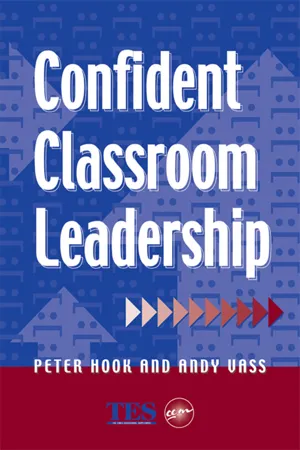
Confident Classroom Leadership
About this book
First Published in 2000. Confident Classroom Leadership offers newly qualified and experienced teachers highly practical and successful skills to empower and support them in their key role of effectively managing classrooms. Powerful behaviour management approaches, influential language patterns and core skills for building positive relationships are presented in a detailed and well- structured style making it easy to incorporate them into practice.
Information
Chapter 1
BECOMING A LEADER IN YOUR CLASSROOM
True leadership must be for the benefit of the followers, not the enrichment of the leaders.Robert Townsend, Up the Organisation, 1970
What is leadership?
What does the word conjure up for you?
Stop.
Note down or draw the first thoughts and pictures that come into your mind when you think of the word ‘leadership’.
Don’t read on.Really do it!Write down your thoughts NOW!
Leadership is the fabled elixir. It can turn failing schools into centres of excellence. It is the potion that enables head teachers to inspire competent teachers into becoming masters of their profession. It is the process by which you allow your students to become winners.
This book is all about helping you to become a competent classroom leader. We will look at the skills that are involved and how they can become relevant to every aspect of your professional life.
You recognise leadership as soon as you see it. We doubt that any of you found yourself with a blank piece of paper when we asked you to note down what the word conjured up for you (You did do the exercise didn’t you!).
There is more to leadership than the public, glamorous images that many people conjure up.
Classroom leadership is present:
- in every classroom when students achieve things they didn’t think were possible;
- every time a student grows, even just a little bit, in personal stature in your classroom;
- when a teacher simply holds up their hand and an entire hall full of students falls silent;
- every time your students look towards you for guidance or an example.
Why bother to become a leader in your classroom?
The answer is simple: to be able to achieve what is really important to you. By becoming an effective classroom leader you will enable the students you teach to grow both academically and socially.
Leadership is not a mysterious quality that is given to you during a secret ceremony. Leadership is simply a term which we use to describe the influential relationships that you have with others and the skills you bring to your interactions.
Classroom leadership is …
- the skills you have to manage yourself and to communicate with others;
- your ability to see the ‘big picture’as well as the day-to-day detail and your skill in making sense of the relationships between the two;
- your ability to communicate your vision for your students in a way that attracts them to want to follow you.
Beginning the journey
Every leader is different. Leadership is not a specific set of fixed attributes that you have to squeeze yourself into. Becoming a classroom leader is about becoming more of yourself and, in doing so, inspiring your students to become more of themselves.
The notion of becoming a classroom leader may bring forth images of a charismatic teacher, leaping around the classroom, inspiring students through their infectious vitality — rather like Robin Williams in ‘the Dead Poets Society’. That is certainly one, extremely energetic method of giving leadership to your students! Nevertheless, as Joseph O’Connor says so eloquently in Leading with NLP, ‘the guide on the side is as effective as the sage on the stage’!
Leading is about influence. Leadership is about self-development. It is noticing the skills you have and learning new ones. Effective leaders then continue to refine these skills in the light of feedback. To become an effective classroom leader, the first person you will have to lead is yourself. Your students will not follow you if they don’t believe that you know where you are going and that the journey matters to you.
What skills will you need?
You will need skills to:
- develop your own understandings and visions (for both yourself and your students);
- communicate these visions to your students;
- be able to see how your students work, what drives their behaviour and aspirations, and how you and your students come together as a classroom system;
- bring out the best in your students;
- create an environment within which students want to work, instead of feeling they have to work.
You will probably have realised that you are already demonstrating elements of these through your practice.
Our purpose is to help you learn from the best classroom leaders that we have met. We will show you how the best classroom leaders model the world they create for their students. We will give you access to a wide range of strategies from which you can select those that you feel will help you achieve your own, unique style of leadership.
The basics of leadership
Within the classroom, authority alone is not enough. Students will make very little progress both academically or socially simply by being told what to do. Authoritarian systems actively seek to discourage empowerment. Students with authoritarian teachers become disempowered learners.
How do you get your students to want to work if simply using authority will not be successful?
There are two extremes of approach that we have seen within classrooms. At one extreme is the ‘natural growth’ approach. This offers very little guidance or direction. It allows students to grow and learn through a natural osmosis.
At the other extreme is teaching by exception. These teachers only intervene if something is wrong — ‘catch them being bad’! They provide no leadership or example to their students but simply believe that students will come to find the ‘correct’way if they are sufficiently reprimanded for their mistakes.
These two styles are concerned with task and not direction. Classroom leaders empower their students. They show them how to learn as well as what to learn. The real test of your leadership is whether or not your students would still follow you if your authority disappeared.
Motivational matters
The simplistic view of motivation divides between two camps: adherents to the ‘power of the stick’ and ‘followers of the carrot’.
The supporters of the stick believe that true motivation comes from avoidance behaviour — we are motivated away from the stick. The problem in class with this approach is that they frequently develop pupils who are good at avoiding the stick but learn very little.
‘Followers of the carrot’believe that motivation comes through rewards. We are motivated towards the carrot rather than away from the stick. Is it effective? Yes, very frequently it seems to be highly effective. The problem comes when you run out of carrots! No carrot, no learning! Carrots represent extrinsic motivation and will only be successful while you are able to keep up a ready supply of tasty carrots. Everyone likes outward recognition of success — smiles, merits, certificates, etc. — and withholding these can be a great de-motivator but they are not the solution to the motivation problem.
Classroom leaders know a better way. They know that true motivation comes from inside their students — intrinsic motivation. Classroom leaders give their students what is important to them and not what is important to the teacher. Classroom leaders enable their students to gain pleasure from knowing they have achieved and grown.
And finally…
Classroom leaders lead by example. They ‘walk the talk’. If you are setting out on the journey to become a classroom leader then the first person you need to lead is yourself. You must take charge of your own learning. Create your own vision and then set out to make it meaningful to your students. Learn from other classroom leaders and adapt their skills to help you inspire and motivate your students.
Classroom leadership is a skill you can learn.
To help you lay a good foundation for your journey, we suggest that you take some time to complete the exercises in Activities 1.1 to 1.3.
Key points
•Leadership comes from what you are within. It is not a bolt-on extra.
•Leadership is something given to you by others. You cannot give it to yourself.
•Effective classroom leadership enables students to grow both academically and socially.
•The specific skills involved include:
—the ability to develop your understandings and visions—the skills of powerful communication—the understanding of what drives your students’behaviour and aspirations—the insights to help you understand your classroom as a system—the ability to seek out and understand feedback.
•Authority and leadership are not synonyms.
•Authoritarian teachers develop disempowered learners.
•Classroom leaders develop empowered learners by giving direction, meaning and purpose to learning.
•Classroom leaders recognise the power of extrinsic motivation but are constantly seeking out strategies to develop intrinsically motivated students. They do this by giving their students what is important to them and not what is important to the teacher.
Activity 1.1- Creating your vision
Think back to the first time that you walked into a classroom to teach a class of pupils. If your experience was anything like ours, one of your immediate goals was to get to the end of the lesson still standing upright! That’s OK. Teaching, particularly when you are new to it, is stressful, at times confusing, unpredictable, often daunting and always hard work! We are inviting you to look beyond your immediate survival needs. Go deeper. What was it that caused you to stand in front of a group of students who may, or may not, have been the least bit interested in what you had to say? What was it that you hoped to achieve for them? What was it that you hoped to achieve for yourself?
The old saying that ‘When you’re up to your neck in alligators, it is difficult to remember that you went in to drain the swamp’is probably never more true than in teaching! Yet, if you are to become an influential leader in your classroom, you need to keep a tight hold on your vision for your students’futures. If you want to constantly feel excited by the process of teaching, if you want to go home at the end of each day with a genuine feeling of satisfaction, then you need to be very clear about your visio...
Table of contents
- Cover
- Half Title
- Full Title
- Copyright
- Contents
- Acknowledgements
- Some thoughts
- How to use this book
- Introduction Beginning the journey
- Chapter 1 Becoming a leader in your classroom
- Chapter 2 The emotional climate
- Chapter 3 Establishing your classroom agenda
- Chapter 4 The power of language
- Chapter 5 Essential protocols
- Chapter 6 Putting it into practice
- References and resources
Trusted by 375,005 students
Access to over 1.5 million titles for a fair monthly price.
Study more efficiently using our study tools.
Frequently asked questions
Yes, you can cancel anytime from the Subscription tab in your account settings on the Perlego website. Your subscription will stay active until the end of your current billing period. Learn how to cancel your subscription
No, books cannot be downloaded as external files, such as PDFs, for use outside of Perlego. However, you can download books within the Perlego app for offline reading on mobile or tablet. Learn how to download books offline
Perlego offers two plans: Essential and Complete
- Essential is ideal for learners and professionals who enjoy exploring a wide range of subjects. Access the Essential Library with 800,000+ trusted titles and best-sellers across business, personal growth, and the humanities. Includes unlimited reading time and Standard Read Aloud voice.
- Complete: Perfect for advanced learners and researchers needing full, unrestricted access. Unlock 1.5M+ books across hundreds of subjects, including academic and specialized titles. The Complete Plan also includes advanced features like Premium Read Aloud and Research Assistant.
We are an online textbook subscription service, where you can get access to an entire online library for less than the price of a single book per month. With over 1.5 million books across 990+ topics, we’ve got you covered! Learn about our mission
Look out for the read-aloud symbol on your next book to see if you can listen to it. The read-aloud tool reads text aloud for you, highlighting the text as it is being read. You can pause it, speed it up and slow it down. Learn more about Read Aloud
Yes! You can use the Perlego app on both iOS and Android devices to read anytime, anywhere — even offline. Perfect for commutes or when you’re on the go.
Please note we cannot support devices running on iOS 13 and Android 7 or earlier. Learn more about using the app
Please note we cannot support devices running on iOS 13 and Android 7 or earlier. Learn more about using the app
Yes, you can access Confident Classroom Leadership by Peter Hook,Andy Vass in PDF and/or ePUB format, as well as other popular books in Education & Behavioural Management. We have over 1.5 million books available in our catalogue for you to explore.