eBook - ePub
Managing Creativity and Innovation in the Workplace
- 96 pages
- English
- ePUB (mobile friendly)
- Available on iOS & Android
eBook - ePub
Managing Creativity and Innovation in the Workplace
About this book
Super series are a set of workbooks to accompany the flexible learning programme specifically designed and developed by the Institute of Leadership & Management (ILM) to support their Level 3 Certificate in First Line Management. The learning content is also closely aligned to the Level 3 S/NVQ in Management. The series consists of 35 workbooks. Each book will map on to a course unit (35 books/units).
Session B
Encouraging creativity
•
1 Introduction
‘If at first, the idea is not absurd, there is no hope for it.’
Albert Einstein
In Session A, we saw that creativity is usually associated with artists and craftspeople but that everyone is capable of being creative, of thinking novel and appropriate ideas. Unfortunately most people lack the confidence to think such ideas, at least at work.
We spend so much of our lives learning to think and act conventionally, and to follow the rules and procedures the way that things have always been done. If you want to get people to think novel and appropriate ideas you need to create an environment in which this is seen to be possible. There are also a number of different techniques that you can use to encourage people to think of creative ideas, and in this session we will help you to use some of these techniques to encourage creativity in your team.
•
2 The innovation cycle
This session and Session C will use the idea of the innovation cycle to help you use creative techniques to finding innovative ways of resolving problems and developing news ways of working, new products and new services.
The innovation cycle involves four stages, and this session will focus on the first two of these:
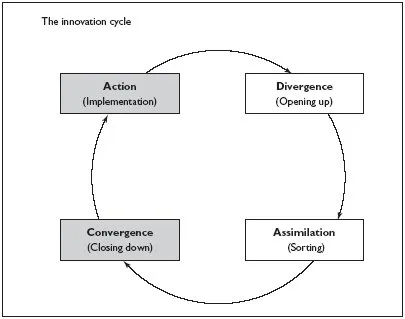
These four stages start with Divergence, the ‘opening up’ stage; this means encouraging people to come up with as many new and different ideas as they can, with no limit on imagination — the more outrageous the better. This is the chance to be creative, to look for ways of doing things which have never been thought of before because they turn received opinion upside down. Practicality must not be allowed to interfere with the generation of ideas, and quantity of ideas is better than quality.
Assimilation is the stage at which the ideas are sorted and their value is judged. It is important not to discard those which are different just because they are different but to sort through them and find the bits that are worth using. This is the stage which takes most time and is when the real breakthroughs can occur, when the impossible starts to be seen as the possible.
Some of the creative techniques (to encourage divergence) also have assimilation built in to them, others require it to be added on, as you will see.
It is valuable still to have more ideas than can actually be used after the assimilation stage for the move onto Convergence or ‘closing down’, deciding just what to go ahead with. The criteria for agreement before making the decision should be agreed, so the final choice is based on rational decisions and not just what people feel most comfortable with. The final stage is Action, implementing the decision.
The four creativity techniques we will look at in detail in this session are:

We will also consider some variants on these, including Nominal Group Technique (NGT) and Trigger Sessions (variants on Brainstorming), and Lateral Thinking and Random juxtaposition (variants on Synectics).
•
3 Brainstorming
Brainstorming is probably the most widely used (and abused) technique for encouraging creative thinking. Is has been round for more than half a century, having been developed by American advertising man, Alex Osborn. He first described it in his 1948 book Your Creative Power.

Activity 8
Have you ever taken part in a brainstorming session? What did you think about it? What rules (if any) were used to govern the activity?
_______________________________________________________________
_______________________________________________________________
_______________________________________________________________
_______________________________________________________________
_______________________________________________________________
_______________________________________________________________
_______________________________________________________________
Brainstorming is designed to be used with a group, ideally one that is large enough to include some diversity of experience and personality, but not so large that individuals may not get a chance to contribute. Around five to nine people are probably ideal. The rules (and there must be rules to make sure it works properly) are:
Table of contents
- Frontcover
- Title
- Copyright
- Contents
- Series preface
- Unit specification
- Workbook introduction
- Session A The importance of creativity and innovation
- Session B Encouraging creativity
- Session C Encouraging innovation
- Performance checks
- Reflect and review
Trusted by 375,005 students
Access to over 1.5 million titles for a fair monthly price.
Study more efficiently using our study tools.
Frequently asked questions
Yes, you can cancel anytime from the Subscription tab in your account settings on the Perlego website. Your subscription will stay active until the end of your current billing period. Learn how to cancel your subscription
No, books cannot be downloaded as external files, such as PDFs, for use outside of Perlego. However, you can download books within the Perlego app for offline reading on mobile or tablet. Learn how to download books offline
Perlego offers two plans: Essential and Complete
- Essential is ideal for learners and professionals who enjoy exploring a wide range of subjects. Access the Essential Library with 800,000+ trusted titles and best-sellers across business, personal growth, and the humanities. Includes unlimited reading time and Standard Read Aloud voice.
- Complete: Perfect for advanced learners and researchers needing full, unrestricted access. Unlock 1.5M+ books across hundreds of subjects, including academic and specialized titles. The Complete Plan also includes advanced features like Premium Read Aloud and Research Assistant.
We are an online textbook subscription service, where you can get access to an entire online library for less than the price of a single book per month. With over 1.5 million books across 990+ topics, we’ve got you covered! Learn about our mission
Look out for the read-aloud symbol on your next book to see if you can listen to it. The read-aloud tool reads text aloud for you, highlighting the text as it is being read. You can pause it, speed it up and slow it down. Learn more about Read Aloud
Yes! You can use the Perlego app on both iOS and Android devices to read anytime, anywhere — even offline. Perfect for commutes or when you’re on the go.
Please note we cannot support devices running on iOS 13 and Android 7 or earlier. Learn more about using the app
Please note we cannot support devices running on iOS 13 and Android 7 or earlier. Learn more about using the app
Yes, you can access Managing Creativity and Innovation in the Workplace by Institute of Leadership & Management in PDF and/or ePUB format, as well as other popular books in Business & Business General. We have over 1.5 million books available in our catalogue for you to explore.