- 132 pages
- English
- ePUB (mobile friendly)
- Available on iOS & Android
eBook - ePub
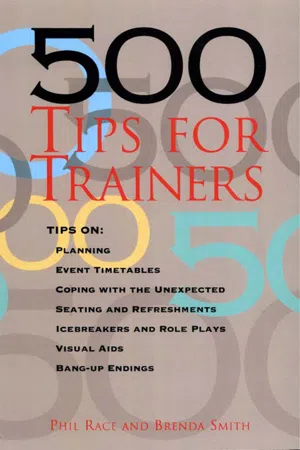
500 Tips for Trainers
About this book
'500 Tips for Trainers' is a treasure trove of more than 500 enlightening, practical suggestions. all are easy to read and simple to use.
This handbook is great as a quick reference when it's time to:
*organize the venue
* create flip charts and handouts
* motivate the participants
* fill five minutes until coffee!
This entertaining book is packed with good ideas, creative techniques, and extensive appendices available for photocopying. It is a basic handbook for trainers in areas such as industry, government, and healthcare, as well as for personnel and HRD staff, and staff development officers in education.
Phil Race, an open and flexible learning specialist, conducts staff development workshops on learning, teaching, and assessment throughout the world. He has co-authored many books, including '500 Tips for Tutors', '500 Tips for Teachers' and 'Assess Your Own Teaching Quality'.
Brenda Smith is teaching and learning quality manager at Nottingham Trent University. She facilitates seminars and is co-editor of 'Research, Teaching and Learning in Higher Education'.
Planning and Preparation
DOI: 10.4324/9780080498447-1
In this chapter we take a look at things to do with planning and preparing your training sessions, and also include suggestions for putting into practice your planning when running training sessions. Several of the ideas we introduce in this chapter are expanded on in suggestions in the remainder of this book. We have discovered how dangerous it can be to imagine that we've run a particular session so often that we can afford to skip some of the detail of preparing the ground in advance.
For a start, we think that it's worth thinking about exactly what we mean by a “training session.” If everyone expects a training session to be interactive, participant-centered, and not just a lecture or presentation, we think that such training sessions are more likely to be effective than when no one knows quite what to expect.
We move on next to consider the intended outcomes of training sessions. Participants want to know–and need to know–what is likely to be expected of them in our sessions. One of the best ways to let participants know exactly what is expected is to formulate the training session outcomes in the form of objectives.
Obviously, the content of your training sessions is important. However, perhaps even more important are the processes and methods by which you deliver your training sessions. Our advice boils down to suggesting that you consider how best you can turn the theoretical or practical content of your training sessions into learning resources that participants use during your sessions and activities that they engage in during the sessions.
We cannot overestimate the importance of keeping on schedule. When a training session falls behind schedule, everyone feels uncomfortable. Perhaps the secret is to have schedules that are in practice sufficiently flexible to allow us as facilitators to make gentle adjustments to the program without anyone feeling that they are being rushed or that things are being omitted.
Sometimes, the success of your training session will depend on how well you advertise it. One of the key points is to make your sessions appear really attractive and relevant to the people you regard as your ideal target audience.
Sometimes you'll be using visiting trainers to run training sessions for your own people. We've learned that it's worth paying attention to how we make best use of such colleagues, and have wrapped up what we have learned in the form of some suggestions you can adapt to your own situation.
One way of getting a training session off to a good start is to make sure that everyone has done some preparatory work. We give some suggestions for pre-session tasks, which can help to focus your training sessions on the important issues rather than filling in background detail.
Many of the little preparations that ensure the smooth running of training sessions could be said to take place “behind the scenes.” We provide some general tips based on our own experiences (unsuccessful as well as successful) at setting up a good training session environment.
Human beings require feeding and watering! We regard refreshments as just as important a part of our training sessions as anything we try to do ourselves. When refreshments are punctual, appropriate and good, the whole atmosphere of a training session is improved considerably, and leaves partici– pants with the memory of a very pleasant taste!
1 What do you want to be the nature of your training sessions?
In this book, we're sharing ideas to help make training sessions active learning experiences, and not just “sit, watch and listen” occasions. It is a useful start to plan into the design of your training sessions several features and characteristics. We suggest some ideas below.
- A training session should be an active occasion for participants, not just for us! It's well worth building your training session programs around the things that participants will do during the sessions. People tend to remember more when they are actively involved– and having fun!
- Plan each training session like a journey, with a beginning, a middle, and a goal. This helps you to ensure that training sessions are a coherent learning experience for participants, and that they know where they are at each stage.
- Participants need to know where they're going. Make the purposes of each training session as clear as possible, for example by spelling out intended learning outcomes or training session objectives.
- Participants want to know why they should be going. Express the intended learning outcomes in terms that participants will find relevant to their work situations and attractive targets for them personally.
- Participants like to know how they will get there. Share with participants information about the sorts of processes they will engage in during the various stages of a training session–doing so may help to dispel any anxieties.
- Regard the experience of your participants as your greatest training session resource. Whenever possible, allow participants to tell you things, rather than you telling them things that some of them may already know. Give participants credit for what they already know whenever possible.
- Build m interaction whenever possible. A good training session is mainly interactive and uses only a very limited amount of “direct input” from trainers. The input does not have to be in presentation format, but can take the form of learning resources such as handouts, displays, and case studies.
- Allow for ongoing feedback from participants. It is far better to abandon your original plans when something unexpected but important crops up than to try to continue on and stick to a preplanned schedule of what should be covered in a training session. However, don't abandon coffee breaks!
- Anticipate “what I would like participants to say about this training session.” Try to plan your training sessions along lines that will be both enjoyable and productive from their point of view.
- Regard each training session as a new learning experience for yourself. The day you think you've got a training session “exactly right,” you've got a problem! If that day comes, design some different training sessions, and keep on learning!
2 Setting training session objectives
People like to know where they're heading. They like to know what they may expect to be able to do at the end of the training session that they can't do already, or that they may like to do better. They also like to know how the things they can already do relate to the agenda for the session. It is therefore crucial to be clear about the intended learning outcomes of training sessions.
- Look for likely “training needs.” In pre-session planning, talk to anyone who can help you focus on the real issues that you should attempt to cover during the forthcoming training session.
- Start with some “provisional” objectives. Prepare an overhead transparency (or handout sheet) listing some relatively broad “intended outcomes” of your training session.
- Ask participants, “What do you want?” Asking participants to identify their own personal wishes helps you to find out the “real agenda” that may lie behind the training session. A good way of doing this is to give out small note pads (or Post-its™) and ask participants to write down what they “hope for most” from the forthcoming session.
- Treat participants’ wishes seriously. If you have gone to the trouble of collecting participants’ expectations, don't waste them. Stick them up on a flipchart where they can remain visible throughout the training session. As often as possible, return to particular participants’ expectations as the session progresses.
- Get the wording right. Make sure that the words used to express training objectives or intended learning outcomes mean the same to everyone. Ask, “What do we really mean by this?” and adjust the wording so that the objectives are understood and shared by all present.
- Feel free to jettison some of your own objectives. When the real agenda (as determined from participants) differs from the agenda that you prepared in your planning for a training session, it is important to be seen to be willing to favor participants’ wishes, even at the expense of some training session objectives which you yourself feel are really valuable.
- Try getting participants to prioritize objectives or outcomes. For example, suppose there are six possible objectives. Ask participants to give each of the objectives a “star rating,” such as “three stars for crucial,” “two stars for useful,” “one star for interesting,” “zero stars for irrelevant.” Collect up the “stars” on a flipchart or overhead listing the objectives, and take your priorities from the result.
- Return to the objectives or intended outcomes. Link training session activities to the objectives, so that your participants can see exactly why they are being asked to do particular things during the training session.
- At the end, review the objectives or intended outcomes. Feel free to admit those that have not been achieved by the session. Confirm those that you know have been addressed successfully.
- At the very end, return to your participants’ expectations. Give them the opportunity to confirm which of their expectations have been realized during the training session and which still remain as “outstanding.” It is often possible to use the outstanding expectations as the basis for a follow-up training session.
3 Getting the content right
Many of the suggestions in our book are about how to conduct training sessions, rather than about what to cover in them. Of course, the content itself is important too. We hope the following ideas will prove useful.
- Link the content of your training session directly to the advertised aims or objectives. Of every component of your planned training session, ask yourself, “How exactly does this relate to the intended outcomes?” If the link is tenuous, the element concerned may be an optional extra.
- Remember that most activities take longer than we imagine they will. This is particularly important when devising new activities that you haven't tried out before. It is better to allow 45 minutes for such an activity, then fill in with something else if it only takes 30 minutes, than vice versa.
- Don't ride hobbyhorses too hard! When we've got a strong belief in something, it's all too easy for us to plug it so hard that it becomes difficult for participants to take–particularly if they have views rather different from ours.
- Research how relevant and useful each part of your training session feels to participants. In follow-up questionnaires or interviews, ask which parts of the training session content were most useful and ask which things could be left out if necessary.
- Give participants your content rather than telling them about it. It can save a great deal of time to have the main principles of your training session wrapped up in handout materials or summaries, so that participants can spend their time with you exploring the issues rather than trying to write them down.
- Check that your content is authoritative, up-to-date, and correct. It is very useful to find trusted colleagues elsewhere who will be willing to look at your handout materials and overheads with a supportive but critical eye and give you feedback about anything that may need to be adjusted.
- Remember that content changes. Participants will regard your training session as being as up-to-date as the most recent developments you refer to during the session. Make sure you have some new references as well as well-established ones. A handout sheet listing these is very much appreciated.
- Let participants help you to develop your content. Next month's repeat session can benefit a lot by incorporating questions and answers that emerge from your present training session. A sheet collecting together such questions and answers is very useful as handout material for future training sessions.
- Focus on what participants will do during your training session. The activities you devise will be the most important aspect of your participants’ view of the content of your training session.
- Have plenty of spare “content” up your sleeve! You never know when an activity will take only half the time you allowed for it (for example when everyone already knows a lot about the subject). Sometimes, you'll have to drop a training session element entirely because you find out at the last minute that everyone has already covered it elsewhere. Have ready a range of alternative things that you can use to fill participants’ time usefully.
4 Timetabling your training session
If you can manage time, you can manage everything else. Timetabling a training session is an important element of designing it. We've gathered the following ideas by trial and error–mostly by error!
- Start with coffee (and tea, and juice!). For example, you're much more likely to achieve a prompt 10:15 start if the advertised program starts with “Coffee and Informal Introductions” at 9:45.
- Start on time anyway. Even if participants are still drifting in for an assortment of wonderful reasons, it does no harm to be seen to be already under way at the advertised start time. You can choose to do things that aren't particularly important until everyone has arrived. If you delay the start, participants who have made the effort to be punctual can feel very cheated!
- Stop on time (or even ahead of time) for coffee breaks or meal breaks. It may come as a great disappointment to you that most participants are actually rather pleased when a coffee break starts five minutes early!
- Don't say “come back in 20 minutes.” No one will know when the 20 minutes started! It's more effective to say “Please can we resume at 11:23?” (An odd time tends to stick in people's memories and usually works surprisingly well.)
- Plan a reasonable amount of time for coffee breaks. As well as consuming a drink and a snack, participants will probably want to pay a call–or make a call. Also, the conversations that participants get into during breaks are not only interesting but useful. It's better to have a prompt start after a 25-minute break than a labored start after an attempt at a 15-minute break.
- Sometimes, avoid breaks, but still have coffee. Where refreshments are available in the room, it is then possible to give “five minutes” for everyone to equip themselves with refreshments, and enter into (for example) a general discussion or group task where participants can enjoy their refreshments as they work.
- Don't underestimate how long it takes for everyone to get lunch! Even when running training sessions in hotels, there may be slow table service, or lines at the buffet table. (Pull out the buffet table from the wall which it always seems to be placed against, so that participants have twice the opportunity of serving themselves!)
- In case lunch is fast, ensure that participants don't have a boring wait. One way of doing this is to combine lunch with a lunchtime task or an exhibition of materials, so that participants can use any spare time without feeling held-up.
- Have a clearly advertised finishing time. This helps participants plan round the other things in their lives, including transportation home or picking up kids from school. Always finish on (or ahead of) this time. You can of course stay on for informal chats with those participants who are not in any hurry after “closing time.”
- Don't try to do everything you've prepared for. When a training session gets “behind your personal schedule,” feel free to drop inputs or activities that are not crucial, and aim to give every appearance of sticking to the planned timetable. Remember, participants find the words, “I don't think we need to spend any further time on this–w...
Table of contents
- Cover Page
- Title Page
- Copyright Page
- Contents
- Introduction
- Chapter 1 Planning and Preparation
- Chapter 2 Getting Participants Going
- Chapter 3 Using Things Around You
- Chapter 4 Keeping Your Training Sessions Going
- Chapter 5 Looking After Yourself
- Chapter 6 Evaluating Your Training Sessions
- Some Resources for Trainers
- Questionnaire
- Index
Trusted by 375,005 students
Access to over 1.5 million titles for a fair monthly price.
Study more efficiently using our study tools.
Frequently asked questions
Yes, you can cancel anytime from the Subscription tab in your account settings on the Perlego website. Your subscription will stay active until the end of your current billing period. Learn how to cancel your subscription
No, books cannot be downloaded as external files, such as PDFs, for use outside of Perlego. However, you can download books within the Perlego app for offline reading on mobile or tablet. Learn how to download books offline
Perlego offers two plans: Essential and Complete
- Essential is ideal for learners and professionals who enjoy exploring a wide range of subjects. Access the Essential Library with 800,000+ trusted titles and best-sellers across business, personal growth, and the humanities. Includes unlimited reading time and Standard Read Aloud voice.
- Complete: Perfect for advanced learners and researchers needing full, unrestricted access. Unlock 1.5M+ books across hundreds of subjects, including academic and specialized titles. The Complete Plan also includes advanced features like Premium Read Aloud and Research Assistant.
We are an online textbook subscription service, where you can get access to an entire online library for less than the price of a single book per month. With over 1.5 million books across 990+ topics, we’ve got you covered! Learn about our mission
Look out for the read-aloud symbol on your next book to see if you can listen to it. The read-aloud tool reads text aloud for you, highlighting the text as it is being read. You can pause it, speed it up and slow it down. Learn more about Read Aloud
Yes! You can use the Perlego app on both iOS and Android devices to read anytime, anywhere — even offline. Perfect for commutes or when you’re on the go.
Please note we cannot support devices running on iOS 13 and Android 7 or earlier. Learn more about using the app
Please note we cannot support devices running on iOS 13 and Android 7 or earlier. Learn more about using the app
Yes, you can access 500 Tips for Trainers by Phil Race,Brenda Smith in PDF and/or ePUB format, as well as other popular books in Business & Business General. We have over 1.5 million books available in our catalogue for you to explore.