- 348 pages
- English
- ePUB (mobile friendly)
- Available on iOS & Android
eBook - ePub
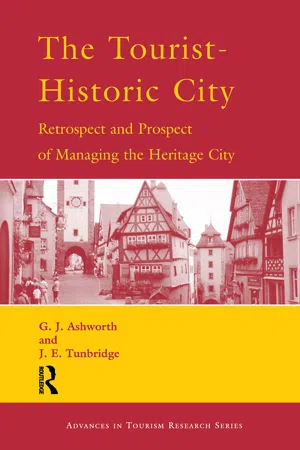
The Tourist-Historic City
About this book
Reflects the importance of heritage to cities, and cities to the creation and marketing of heritage products, not least within tourism. This book presents a review of the state of urban heritage tourism at the turn of the twentieth and twenty-first centuries.
Information
1
The concept: origin, nature and scope
The city between two futures
In 1958 Ian Nairn published an impassioned polemic in the architectural press, appropriately entitled Outrage, which pilloried contemporary practices of urban development and design, and, striking a chord of popular unease, this tract reached a wide non-professional readership. The simple, impressively illustrated and inevitably overstated case was that the post-war years had witnessed an unprecedented physical change in the urban landscape of Britain. The damage done by wartime destruction had been more than equalled in extent by a ruthless post-war reconstruction. A generation's concentration of effort on the almost overwhelming needs for new housing, new industry and new infrastructure had led to an abrupt break in the centuries-long evolution of the physical fabric of cities. The past and its values had been rejected in favour of a ‘brave new world’ whose creation threatened to destroy all trace of preceding architectural achievement. This was to be a last warning of impending disaster and a call to a last-stand rescue action of concerned citizens.
Around 30 years later, a number of equally impassioned, popular polemics appeared issuing equally dire warnings of an imminent catastrophe and calling for popular action before it was too late. Hewison's The Heritage Industry (1987) and Lumley's The Museum Time Machine (1988), among others on the same campaign, sketched a Britain so obsessed with its past as to be incapable of confronting the problems of the present or challenges of the future. Allegedly the form of cities had become so preserved as to be largely incapable of change, and they were increasingly functioning as large open-air museums housing a comforting re-creation of a sanitised reassuring past.
Both sets of warnings were drawn from British experience but in each case the British city was seen as only a more advanced case of a wider problem of Western urban societies.
In pursuing its objective, this book occupies the ground between these positions in a number of different ways. In terms of time it discusses how, within a single generation, fears for the survival of an urban past could become fear of the consequences of its conservation. History has become heritage, heritage has become an urban resource, and this resource supplies a major ‘history/heritage industry’, which shapes not merely the form but the functioning and purpose of the ‘commodified’ city. Since the principal task is description and explanation of what has occurred in and to cities, this book does not need to begin by either adopting or confronting the assumptions, underlying values or political positions of any of these propagandists. Admittedly, once the consequences of these processes are outlined and the resulting issues thereby emerge from the first part of the book, then it becomes necessary in the second part to pose the questions, ‘who has so changed our cities, by which methods and for what reasons?’. From here it is a very short step to the question ‘what sort of cities therefore do we want?’; when this question is posed, we are at least implicitly back to supporting or rejecting either or both polemical positions.
The dimensions of the tourist-historic city
The focus of this book is encapsulated in the phrase ‘the tourist-historic city’.
A fundamental point needs to be made immediately and as unambiguously as possible. This is a book about cities: the two adjectives in the title should not detract from the focus on the noun. This is neither a history of cities nor an account of urban tourism. It is a book about the modern city: the urban situation at the turn of the twentieth and twenty-first centuries. Both the past and the future are intrinsic characteristics in the modern city: the present is frequently explained in terms of an evolution through time and much of the shape of the future is already apparent in current trends. However the focus remains on the modern city: its nature, functioning, problems, opportunities and management. This is neither an urban historical geography nor a set of predictions for a future to be striven for or to be avoided. Neither Utopia nor Armageddon appear as case studies.
The two adjectives in the book's title can help to set the boundary markers around our chosen terrain.
The term ‘historic’ does not imply that this is an account of the history of urban development, although episodes and aspects of that development are critical determinants in the creation of our modern cities. Still less is this book intended to be a panegyric for old buildings or a plea for their preservation in the fabric of the conserved urban form, although without such passions in others and the success of just such pleading, much of the content of the book would not exist.
Similarly, our use of the term ‘tourist’ does not mean that there follows an account of the rise of the tourism industry, the ‘golden horde’, whether this is to be welcomed or feared. This is not a plea for tourism development in cities nor a warning of its consequences, although the tourist is a central actor in the developments related, and the tourism industry is frequently (and often increasingly) the motive powering such developments. Indeed we have attempted not to focus upon a narrow definition of tourism or the tourist, but more broadly upon tourism as a central component of a cultural and entertainment function of cities.
The heart of our concern is in the conjunction of tourist, historic and city. Of course not all tourism is concerned with historic resources, nor are such resources inevitably or invariably concerned with tourism, and both can be located in rural as well as urban situations. However, the justification for this book rests upon three axioms, namely that tourism in its various forms has played, and continues to exercise, a critical role in the development of such resources; while conversely that historical resources form an equally critical part of a growing tourism industry; and that the symbiosis of the two has become a major activity of cities and a major force in the design and structure of the modern city.
The demarcation of the tourist-historic city can be made clearer not only by means of the disclaimers above but more positively through a series of tensions between a number of its dimensions that will form the leitmotifs through much of what follows. The tourist-historic city is, or can be viewed as:
- both a form and a function. It is a particular sort of urban morphology but also, and increasingly, an urban activity.
- both a particular type of city and a specialised morphological-functional region within a city.
- both a particular use of history as a tourism resource and a use of tourism as a means of supporting the maintenance of the artefacts of the past and justifying attention to the historicity of cities.
The account of the tourist-historic city that follows is intended at least initially to be:
- descriptive of what has occurred and is occurring rather than prescriptive of what should, or should not, occur.
- an account of what is happening rather than a manual of instructions about how to make it happen.
- an account of a phenomenon of cities in general rather than of specific special areas within a particular category of cities: the book addresses urban geography as a whole.
- a monitoring and explanation of similarities and differences between cities, countries and continents, rather than a search for a recommended ‘best practice’ of universal application to cities in all circumstances.
All of these statements require extensive definition, exemplification and justification; and the intentions held at the outset will be more difficult to sustain and necessarily modified in the course of this amplification.
Conceptual scope and structure
There can be few introductions that do not claim that the subject to be embarked upon is an intellectual terra incognita, in need of delimiting and mapping. This has been no exception, but the authors are under no illusion that most of the originality has lain in the ordering of existing knowledge into new juxtapositions, so that new perspectives have become possible. Here the originality lies chiefly in the refinement of our earlier work.
The fields of tourism development, urban conservation and urban development have each generated substantial, and rapidly growing, literatures which have been drawn upon extensively wherever relevant. A fundamental problem, however, is that each of these bodies of knowledge and accumulated experience has been created without reference to the others. Urban conservation had developed from the investigative and custodial concerns and skills of historians, archaeologists and architects, working on the basis of professional norms, evaluated according to some criteria of public interest, usually within collectively responsible organisations. Tourism on the other hand is rooted in the techniques and justifications of commercial management, even when such management is undertaken by public organisations, and its academic study has adopted this industrial bias by concentrating upon attempts to isolate, and thus define and delimit, its demand and supply components. If conservation has had difficulty shifting its focus of attention from (primarily) the building to the wider impacts of its preservation, so tourism has faced a similar difficulty in relating the tourist, the tourism facility and the tourism industry to the multimotivated consumer of the multi-used product in the multifunctional city. Most studies of specifically urban conservation and urban tourism have traditionally involved little more than the acknowledgement that building preservation or tourism activities can occur in cities, rather than investigations of the specific urban dimension in either tourism or conservation.
Prior to the 1990s even the enormous quantity of literature produced by the related disciplines of urban geography, urban planning and development, which might have fulfilled a co-ordinating role in this respect, tended to neglect the tourism function of cities, as either so ubiquitous to all cities as to be almost invisible and thus unworthy of attention, or conversely so important within a few specialised resorts as to be discounted as atypical. Recent improvement in this respect signals some awakening of interest in these topics, in which the first version of this book, we would hope, played a part.
Thus we have been faced with more or less self-contained groups of specialists, each of which has only a partial view of our central topic, and each of which has evolved its own working practices and terminology, sets of concepts and methods of analysis, institutional allegiances and professional justifications. The most fundamental task, therefore, has been to find ways of bridging these gaps so as to confront the activity of tourism, with the conservation philosophy of management, within the city, which is itself more than a stage upon which these processes occur and actively contributes a distinctly urban set of characteristics, variables and management objectives and constraints to the tourist-historic city.
The book is divided into two parts. The first attempts to define and explain the composite concept of the tourist-historic city, and to outline the processes which have created and maintain it, while the second concentrates on the planning and management of such cities. The first necessarily therefore focuses upon general trends and processes and seeks to develop general descriptive and explanatory models, while the second pays more attention to the details of the creation of particular tourist-historic cities.
The subject of the book does not in fact appear until Chapter 4, because an understanding of the composite concept is dependent upon a prior understanding of its two components. The task of Chapter 2, therefore, is to chronicle and explain the rise of the urban conservation movement as a climate of informed opinion and as a set of legislative and planning instruments, and to trace the processes through which aspects of the past have become ‘heritage’. The end product is the ‘historic city’, which is paralleled in Chapter 3 by a definition of the concept of the ‘tourist city’ and an account of its development. Only then is it possible to combine the two to produce the ‘tourist-historic city’. This ‘city’ does not exist in isolation but in a series of associations, whether functional or spatial, with other urban activities, thus the tourist-historic city must be occupied and populated by its uses and users in Chapter 5.
The focus on planning and management in the second part of the book requires a taxonomy of tourist-historic cities. This can be attempted using a number of different dimensions. Chapter 6 examines the types of planning and management, broadly defined, found in practice, in terms of organisational structures, objectives, available instruments and management philosophies. The application of a variety of these techniques and practices of intervention follows in the next three chapters. Chapter 7 considers those cases where either the historic or the tourist elements are so relatively important as to be categorised as ‘monofunctional’ historic ‘gems’ or tourist resorts. Chapters 8 and 9 both survey examples of multifunctional cities, where tourist-historic elements coexist with other urban functions. In both the major world metropolises of Chapter 8 and the medium-sized multifunctional cities of Chapter 9, the role of tourist-historic elements in urban revitalisation programmes will receive particular attention in various spatial and organisational contexts. In this respect Chapters 7 to 9 make substantial reference to revitalising waterfronts, illustrating a key variant in the formulation of the tourist-historic model. In Chapter 10, the evolving issues and values intrinsic in the planning and management of the tourist-historic city are reviewed at some length in our overall conclusion.
Global scope and selection
No claim to a comprehensive coverage of the history of urban development has been made, but a similar claim to global cover is asserted, in the sense that the tourist-historic city is approached as a world-wide phenomenon needing general, universally applicable, explanation. There are thus no regional or continental qualifiers in the title: the book is not intended to be a study of the West European, or North American, city in particular. This intention is modified by the content in which large parts of the world are cursorily treated, while others receive lavish attention as sources of examples and illustration of general points. In part this reflects the accident of an uneven distribution of world knowledge that the authors share with most of the academic world. There is in addition, however, the justification that the tourist-historic city as conceived and developed was principally if not a European then a Western phenomenon; and although it has increasing significance in other parts of the world, its study is likely to be rooted in the experiences of Europe, and those parts of the world where European influence, whether through settlement, colonial government or, more recently, tourism demands and investments, has been most marked. Therefore the trends and conclusions investigated in the cities of Europe, the Eastern Mediterranean, North America, the Caribbean, Australasia and Southern Africa are intended, and likely, to have a global relevance. This argument should not however be construed as the type of Eurocentric neoimperialism characteristic of some late twentieth-century geographical literature.
The selection of particular illustrative cases from within these areas of the world was influenced by two convictions: first that detailed studies in depth of a limited number of cities would be more revealing than superficial reference to a large number, and secondly that long-term, firsthand experience was needed to supplement secondary information if reliable comparable conclusions on what was occurring were to be drawn. These intentions, albeit not always fulfilled, result necessarily in some repetition of examples in different illustrative contexts.
Several more specific geographical constraints need to be clarified. First, little particular reference is made to many of the best known tourist-historic cities. Cities like Florence, York and Salzburg are implicitly rather than explicitly present. Others such as Norwich or Québec City are discussed at length because in the authors’ experience they manifest important principles of wider relevance. We reiterate that our primary concern has been to alert the reader to a much more comprehensive urban phenomenon in which the famous ‘gems’ are only glamorous centre-pieces and stimulating catalysts.
Secondly, we make comparatively limited reference to the global giants of tourism, such as London, Rome or Paris, where tourist-historic resources make a major contribution to national economies. These cities are the extreme manifestations of the significance of our theme. They cannot, however, be comprehensively addressed in this book but will be referred to where they illustrate particular more widely applicable dimensions of the tourist-historic city.
Thirdly, the socialist world received little explicit attention in the original conception of the book, despite the impressive historic conservation and restoration of cities such as St. Petersburg, Warsaw and Prague. The spatial organisation of socialist cities followed quite different principles and they had not then been exposed to the full force of free-market tourism. Nevertheless, the economic and political liberalisation of the 1990s has made it clear that the cities of Eastern Europe and the former Soviet Union, and in different degrees those of socialist East Asia and Cuba, must now be regarded as a variant...
Table of contents
- Front Cover
- THE TOURIST-HISTORIC CITY
- ADVANCES IN TOURISM RESEARCH SERIES
- Title Page
- Copyright
- Contents
- Perface
- Acknowledgements
- List of figures
- List of tables
- 1 The concept: origin, nature and scope
- 2 The historic city
- 3 The tourist city
- 4 Modelling the tourist-historic city
- 5 Uses and users of the tourist-historic city
- 6 The planning, management and marketing of the tourist-historic city
- 7 The management of monofunctional tourist-historic cities
- 8 The management of tourist-historic elements in large multifunctional cities
- 9 The management of tourist-historic elements in medium-sized multifunctional cities
- 10 Values, issues and conclusions
- References
- Author Index
- Subject Index
- Place Index
Trusted by 375,005 students
Access to over 1.5 million titles for a fair monthly price.
Study more efficiently using our study tools.
Frequently asked questions
Yes, you can cancel anytime from the Subscription tab in your account settings on the Perlego website. Your subscription will stay active until the end of your current billing period. Learn how to cancel your subscription
No, books cannot be downloaded as external files, such as PDFs, for use outside of Perlego. However, you can download books within the Perlego app for offline reading on mobile or tablet. Learn how to download books offline
Perlego offers two plans: Essential and Complete
- Essential is ideal for learners and professionals who enjoy exploring a wide range of subjects. Access the Essential Library with 800,000+ trusted titles and best-sellers across business, personal growth, and the humanities. Includes unlimited reading time and Standard Read Aloud voice.
- Complete: Perfect for advanced learners and researchers needing full, unrestricted access. Unlock 1.5M+ books across hundreds of subjects, including academic and specialized titles. The Complete Plan also includes advanced features like Premium Read Aloud and Research Assistant.
We are an online textbook subscription service, where you can get access to an entire online library for less than the price of a single book per month. With over 1.5 million books across 990+ topics, we’ve got you covered! Learn about our mission
Look out for the read-aloud symbol on your next book to see if you can listen to it. The read-aloud tool reads text aloud for you, highlighting the text as it is being read. You can pause it, speed it up and slow it down. Learn more about Read Aloud
Yes! You can use the Perlego app on both iOS and Android devices to read anytime, anywhere — even offline. Perfect for commutes or when you’re on the go.
Please note we cannot support devices running on iOS 13 and Android 7 or earlier. Learn more about using the app
Please note we cannot support devices running on iOS 13 and Android 7 or earlier. Learn more about using the app
Yes, you can access The Tourist-Historic City by G.J. Ashworth,J.E. Tunbridge in PDF and/or ePUB format, as well as other popular books in Architecture & Historic Preservation in Architecture. We have over 1.5 million books available in our catalogue for you to explore.