Research on history instruction and learning is emerging as an exciting new field of inquiry. The editors prepared this volume because the field is at an important moment in its development -- a stage where there is research of sufficient depth and breadth to warrant a collection of representative pieces.
The field of research on history teaching and learning connects with both traditional research on social studies and with recent cognitive analyses of domains such as mathematics and physics. However, the newer research goes beyond these activities as well. Where traditional research approaches to social studies instruction and learning have focused on curriculum, they have avoided the study of purely disciplinary features, the textual components of history and the concomitant demands, as well as the nature of various learners. Where recent cognitive analyses of mathematics and physics have dealt with misconceptions and knowledge construction, they have avoided topics such as perspective-taking, interpretation, and rhetorical layerings. The new work, by contrast, has been concerned with these issues as well as the careful analyses of the nature of historical tasks and the nature of disciplinary and instructional explanations.
The lines of research presented in these chapters are both compelling and diverse and include a range of topical questions such as:
* What affects the quality of teaching?
* How are historical documents interpreted in the writing of history?
* How is history explained?
* What are the classroom demands on an elementary school social studies teacher?
* What does text accomplish or fail to accomplish in educational settings?
* How do teachers think about particular topics for history teaching?
Although much of the research reflects a grounding in, or the influence of, cognitive psychology, not all of it derives from that tradition. Traditions of rhetoric, curriculum analysis, and developmental psychology are also woven throughout the chapters. The editors envision this volume as a contribution to educational research in a subject matter, and as a tool for practitioners concerned with the improvement of instruction in history. They also anticipate that it will contribute to cognitive science.
eBook - ePub
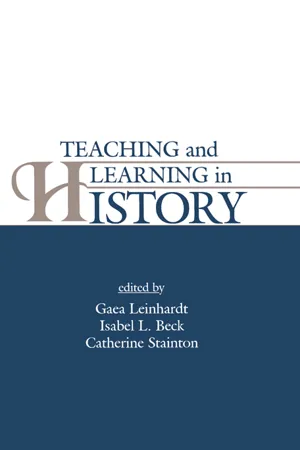
Teaching and Learning in History
- 278 pages
- English
- ePUB (mobile friendly)
- Available on iOS & Android
eBook - ePub
Teaching and Learning in History
About this book
Information
Table of contents
- Cover
- Half Title
- Title Page
- Copyright
- Dedication
- Contents
- Preface
- Chapter 1. Making Sense of Accounts of History: Why Young Students Don’t and How They Might
- Chapter 2. On the Paradox of Understanding History in an Educational Setting
- Chapter 3. Learning from History Texts: From Causal Analysis to Argument Models
- Chapter 4. The Cognitive Representation of Historical Texts
- Chapter 5. Students as Authors in the Study of History
- Chapter 6. Educational Ideologies and the Teaching of History
- Chapter 7. History: A Time to Be Mindful
- Author Index
- Subject Index
Trusted by 375,005 students
Access to over 1.5 million titles for a fair monthly price.
Study more efficiently using our study tools.
Frequently asked questions
Yes, you can cancel anytime from the Subscription tab in your account settings on the Perlego website. Your subscription will stay active until the end of your current billing period. Learn how to cancel your subscription
No, books cannot be downloaded as external files, such as PDFs, for use outside of Perlego. However, you can download books within the Perlego app for offline reading on mobile or tablet. Learn how to download books offline
Perlego offers two plans: Essential and Complete
- Essential is ideal for learners and professionals who enjoy exploring a wide range of subjects. Access the Essential Library with 800,000+ trusted titles and best-sellers across business, personal growth, and the humanities. Includes unlimited reading time and Standard Read Aloud voice.
- Complete: Perfect for advanced learners and researchers needing full, unrestricted access. Unlock 1.5M+ books across hundreds of subjects, including academic and specialized titles. The Complete Plan also includes advanced features like Premium Read Aloud and Research Assistant.
We are an online textbook subscription service, where you can get access to an entire online library for less than the price of a single book per month. With over 1.5 million books across 990+ topics, we’ve got you covered! Learn about our mission
Look out for the read-aloud symbol on your next book to see if you can listen to it. The read-aloud tool reads text aloud for you, highlighting the text as it is being read. You can pause it, speed it up and slow it down. Learn more about Read Aloud
Yes! You can use the Perlego app on both iOS and Android devices to read anytime, anywhere — even offline. Perfect for commutes or when you’re on the go.
Please note we cannot support devices running on iOS 13 and Android 7 or earlier. Learn more about using the app
Please note we cannot support devices running on iOS 13 and Android 7 or earlier. Learn more about using the app
Yes, you can access Teaching and Learning in History by Ola Hallden, Gaea Leinhardt,Isabel L. Beck,Catherine Stainton in PDF and/or ePUB format, as well as other popular books in Education & Education General. We have over 1.5 million books available in our catalogue for you to explore.