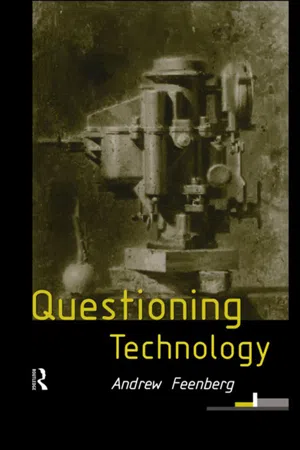
In this extraordinary introduction to the study of the philosophy of technology, Andrew Feenberg argues that techonological design is central to the social and political structure of modern societies. Environmentalism, information technology, and medical advances testify to technology's crucial importance.
In his lucid and engaging style, Feenberg shows that technology is the medium of daily life. Every major technical changes reverberates at countless levels: economic, political, and cultural. If we continue to see the social and technical domains as being seperate, then we are essentially denying an integral part of our existence, and our place in a democratic society.
Questioning Tecchnology convinces us that it is vital that we learn more about technology the better to live with it and to manage it.
- 272 pages
- English
- ePUB (mobile friendly)
- Available on iOS & Android
eBook - ePub
Questioning Technology
About this book
Information
1. Technology, Philosophy, Politics
DOI: 10.4324/9780203022313-1
Determinism and Substantivism
In this introductory chapter, I will sketch the main themes of this book in the context of a brief account of the growth of interest in technology in the humanistic disciplines. This process has not been an easy one and its full implications are still unclear.1
If the human significance of technology is largely unmapped territory, this is mainly due to the idealism of Western higher culture. Only recently have scholars outside the technical fields become interested in their problems and achievements. In earlier times the humanities rejected discourse on technology as unworthy. That tradition goes back to the ancient Greeks who lived in aristocratic societies in which the highest forms of activity were social, political, and theoretical rather than technical.
Humanist scholars first took technology seriously in the modern period, especially with the publication of Diderot’s Encyclopédie. However, as Langdon Winner explains, modern political theory subsumed technical activity under the economy and did not raise the same kinds of issues about rights and responsibilities in relation to it that are considered relevant to the state. Common sense instrumentalism treated technology as a neutral means, requiring no particular philosophical explanation or justification. So once again it was pushed aside; as an aspect of private life, it was considered irrelevant to the basic normative questions that concerned the thinkers of the great tradition in political theory such as Hobbes, Rousseau, and Locke (Winner, 1995).
There is, however, another fateful path by which technology enters the larger conversation of modernity: the historicizing trend in the emerging biological and social sciences of the late 18th and 19th centuries. This trend was firmly rooted in the idea of progress, which found its surest guarantee in the promise of technology. By the end of the 19th century, under the influence of Marx and Darwin, progressivism had become technological determinism. Following the then common interpretation of these materialist masters, technical progress was believed to ground humanity’s advance toward freedom and happiness.
Note the link between humanism and determinism. Of course progressive thinkers were well aware of the social divisions that prevented humanity as such from acting as the concrete subject of its own history. However, they regarded competing social groups and nations as proxies for the human race and so ignored this detail. Their universalistic treatment of cultural differences was similarly expeditious. They assumed that the ends which technology serves are permanent features of our biological constitution. Technology was thought to be neutral since it did not alter these natural ends but merely shortened the path to them. This neutralization of technology removed it still further from political controversy. If technology merely fulfills nature’s mandate, then the value it realizes must be generic in scope. In fact this is the story that is so often told: technology’s advance is the advance of the human species. The editorial “we” intervenes often in this story: “we” as human beings went to the moon.
The great success of modern technology in the early years of this century seemed to confirm this view. But that success also meant that technological decisions affected more and more of social life and had obvious political impacts. From this one can draw diametrically opposed conclusions: either politics becomes another branch of technology, or technology is recognized as political. The first alternative leads straight to technocracy: public debate will be replaced by technical expertise; research rather than the uninformed opinion of the voters will identify the most efficient course of action. The idea of replacing traditional normative paradigms of politics with technical ones dates back to Saint-Simon, but it achieved its greatest popularity in the 1950s and 1960s. The “end of ideology” was much discussed then as it is today for different reasons.
In opposition to this technocratic trend, there is a grand tradition of romantic protest against mechanization going back a century and more. These “substantive” theories of technology attribute a more than instrumental, a substantive, content to technical mediation. They argue that technology is not neutral but embodies specific values. Its spread is therefore not innocent. The tools we use shape our way of life in modern societies where technique has become all pervasive. In this situation, means and ends cannot be separated. How we do things determines who and what we are. Technological development transforms what it is to be human.
Heidegger is the most prominent advocate of this position, which he formulated in ontological terms. In Heidegger’s view, we encounter our world in action as a concrete whole, revealed and ordered in a definite manner that belongs to our epoch. Technology is such a mode of “revealing,” a way in which what is appears. As the mode of revealing of our time, technology is no mere instrumentality. It forms a culture of universal control. Nothing escapes it, not even its human makers. They, like the things they appropriate technically, are reduced to raw materials through the technological revealing. Everything loses its integrity as a part of a coherent world and is leveled down to an object of pure will (Heidegger, 1977a).
According to substantivism, modernity is also an epistemological event that discloses the hidden secret of the essence of technology. And what was hidden? Rationality itself, the pure drive for efficiency, for increasing control and calculability. This process unfolds autonomously once technology is released from the restraints that surround it in premodern societies.
Something like this view was implied in Max Weber’s dystopian conception of an “iron cage” of rationalization. In his account modernity is characterized by a unique form of technical thought and action which threatens non-technical values as it extends ever deeper into social life. However, Weber did not specifically connect this process to technology. Jacques Ellul, another major substantive theorist, makes that link explicit, arguing that the “technical phenomenon” has become the defining characteristic of all modern societies regardless of political ideology. “Technique,” he asserts, “has become autonomous” (Ellul, 1964: 6). In Marshall McLuhan’s melodramatic phrase: technology has reduced us to the “sex organs of the machine world” (McLuhan, 1964: 46). Ellul is as pessimistic as Heidegger and calls for an improbable spiritual transformation in response to the domination of technology.
Substantive critique has affinities with determinism. For both, technological advance has an automatic and unilinear character. What makes substantivism so very gloomy, where determinism started out as a cheerful doctrine of progress, is the additional assumption that technology is inherently biased toward domination. Far from correcting its flaws, further advance can only make things worse. I call this view essentialist. Essentialism holds that there is one and only one “essence” of technology and it is responsible for the chief problems of modern civilization. I will offer both a critique of essentialism, which continues to set the terms of most philosophy of technology, and an alternative to it, in the concluding chapters of this book.
Left Dystopianism
Surprisingly, substantivism became a new popular culture of technology in the 1960s and 1970s, showing up not only in political discourse but in films and other media. In the United States, the dystopian viewpoint replaced traditional liberalism and conservatism to such an extent that current politics is still largely determined by vulgarized versions of the substantivist categories and sensibility (Feenberg, 1995: chap. 3).2
It is not easy to explain the dramatic shift in attitudes toward technology that occurred in the 1960s. By the end of the decade early enthusiasm for nuclear energy and the space program gave way to technophobic reaction. But it was not so much technology itself as the rising technocracy that provoked public hostility.
By “technocracy” I mean a wide-ranging administrative system that is legitimated by reference to scientific expertise rather than tradition, law, or the will of the people. To what extent technocratic administration is actually scientific is another matter. In some cases new knowledge and technology really does support a higher level of rationalization, but often a hocus-pocus of pseudo-scientific jargon and dubious quantifications is all that links the technocratic style to rational inquiry. In terms of social impact, the distinction is not so important: reliance on technocratic arguments evokes similar reactions from the administered whether the computer is really “down” or the employee behind the counter too lazy to consult it. The up-to-date excuse for inaction tells a tale all its own. What makes a society more or less “technocratic” is largely its rhetoric rather than its practice. But the fact that the term is ideological does not mean it is without consequences. On the contrary.
That those consequences were political was due to the intellectual arrogance of the Kennedy and Johnson administrations. The Vietnam War was conceived by the US government and sold to the public as a technical problem American ingenuity could quickly solve. Today one is astonished to read behaviorist discussions of strategy from the 1960s: villages were bombed to “condition” their inhabitants to reject the communists—some advisers wondered whether cutting off ears might not be more effective. Support for the counter-cultural critique of technocracy grew tremendously during the War and gradually spread to encompass the whole liberal agenda. In a benign vein, the “War on Poverty” proposed to achieve a smoothly functioning social system through enhanced administrative control. Similarly, the creation of the “multiversity” involved integrating a hitherto somewhat marginal and tradition-bound institution to the industrial system. These rationalizing ambitions too appeared as a dystopian threat to many young people and became part of the inspiration for the new left. (Today the same dystopian fears are mobilized in a far more confused form by the right.)
These popular movements transformed the dystopian themes they shared with the critics of modernity. The cultural elitism of discouraged humanists gave way to populist demands incompatible with substantivism. This shift redefined the question of technology as political, and showed that it could be addressed from the left. The left in this period called for democratic control over the direction and definition of progress, and reformulated socialist ideology on these terms. These socialist positions were more or less tied to traditional Marxism, and so may appear outdated today. But, as we will see, they also anticipated a new micropolitics of technology which engages the issue of progress in concrete struggles of a new type in domains such as computers, medicine, and the environment.
Part I of this book therefore includes two chapters on particularly revealing events and debates of the late 1960s and early 1970s. I have chosen subjects which seemed important to me at the time and which shape the philosophy of technology presented in this book. I do not claim that these examples are typical, but I do believe that close attention to them opens a window on the revolution in thinking about technology that continues to this day.
The French May Events was the culminating new left movement. In the spring of 1968, a national student protest began in Paris. It was soon seconded by a general strike which led in turn to the collapse of most of the institutions of the French state. Some 10 million strikers in every sector of the economy brought France to a crashing halt for over a month, threatening the capitalist system. Despite its working-class ideology, the May Events articulated its demands in a distinctively anti-technocratic language. Soviet-style socialism was denounced in the same breath as advanced capitalism: two peas in the technocratic pod. The students and their working-class allies demanded self-management as an alternative. This demand was a response to dystopian anxieties linked to the growth of the technocratic state under de Gaulle. Chapter 2 explores this movement through examples drawn from documents of the period.
In chapter 3, I address a second domain in which technology emerged early as a political issue: the environment. I analyze in some detail the debate between Paul Ehrlich and Barry Commoner that divided environmentalists in the early 1970s. This was one of the first serious attempts to introduce the question of technology into the environmental movement.3 Commoner rejected antigrowth environmentalism in favor of democratic control of industrial development. The lasting significance of this debate lies in the sharp focus it brought to bear on the conservative political implications of determinism in the environmental arena and the need for a new philosophy of technology emphasizing contingency and social shaping.
The movements of the 1960s created a context and an audience for the break with technocratic determinism that had already begun in the theoretical domain in the works of Mumford and a few other skeptical observers of the postwar scene. Soon they were joined by a host of critics responding to the changed political climate. It was in this context that an American school of philosophy of technology emerged which incorporated elements of substantivism in a democratic framework. Several members of this school, Langdon Winner, Albert Borgmann, Don Ihde, will be referred to frequently in this book, which itself belongs within this tradition (Achterhuis, et al., 1997).
Marcuse and Foucault stand out in this period as the most powerful critics of the role of scientistic ideologies and technological determinism in the formation of modern hegemonies (Marcuse, 1964; Foucault, 1977). They rejected the idea that there is a single path of progress based on technical rationality, and opened a space for philosophical reflection on social control of technological development. At the same time, they argued, apparently inconsistently, that modern forms of domination are essentially technical. I describe their position as a “left dystopian” critique of technology.
These thinkers were strongly influenced by substantivism. Marcuse was a student of Heidegger and clearly learned a good deal from him. His discussion of technology in One-Dimensional Man is explicitly phenomenological (Marcuse, 1964: 153–154). Foucault too claimed to be a sort of Heideggerian. Although the connection is less direct than for Marcuse, the case can be made for significant similarities between Heidegger’s critique of technology and Foucault’s writings on power, especially in the period of Discipline and Punish (Dreyfus, 1992).
In any case, both Marcuse and Foucault agree that technologies are not just means subservient to independently chosen ends but that they form a way of life, an environment. Whether it be an assembly line or a panoptic prison, technologies are forms of power. But Marcuse and Foucault differ with substantivism in introducing a more socially specific notion of domination. Although it sometimes seems so, they do not really claim...
Table of contents
- Cover Page
- Half Title Page
- Title Page
- Copyright Page
- Contents
- List of charts
- Preface
- 1. Technology, Philosophy, Politics
- Part I. The Politicizing of Technology
- Part I. The Politicizing of Technology
- 2. Technocracy and Rebellion: The May Events of 1968
- Part I. The Politicizing of Technology
- 3. Environmentalism and the Politics of Technology
- Part II. Democratic Rationalization
- Part II. Democratic Rationalization
- 4. The Limits of Technical Rationality
- Part II. Democratic Rationalization
- 5. The Problem of Agency
- Part II. Democratic Rationalization
- 6. Democratizing Technology
- Part III. Technology and Modernity
- Part III. Technology and Modernity
- 7. Critical Theories of Technology
- Part III. Technology and Modernity
- 8. Technology and Meaning
- Part III. Technology and Modernity
- 9. Impure Reason
- References
- Index
Trusted by 375,005 students
Access to over 1.5 million titles for a fair monthly price.
Study more efficiently using our study tools.
Frequently asked questions
Yes, you can cancel anytime from the Subscription tab in your account settings on the Perlego website. Your subscription will stay active until the end of your current billing period. Learn how to cancel your subscription
No, books cannot be downloaded as external files, such as PDFs, for use outside of Perlego. However, you can download books within the Perlego app for offline reading on mobile or tablet. Learn how to download books offline
Perlego offers two plans: Essential and Complete
- Essential is ideal for learners and professionals who enjoy exploring a wide range of subjects. Access the Essential Library with 800,000+ trusted titles and best-sellers across business, personal growth, and the humanities. Includes unlimited reading time and Standard Read Aloud voice.
- Complete: Perfect for advanced learners and researchers needing full, unrestricted access. Unlock 1.5M+ books across hundreds of subjects, including academic and specialized titles. The Complete Plan also includes advanced features like Premium Read Aloud and Research Assistant.
We are an online textbook subscription service, where you can get access to an entire online library for less than the price of a single book per month. With over 1.5 million books across 990+ topics, we’ve got you covered! Learn about our mission
Look out for the read-aloud symbol on your next book to see if you can listen to it. The read-aloud tool reads text aloud for you, highlighting the text as it is being read. You can pause it, speed it up and slow it down. Learn more about Read Aloud
Yes! You can use the Perlego app on both iOS and Android devices to read anytime, anywhere — even offline. Perfect for commutes or when you’re on the go.
Please note we cannot support devices running on iOS 13 and Android 7 or earlier. Learn more about using the app
Please note we cannot support devices running on iOS 13 and Android 7 or earlier. Learn more about using the app
Yes, you can access Questioning Technology by Andrew Feenberg in PDF and/or ePUB format, as well as other popular books in Philosophy & Critical Theory. We have over 1.5 million books available in our catalogue for you to explore.