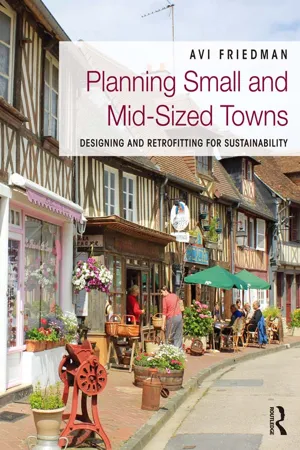
Small and mid-sized suburban towns house two-thirds of the world's population and current modes of planning for these municipalities are facing challenges of both philosophy and form. Common approaches that have prevailed in past decades no longer sustain new demands and require innovative thinking. Rather than dismissing small and mid-sized towns as unattractive suburban sprawl, Planning Small and Mid-Sized Towns offers ideas and methods on how small isolated and edge towns can be designed and retooled into sustainable, affordable and adaptable communities.
Coverage includes:
the evolution of small towns
mobility and connectivity
neighborhood and sustainable dwelling design
town centers and urban renewal
economic sustainability and wealth generation, and more.
With numerous case studies from North America and Europe and over 150 color photographs, maps, and illustrations, Planning Small and Mid-Sized Towns is a valuable, practical resource for professional planners and urban designers, as well as students in these disciplines.
The visitors’ chairs in the small council chamber of Middlesex Centre's town hall were empty. I sat across from the six councilors and the mayor who govern the Municipality. A photo of her majesty Queen Elizabeth II hung on the wall behind them. On another wall there were photos of former mayors. I had been invited to present a report that I had authored for the municipality on economic development and branding strategies.
Located in the shadow of the city of London in the Province of Ontario, Canada, Middlesex Centre is a small rural community. Formal settlement of the area began in 1820 when the place was surveyed and divided into 100 acre (40.46 hectare) lots and laid out in parallel strips called “concessions” separated by roads. The Municipality, population 16,000, was formed in 1998 with the amalgamation of three small townships.
Cornfields and horse and dairy farms interrupted by urban hamlets make up most of the Municipality's land. Like many towns that reside next to a sprawling urban hub, Middlesex Centre saw the construction of subdivisions made up of large single-family homes for daily commuters. My suggestion that the Municipality needed to diversify its economy, which at present relies heavily on agriculture, by attracting industries, sparked a lively discussion. “Do you mean we should abandon our agricultural heritage?” a councilor asked. The response came from another elected official and the debate that followed captured the essence of what small towns are, and what their future may entail. Should they keep to a certain population size or actively seek newcomers and non-traditional land uses and other sources of revenue? Will expansion alter the cultural traditions of the place and offset its much accustomed social fabric? Is diversification an absolute necessity for survival and prosperity given current economic realities?
These fundamental questions are of value to settlements of any size; yet their implication on a small place can be significant and define every facet of their existence and evolution. Prior to delving into the heart of these issues, this chapter defines the unique characteristics of small towns.
Drawing Perimeters
A literature review shows that the lion's share of the research on the makeup and working of all settlements has been devoted to large metropolitan areas. The city and its many intricate concerns and forces have been the focus of writing by urban planners, geographers, and other social scientists. Small towns have often been left out, a point noted by several scholars (Ofori-Amoah 2007; French 2005; Partridge et al. 2008). The reasons are varied but they can perhaps be traced to the fact that many academic institutions and government seats of power are located in big cities. One will be hard-pressed to find the headquarters of a national or multinational media outlet or insurance company in a small town, for example. These enterprises may employ people who live nearby and commute daily, but the city will house the head office.
Small towns occupy only one of the spots in a fabric that ranges from a hamlet made up of a cluster of dwellings to a large urban metropolis. A “small town” can be defined by a variety of attributes such as demographic, geographic, or economics factors, to name a few. Those attributes will be closely examined in later chapters. Yet in the literature, population size seems to be an index most commonly used to draw their perimeter. Ofori-Amoah (2007) suggests that small cities are loosely defined as those with less than 100,000 residents. French (2005) refers to places with population of between 2,500 and 25,000 inhabitants. The Canadian Centre for Justice Statistics (2006) distinguishes them from rural places and defines them as “any urban area that has a minimum population of 1,000 persons and a population density of at least 400 persons per square kilometer.” The European Union defines smaller cities as those with population between 10,000 and 50,000 people (European Union 2011).
“Mid-sized cities” or “mid-sized towns” are also commonly mentioned along with smaller ones. By some definitions those include urban areas with population between 50,000 and 100,000 people. In both small and mid-sized towns the population spans from 2,500 to 100,000, a range that will also be used as a yardstick in this book. My reference to “small towns” will, therefore, include “mid-sized cities” as well.
Small towns hold critical importance when it comes to where people live. Despite the fact that urban areas are still a draw, and the world is becoming increasingly urbanized, the share of those who live in smaller places has remained significant. A report by the United Nations Population Division (UNPD) (2005) suggests that 46 percent of all population growth will occur in relatively small cities. That percentage will likely depend on the development phase and evolution of a country. Similar to the migration pattern that characterized the Industrial Revolution, the proportion of agrarian-based living diminishes when higher paying manufacturing and service jobs grow.
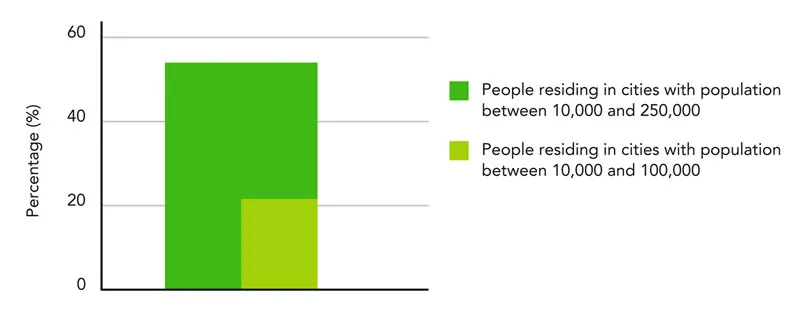
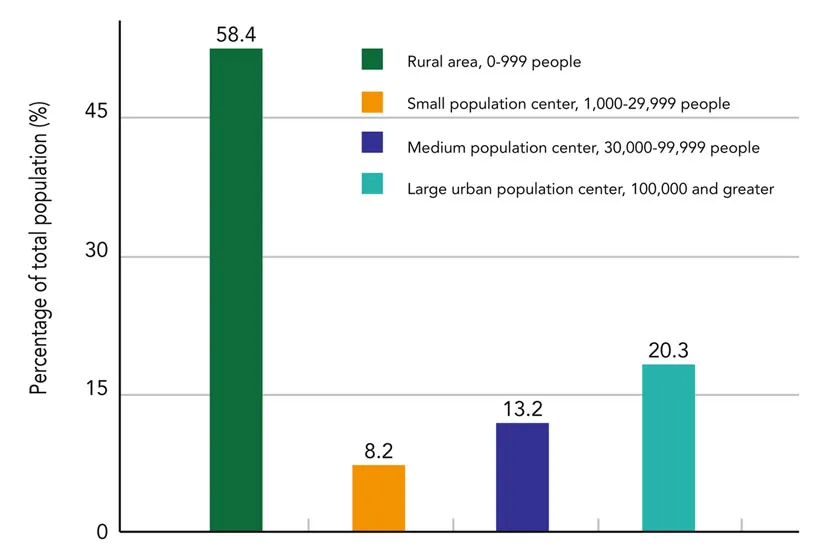
According to the United States Census Bureau (2009), in 2006, 54 percent of Americans lived in cities with population between 10,000 and 250,000; of them, over 20 percent lived in cities between 10,000 and 100,000 (Figure 1.1). As shown in Figure 1.2, in Canada, 21.4 percent of citizens resided in small and mid-sized cities as per the above definition (Canadian Centre for Justice Statistics 2006; Statistics Canada 2005). In Europe, 38 percent of the total population lives in small and mid-sized cities and towns of between 5,000 and 100,000 inhabitants (European Union 2011).
These numbers have not been ignored by politicians and often lent small town and rural areas importance. Strong conviction, traditional values, and the loyalty that their citizens adhere to have drawn the attention of political parties. In some countries, policies and actions are often introduced to address their unique needs and gain favor. Constructing a road or locating government buildings in a sparsely populated area are some examples.
1.1 Percentage of Americans who reside in small and mid-sized cities and towns
1.2 Distribution of Canada's population by place of residency
1.3 Hot peppers on sale as natural Viagra in Positano, Italy
In addition to demographic indexes, there are other non-quantifiable attributes that define small towns. “Sense of place” is one of them. It is an aspect that commonly refers to physical markings unique to each locale which give places, and indirectly the people who inhabit them, identity. The scene, noises, sounds, and smells of a busy urban hub are naturally different from those of a town (Figure 1.3). Their small scale and often reduced land mass also define their human side. Relaxed lifestyle, familiarity with each other, and established cultural traditions are some of the traits of these places. A popular perception often associated with small towns is that they are a place in which to raise a family, and with cities, as a place to foster a thriving career on one's own.
What makes people choose to reside and remain in small towns? Location theory suggests that people select their places of residency for diverse reasons. Employment opportunities, presence of relatives, availability and access to amenities, and housing affordability are some of the draws (Tabuchi et al. 2005). Filion (2010), for example, suggests that in Canada the urban system was first shaped by exogenous demand for staples and, subsequently, by the “dichotomy between an industrial heartland and resource-based hinterland.” At times, unique opportunities, such as very cheap land, led to the migration to a place. In other times, small towns have attracted those who crave both traditional social values and unique physical environment.
Recent societal shifts that have affected governments and cities at large have not spared small towns. Some of these transformations are likely to have lasting social, environmental, and economic effects that will serve as a backdrop to this book and will be outlined below.
Societal Shifts
The outset of the twenty first century launched a “perfect storm” of societal shifts that are bound to affect and transform nations and municipalities. These transformations will require rethinking of currently followed planning policies and strategies. It would be of value to examine three domains where fundamental changes have taken place and affected urban systems: social, environmental, and economic. One needs, however, to note that variations exist in the manifestation of these aspects between continents, nations, and towns. The phenomena listed here can therefore be regarded as general in nature, yet present in most contexts, particularly western nations.
Social Transformations
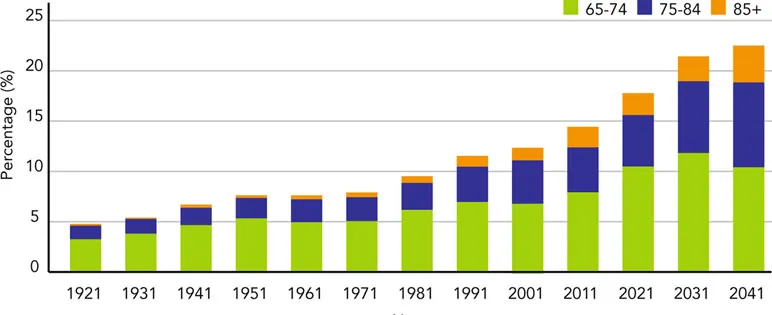
Demographic trends can be looked upon and interpreted through various lenses. They include the age of the population, gender composition, and ethnic makeup, to name a few. The “graying” of small towns and the rise in the number of seniors, those aged 65 and older, is one such aspect, as shown in Figure 1.4. Born between 1945 and 1959, the “baby boom” generation will face retirement in the coming decades. The significant number of seniors is expected to put a strain on the social services of small communities where budget allocations for such sectors are often limited.
Residential mobility is another characteristic of aging. Some retirees are projected to trade a large, hard-to-maintain home with a smaller unit. Those who can afford it will move to regions with comfortable weather year-round and proximity to basic amenities, taking their wealth along with them. Those who stay will look for an apartment adjacent to or aboven shopping hubs or transportation routes. Demand for non-traditional dwelling types and intense remodeling activities will also rise as a result. There will be a growing interest in arrangements that accommodate aging in place, multi-generational homes, and assisted living. A growth in healthcare facilities and accessory services such as specialized fitness centers is also anticipated.
1.4 Canadian seniors by age groups as percentage of the total population, 1921%#x2013;2041
The rise in the number of seniors can offset the demographic continuum of small towns on account of young cohorts. To some degree, it is bound to adversely affect citizens’ contribution to public life and the draw of some towns as “dynamic and growing places for all.” Communal activities in many places are based on the contributions and participation of volunteers. These groups often meet in evening hours when older participants, particularly in cold climate areas, have difficulty getting to meetings. Once these social networks lack participants, they tend to function poorly or disi...
Table of contents
Cover Page
Half-title Page
Title Page
Copyright Page
Table Of Contents
Preface
Acknowledgments
1 Affixing a Lens
2 Form and Function
3 Green Small Towns
4 Moving Around
5 Dwelling in Small Towns
6 Strengthening Core Areas
7 Wealth Generation
8 People, Places, and Well-Being
Project Teams
Illustration Credits
References
Index
Trusted by 375,005 students
Access to over 1.5 million titles for a fair monthly price.
Study more efficiently using our study tools.
Frequently asked questions
Yes, you can cancel anytime from the Subscription tab in your account settings on the Perlego website. Your subscription will stay active until the end of your current billing period. Learn how to cancel your subscription
No, books cannot be downloaded as external files, such as PDFs, for use outside of Perlego. However, you can download books within the Perlego app for offline reading on mobile or tablet. Learn how to download books offline
Perlego offers two plans: Essential and Complete
Essential is ideal for learners and professionals who enjoy exploring a wide range of subjects. Access the Essential Library with 800,000+ trusted titles and best-sellers across business, personal growth, and the humanities. Includes unlimited reading time and Standard Read Aloud voice.
Complete: Perfect for advanced learners and researchers needing full, unrestricted access. Unlock 1.5M+ books across hundreds of subjects, including academic and specialized titles. The Complete Plan also includes advanced features like Premium Read Aloud and Research Assistant.
Both plans are available with monthly, semester, or annual billing cycles.
We are an online textbook subscription service, where you can get access to an entire online library for less than the price of a single book per month. With over 1.5 million books across 990+ topics, we’ve got you covered! Learn about our mission
Look out for the read-aloud symbol on your next book to see if you can listen to it. The read-aloud tool reads text aloud for you, highlighting the text as it is being read. You can pause it, speed it up and slow it down. Learn more about Read Aloud
Yes! You can use the Perlego app on both iOS and Android devices to read anytime, anywhere — even offline. Perfect for commutes or when you’re on the go. Please note we cannot support devices running on iOS 13 and Android 7 or earlier. Learn more about using the app
Yes, you can access Planning Small and Mid-Sized Towns by Avi Friedman in PDF and/or ePUB format, as well as other popular books in Architecture & Architecture General. We have over 1.5 million books available in our catalogue for you to explore.